

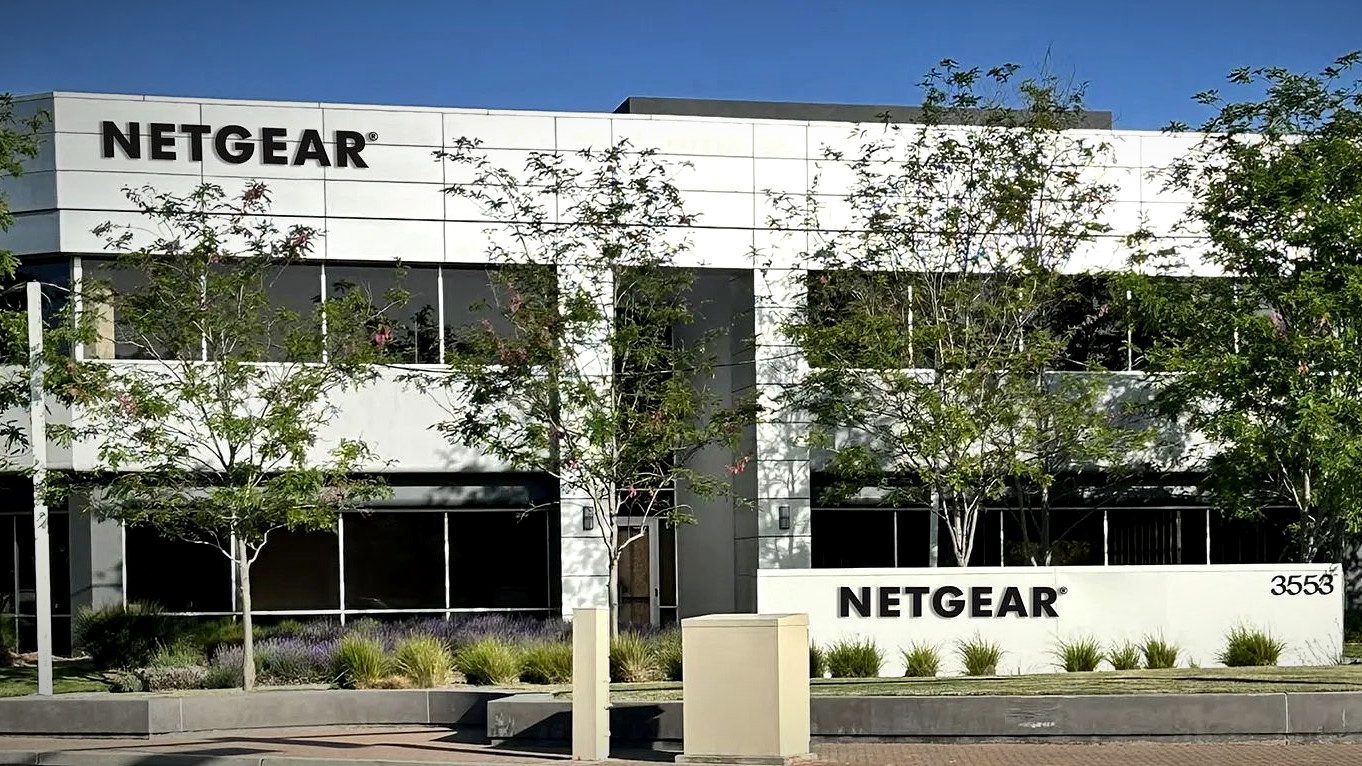
Netgear is quietly reinventing itself as an enterprise networking and software company, writes Maravedis Research. It is betting on cloud management, AI-driven automation, security services, and MSP-led growth to shed its consumer image and compete in underserved markets.
For most of its three decades, Netgear has been synonymous with the consumer networking aisle: the blue box router, the Nighthawk gaming brand, the Orbi mesh system. That association is now working against the company’s most important story. Today, more than half of Netgear’s revenue, roughly 55 percent, comes from its enterprise division, a business approaching $400 million annually that spans switching, Wi-Fi, routing, AV over IP, cloud management, and security.
The consumer brand may still dominate perception, but the business underneath it has fundamentally changed. This spotlight is part of our ongoing independent coverage of the managed connectivity market. No compensation was received from the featured company, and the analysis reflects the views of Maravedis Research alone.
I recently spent an hour with Pramod Badjate, president of Netgear’s enterprise division, to understand how deliberate this transformation is and where it is headed. Badjate’s resume itself signals intent: Airespace in the early Wi-Fi days, engineering leadership for Cisco’s wireless business unit, general manager at Ruckus, campus networking at Arista.
Netgear did not hire a consumer products executive to run this division. It hired someone who has built enterprise networking stacks at three of the industry’s most respected franchises, and who admits he initially hesitated because he, too, associated Netgear with a great consumer brand and little else.
Pivot in numbers
The financial evidence backs the narrative. In Q3 2025, Netgear’s enterprise segment posted revenue of $90.8 million, up 15.7 percent year over year, while the legacy home networking business declined. Company wide, the annual recurring revenue reached $37.9 million, growing 17 percent year over year, and non-GAAP gross margin hit a record 39.6 percent, up 850 basis points from the prior year.
At its Investor Day on November 17, 2025 in New York, management framed the company around a transformation update built on enterprise growth, software differentiation, and recurring revenue – a very different pitch from the hardware-volume story of old.
The go-to-market machinery is being rebuilt to match. In November 2025, Netgear launched DRIVE, its first global tiered partner program aimed at integrators, MSPs, and VARs serving small and medium enterprises, with IGNITE, APEX, and APEX MSP tiers. Badjate acknowledges the company is not yet running a marquee annual event in the mold of Cisco Live or Extreme Connect partner conferences, opting instead for regional gatherings of key partners, but he expects that to evolve as the program matures.
The sales bench tells its own story: the head of sales, the head of the SE organization, and several recent regional hires all came from Ruckus.
The SaaS engine
The center of gravity for the SaaS transition is Insight, Netgear’s cloud management platform. Badjate describes it, without much prompting, as a multi-tenant portal from which an MSP can manage Wi-Fi, switching, routing, floor plans, and, increasingly, security across all of its customers, while each end customer can claim and view its own network.
Three design choices distinguish the approach. First, it is built deliberately down-market, and Netgear treats that as a feature rather than a limitation. Badjate is blunt about the lesson from his time at Cisco, Ruckus, and Arista: those platforms were architected for Fortune 500 requirements, and everything below inherits complexity and cost that it does not need. Netgear defines its target as sites with fewer than 500 employees, often multi-site franchises with cookie-cutter deployments.
No service chaining, no VLAN pooling, no centralized data plane. The pitch, he says, resonates with MSPs: enterprise-level reliability and support with SME-level simplicity, backed by phone support, warranties, and next-business-day replacement rather than community forums.
Second, everything in the UI is exposed through APIs. Because Insight’s own interface communicates via API, the entire surface is available to partners who want to fold Netgear gear into their own operational support systems. Badjate described a Japanese MSP managing several thousand apartments plus car dealerships whose developer integrated Insight into the firm’s homegrown OSS in two days. For MSPs, whose economics depend on operational efficiency across many small customers, that integration speed matters more than any datasheet spec.
Third, security is being pulled natively into the platform. Netgear has embedded Exium’s next-generation firewall into its PR60 router, currently linked through single sign-on, with native integration of the security portal into Insight promised on the next quarterly release. The logic is straightforward: MSPs serving healthcare, education, and professional services increasingly refuse to onboard customers who will not take a security solution, both for liability reasons and compliance mandates like HIPAA. One box, one portal, one vendor to call.
That last point, one vendor to call, is worth dwelling on. Badjate looked at founding an open Wi-Fi startup during a stint in venture capital and walked away for exactly this reason: MSPs told him they would happily pay a modest premium for a single accountable throat to choke. It is a telling admission from someone now competing against the premium incumbents.
Chatbots to agents
Where the SaaS story gets more interesting is Netgear’s AI roadmap, which goes beyond the now-standard RRM automation and conversational troubleshooting that every WLAN vendor demos.
The near-term flagship is what Badjate calls ‘AI-defined networking’, or AIDN, entering official beta within weeks of our conversation. An MSP describes a deployment conversationally, so many employees, so much square footage, and the system generates a proposed topology and pre-configuration in real time. The differentiator is the digital twin underneath: every Netgear device has a virtual instance running the same code as the physical hardware in the cloud, so the generated configuration can be validated, spanning tree loops and all, before a single box ships to the customer site. When the hardware arrives, the verified configuration flows down to it.
For MSPs, whose margin lives or dies on truck rolls and rework, pre-validated zero-touch deployment is a genuinely valuable proposition.
The longer arc is agentic. Badjate expects that within a year or two, most routine network operations at MSPs will be executed by AI agents rather than humans clicking through dashboards, with humans supervising. Netgear is building an MCP server alongside Insight so that a partner’s AI agents can reboot an access point, adjust a configuration, or pull telemetry through governed, permissioned interfaces rather than screen-scraping a GUI.
Because Netgear controls the full stack, Wi-Fi, switching, routing, and security, in one cloud, it can present that entire estate to an agent coherently. This is not shipping today, but it is a credible reading of where MSP operations are going, and it repositions Insight from a management console into an automation substrate. That is a SaaS story, not a hardware story.
The MDU question
Multi-dwelling units (MDUs) are the market I track most closely, and it is the one where Netgear is most clearly still a challenger. Badjate confirmed the company is in active proof-of-concept engagements with several MDU-focused MSPs in the US and abroad and expects to move from trials to scaled deployments before year-end. The technical table stakes are in place: multi-PSK for per-tenant credentials with traffic segmentation, multi-tenancy in Insight, integrated firewalling for property-level security. Notably absent are Passpoint and OpenRoaming, which Badjate says simply have not come up as asks from his current customer base and are not on the roadmap.
The competitive context makes this a plausible wedge. Ruckus remains the gold standard in MDU, but its premium pricing is increasingly hard to justify, and the vendor landscape is in flux: TP-Link is making faster inroads than expected despite the geopolitical cloud hanging over it, Cambium carries financial uncertainty after its Nasdaq delisting, and OpenWiFi is gaining credibility only slowly because nobody has fully solved the accountability question. An MDU market hungry for a credible mid-priced alternative with a single accountable vendor is precisely the gap that Netgear’s positioning targets.
There is also a second act here. Netgear is already dominant in AV over IP, where its switches power millions of endpoints in Broadcast and Pro AV ecosystems, and it holds a strong IT networking position. As MDU connectivity evolves toward smart building as a service, with the connectivity layer becoming the foundation for access control, energy management, and building automation, owning two of the three pillars of the smart building stack, plus the ecosystem integrations with lighting, audio, and visual partners, gives Netgear an angle that pure WLAN vendors lack.
The bottom line
The skeptic’s case is easy to write. Netgear’s enterprise unit is a $400 million business competing against companies that spend more than that on R&D alone. It lacks Passpoint, lacks a marquee partner event, and is still proving itself in MDU. A company-wide ARR of roughly $38 million, while growing at a healthy double-digit clip, is a fraction of what the Meraki machine generates.
But the strategy is coherent in a way Netgear’s enterprise ambitions have not been before. The company has stopped trying to be a cheaper version of everyone else’s enterprise stack and started building specifically for the MSP-led SME and MDU segments: simplicity as a design principle, APIs and soon agents as the operating model, integrated security as the attach-engine, and hardware as the on-ramp to subscription revenue. Geographic distribution is already balanced, roughly half in the US with the remainder split between EMEA and APAC, and gross margins are at record levels.
The consumer brand that once made enterprise buyers hesitate may, ironically, end up being the smaller half of the story. If the AIDN beta lands, the Exium integration ships natively into Insight next quarter, and the MDU proof of concepts convert as expected, 2026 will be the year Netgear stops being a consumer company with an enterprise side business and becomes an infrastructure software company that happens to ship excellent boxes.
That transition is not complete. But it is real, it is funded, and it is being run by people who have built these businesses before.

