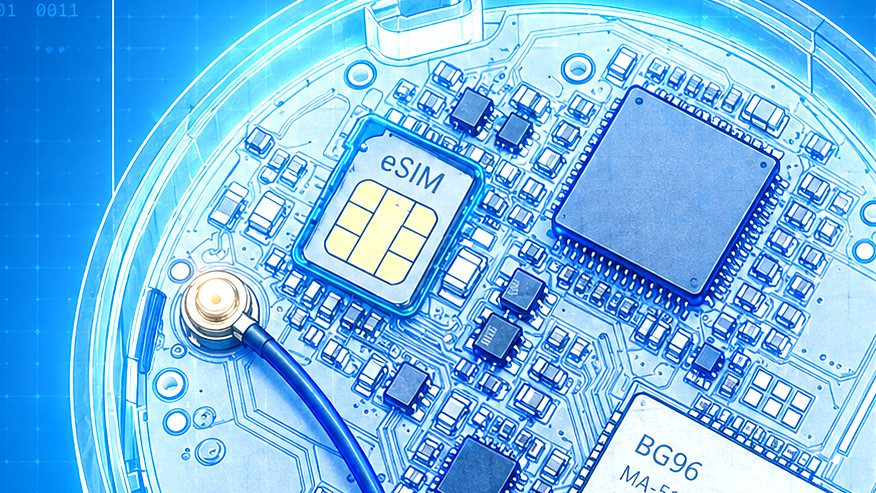
At one stage the IoT market was dominated by the automotive industry, with fleet management and telematics generating the bulk IoT traffic. At that time the business model for the mobile network operators (MNOs) seemed straightforward – sell SIM cards on a per-device basis at scale, add roaming to enable global connectivity and generate returns over long contract lifecycles. But the landscape is changing due to eSIM and the onset of SGP.32 eSIM IoT standard, which is reshaping enterprise IoT, opening it up to new vertical segments beyond automotive.
The new eSIM standard is reducing barriers to entry for segments previously constrained by complexity, fragmented form factors and bespoke integrations. It enables zero-touch connectivity management at a scale that was previously difficult to achieve, supported by technologies that allow enterprises, manufacturers and OEMs to orchestrate deployments globally. As a result, the larger OEMs are increasingly taking the lead, and the MNOs are now rethinking their position within this evolving IoT value chain.

The SGP.32 standard has signalled a move toward more flexible, software-driven connectivity models, where operators can enable enterprise deployments while unlocking new upsell and cross-sell opportunities.
Industry forecasts estimate that IoT connections will reach 6.4 billion in the coming years. By the end of 2024, global cellular IoT connectivity had reached 3.8 billion connections. Excluding China’s 2.7 billion, the rest of the world accounted for around 1.1 billion, underlining the scale of the opportunity ahead. We’ve seen IoT traffic surpassing 100m connected devices globally on the Aeris platform alone – a 90% growth rate over two to three years, nearly triple the industry average.
Enterprise demand is reshaping strategy
As adoption scales, enterprise requirements are becoming more complex and more influential. Organisations are no longer simply seeking connectivity – they expect flexibility, control and the ability to deploy and manage devices globally without the constraints of traditional SIM provisioning.
This shift is changing how connectivity is evaluated and purchased. Some enterprises continue to favour a single global operator, while others adopt a regional approach across markets such as North America, Europe or APAC. In both cases, the ability to support eSIM-based deployments is becoming a key differentiator.
At the same time, enterprises now have greater control over connectivity. They can remotely provision devices, switch profiles, and select providers based on geography or use case. While this flexibility enables faster deployments, it also increases competition among operators. For MNOs, this evolution requires a shift away from legacy commercial models. Historically, IoT revenues were driven by selling network capacity and supporting wholesale roaming. In sectors such as automotive, operators relied heavily on roaming agreements to maintain connectivity as devices moved between markets.
With the introduction of SGP.32, that model is beginning to change. Rather than relying solely on roaming, operators can enable local connectivity through downloadable SIM profiles, allowing devices to connect as if they were native to the network. This creates an opportunity for operators to reposition themselves within the value chain. Instead of acting purely as connectivity providers, they can offer more specialised, service-led propositions aligned with enterprise needs.
Unlocking value through local connectivity
The ability to provision local SIM profiles is central to this shift. By enabling local data breakout, operators can improve latency, enhance performance and support services tailored to specific markets.
For applications such as in-car infotainment and telematics, this localisation is critical. Access to local IP addressing allows services to operate more efficiently, improving reliability and user experience. Importantly, this also creates new commercial opportunities. Many connected services are now subscription-based, meaning service quality directly influences customer retention. By enabling high-performance, localised connectivity, operators can support these services and participate more directly in recurring revenue streams.
This model is already gaining traction. In markets such as APAC, operators are increasingly acting as local connectivity anchors, supporting enterprise deployments through partnerships and platform integration. These collaborations allow operators to extend their reach beyond their core footprint while maintaining relevance within global deployments. At the same time, they create opportunities to upsell and cross-sell services, reinforcing the operator’s role within the broader IoT ecosystem.
Connectivity, in this context, becomes more than a commodity. It can be positioned as a premium, value-generating service supported by commercial models that benefit both the local operator and the operator managing the enterprise relationship.
Role of unified platforms to scale IoT
Underpinning this shift is the need for more sophisticated management infrastructure. Unified eSIM platforms are emerging as a critical enabler, allowing operators to manage connectivity, security and device behaviour across large, distributed fleets.
These platforms provide a single point of control for provisioning, policy management and lifecycle operations, helping operators meet the demands of increasingly complex enterprise deployments. They also support interoperability across networks, reducing fragmentation and simplifying global rollouts. For enterprises, this translates into greater visibility and control. For operators, it provides the foundation to deliver differentiated services at scale.
Capturing the next phase of IoT growth
The SGP.32 standard marks a significant inflection point for the IoT market. It introduces a more dynamic, flexible model for connectivity – one that reflects the needs of enterprise users and the realities of global deployments.
For MNOs, the opportunity is clear, but so is the risk. Those that continue to rely on traditional models centred on roaming and basic connectivity may struggle to maintain relevance as the ecosystem evolves.
Operators that embrace eSIM, invest in platform capabilities and align their offerings with enterprise requirements will be better positioned to capture new revenue streams, strengthen partnerships and play a central role in the next phase of IoT growth.