


Final word on this fascinating Nokia narrative, this time from the independent analyst community – about how the Finnish firm is losing a little to Ericsson in its 5G heartlands, but also switching it up with clever short- and long-term gambles in new AI-geared telecoms; plus how it might have something up its sleeve in AI-RAN – for enterprises.
In sum – what to know:
Future fabrics – Nokia’s push into AI-RAN is a grasp for 6G-era differentiation, even if it means accepting a smaller footprint in 5G, argue analysts; but it is not just a straight telco optimization play, it turns out. (See part 1)
Weird retreats – Nokia is selling its ECE unit ahead of a post-2030 boom-time for campus 5G; the sector is integrator-led, but Ericsson stands to benefit; but there is also method in the madness, maybe. (See part 2)
Tactical deals – Nokia has signed InfiniG to sell RAN with its MOCN neutral-host product to US enterprises – plus, in time, AI-RAN for physical AI on private 5G. But the same volume and value questions will arise. (See part 2)
Note, this article is continued from here…
As we were, then: so what about private 5G – and the fact that the one place Nokia is winning is the one place it is quitting? Yes, one can argue about the semantics, as RCR wrote in its op/ed on Tuesday – that Nokia will sell macro systems to ‘mission-critical’ utilities and railways, and RAN units to industrial campuses (sometimes with its old MPW/DAC systems, on license to a new owner). It’s like that Micky Flanagan sketch; it might not be out-out, but it is still going out – of a market it helped to build, which it has 50 percent of (a whole-market share). Private 5G might be niche and difficult, but is high-stakes – where critical cellular is put to work, where AI lives and dies: in the enterprise.
Does Nokia’s exit make Ericsson its heir apparent? Joe Madden, founder and chief analyst at Mobile Experts, answers: “Yes, Nokia’s decision to deemphasize its ECE business has put Ericsson into a good position for industrial private 5G. Nokia will remain in the mission-critical market but it is stepping back from opportunities in the broader and more fragmented sector. Ericsson is the clear number-two in market share, so it now has the opportunity to take a leading position.” He has a neat diagram to segment the varied ‘criticality’ of the market – for volume and value, with a line about the rate of return. The ‘mission-critical’ segment is “small”, he says, but filled with “first movers”.
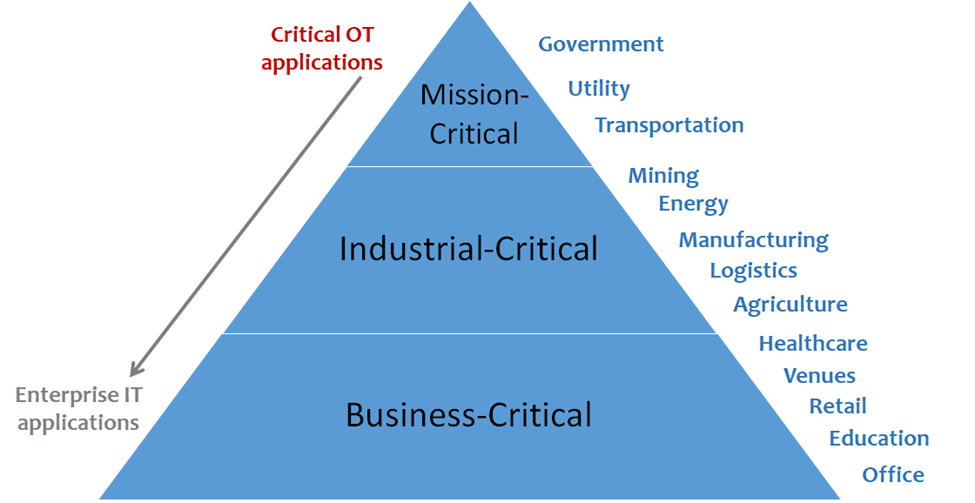
He adds: “The number in industrial and carpeted enterprises is much larger, but the fragmentation of these markets makes scaling up a solution slow. [But] in the 2030s, we will see massive growth in those areas.” Which Nokia has evidently decided is a late schedule. Luke Pearce at CCS Insight says: “Nokia’s shift does create an opportunity for competitors, given the strong position it previously held. But it does not automatically make Ericsson the default leader. Ericsson has been particularly prominent in mission-critical networks… but the market is fragmented and highly use-case driven… We are likely to see a broader mix benefit, including smaller and more specialised vendors.”
He names Celona and Airspan, and doubts a “straightforward transfer of leadership from Nokia to Ericsson”. James Moar at Kaleido says the same – including about integrator and specialist players, and the complexity for Ericsson to present an end-to-end solution for varied industrial usage. “Nokia’s repositioning makes Ericsson the most prominent European end-to-end provider for campus networks,” he says. “But the campus network space is very fragmented. Ericsson will be the largest remaining single player in it, but it’s too pluralistic a market to say that it will dominate. It is very integrator-led… The point of contact is the integrator, even if there is a diverse chain of vendors behind.”
He adds: “An integrated solution like Ericsson’s will certainly pick up more business, but the large-scale contracts will be [shared with] Nokia’s mission-critical enterprise division, which it is hanging on to.” All of which reinforces the standard narrative, ultimately, and represents a long way into another discussion, potentially more interesting. Because in a press release on Tuesday, discussed briefly in the RCR op/ed on Wednesday (yesterday), US-based neutral-host provider InfiniG said it will offer a MOCN set-up to enterprises with Nokia radios, including (eventually) with Nvidia-backed AI-RAN. Which brings new perspective to Nokia’s AI-RAN story, and also its private 5G strategy.
Gateway strategy
But we are 1,500 words in already, and RCR has a deadline in two hours – and so a proper discussion of this will be published next week. In the meantime, in brief: the gist is that InfiniG will, off the bat, offer neutral-host multi-operator core network (MOCN) systems with ‘carrier-grade’ Nokia 5G radios to attach to all three US mobile carriers – should the deals be big enough to weaken the anti-MOCN defenses at Verizon and T-Mobile; which they will, provisionally, on the grounds that enterprises seeking carrier-grade (Nokia) systems, even at enterprise-grade (Airspan?) rates, will have serious-enough workloads to turn their heads, and also because InfiniG will pursue such clients.
It might be noted, AT&T is more supportive of third‑party MOCN deployments with a CBRS provision than either T‑Mobile (steering partners towards licensed spectrum, but always pragmatic) and Verizon (which emphasises its own licensed assets, and is belatedly pragmatic). But the intriguing piece, so far as Nokia’s bigger strategy goes, is that InfiniG’s Nokia-based neutral-host architecture, as deployed in hospitals and campuses, offers a RAN platform for enterprise clients to also host third-party private 5G core setups for mission/industrial/business-critical workloads. And so InfiniG will roll Nvidia “blades” into neutral-host AI-RAN stacks – for proper use in private 5G setups.
That’s the Trojan Horse theory, anyway. As we say, RCR will have more on the story next week. But the sense is Nokia’s AI-RAN placements will find new workloads in new homes, running inference for latency-sensitive / compute-heavy physical AI applications on neutral-host and private-network infrastructure; rather than just in macro cell sites for telco RAN optimization, plus whatever middle-of-the-road latency cases can be served by that intra-cloud/edge metro sweet-spot. Pilots in six-to-12 months, say; full adoption some years after. By managing both MOCN and RAN gateways, InfiniG can reduce 70 percent of the complexity with private 5G scratch setups – it says.
Enterprises only need to worry about the core network and the SIM cards. They can deploy infrastructure now, with clearer Nokia-authored 6G migration paths, and integrate AI as they go – until they have a well-spring of critical automation cases, and they need to attach a private network on the end, and a GPU inside. Of course, GPUs are expensive; the business case must be clear. ABI Research has a bylined piece on RCR, out tomorrow (April 3; link pending), that moving inference servers out of the cloud makes little “material difference to the user experience” in most cases. The only applications that matter in latency terms, which justify such an edge-wards migration, is sub-10ms physical AI.
Dimitris Mavrakis, senior research director at ABI Research, writes: “In these cases, cloud inference becomes untenable and inference needs to move to the edge of the network: a 100ms latency for an autonomous car moving at 100 km/h would [make] the car blind for 2.8 meters. The same could be said for video surveillance, drone delivery robots, and a host of other applications.” Which, except maybe for self-driving cars (but maybe for them, too), are all enterprise-geared scenarios, which will variously (sometimes, at least) be served on private networks. As a frame of reference, it would cost a major US operator $3.7 billion to fit-out all its rooftop cell sites with ARC-1 servers, he says.
Tricky business
A likelier mid-term scenario is they will install AI accelerators in core network locations first, per Nvidia’s broader AI grid concept – but they have “typically fewer than 10 across a country”, he writes. The model for enterprise-based AI-RAN is subject to the same ROI calculations, of course – about the volume and value of critical applications and workloads, to justify a $60,000 GPU insertion into an existing RAN setup. Robots in hospitals, AGVs in factories, barcode scanners in warehouses? Such cases are often served on CPU arrays adjacent to private LTE systems. To an extent, it is a chicken-and-egg question about how and when advanced AI applications start to scale.
And so enterprise AI-RAN starts to look like enterprise 5G – easy promise, hard execution. But so far as Nokia’s weird exit from private 5G goes, the new deal with InfiniG shows how it might continue to sell RAN units to campus-based enterprises while offloading its resource-hungry DAC/MPW assets (via its pending ECE sale) – and also leverage the neutral-host model as a way to hold steady in smaller campus-based private 5G environments, and to explode its AI RAN strategy into new venues. But we have written around the topic again; RCR will write the interview with InfiniG next week, and hopefully publish MWC discussions about private 5G with Nokia and Ericsson as well.
Except maybe that’s enough about Nokia for now.

