

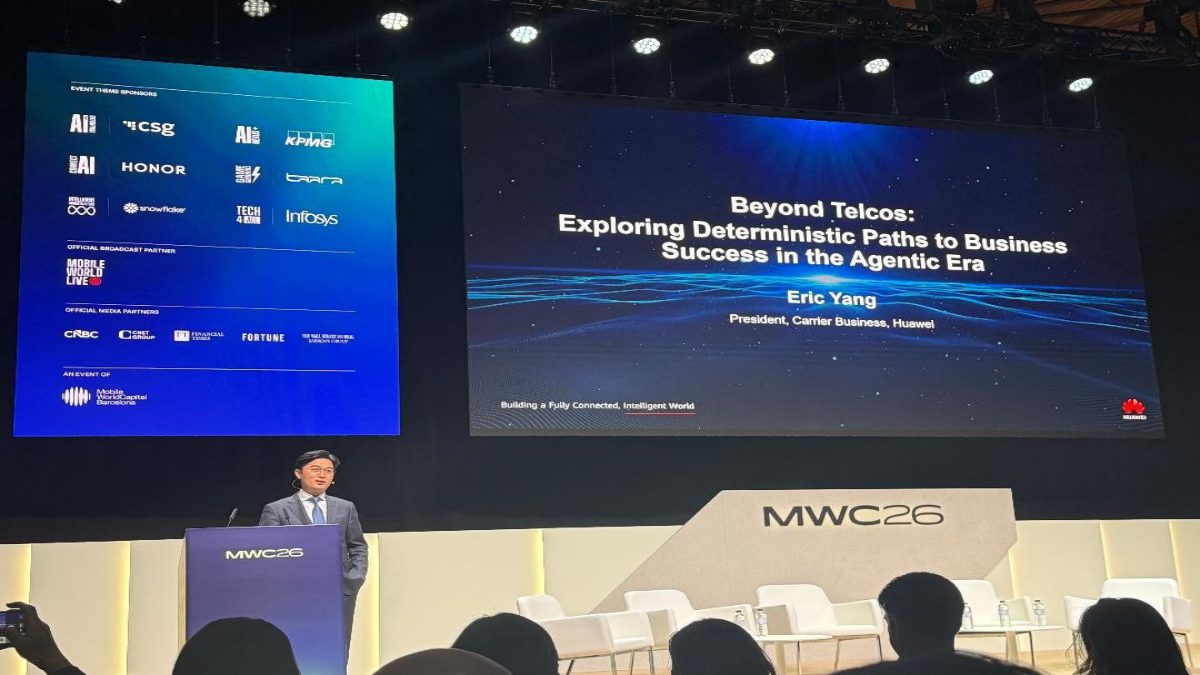
Eric Yang, president of carrier business at Huawei, said that China Telecom is upgrading VIP services with fiber-to-room packages combined with home AI agents
In sum – what to know:
Massive AI scale ahead – Huawei predicts 10x AI capability growth, 900 billion agents and a 1,000x increase in data, creating new demands and opportunities for carriers.
Consumer and voice reinvention – AI agents could upgrade home broadband, automate troubleshooting and modernize traditional voice services.
Monetization in three phases – Telcos should start with operational efficiency, expand into enterprise services and scale high-frequency consumer AI scenarios.
At MWC 2026 in Barcelona, Huawei’s president of carrier business, Eric Yang, argued that artificial intelligence will fundamentally reshape telecom networks, services, and operations — and that carriers are uniquely positioned to capture that value.
“AI will become reliable, more and more reliable. And the ability will increase by 10 times. And there will be 900 billion agents, AI agents,” Yang said during his presentation.
Yang said operators must focus on three priorities: upgrading consumer and home services with AI to strengthen the core business; delivering consistent cross-device experiences to increase customer stickiness; and optimizing internal operations to improve efficiency before extending AI capabilities to other industries.
The Huawei executive described home broadband as a core opportunity. Using AI agents, customers could manage network performance via voice commands. For example, when home network quality degrades, an AI agent could prioritize latency-sensitive applications such as gaming, test the network automatically, and either resolve the issue or generate a maintenance ticket and schedule a service visit.
He pointed to Chinese operators already exploring such models, citing China Telecom as an example of upgrading VIP services with fiber-to-room packages combined with home AI agents.
Voice services were also highlighted by the executive as an area for reinvention. Yang explained that AI-powered call agents can significantly reduce background noise and enable additional services such as booking, food delivery, translation, and reservations. In his view, calling agents allow carriers to modernize traditional voice offerings while improving user experience and expanding service scope.
Operational efficiency remains central to Yang’s argument. He cited AI-based quality inspection in network installation and maintenance as an example: where manual checks once covered only around 2% of users, AI systems can review 100%.
He suggested that once carriers validate AI internally, they can extend those capabilities to vertical industries such as manufacturing and healthcare.
To monetize AI, Yang proposed three paths: starting with high-maturity use cases such as energy savings and O&M efficiency; expanding AI tools used in office work, sales and customer service into enterprise offerings; and focusing on high-frequency, high-stickiness consumer scenarios to scale rapidly.
“AI agents will reshape and change our world. Carriers have the capability and the responsibility to become the leader in this area,” the Huawei executive said.

