
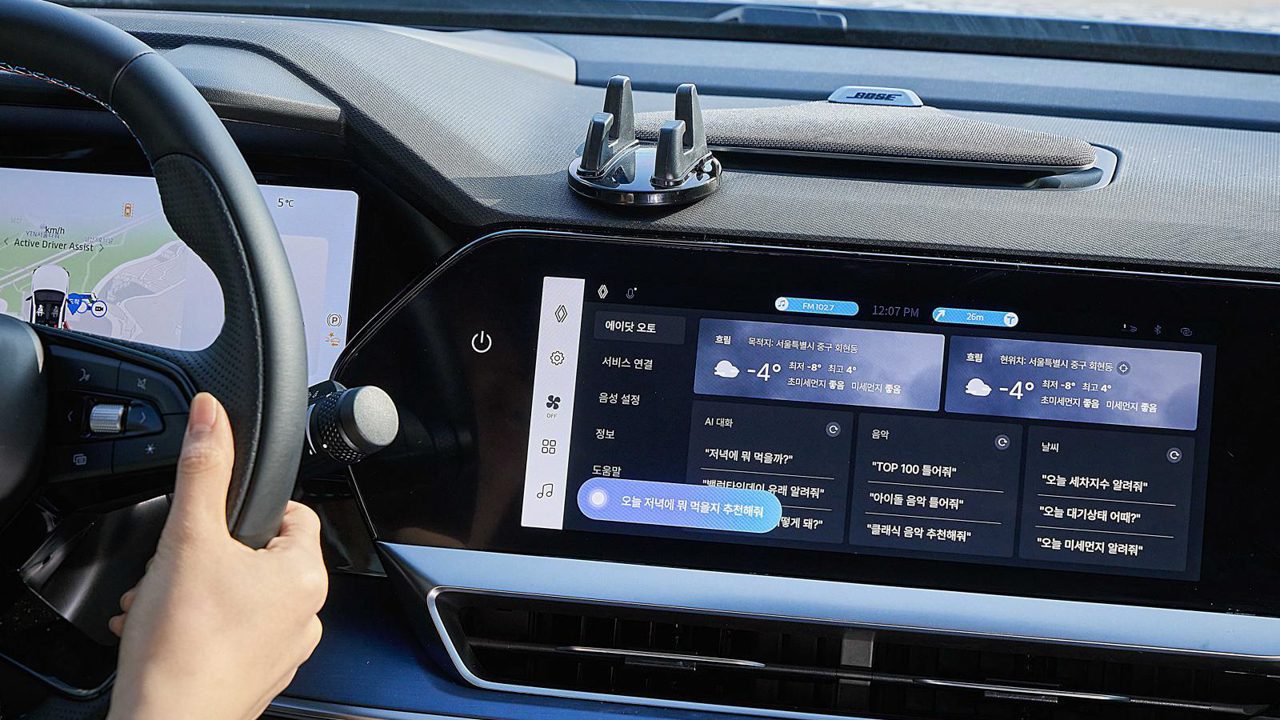
The car could be the best place for telcos to deliver AI features
In sum – what we know:
- A. auto launch – SK Telecom announced its in-vehicle AI agent on Jan 14, 2026, debuting in Renault Korea’s Filante model.
- Broad capabilities – The system controls infotainment and vehicle hardware (windows, AC) using the proprietary A.X 4.0 LLM for contextual assistance.
- Strategic pivot – The move exemplifies a global trend of telcos diversifying into AI applications to compete with Google and Apple through localization and cross-device integration.
SK Telecom made its formal push into the in-car AI space, unveiling A. auto as the company’s next-generation vehicle assistant. The system ships immediately in Renault Korea’s new Filante, putting the telecommunications giant squarely in competition with established automotive AI players. SK Telecom’s leadership isn’t thinking small here — they’re positioning A. as Korea’s “flagship AI,” with a vision that stretches far beyond smartphones into a persistent, multi-device experience that travels with users wherever they go.
What can it do?
Under the hood, A. auto runs on A.X 4.0, SK Telecom’s open-source large language model built specifically for Korean language processing. This isn’t a bolt-on solution sitting on top of existing infotainment — the system integrates directly into the vehicle’s architecture, enabling conversational interactions tuned for Korean linguistic and contextual nuances.
The infotainment capabilities cover the basics, like voice control for T-map navigation, FLO music, phone calls, and news. But the system also reaches into vehicle hardware, letting drivers manage air conditioning, check air quality readings, and roll windows up or down using voice alone.
The more interesting play is contextual awareness. A. auto builds models of driver behavior and responds to real-time conditions, routing you toward the office on a Tuesday morning because that’s where you usually go, or suggesting you close the windows when sensors pick up elevated fine dust outside. Tie-ins with the A. mobile app let the system pull calendar data and sync preferences, creating a through-line between your phone and your car.
Will telcos play a major role in consumer AI?
SK Telecom’s automotive ambitions fit into a much larger pattern reshaping the telecommunications industry. Telcos around the world are diversifying out of pure connectivity and into AI-powered consumer applications, looking to capture more value than pipes alone can deliver. In-vehicle AI makes sense as a beachhead — telcos already have deep relationships with automakers and infrastructure advantages to build on. South Korean carriers, including KT and LG Uplus alongside SK Telecom, have been especially aggressive in staking out positions as domestic AI champions.
Local language processing and data sovereignty concerns create real differentiation opportunities against English-dominant global platforms. In markets like South Korea, where linguistic subtlety and cultural context matter, this opens territory that others may struggle to occupy effectively.
That said, the competitive landscape is daunting. Google, Apple, and Amazon have spent years building entrenched in-car ecosystems with deep user familiarity. Automakers continue investing in closed-loop proprietary systems, preferring to own the user experience from end to end. For telcos trying to deploy across multiple manufacturers, the fact that every automaker runs different infotainment stacks with different technical constraints makes deployment a challenge.
The trickier challenge might be perception. Consumers have developed relationships with tech company assistants over years of use — whether that trust transfers to telco alternatives is an open question. SK Telecom also hasn’t laid out a clear monetization story for A. auto, leaving uncertainty about whether this represents a genuine revenue opportunity or a defensive move to stay relevant as connectivity services become commoditized.
The Renault Korea rollout is narrow for now, though SK Telecom has signaled plans for broader deployment across multiple automakers with flexible, brand-customized options. The company has already rolled out an enterprise-focused version of the assistant called A. Biz.
Table of Contents