

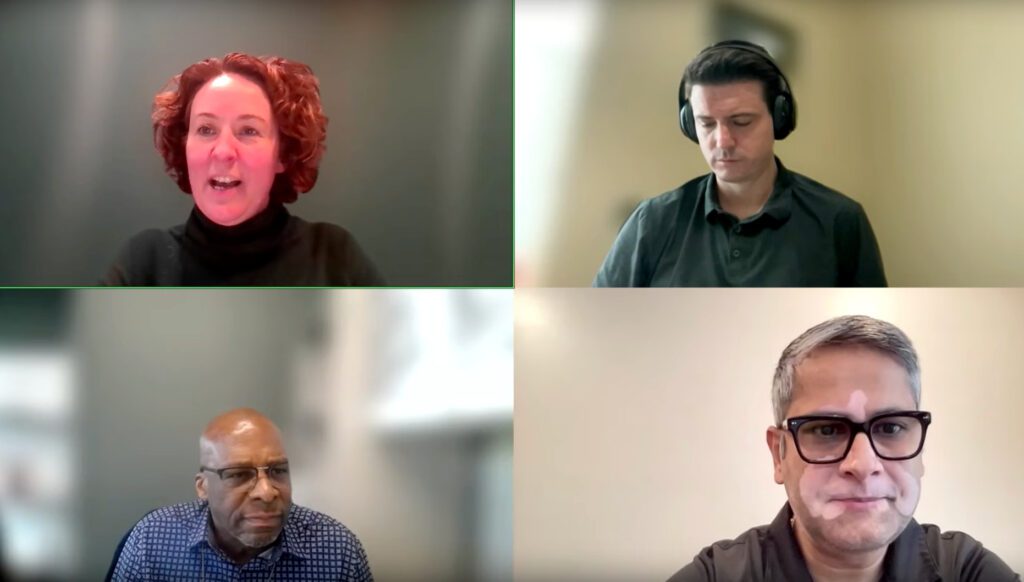
One more private 5G panel write-up, and it’s another cracker. Here, Peter Cappiello, chief executive at Future Technologies, Johnathan Lewis, director of innovation at Miami International Airport, and Dheeraj Remella, chief product officer at Volt Active Data hunkered down for 40 minutes last month at Industrial 5G Forum (available on-demand) to discuss the ‘pathway to more use cases’ on private and industrial 5G networks. Jo Gilbert, technical director for manufacturing at GSMA, asked the questions, and got a tune out of all of them, as follows…
1 | EUREKA MOMENTS
Start at the beginning – was the advice from the panel. Everything is easier if applications are defined and designed from the start; if stakeholders are cajoled and convinced from the get-go. This was really Cappiello’s point, but you could practically hear Lewis and Remella nodding in agreement beside him; their convivial cross-over on the panel was pretty consistent. “We start by explaining what’s possible,” said Cappiello, going on to explain how system integrator Future Technologies has sunk “a few million” into a ‘living lab’ in Atlanta, Georgia, to show enterprises how 4G/5G augments sundry-other tech infrastructure solutions – to bring their private Industry 4.0 concepts to life.
The firm has developed a lab-on-wheels, as well, to go on the road, and take to their offices and factories. Cappiello explained: “Our chief innovation officer, Gary Hill, spent 30 years on the buyer side as CTO of Georgia Pacific, a big $20 billion manufacturing company. We’ve invested a few million in this lab, and he’s curated real-world [use cases] using all different types of connectivity – to show the table-stakes apps for connected workers, and more advanced use cases. Because too many pilots fail. So we are trying to model it with customers from the start, and get the right stakeholders on board, and then to pick a live production site that makes sense.”
The point is to expedite a kind of eureka moment with clients – so they see the network functions in the flesh, as part of familiar systems, in support of novel solutions, and they move mob-handed into production at a faster rate. “If we have to do a lab pilot to clear security, then we do that; but we like to, and have found it successful to, get the stakeholders from the start to go straight into production. We replicate the customer’s IT environment before we go on site, and integrate into the application stack on site… We get the cake baked at that first site, and then apply the learnings [from clients and partners] to scale in the same building or a larger facility, and then to multiple sites.”
2 | SNOWBALL EFFECTS
But what is that eureka moment? How do you get the ball rolling, even when everyone is huddled around the table on tenterhooks. “It’s a snowball effect. You need [that] first snowball, and then gain momentum through learnings and stakeholdership [to] add more use cases and create more value,” said Cappiello. Next to him, Ramella at Volt Active Data said even eureka moments require hard graft; forget about killer applications, he said, and pursue the ancient art of problem-solving through good-old consultancy and co-creation. “There are two ways to look at this. One is to create a killer use case. Which usually just engenders writer’s block, which just leaves you stuck,” said Remella.
He went on: “Alternatively, you can [consult with] the folks that are actually doing things, and [figure out] what they are actually missing [and what they could use help with]. So it’s a greenfield next to a brownfield; think about how to augment existing systems and processes, so you’re not in a quagmire with [a separate network]… Just making life better is a good start – instead of trying to take people to Mars.” Again, all good advice; but give us some examples, why don’t you? (Gilbert at the GSMA, asking the questions.) Lewis at Miami International Airport, handling 58 million passengers and 2.9 million tons of cargo in 2024, provided the answer, with a real-life illustration of an anchor case.
“We wanted to be a smarter airport,” responded Lewis, adding context about a pressured efficiency drive for a landlocked airport to carry rising traffic. “We’re 3,300 acres, with no room to expand. We wanted to be more efficient, and to improve situational awareness and make data-driven decisions… We wanted to put CCTV on the airport perimeter – which would have meant 6,000 feet of fiber conduit and trenching permits, and all the rest. Whereas with a private wireless, we can do that in half the time, at half the cost. So that was very attractive. And we started piloting some CCTV projects in 2021, and – from there, with the more we learned – there were other things we saw.”
Cappiello chimed in with more generalised anchor cases, going industry-by-industry. “Often, it’s just for coverage; sometimes it is for a more advanced use case. Sometimes it’s for both. In manufacturing, you’ll have an anchor case like AMRs, to which you can quite quickly add a connected worker case. And then you have automation as a third leg. In the ports sector, it is about connectivity or automation; but you solve one as you solve the other. In the energy market, it’s about coverage in the oil field, to connect the workers and the wellhead, and density at chemical sites, where you’re working in very hazardous environments. You stitch it all together. But those are the themes.”
3 | NO-BRAINER PROJECTS
But the charm offensive and problem solving are sometimes not even necessary. In fact, the original case for the perimeter cameras at Miami International Airport were initially plotted with fiber in mind. Lewis said: “We worked on a pilot [to enable] computer vision for aircraft turnaround on the apron, based on [installing] cable [to connect] four cameras at every gate. The cost for that was roughly $140,000. For that same money, we took a single [4G/5G] radio and lit-up 800 square meters, with vigorous connectivity everywhere. So it saves us a lot of money, and it also saves us a lot of time. And for us, time is literally money in terms of the departures and arrivals of aircraft.”
The point, then, is that the business case for private 4G/5G can be solved backwards, too – where the project is already approved, or even just explored, and shrunk-down cellular presents a cheaper way of achieving the same result. And from there, it snowballs – and new results come into view. Lewis has deployed “dynamic signage” on the same CBRS setup in Miami – remotely-controlled digital screens (“46 inches wide”) that can be moved about to direct passengers. “That’s not something we could do before. We would have had to x-ray the floor, install conduit, have all these holes [in the ground], and all of these static devices.” Less money, happier customers – is the logic.
4 | A GAME OF WHACK-A-MOLE
Gilbert at the GSMA asked about the challenge to keep IT and OT teams in the same room, on the same page. Cappiello responded by explaining the role of system integrators like Future Technologies, joining industrial OT systems into enterprise IT systems with new cellular ICT technologies, as go-betweens, and translators. “We’re really speaking two different languages. But even with a lot of experience, it is a challenge. As an industry, we’re making progress, but there’s a lot of upside still to be had,” he said. Remella at Volt Active Data made an obscure reference about a “curse of Babylon”, perhaps misheard and misquoted, where “nobody speaks the same language”.
But it was the same point. He said: “In industrial IoT, at least in manufacturing, there is a little bit of [that challenge] – so IT and OT start talking the same language, to roll OT up into IT. But who is who? How do you join the dots? And what are those dots, right? It’s like a whack-a-mole. Every answer leads to more questions.” He returned to his point about foregoing Mars trips for closer expeditions, suggesting that enterprise suppliers should convene with both sides around common business problems, to be followed like industrial north stars on private mystery rides – like the turnaround times at airport gates, he said, referencing Lewis’ commentary about anchor cases in Miami.
But it’s not just about departmental silos; there are the same translation issues with data, too, he said – which can turn into another game of whack-a-mole if they are not addressed from the start. The goal, in the end, is to achieve an “event-driven architecture”, he said. “In real life things happen [as events in data], and those events need to be responded to. But they also generate data… That whole construct will make smarter automation possible.” Think about your data architecture – was the message. Visit Volt – was the implication. Remella had a note about the future of work, too. “Automation is not going to reduce jobs. It’s going to give people time back to do more intelligent stuff.”
Less manual “method-of-procedure and checkbox-checkbox-checkbox” by humans, he said. Industrial revolution – sprung by faster networks, punchier computing, smarter processing – will automate menial data-entry and number-crunching tasks, and free workers to bring higher value. He said: “Does that answer the question or did I actually go on a tangent?” Yeah, maybe, but it’s useful to think about.

