

RCR Wireless
  • News
  • Channels
    • 5G
    • 6G
    • BSS OSS
    • Carriers
    • IoT
    • Network Infrastructure
    • Open RAN
    • Private 5G
    • Telco AI
    • Telco Cloud
    • Test & Measurement
  • Resources
    • Reports
    • Webinars
    • White papers
    • AI Fundamentals
    • Analyst Angle
    • Editorial Calendar
    • Fundamentals
      • 5G NR Release 17
      • AI
        • Telco AI in 2025
    • Podcasts
      • Let’s Get Digital with Carrie Charles
      • Wireless Connectivity to Enable Industry 4.0 for the Middleprise
      • Well Technically…
      • Will 5G Change the World
      • Accelerating Industry 4.0 Digitalization
  • AI Infrastructure
  • Programs
  • Events
  • RCRtv
  • Advertise
  • Subscribe
Sunday, July 26, 2026
RCR Wireless
  • News
  • Channels
    • 5G
    • 6G
    • BSS OSS
    • Carriers
    • IoT
    • Network Infrastructure
    • Open RAN
    • Private 5G
    • Telco AI
    • Telco Cloud
    • Test & Measurement
  • Resources
    • Reports
    • Webinars
    • White papers
    • AI Fundamentals
    • Analyst Angle
    • Editorial Calendar
    • Fundamentals
      • 5G NR Release 17
      • AI
        • Telco AI in 2025
    • Podcasts
      • Let’s Get Digital with Carrie Charles
      • Wireless Connectivity to Enable Industry 4.0 for the Middleprise
      • Well Technically…
      • Will 5G Change the World
      • Accelerating Industry 4.0 Digitalization
  • AI Infrastructure
  • Programs
  • Events
  • RCRtv
  • Advertise
  • Subscribe
Add RCR Wireless as a preferred source on Google
  • Qualcomm 6G Insights
  • Huawei Content Hub
  • Qualcomm – 6G Vision
  • OSS/BSS Channel
  • RCRTech Roundtable: AI Infrastructure
RCR Wireless
RCR Wireless
  • Advanced Mimo
  • Mobile mmWave
  • 5G Positioning
  • Green Networks
  • Metaverse
  • Automotive
  • Industrial and Wide-area IoT
Copyright 2021 - All Right Reserved
Home - Four drivers of Open RAN for in-building cellular
Open RANFundamentals

Four drivers of Open RAN for in-building cellular

by Sean Kinney, Principal Analyst November 5, 2024
written by Sean Kinney, Principal Analyst November 5, 2024 Share
LinkedinEmail
Share 0LinkedinEmail
open ran in-building
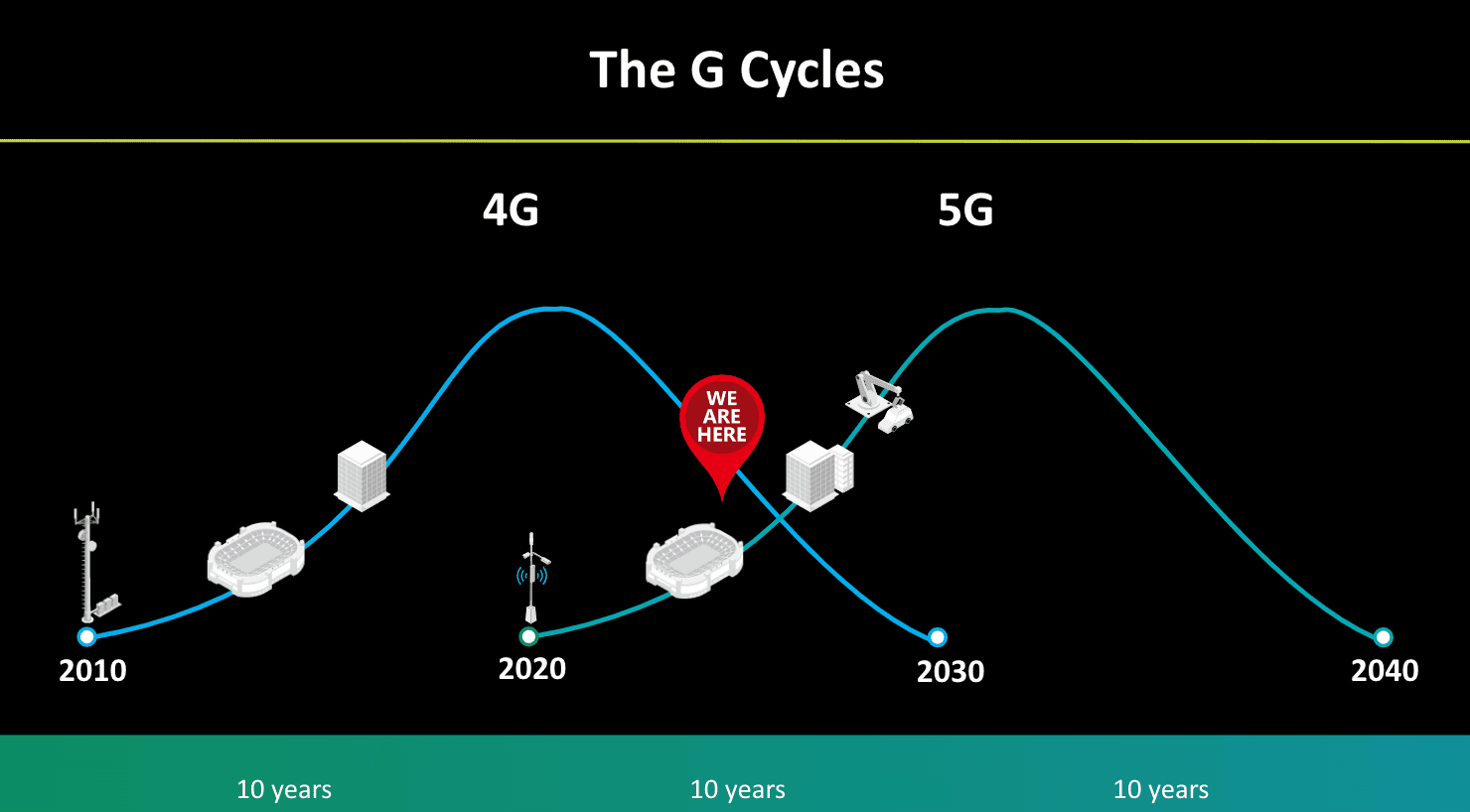
Image courtesy of CommScope.
153

CommScope sees market opportunity, TCO, ecosystem support and convergence all making the case for in-building Open RAN

Reflecting on the typical 10-year cellular generation cycle, as well as the roughly 20-year lifecycle of a G, CommScope’s Luigi Tarlazzi, vice president of engineering, pointed out that attention is historically turned to in-building investment at roughly the mid-point of the decade. So 4G was launched in 2010 and in-building investment ramped around 2015. If you count the start of 5G as around 2020, that means the in-building step is upon us. 

“This is happening now,” he told attendees to the Open RAN Global Forum, available on-demand here. “We’ve started to see a huge uptick in 5G deployments for large public venues,” including stadiums, airports and the like. But what does that mean for Open RAN which has similarly increased in interest along with the build out of 5G? 

Tarlazzi said investment in Open RAN “will continue, and we’ll see more and more wide adoption of this new way of building cellular networks.” That includes, he said, multi-carrier in-building cellular systems and private cellular networks. He pointed out challenges carriers are navigating around implementing Open RAN in brownfield networks; “in-building cellular, actually…is a little bit kind of lower-hanging fruit in terms of risk that an [mobile network operator] would take to deploy a new technology in this environment.” Essentially, in-building cellular networks and private networks are inherently greenfield and isolated from the macro network. 

“When there is no coverage, you bring new coverage,” he said. “It’s basically a greenfield scenario…Indoor is probably, from a timeline standpoint, where we see—potentially see—the fastest adoption.” In addition to the macro opportunity, Tarlazzi highlighted TCO benefits given reduction in on-prem footprint and reduced energy consumption as compared to a traditional distributed antenna system (DAS).

And from an enterprise perspective, Tarlazzi said Open RAN is more user-friendly because it’s more IT-like than integrated cellular. “There is an opportunity, we believe, to allow the enterprise maybe to actually source some of the hardware that is needed, then bring in the carriers, their software and RAN workloads, to actually operate the network.” 

To the ecosystem point, he said there’s an established pool of in-building specialists, including system integrators, neutral host providers and managed service providers. “There is already a proven ecosystem supporting what can come from the carriers…and then can be integrated into what is deployed on prem…The indoor ecosystem is ready…to take ownership of these solutions.” 

Tarlazzi then talked about convergence—convergence of public and private cellular on a shared infrastructure, convergence of licensed and unlicensed spectrum, and convergence of multiple software elements for different use cases on a unified hardware platform. “We believe that even more looking forward, looking at how the quickly the network and the technologies are evolving…there is the need to have a network in a venue or an enterprise that can actually scale up and be upgraded seamlessly via software.” 

You Might Also Like
  • Friday (telco diary) | Telco reset, RAN reboot, P5G reality check
  • Qualcomm Webinar: Agentic RAN Management: Delivering OPEX efficiency and a path to 6G
  • Open Interfaces, Smarter Networks: The O-RAN Advantage for Indoor Deployments
  • Beyond the black box: How TELUS and P.I. Works are redefining network intelligence for the open RAN era
  • Department of War takes aim at closed RAN stacks with open source
  • Rakuten Mobile to deploy 3,000 open mMIMO radios in Japan
Share 0 LinkedinEmail
Sean Kinney
Sean Kinney, Principal Analyst

Sean focuses on multiple subject areas including 5G, 6G, Open RAN, hybrid cloud, edge computing, and Industry 4.0. Prior to his work at RCR, Sean studied journalism and literature at the University of Mississippi then spent six years based in Key West, Florida, working as a reporter for the Miami Herald Media Company. He currently lives in Fayetteville, Arkansas.

previous post
Fixed Wireless Access adoption takes off, shedding new light on design and test requirements
next post
BT intros app-level tracking of enterprise AI emissions

White Papers

  • Norton eBook: The 2026 Telco Playbook

  • Enea White Paper: Why Intelligent AAA is the Swiss Army Knife of Telecom

  • CSG White Paper: Telco AI Enabler: Mediation’s Defining Role

  • Enea White Paper: Scalable Database Design for 5G and Beyond

  • Supermicro and NVIDIA Whitepaper: Powering sovereign AI at scale

Editorial Reports

  • Market Pulse Report: Telco AI in 2026 – Trends, Challenges and Opportunities

  • Nvidia Report: The State of AI in Telecommunications: 2026 Trends

  • Report: Scaling Optical Networks For The Hyperscale And AI Era

Webinars

  • Webinar: Building 6G — aligning technology, policy and purpose

  • SIMCom Webinar: Scaling your next deployment – from plastic to provisioning

  • Webinar: Rethinking the RAN as AI, cloud and openness converge

  • Webinar: Scale-Up, Scale-Out, Scale-Across – Building AI-Era Network Fabrics

  • Webinar: NTN in motion – evolving standards, expanding services

Since 1982, RCR Wireless News has been providing wireless and mobile industry news, insights, and analysis to mobile and wireless industry professionals, decision makers, policy makers, analysts and investors.

Facebook Twitter Youtube Linkedin Envelope Rss

Useful Links

  • Subscribe
  • About RCR Wireless News
  • Contact Us
  • Advertise
  • Editorial Calendar
  • Archive
  • RSS
  • Wireless News Archive
  • Subscribe
  • About RCR Wireless News
  • Contact Us
  • Advertise
  • Editorial Calendar
  • Archive
  • RSS
  • Wireless News Archive

Edtior's Picks

AT&T says its network is already built for the agentic AI wave
AT&T and Ericsson use network sensing to spot drones with ordinary 5G towers
Huawei sees Mobile AI driving new wave of uplink network investment

Latest Articles

AT&T says its network is already built for the agentic AI wave
AT&T and Ericsson use network sensing to spot drones with ordinary 5G towers
Huawei sees Mobile AI driving new wave of uplink network investment
Spectrum supercycle – US opens floodgates; UK shares it out

© 2026 RCR Wireless News All Right Reserved. Developed by Eight Hats.

Cookie Policy | Privacy Policy

RCR Wireless
  • News
  • Channels
    • 5G
    • 6G
    • BSS OSS
    • Carriers
    • IoT
    • Network Infrastructure
    • Open RAN
    • Private 5G
    • Telco AI
    • Telco Cloud
    • Test & Measurement
  • Resources
    • Reports
    • Webinars
    • White papers
    • AI Fundamentals
    • Analyst Angle
    • Editorial Calendar
    • Fundamentals
      • 5G NR Release 17
      • AI
        • Telco AI in 2025
    • Podcasts
      • Let’s Get Digital with Carrie Charles
      • Wireless Connectivity to Enable Industry 4.0 for the Middleprise
      • Well Technically…
      • Will 5G Change the World
      • Accelerating Industry 4.0 Digitalization
  • AI Infrastructure
  • Programs
  • Events
  • RCRtv
  • Advertise
  • Subscribe
RCR Wireless
  • News
  • Channels
    • 5G
    • 6G
    • BSS OSS
    • Carriers
    • IoT
    • Network Infrastructure
    • Open RAN
    • Private 5G
    • Telco AI
    • Telco Cloud
    • Test & Measurement
  • Resources
    • Reports
    • Webinars
    • White papers
    • AI Fundamentals
    • Analyst Angle
    • Editorial Calendar
    • Fundamentals
      • 5G NR Release 17
      • AI
        • Telco AI in 2025
    • Podcasts
      • Let’s Get Digital with Carrie Charles
      • Wireless Connectivity to Enable Industry 4.0 for the Middleprise
      • Well Technically…
      • Will 5G Change the World
      • Accelerating Industry 4.0 Digitalization
  • AI Infrastructure
  • Programs
  • Events
  • RCRtv
  • Advertise
  • Subscribe
@2020 - All Right Reserved. Designed and Developed by PenciDesign
