


RCR Wireless
  • News
  • Channels
    • 5G
    • 6G
    • BSS OSS
    • Carriers
    • IoT
    • Network Infrastructure
    • Open RAN
    • Private 5G
    • Telco AI
    • Telco Cloud
    • Test & Measurement
  • Resources
    • Reports
    • Webinars
    • White papers
    • AI Fundamentals
    • Analyst Angle
    • Editorial Calendar
    • Fundamentals
      • 5G NR Release 17
      • AI
        • Telco AI in 2025
    • Podcasts
      • Let’s Get Digital with Carrie Charles
      • Wireless Connectivity to Enable Industry 4.0 for the Middleprise
      • Well Technically…
      • Will 5G Change the World
      • Accelerating Industry 4.0 Digitalization
  • AI Infrastructure
  • Programs
  • Events
  • RCRtv
  • Advertise
  • Subscribe
Monday, July 13, 2026
RCR Wireless
  • News
  • Channels
    • 5G
    • 6G
    • BSS OSS
    • Carriers
    • IoT
    • Network Infrastructure
    • Open RAN
    • Private 5G
    • Telco AI
    • Telco Cloud
    • Test & Measurement
  • Resources
    • Reports
    • Webinars
    • White papers
    • AI Fundamentals
    • Analyst Angle
    • Editorial Calendar
    • Fundamentals
      • 5G NR Release 17
      • AI
        • Telco AI in 2025
    • Podcasts
      • Let’s Get Digital with Carrie Charles
      • Wireless Connectivity to Enable Industry 4.0 for the Middleprise
      • Well Technically…
      • Will 5G Change the World
      • Accelerating Industry 4.0 Digitalization
  • AI Infrastructure
  • Programs
  • Events
  • RCRtv
  • Advertise
  • Subscribe
Add RCR Wireless as a preferred source on Google
  • Qualcomm 6G Insights
  • Huawei Content Hub
  • Qualcomm – 6G Vision
  • OSS/BSS Channel
  • RCRTech Roundtable: AI Infrastructure
RCR Wireless
RCR Wireless
  • Advanced Mimo
  • Mobile mmWave
  • 5G Positioning
  • Green Networks
  • Metaverse
  • Automotive
  • Industrial and Wide-area IoT
Copyright 2021 - All Right Reserved
Home - Simplifying global IoT for trackers – why LTE-M is best (Reader Forum)
Reader Forum

Simplifying global IoT for trackers – why LTE-M is best (Reader Forum)

by By Dana Cohen Mizrahi, Product Marketing Manager, Sony Semiconductor Israel October 18, 2024
written by By Dana Cohen Mizrahi, Product Marketing Manager, Sony Semiconductor Israel October 18, 2024 Share
LinkedinEmail
Share 0LinkedinEmail
Background image: 123rf
122

IoT connectivity has been a game-changer in the asset tracking landscape. Personal devices, pets, vehicles, international packages, or any kind of asset can all easily be tracked through the cloud. This has opened the door to innovative use cases that have transformed global shipping, automotive loans, retail management, construction, and other industries. 

Using asset trackers allows shippers to track the temperature and condition of products and raw materials as they move on ships, planes, and trucks through the supply chain. Families have a better chance at recovering lost pets. Banks are more willing to approve high-risk car loans, knowing they can locate and recover a vehicle if its owner falls behind on payments. 

Dana Cohen Product Marketing Manager at Sony Semiconductor Israel
Cohen Mizrahi – debate; what debate? LTE-M is best

While there is some debate about the best IoT connectivity technology for trackers, the benefits of low-power wide-area (LPWA) IoT networks are hard to overstate. LPWA technologies are optimised for low-power, long-range communications, making them ideal for tracking applications with extended battery life and broad coverage requirements. 

LTE-M, a cellular LTE-based LPWA technology, has demonstrated its value in terms of cost, coverage, power consumption, and longevity. It offers a number of benefits over other cellular solutions, such as LTE Cat-1 bis. This article will focus on the coverage and hardware advantages offered by LTE-M.

Why LTE-M for low-power IoT

Long-Term Evolution for Machines, better known as LTE-M, is a versatile connectivity solution that extends the capabilities of LTE networks to support IoT applications. LTE-M offers superior coverage, better signal penetration, improved power efficiency, and other benefits – all of which support its case as the most effective connectivity solution for asset trackers. 

LTE-M is governed by standards set by 3GPP. As a result, it is included in 5G, and is effectively future-proofed for the next 15 years or more. Since 2017, the number of LTE-M networks has dramatically grown; by 2023, over 115 mobile network operators supported the protocol. Effectively, LTE-M (and NB-IoT) is directly supported in North and South America, Europe, most of Asia, Australia and more. 

Hardware benefits versus Cat-1

LTE Cat-1 bis is a comparable technology sometimes used in connecting devices. It is a low-cost version of the LTE Cat-1 chip, containing only one antenna. It is ideal for low-cost IoT devices that don’t need the complexity of a MIMO antenna, found in Cat-1 chips, but want to utilise LTE networks with higher data rates. 

LTE Cat-1 bis is also used for applications that require higher throughput. Devices that involve voice transmissions or require real time, two-way communication such as routing updates are better served with the faster communication capabilities of LTE Cat-1 bis. But Cat-1 bis chipsets introduce a hardware/coverage challenge. 

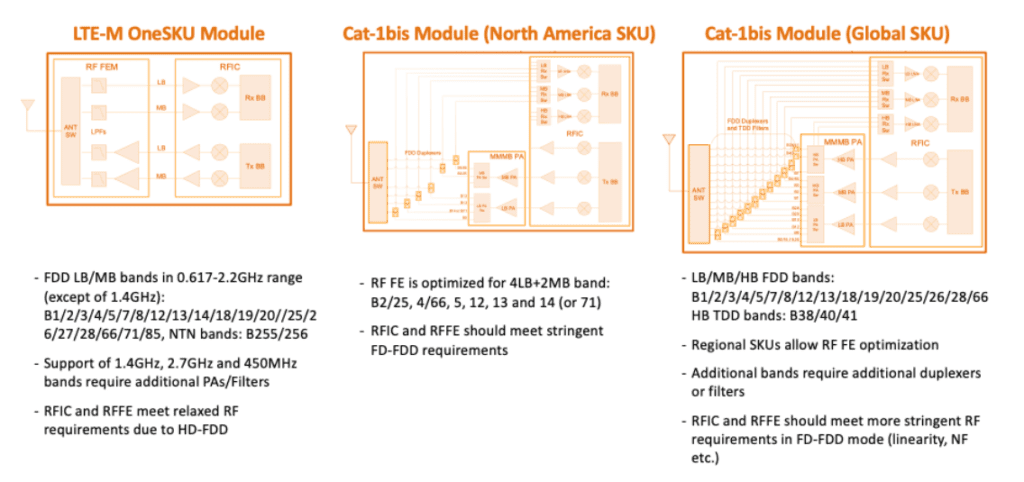
These chips use a full-duplex frequency division duplex (FD-FDD) operation mode, which means simultaneous transmission and reception on two different frequency bands. These bands vary between regional networks due to regulatory requirements, and the duplex gaps are different in each region. As a result, each Cat-1 bis chip needs to be built for a specific regional network. 

As shown in the below figure, a manufacturer developing a tracking product that will be sold globally must develop and install chips for each region. Building a global Cat-1 bis SKU increases the hardware components within the chip and might add up to $4 to the cost of the chip (out-of China prices). LTE-M chipsets, on the other hand, have a half-duplex (HD-FDD) operation mode. 

This means they can simultaneously transmit and receive data. It also allows for more simplicity on the hardware side, in terms of supported frequency bands: LTE-M has one global SKU design. As a result, it is able to connect with any network operator that supports 4G or 5G. This simplifies manufacturing, as developers can create a single chipset model and deploy it globally. 
Sony Semi Graphic LTE M
High level hardware designs – for LTE-M (single SKU) and LTE Cat-1 bis (regional and global SKUs)

This differentiation takes on greater importance with trackers. As items sometimes move from one country or region to the next, those devices being monitored by an LTE Cat-1 bis unit need to be designed initially with a specific region-SKU or global-SKU. Packages, shipments, and other devices using an LTE-M chip can still be monitored wherever they go.

Other LTE-M advantages 

LTE-M has several other advantages over LTE Cat-1 bis which make it ideal for tracking devices. It has a longer battery life, ensuring that users can track the device for a longer period of time. This takes on greater importance when items are being tracked and monitored over a long period of time. 

LTE-M also has better network coverage and signal penetration than LTE Cat-1 bis. Testing has shown that LTE-M can maintain connectivity at coupling losses of up to 154 dB. LTE Cat-1 bis loses connectivity at 145 dB. This means LTE-M maintains connectivity in areas with poor network coverage and gain 9dB compared to cat 1bis. 

This reliability is important in tracking, where objects being tracked with a LTE-M chipset will continue to transmit their locations even in poor coverage areas. The choice of connectivity technology plays a decisive role in the success of tracking assets anywhere in the world. LTE-M’s versatility and ability to operate seamlessly across regions makes it an obvious choice – so organisations don’t have the worry of losing connectivity. 

This level of reliability allows businesses to monitor their assets in remote locations, harsh conditions, or densely populated urban environments with the same confidence. As these technologies evolve, the balance between cost efficiency, global scalability, and operational performance will further solidify LTE-M as the dominant choice to track assets.


You Might Also Like
  • How operations leaders see 5G as vital for mission-critical workflows (Reader Forum)
  • How the FCC can protect IoT innovation and GPS resilience in the 900 MHz band (Reader Forum)
  • Trust you can see – the convergence of voice, messaging, and identity (Reader Forum)
  • Subsea resilience needs to move beyond cable count – here’s why (Reader Forum)
  • Real-world network emulation is critical for 5G deployments (Reader Forum)
  • Why autonomous networks don’t mature uniformly (Reader Forum)
Share 0 LinkedinEmail
By Dana Cohen Mizrahi, Product Marketing Manager, Sony Semiconductor Israel

previous post
5G-IoT (‘trademark’) connected ambulances come to India
next post
‘It’s whatever you want it to be’ — Creating and defining 6G use cases

White Papers

  • Enea White Paper: Why Intelligent AAA is the Swiss Army Knife of Telecom

  • CSG White Paper: Telco AI Enabler: Mediation’s Defining Role

  • Enea White Paper: Scalable Database Design for 5G and Beyond

  • Supermicro and NVIDIA Whitepaper: Powering sovereign AI at scale

  • VIAVI Whitepaper: RAN scenario generators and their critical role for future-proofing AI-native RAN in Advanced 5G and 6G networks

Editorial Reports

  • Report: Scaling Optical Networks For The Hyperscale And AI Era

  • Test And Measurement Market Pulse Report

  • Editorial Report: Securing telecom infrastructure for the quantum era

Webinars

  • Webinar: Building 6G — aligning technology, policy and purpose

  • SIMCom Webinar: Scaling your next deployment – from plastic to provisioning

  • Webinar: Rethinking the RAN as AI, cloud and openness converge

  • Webinar: Scale-Up, Scale-Out, Scale-Across – Building AI-Era Network Fabrics

  • Webinar: NTN in motion – evolving standards, expanding services

Since 1982, RCR Wireless News has been providing wireless and mobile industry news, insights, and analysis to mobile and wireless industry professionals, decision makers, policy makers, analysts and investors.

Facebook Twitter Youtube Linkedin Envelope Rss

Useful Links

  • Subscribe
  • About RCR Wireless News
  • Contact Us
  • Advertise
  • Editorial Calendar
  • Archive
  • RSS
  • Wireless News Archive
  • Subscribe
  • About RCR Wireless News
  • Contact Us
  • Advertise
  • Editorial Calendar
  • Archive
  • RSS
  • Wireless News Archive

Edtior's Picks

Netgear’s quiet reinvention as a B2B and SaaS company (Analyst Angle)
Friday (telco diary) | Telco reset, RAN reboot, P5G reality check
Operators are seeking greater control of NTN: GSMA Intelligence

Latest Articles

Netgear’s quiet reinvention as a B2B and SaaS company (Analyst Angle)
Friday (telco diary) | Telco reset, RAN reboot, P5G reality check
Operators are seeking greater control of NTN: GSMA Intelligence
Webinar: Building 6G — aligning technology, policy and purpose

© 2026 RCR Wireless News All Right Reserved. Developed by Eight Hats.

Cookie Policy | Privacy Policy

RCR Wireless
  • News
  • Channels
    • 5G
    • 6G
    • BSS OSS
    • Carriers
    • IoT
    • Network Infrastructure
    • Open RAN
    • Private 5G
    • Telco AI
    • Telco Cloud
    • Test & Measurement
  • Resources
    • Reports
    • Webinars
    • White papers
    • AI Fundamentals
    • Analyst Angle
    • Editorial Calendar
    • Fundamentals
      • 5G NR Release 17
      • AI
        • Telco AI in 2025
    • Podcasts
      • Let’s Get Digital with Carrie Charles
      • Wireless Connectivity to Enable Industry 4.0 for the Middleprise
      • Well Technically…
      • Will 5G Change the World
      • Accelerating Industry 4.0 Digitalization
  • AI Infrastructure
  • Programs
  • Events
  • RCRtv
  • Advertise
  • Subscribe
RCR Wireless
  • News
  • Channels
    • 5G
    • 6G
    • BSS OSS
    • Carriers
    • IoT
    • Network Infrastructure
    • Open RAN
    • Private 5G
    • Telco AI
    • Telco Cloud
    • Test & Measurement
  • Resources
    • Reports
    • Webinars
    • White papers
    • AI Fundamentals
    • Analyst Angle
    • Editorial Calendar
    • Fundamentals
      • 5G NR Release 17
      • AI
        • Telco AI in 2025
    • Podcasts
      • Let’s Get Digital with Carrie Charles
      • Wireless Connectivity to Enable Industry 4.0 for the Middleprise
      • Well Technically…
      • Will 5G Change the World
      • Accelerating Industry 4.0 Digitalization
  • AI Infrastructure
  • Programs
  • Events
  • RCRtv
  • Advertise
  • Subscribe
@2020 - All Right Reserved. Designed and Developed by PenciDesign