


RCR Wireless
  • News
  • Channels
    • 5G
    • 6G
    • BSS OSS
    • Carriers
    • IoT
    • Network Infrastructure
    • Open RAN
    • Private 5G
    • Telco AI
    • Telco Cloud
    • Test & Measurement
  • Resources
    • Reports
    • Webinars
    • White papers
    • AI Fundamentals
    • Analyst Angle
    • Editorial Calendar
    • Fundamentals
      • 5G NR Release 17
      • AI
        • Telco AI in 2025
    • Podcasts
      • Let’s Get Digital with Carrie Charles
      • Wireless Connectivity to Enable Industry 4.0 for the Middleprise
      • Well Technically…
      • Will 5G Change the World
      • Accelerating Industry 4.0 Digitalization
  • AI Infrastructure
  • Programs
  • Events
  • RCRtv
  • Advertise
  • Subscribe
Sunday, July 26, 2026
RCR Wireless
  • News
  • Channels
    • 5G
    • 6G
    • BSS OSS
    • Carriers
    • IoT
    • Network Infrastructure
    • Open RAN
    • Private 5G
    • Telco AI
    • Telco Cloud
    • Test & Measurement
  • Resources
    • Reports
    • Webinars
    • White papers
    • AI Fundamentals
    • Analyst Angle
    • Editorial Calendar
    • Fundamentals
      • 5G NR Release 17
      • AI
        • Telco AI in 2025
    • Podcasts
      • Let’s Get Digital with Carrie Charles
      • Wireless Connectivity to Enable Industry 4.0 for the Middleprise
      • Well Technically…
      • Will 5G Change the World
      • Accelerating Industry 4.0 Digitalization
  • AI Infrastructure
  • Programs
  • Events
  • RCRtv
  • Advertise
  • Subscribe
Add RCR Wireless as a preferred source on Google
  • Qualcomm 6G Insights
  • Huawei Content Hub
  • Qualcomm – 6G Vision
  • OSS/BSS Channel
  • RCRTech Roundtable: AI Infrastructure
RCR Wireless
RCR Wireless
  • Advanced Mimo
  • Mobile mmWave
  • 5G Positioning
  • Green Networks
  • Metaverse
  • Automotive
  • Industrial and Wide-area IoT
Copyright 2021 - All Right Reserved
Home - What goes where – deconstructing critical 5G edge/cloud workloads
FundamentalsIndustry 4.0Internet of Things (IoT)IoTPrivate 5GPrivate Networks

What goes where – deconstructing critical 5G edge/cloud workloads

by James Blackman October 25, 2023
written by James Blackman October 25, 2023 Share
LinkedinEmail
Share 0LinkedinEmail
Background image: 123rf
96

Note, this article is taken from the RCR editorial report on Critical 5G Edge Workloads, published in September. The following is the first part of the foreword to the report. Go here to download the full report. The subject will be further explored in the upcoming Industrial 5G Forum on November 7; sign up here.

Let’s get down to brass tacks. Which critical industrial workloads should stay on site at the enterprise edge, and which should go to far-off cloud data centres? That is the question. What rules should critical-grade industries and industrial-grade service providers follow? None, retorts almost everyone (see interviews, pages 8ff). That is the challenge with Industry 4.0; nothing is easy with the design and implementation of new-fangled digital-change infrastructure for critical industry. Almost everything is bespoke – and the solution invariably takes on a life of its own when it gets to sign-off.

There isn’t a “one-size-fits-all”, responds AWS. “There are no rules,” says Siemens. Others say the same, in effect. Except this is not exactly true. There are no hard-and-fast rules, the message goes; and we are deliberately misquoting Siemens, in fact. In response to a direct question, it actually responds: “There is no rule-of-thumb.” Which is different, of course – and also wrong. Because while there are no strict rules, there are very clearly rules-of-thumb; and even Siemens, in denial or in translation, says so in its response – and promptly reels them off.

Screen Shot 2023 10 17 at 8.59.54 AM

The German firm suggests (see pages 22-23) the “key factors” that govern the provenance of data processing are latency, bandwidth, and “privacy and security”. The last two are often bundled together, and might be related, but they are also different: the first is about sharpening regulation, which says local data should be processed in local data centres, of whatever type; the second is about robbery and vandalism of property and systems, in the digital sense. The point is that the edge should be engaged whenever these factors are critical.

Across the interviews in the following pages, everyone agrees on this: edge requirements are most often dictated by application performance, where latency and bandwidth are the king measures, or else by security and privacy (and abiding industrial distrust in public infrastructure). In ways, these factors are all facets of infrastructure ‘reliability’. But reliability is the de facto terminology for infrastructure uptime, measured as a percentage of time (99.99… percent reliable) – arrived at initially by calculating operational outages, and arrived at finally by calculating capital outages. “Because an extra nine costs an extra zero,” explains Volt Active Data. Four nines, five nines, six nines? How many do you want? And how many can you actually afford?

Data streaming specialist Volt Active Data addresses the mad challenge of ultra-reliability very well (see pages 18-19); system integrator Kyndryl notes that enterprises are invariably pragmatic about digital change, whatever ‘rules’ are imposed during its design (see pages 8-9). But these are rules-of-thumb, remember; no one (quizzed as part of this exercise) is prepared to put metrics against latency and bandwidth, say, to explain when workloads start to migrate from the cloud to the edge. Because everything, as above, is bespoke. The only rock-solid rule is to look at the data.

Industrial 5G Forum

“What is the data? How do you collect it? What are you going to do with it? Once you understand all of that, then everything gets a little clearer,” explains Steve Currie, vice president of global edge compute at Kyndryl. Of course, answers about the nature and velocity of critical data go in all different directions – which is where the long process of consultancy and collaboration starts, and what this report discusses in separate conversations with various protagonists in the Industry 4.0 mix.
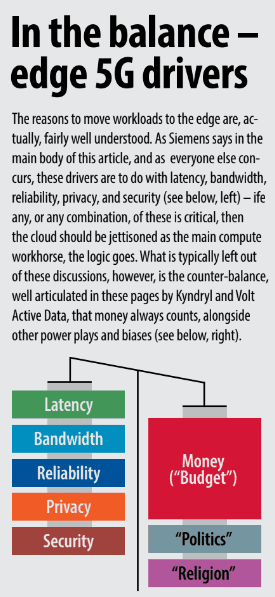
Edge Workloads

Interestingly, Siemens points to certain other practicalities, besides (see pages 22-23): the ring-fenced enterprise edge also becomes important because of constrained or restricted network or compute resources. System integrator NTT says the same in a separate conversation (not included here; available online): certain new industrial IoT solutions, especially camera-based sensor applications, would fall-over if their payloads had to traverse the open internet, or channels of it, to be transmogrified into useful information, it says.

Certain of them would knock-out legacy enterprise networks if they were not rerouted on local-edge cellular, it adds. “There’s lots of data – especially in a large plant with thousands of sensors. There is so much data that the backhaul to the cloud would be overwhelmed, and the cost to upgrade could be very high,” comments Parm Sandhu, vice president of enterprise 5G services at the firm. “Which is another reason to process data locally – because the volume of data would add significant cost to centralising [compute functions].”

This article is continued in the RCR editorial report on Critical 5G Edge Workloads, available to download here. The subject will be further explored in the upcoming Industrial 5G Forum on November 7; sign up here.

Screen Shot 2023 10 17 at 8.59.54 AM
You Might Also Like
  • The most expensive wireless system is the one you install twice (Reader Forum)
  • Monday (telco diary) | Sovereign AI for Industry 4.0
  • When the push becomes the pull – private 5G and physical AI
  • Ericsson wins role in £8bn UK’s defense upgrade as private 5G moves to frontline
  • Fast-growing private 5G offers blueprint for AI-era telecoms
  • Wednesday (telco diary) | What telcos want – and why they wait
Share 0 LinkedinEmail
James Blackman
James Blackman

James Blackman has been writing about the technology and telecoms sectors for over a decade. He has edited and contributed to a number of European news outlets and trade titles. He has also worked at telecoms company Huawei, leading media activity for its devices business in Western Europe. He is based in London.

previous post
Nokia adds new 5G devices to its FWA portfolio
next post
Brazil’s Teatro Gazeta theater is outfitted with Wi-FI OpenRoaming capabilities

White Papers

  • Norton eBook: The 2026 Telco Playbook

  • Enea White Paper: Why Intelligent AAA is the Swiss Army Knife of Telecom

  • CSG White Paper: Telco AI Enabler: Mediation’s Defining Role

  • Enea White Paper: Scalable Database Design for 5G and Beyond

  • Supermicro and NVIDIA Whitepaper: Powering sovereign AI at scale

Editorial Reports

  • Market Pulse Report: Telco AI in 2026 – Trends, Challenges and Opportunities

  • Nvidia Report: The State of AI in Telecommunications: 2026 Trends

  • Report: Scaling Optical Networks For The Hyperscale And AI Era

Webinars

  • Webinar: Building 6G — aligning technology, policy and purpose

  • SIMCom Webinar: Scaling your next deployment – from plastic to provisioning

  • Webinar: Rethinking the RAN as AI, cloud and openness converge

  • Webinar: Scale-Up, Scale-Out, Scale-Across – Building AI-Era Network Fabrics

  • Webinar: NTN in motion – evolving standards, expanding services

Since 1982, RCR Wireless News has been providing wireless and mobile industry news, insights, and analysis to mobile and wireless industry professionals, decision makers, policy makers, analysts and investors.

Facebook Twitter Youtube Linkedin Envelope Rss

Useful Links

  • Subscribe
  • About RCR Wireless News
  • Contact Us
  • Advertise
  • Editorial Calendar
  • Archive
  • RSS
  • Wireless News Archive
  • Subscribe
  • About RCR Wireless News
  • Contact Us
  • Advertise
  • Editorial Calendar
  • Archive
  • RSS
  • Wireless News Archive

Edtior's Picks

AT&T says its network is already built for the agentic AI wave
AT&T and Ericsson use network sensing to spot drones with ordinary 5G towers
Huawei sees Mobile AI driving new wave of uplink network investment

Latest Articles

AT&T says its network is already built for the agentic AI wave
AT&T and Ericsson use network sensing to spot drones with ordinary 5G towers
Huawei sees Mobile AI driving new wave of uplink network investment
Spectrum supercycle – US opens floodgates; UK shares it out

© 2026 RCR Wireless News All Right Reserved. Developed by Eight Hats.

Cookie Policy | Privacy Policy

RCR Wireless
  • News
  • Channels
    • 5G
    • 6G
    • BSS OSS
    • Carriers
    • IoT
    • Network Infrastructure
    • Open RAN
    • Private 5G
    • Telco AI
    • Telco Cloud
    • Test & Measurement
  • Resources
    • Reports
    • Webinars
    • White papers
    • AI Fundamentals
    • Analyst Angle
    • Editorial Calendar
    • Fundamentals
      • 5G NR Release 17
      • AI
        • Telco AI in 2025
    • Podcasts
      • Let’s Get Digital with Carrie Charles
      • Wireless Connectivity to Enable Industry 4.0 for the Middleprise
      • Well Technically…
      • Will 5G Change the World
      • Accelerating Industry 4.0 Digitalization
  • AI Infrastructure
  • Programs
  • Events
  • RCRtv
  • Advertise
  • Subscribe
RCR Wireless
  • News
  • Channels
    • 5G
    • 6G
    • BSS OSS
    • Carriers
    • IoT
    • Network Infrastructure
    • Open RAN
    • Private 5G
    • Telco AI
    • Telco Cloud
    • Test & Measurement
  • Resources
    • Reports
    • Webinars
    • White papers
    • AI Fundamentals
    • Analyst Angle
    • Editorial Calendar
    • Fundamentals
      • 5G NR Release 17
      • AI
        • Telco AI in 2025
    • Podcasts
      • Let’s Get Digital with Carrie Charles
      • Wireless Connectivity to Enable Industry 4.0 for the Middleprise
      • Well Technically…
      • Will 5G Change the World
      • Accelerating Industry 4.0 Digitalization
  • AI Infrastructure
  • Programs
  • Events
  • RCRtv
  • Advertise
  • Subscribe
@2020 - All Right Reserved. Designed and Developed by PenciDesign
