

RCR Wireless
  • News
  • Channels
    • 5G
    • 6G
    • BSS OSS
    • Carriers
    • IoT
    • Network Infrastructure
    • Open RAN
    • Private 5G
    • Telco AI
    • Telco Cloud
    • Test & Measurement
  • Resources
    • Reports
    • Webinars
    • White papers
    • AI Fundamentals
    • Analyst Angle
    • Editorial Calendar
    • Fundamentals
      • 5G NR Release 17
      • AI
        • Telco AI in 2025
    • Podcasts
      • Let’s Get Digital with Carrie Charles
      • Wireless Connectivity to Enable Industry 4.0 for the Middleprise
      • Well Technically…
      • Will 5G Change the World
      • Accelerating Industry 4.0 Digitalization
  • AI Infrastructure
  • Programs
  • Events
  • RCRtv
  • Advertise
  • Subscribe
Thursday, July 9, 2026
RCR Wireless
  • News
  • Channels
    • 5G
    • 6G
    • BSS OSS
    • Carriers
    • IoT
    • Network Infrastructure
    • Open RAN
    • Private 5G
    • Telco AI
    • Telco Cloud
    • Test & Measurement
  • Resources
    • Reports
    • Webinars
    • White papers
    • AI Fundamentals
    • Analyst Angle
    • Editorial Calendar
    • Fundamentals
      • 5G NR Release 17
      • AI
        • Telco AI in 2025
    • Podcasts
      • Let’s Get Digital with Carrie Charles
      • Wireless Connectivity to Enable Industry 4.0 for the Middleprise
      • Well Technically…
      • Will 5G Change the World
      • Accelerating Industry 4.0 Digitalization
  • AI Infrastructure
  • Programs
  • Events
  • RCRtv
  • Advertise
  • Subscribe
Add RCR Wireless as a preferred source on Google
  • Qualcomm 6G Insights
  • Huawei Content Hub
  • Qualcomm – 6G Vision
  • OSS/BSS Channel
  • RCRTech Roundtable: AI Infrastructure
RCR Wireless
RCR Wireless
  • Advanced Mimo
  • Mobile mmWave
  • 5G Positioning
  • Green Networks
  • Metaverse
  • Automotive
  • Industrial and Wide-area IoT
Copyright 2021 - All Right Reserved
Home - How to unlock the technical barriers to digitalization
EnterpriseFundamentalsInternet of Things (IoT)Smart Factory

How to unlock the technical barriers to digitalization

by Catherine Sbeglia Nin November 16, 2022
written by Catherine Sbeglia Nin November 16, 2022 Share
LinkedinEmail
Share 0LinkedinEmail
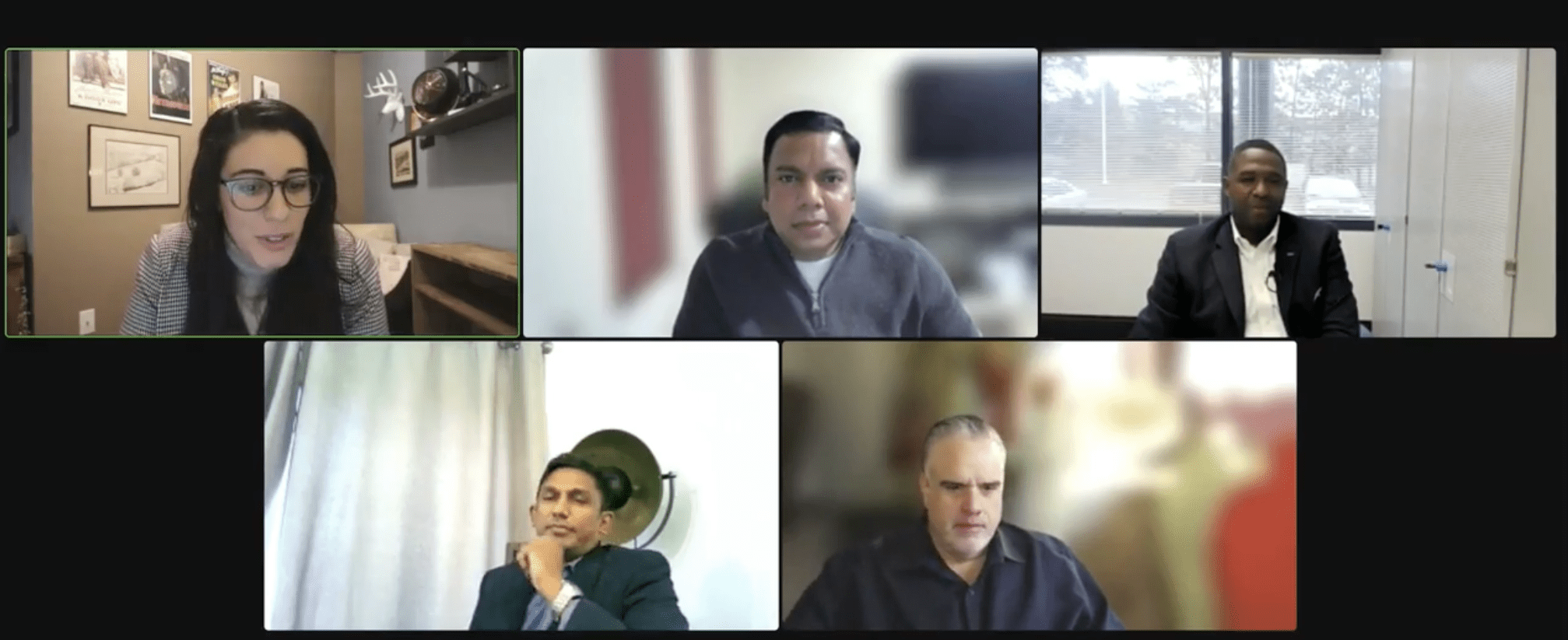
Four industry experts joined RCR Wireless News to discuss the technical barriers to digital transformation.
114

Industry 4.0 represents a shift from ‘islands of automation’ to cyber-physical systems

Four industry experts came together at the 5G Manufacturing Forum to offer insight into how some of the biggest barriers effecting digitalization — like the changing role of data, legacy integration and workforce management — can be addressed.

As background, Ted Rozier, director of engineering at Festo, explained that Industry 4.0 represents a shift from “islands of automation” to cyber-physical systems that integrate computation, networking and physical processes. “All of sudden, we don’t have these blinders and we now have the ability to capture information, and when we put the right tools into place, we know what to do with that information. We can change the process of the complete manufacturing floor,” he said.

Data: Along for the ride

This integration of computation, networking and physical processes allows manufacturers to develop a robust data strategy for preventive and predictive maintenance, which lets them exist in a state of maintenance urgency rather than emergency, according to KORE Wireless’ Director of IoT Channel and Business Development Adam Cohen.

“Real-time data … helped shift the industry so much that there are new types of as a service [offerings] … this opens up a whole new area of services where predicative maintenance and monitoring … actually rule [the] whole business opportunity,” he added.

While data is king in a digitally transformed enterprise, Suresh Daniel, the data and architecture integration director at Coats Plc, highlighted the importance of ensuring that the data itself also undergoes a transformation to avoid bringing “data that’s not useful” along for the ride. “Organizations … move from era to era, but they take the old data with them so … you will not see good results if you don’t transform your data as well,” he claimed.

Change management: ‘Singing from the same sheet music’

Equally critical, said Daniel, is change management, which refers to how an enterprise approaches communicating and facilitating a company-wide move from the industrial era to the digital era. “You can’t pivot overnight,” he reasoned. “You have to take the whole organization on the journey.”

This means that the messaging around digitalization and the direction of the organization has to be clearly and consistently articulated to every employee. Without effective change management, Daniel cautioned, you can’t expect to materially change the organization. “If someone is still stuck in the industrial era, your adoption will drop. You will not get the ROI you need because the people are not transforming,” he said.

Rozier agreed, commenting: “Industry 4.0, digital transformation … in the end, there is a people side of it. When we talk about smart manufacturing, it touches everyone from the CEO all the way down to the operator,” he said, adding that, therefore, it’s important to break down the silos that exist in how different elements — data management, engineering, supply chain logistics, etc. — are taught. “A lot of these topics are siloed [and] taught in different classrooms,” he said. “Bring all of those disciplines together so that they can see what… a complete system look[s] like.”

Rozier also discussed the “pesky skills gap,” anguishing that it “keeps getting bigger and bigger.” The solution, he said, is in “trying to get everyone to sing from the same sheet music.”

“An engineer… loves to design amazing things, but no wants to document the ‘aha’ moment. If you can get several organizations to document [those] moments and bring that into the classroom, everyone is singing from the same sheet music and that is a pull up globally,” he continued. He said, too, that organizations must also support its incumbent workforce by allowing them to get a certification or credential around smart manufacturing so that they can keep up with the changing industry.

System integration: From dumb machines to smart factory

While questions around legacy system integration are some of the most common, Cohen was clear on the answer: It’s not really a barrier.

“When you ask, ‘can it really integrate into legacy machines,’ that’s I think the best part about IoT; [It] is that it’s the anti-tower of babel, it speaks every single language,” he said, explaining that an array of smart devices can act as “teeny translators” for every type of input or output device, even those that don’t “speak,” like a motor or an electrical line.

In practice, this might look like adding an IoT sensor to a large, “dumb” manufacturing machine built in the 80’s. Now, data about the machine’s condition — whether it’s on or off, its temperature, the amount of energy it’s consuming, etc. — can be gathered for use by the company. This increased visibility, Cohen said, will lead to an increase in product production, less down time and manufacturing line flexibility.

Daniel further shared that for Coats, integration came down to plumbing. Likening the process to building pipelines, he said that the company has a team dedicated to looking at each facility process and building connections between them. Agreeing with Cohen, he added that yes, legacy components do all have a way to connect to the new system, but they may do so differently. But what’s important it so make those connections as real time as possible. Once connected, the data from the legacy systems is funneled into the pipeline.

“Then the pipeline will then keep moving and ingesting data into different layers,” Daniel concluded.

Reality check

While these transformations are undoubtably exciting because of what they can deliver and enable, Bhupesh Agrawal, director of private networks and edge computing in Intel’s Networks and Edge Group, was careful to point out that challenges remain.

“When we look at the use cases, especially in the context of industrial 4.0, we also have to align them with the TCO [total cost of ownership] and the ROI,” he argued. “Some of the use cases like factory automation where we talk about the closed-loop applications or robotics — Do you know how much it costs how much to put an ethernet LAN? It costs almost $100 to $200 on a per foot basis … it is costly, especially when you are talking about factories that are several acres.”

Further, while existing Wi-Fi solutions can provide the mobility needed for some smart manufacturing applications, like automated guided vehicles (AGVs), they fail to deliver the necessary reliability. And while advanced cellular technology is proving to be a good substitution here in the form of private networks, Agrawal questioned whether enterprise IT teams are ready to adopt an entirely new technology just yet.

“When we look at these use cases, we have to look at what is ready right now, what the TCO looks like and what is the ROI for it,” summarized Agrawal. “We, as an industry, are still in a market creation phase [of Industry 4.0] and it’s going to take some time to be really ready and really get the benefits.”


You Might Also Like
  • How the FCC can protect IoT innovation and GPS resilience in the 900 MHz band (Reader Forum)
  • “We’re going after the operator channel” – Druid bets on simplicity to scale private 5G
  • Tuesday | Vertical build-outs, horizontal break-ups (Editorial Diary)
  • ‘You can’t tame it’ – private networks, open standards and the AI proof for IoT
  • Monday | Global enterprise reset (Editorial Diary)
  • BT and Verizon merge international arms in $4bn global enterprise JV

Table of Contents

  • Industry 4.0 represents a shift from ‘islands of automation’ to cyber-physical systems
    • Data: Along for the ride
    • Change management: ‘Singing from the same sheet music’
    • System integration: From dumb machines to smart factory
    • Reality check
Share 0 LinkedinEmail
Catherine Sbeglia Nin

Catherine Sbeglia Nin is the Managing Editor for RCR Wireless News, where she covers topics such as Wi-Fi, network infrastructure, AI and edge computing. She also produced and hosted Arden Media's podcast Well, technically... After studying English and Film & Media Studies at The University of Rochester, she moved to Madison, WI. Having already lived on both coasts, she thought she’d give the middle a try. So far, she likes it very much.

previous post
Capgemini Webinar: Industry 4.0 and Sustainable Engineering
next post
Qualcomm and Snapdragon—a tale of two brands

White Papers

  • Enea White Paper: Why Intelligent AAA is the Swiss Army Knife of Telecom

  • CSG White Paper: Telco AI Enabler: Mediation’s Defining Role

  • Enea White Paper: Scalable Database Design for 5G and Beyond

  • Supermicro and NVIDIA Whitepaper: Powering sovereign AI at scale

  • VIAVI Whitepaper: RAN scenario generators and their critical role for future-proofing AI-native RAN in Advanced 5G and 6G networks

Editorial Reports

  • Report: Scaling Optical Networks For The Hyperscale And AI Era

  • Test And Measurement Market Pulse Report

  • Editorial Report: Securing telecom infrastructure for the quantum era

Webinars

  • SIMCom Webinar: Scaling your next deployment – from plastic to provisioning

  • Webinar: Rethinking the RAN as AI, cloud and openness converge

  • Webinar: Scale-Up, Scale-Out, Scale-Across – Building AI-Era Network Fabrics

  • Webinar: NTN in motion – evolving standards, expanding services

  • Webinar: Noise-Figure Measurements with RFmx and PXI VSTs

Since 1982, RCR Wireless News has been providing wireless and mobile industry news, insights, and analysis to mobile and wireless industry professionals, decision makers, policy makers, analysts and investors.

Facebook Twitter Youtube Linkedin Envelope Rss

Useful Links

  • Subscribe
  • About RCR Wireless News
  • Contact Us
  • Advertise
  • Editorial Calendar
  • Archive
  • RSS
  • Wireless News Archive
  • Subscribe
  • About RCR Wireless News
  • Contact Us
  • Advertise
  • Editorial Calendar
  • Archive
  • RSS
  • Wireless News Archive

Edtior's Picks

OCUDU aims to resolve the ‘last bottlenecks of proprietary software’
Optical advances won’t eliminate need for new fiber, says Dell’Oro
SIMCom Webinar: Scaling your next deployment – from plastic to provisioning

Latest Articles

OCUDU aims to resolve the ‘last bottlenecks of proprietary software’
Optical advances won’t eliminate need for new fiber, says Dell’Oro
SIMCom Webinar: Scaling your next deployment – from plastic to provisioning
GSMA Industry Insight: Enabling seamless cellular wearable experiences

© 2026 RCR Wireless News All Right Reserved. Developed by Eight Hats.

Cookie Policy | Privacy Policy

RCR Wireless
  • News
  • Channels
    • 5G
    • 6G
    • BSS OSS
    • Carriers
    • IoT
    • Network Infrastructure
    • Open RAN
    • Private 5G
    • Telco AI
    • Telco Cloud
    • Test & Measurement
  • Resources
    • Reports
    • Webinars
    • White papers
    • AI Fundamentals
    • Analyst Angle
    • Editorial Calendar
    • Fundamentals
      • 5G NR Release 17
      • AI
        • Telco AI in 2025
    • Podcasts
      • Let’s Get Digital with Carrie Charles
      • Wireless Connectivity to Enable Industry 4.0 for the Middleprise
      • Well Technically…
      • Will 5G Change the World
      • Accelerating Industry 4.0 Digitalization
  • AI Infrastructure
  • Programs
  • Events
  • RCRtv
  • Advertise
  • Subscribe
RCR Wireless
  • News
  • Channels
    • 5G
    • 6G
    • BSS OSS
    • Carriers
    • IoT
    • Network Infrastructure
    • Open RAN
    • Private 5G
    • Telco AI
    • Telco Cloud
    • Test & Measurement
  • Resources
    • Reports
    • Webinars
    • White papers
    • AI Fundamentals
    • Analyst Angle
    • Editorial Calendar
    • Fundamentals
      • 5G NR Release 17
      • AI
        • Telco AI in 2025
    • Podcasts
      • Let’s Get Digital with Carrie Charles
      • Wireless Connectivity to Enable Industry 4.0 for the Middleprise
      • Well Technically…
      • Will 5G Change the World
      • Accelerating Industry 4.0 Digitalization
  • AI Infrastructure
  • Programs
  • Events
  • RCRtv
  • Advertise
  • Subscribe
@2020 - All Right Reserved. Designed and Developed by PenciDesign
