

RCR Wireless
  • News
  • Channels
    • 5G
    • 6G
    • BSS OSS
    • Carriers
    • IoT
    • Network Infrastructure
    • Open RAN
    • Private 5G
    • Telco AI
    • Telco Cloud
    • Test & Measurement
  • Resources
    • Reports
    • Webinars
    • White papers
    • AI Fundamentals
    • Analyst Angle
    • Editorial Calendar
    • Fundamentals
      • 5G NR Release 17
      • AI
        • Telco AI in 2025
    • Podcasts
      • Let’s Get Digital with Carrie Charles
      • Wireless Connectivity to Enable Industry 4.0 for the Middleprise
      • Well Technically…
      • Will 5G Change the World
      • Accelerating Industry 4.0 Digitalization
  • AI Infrastructure
  • Programs
  • Events
  • RCRtv
  • Advertise
  • Subscribe
Wednesday, July 29, 2026
RCR Wireless
  • News
  • Channels
    • 5G
    • 6G
    • BSS OSS
    • Carriers
    • IoT
    • Network Infrastructure
    • Open RAN
    • Private 5G
    • Telco AI
    • Telco Cloud
    • Test & Measurement
  • Resources
    • Reports
    • Webinars
    • White papers
    • AI Fundamentals
    • Analyst Angle
    • Editorial Calendar
    • Fundamentals
      • 5G NR Release 17
      • AI
        • Telco AI in 2025
    • Podcasts
      • Let’s Get Digital with Carrie Charles
      • Wireless Connectivity to Enable Industry 4.0 for the Middleprise
      • Well Technically…
      • Will 5G Change the World
      • Accelerating Industry 4.0 Digitalization
  • AI Infrastructure
  • Programs
  • Events
  • RCRtv
  • Advertise
  • Subscribe
Add RCR Wireless as a preferred source on Google
  • Qualcomm 6G Insights
  • Huawei Content Hub
  • Qualcomm – 6G Vision
  • OSS/BSS Channel
  • RCRTech Roundtable: AI Infrastructure
RCR Wireless
RCR Wireless
  • Advanced Mimo
  • Mobile mmWave
  • 5G Positioning
  • Green Networks
  • Metaverse
  • Automotive
  • Industrial and Wide-area IoT
Copyright 2021 - All Right Reserved
Home - ‘Fully connected, self-optimizing’ – Bosch opens €1bn smart factory in Dresden
5GBuildingsChipsetsData AnalyticsEnterpriseInfrastructureInternet of Things (IoT)News & Event CoverageSensorsSmart FactoryWired Networks, Fiber

‘Fully connected, self-optimizing’ – Bosch opens €1bn smart factory in Dresden

by James Blackman June 7, 2021
written by James Blackman June 7, 2021 Share
LinkedinEmail
Share 0LinkedinEmail
590

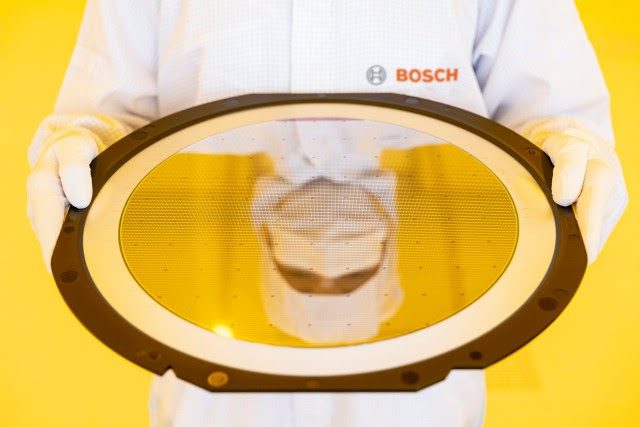
Bosch has opened a new smart factory for silicon wafer production in Dresden, capital of the eastern German state of Saxony. The firm has invested around €1 billion in the new plant, unveiled today (June 7) and set to start production next month. It said the sum is the biggest single investment in the company’s 130-year history. 

The factory is “highly automated, fully connected, data-driven, [and] self-optimizing”. It represents “one of the world’s most modern wafer fabs” and a “trailblazer in Industry 4.0”, it said. “With our first AIoT factory, we are setting new standards in chip production,” commented Volkmar Denner, chairman of the board at Bosch, continuing with its marketing conflation of IoT and AI technologies as the basis for digital change.

The Dresden plant, opening almost six months ahead of its original “late 2021” schedule, will take its cues for 5G connectivity from Bosch’s ongoing engagement with Swedish vendor Ericsson at its semiconductor factory in Reutlingen, in Baden-Württemberg, where the pair have combined on private 5G rollout. The new factory is billed as the company’s first 5G-capable semiconductor plant, “ready for 5G from day one”.

The venue has 72,000 square metres of floor space; 250 staff are already working at the site. Bosch wants to employ 700 at the site when construction work has been completed. Semiconductors made in the new plant will be installed in Bosch power tools. Chip production will start for automotive customers in September, three months earlier than planned. 

Volkmar Denner, chairman of the board at Bosch, said: “For Bosch, semiconductors are a core technology, and it is strategically important to develop and manufacture them ourselves. In Dresden, with the help of artificial intelligence, we will take semiconductor manufacturing to the next level. This is our first AIoT factory: fully connected, data-driven, and self-optimizing right from the start.” 

Bosch has been making semiconductor components since 1958. Its Reutlingen plant has been making silicon components that are not commercially available since the 1970s. The company said it has invested more than €2.5 billion in its Reutlingen and Dresden plants since 200-millimeter technology was introduced in 2010.

The investment in factory infrastructure to produce semiconductors goes alongside “billions… [invested in developing microelectronics”, it said. Denner remarked: “This expertise is the key to many high-caliber systems solutions made by Bosch.” 

The company cited “machines that think for themselves, maintenance work from 9,000 kilometres away, [and] glasses with built-in cameras”, among the industrial applications in Dresden. It flagged usage of a digital twin of the factory so all parts of the factory and construction data can be visualized. 

The digital twin of the factory and operations comprises around half a million 3D objects, including buildings and infrastructure, supply and disposal systems, cable ducts and ventilation systems, and machinery and manufacturing lines, it said. 

The company can use the digital twin models to simulate process optimization plans and renovation work without disrupting operations. Meanwhile, AR glasses and applications will allow maintenance work to be carried out remotely – “by an expert in Asia”, it suggested, to illustrate the use case.

A statement said: “All the data in the wafer fab – from machinery, sensors, and products – is collected in a central database…. Production data equivalent to 500 pages of text [will be] generated every second – equivalent to more than 42 million pages per day. This data is then evaluated using AI [and] self-optimizing algorithms learn to make predictions based on the data. 

“Manufacturing and maintenance processes can be analyzed in real time. An AI algorithm can detect even the tiniest anomalies in products. These anomalies are visible on the wafer surface in the form of specific error patterns known as signatures. Their causes are immediately analyzed and deviations from the process corrected without delay, even before they can affect the reliability of the product.” 

It added: “Semiconductor products can go into full production quickly, saving automotive customers the need for time-consuming trials. Maintenance work can be optimized. Algorithms can precisely predict when machinery or robots need maintenance or adjustment. Such work is not done according to a rigid schedule, but when it is needed – and in advance of any problems.”

Investment in the new Dresden plant is heavily hinged on the automotive sector. Bosch quoted ZVEI figures that the average value of microelectronics on new cars will reach €600 by 2023, from €120 in 1998 and €500 in 2018. 

“Semiconductors are the building blocks of progress. Electronic components equipped with chips from Dresden will make applications such as automated and resource-conserving driving possible, as well as the best possible occupant protection,” said Harald Kroeger, member of the board at Bosch.

He added: “Chips for vehicles are the ultimate discipline in semiconductor technology. This is because in cars, these small building blocks have to be especially robust. The combination of chip and systems expertise is strategically important for Bosch.” 

The state of Saxony is Europe’s biggest production venue for microelectronics, and dubbed Silicon Saxony. One in three chips made in Europe is produced in the state. Michael Kretschmer, minister-president for Saxony, commented: “[This] demonstrates how much faith people have in Saxony as a high-tech location, with its experienced and qualified specialists and unrivalled network.”

The German chancellor, Angela Merkel, was also online for the inauguration of the site, as was EU commissioner Margrethe Vestager. 

Vestager said: “The state-of-the-art technology showcased at the new Dresden wafer fab is a great example of what public and private European actors can achieve when they join their efforts. Semiconductors will contribute to the development of industries like transportation, manufacturing, clean energy, and healthcare – where Europe excels. It will help strengthen Europe’s competitiveness as a cradle for cutting-edge innovations.”


You Might Also Like
  • Private 5G – hype, hope, and (some) hard maths 
  • Hollow-core fiber won’t hit cost parity for a decade – regarding HKT’s 3.2Tbps DCI ‘superhighway’
  • Huawei sees Mobile AI driving new wave of uplink network investment
  • AI drives new demands on optical networks, Ciena says
  • South Korea launches AI-RAN project to advance industrial AI
  • The most expensive wireless system is the one you install twice (Reader Forum)
Share 0 LinkedinEmail
James Blackman
James Blackman

James Blackman has been writing about the technology and telecoms sectors for over a decade. He has edited and contributed to a number of European news outlets and trade titles. He has also worked at telecoms company Huawei, leading media activity for its devices business in Western Europe. He is based in London.

previous post
Kagan: Will Huawei HarmonyOS win against Android?
next post
T-Mo has ‘huge ambitions’ in rural America

White Papers

  • Norton eBook: The 2026 Telco Playbook

  • Enea White Paper: Why Intelligent AAA is the Swiss Army Knife of Telecom

  • CSG White Paper: Telco AI Enabler: Mediation’s Defining Role

  • Enea White Paper: Scalable Database Design for 5G and Beyond

  • Supermicro and NVIDIA Whitepaper: Powering sovereign AI at scale

Editorial Reports

  • Market Pulse Report: Telco AI in 2026 – Trends, Challenges and Opportunities

  • Nvidia Report: The State of AI in Telecommunications: 2026 Trends

  • Report: Scaling Optical Networks For The Hyperscale And AI Era

Webinars

  • Webinar: Building 6G — aligning technology, policy and purpose

  • SIMCom Webinar: Scaling your next deployment – from plastic to provisioning

  • Webinar: Rethinking the RAN as AI, cloud and openness converge

  • Webinar: Scale-Up, Scale-Out, Scale-Across – Building AI-Era Network Fabrics

  • Webinar: NTN in motion – evolving standards, expanding services

Since 1982, RCR Wireless News has been providing wireless and mobile industry news, insights, and analysis to mobile and wireless industry professionals, decision makers, policy makers, analysts and investors.

Facebook Twitter Youtube Linkedin Envelope Rss

Useful Links

  • Subscribe
  • About RCR Wireless News
  • Contact Us
  • Advertise
  • Editorial Calendar
  • Archive
  • RSS
  • Wireless News Archive
  • Subscribe
  • About RCR Wireless News
  • Contact Us
  • Advertise
  • Editorial Calendar
  • Archive
  • RSS
  • Wireless News Archive

Edtior's Picks

Beyond the Hype: Ilissa Miller on Responsible Growth, Data Centers and AI
The rise of agentic infra – why NetOps must outpace AI ambitions (Reader...
The 6G AI uplink panic (Analyst Angle)

Latest Articles

Beyond the Hype: Ilissa Miller on Responsible Growth, Data Centers and AI
The rise of agentic infra – why NetOps must outpace AI ambitions (Reader Forum)
The 6G AI uplink panic (Analyst Angle)
Tuesday (telco diary) | D2D in 3D – Amazon appeals to telcos

© 2026 RCR Wireless News All Right Reserved. Developed by Eight Hats.

Cookie Policy | Privacy Policy

RCR Wireless
  • News
  • Channels
    • 5G
    • 6G
    • BSS OSS
    • Carriers
    • IoT
    • Network Infrastructure
    • Open RAN
    • Private 5G
    • Telco AI
    • Telco Cloud
    • Test & Measurement
  • Resources
    • Reports
    • Webinars
    • White papers
    • AI Fundamentals
    • Analyst Angle
    • Editorial Calendar
    • Fundamentals
      • 5G NR Release 17
      • AI
        • Telco AI in 2025
    • Podcasts
      • Let’s Get Digital with Carrie Charles
      • Wireless Connectivity to Enable Industry 4.0 for the Middleprise
      • Well Technically…
      • Will 5G Change the World
      • Accelerating Industry 4.0 Digitalization
  • AI Infrastructure
  • Programs
  • Events
  • RCRtv
  • Advertise
  • Subscribe
RCR Wireless
  • News
  • Channels
    • 5G
    • 6G
    • BSS OSS
    • Carriers
    • IoT
    • Network Infrastructure
    • Open RAN
    • Private 5G
    • Telco AI
    • Telco Cloud
    • Test & Measurement
  • Resources
    • Reports
    • Webinars
    • White papers
    • AI Fundamentals
    • Analyst Angle
    • Editorial Calendar
    • Fundamentals
      • 5G NR Release 17
      • AI
        • Telco AI in 2025
    • Podcasts
      • Let’s Get Digital with Carrie Charles
      • Wireless Connectivity to Enable Industry 4.0 for the Middleprise
      • Well Technically…
      • Will 5G Change the World
      • Accelerating Industry 4.0 Digitalization
  • AI Infrastructure
  • Programs
  • Events
  • RCRtv
  • Advertise
  • Subscribe
@2020 - All Right Reserved. Designed and Developed by PenciDesign