


RCR Wireless
  • News
  • Channels
    • 5G
    • 6G
    • BSS OSS
    • Carriers
    • IoT
    • Network Infrastructure
    • Open RAN
    • Private 5G
    • Telco AI
    • Telco Cloud
    • Test & Measurement
  • Resources
    • Reports
    • Webinars
    • White papers
    • AI Fundamentals
    • Analyst Angle
    • Editorial Calendar
    • Fundamentals
      • 5G NR Release 17
      • AI
        • Telco AI in 2025
    • Podcasts
      • Let’s Get Digital with Carrie Charles
      • Wireless Connectivity to Enable Industry 4.0 for the Middleprise
      • Well Technically…
      • Will 5G Change the World
      • Accelerating Industry 4.0 Digitalization
  • AI Infrastructure
  • Programs
  • Events
  • RCRtv
  • Advertise
  • Subscribe
Wednesday, July 15, 2026
RCR Wireless
  • News
  • Channels
    • 5G
    • 6G
    • BSS OSS
    • Carriers
    • IoT
    • Network Infrastructure
    • Open RAN
    • Private 5G
    • Telco AI
    • Telco Cloud
    • Test & Measurement
  • Resources
    • Reports
    • Webinars
    • White papers
    • AI Fundamentals
    • Analyst Angle
    • Editorial Calendar
    • Fundamentals
      • 5G NR Release 17
      • AI
        • Telco AI in 2025
    • Podcasts
      • Let’s Get Digital with Carrie Charles
      • Wireless Connectivity to Enable Industry 4.0 for the Middleprise
      • Well Technically…
      • Will 5G Change the World
      • Accelerating Industry 4.0 Digitalization
  • AI Infrastructure
  • Programs
  • Events
  • RCRtv
  • Advertise
  • Subscribe
Add RCR Wireless as a preferred source on Google
  • Qualcomm 6G Insights
  • Huawei Content Hub
  • Qualcomm – 6G Vision
  • OSS/BSS Channel
  • RCRTech Roundtable: AI Infrastructure
RCR Wireless
RCR Wireless
  • Advanced Mimo
  • Mobile mmWave
  • 5G Positioning
  • Green Networks
  • Metaverse
  • Automotive
  • Industrial and Wide-area IoT
Copyright 2021 - All Right Reserved
Home - Empowering telcos with a ubiquitous edge platform – Part 2
5GNetwork Function Virtualization (NFV)Network Infrastructure

Empowering telcos with a ubiquitous edge platform – Part 2

by RCR Wireless News November 9, 2020
written by RCR Wireless News November 9, 2020 Share
LinkedinEmail
Share 0LinkedinEmail
5g edge computing
122


A Recap – the Ubiquitous Edge Platform

This is the second of two blog posts that explore the concept of a ubiquitous multi-access edge computing (MEC) platform that universally addresses edge computing needs, from customer premises to regional telco data centers. If you haven’t yet read the first blog, check it out; it will provide context for the discussion below.

We described the need for this type of MEC platform and the necessary components in the previous post. This article will explore the benefits of this platform and how it might be leveraged as part of a unique MEC strategy.

Benefits of a Unified Edge Platform

As you may recall, we described a uniform MEC platform available across all major elements in a carrier network. This platform may be embedded into an existing product, like a BBU, on a uCPE, part of the RAN equipment in a street-level cabinet, or running on a white box server as part of an NFV-powered telco cloud. This uniform platform would expose the same set of common APIs to application developers and be tied into a single orchestration system with monitoring and telemetry.

Key benefits of such a platform include:

  • Flexibility and agility: with a common platform with presence in all carrier locations, telcos can offer application developers many choices as to where their workloads run, from near the cell sites to mobile aggregation locations, wireline central offices, and telco edge clouds. With a common API and platform experience, application developers can distribute components into the best location to maximize end-user experience while managing costs.
  • Faster time-to-market: some carrier MEC strategies involve different platform partners in different locations, such as hyperscale cloud providers at the network edge, system integrators (SI) or software platform vendors at the enterprise edge, or network equipment providers for their telco cloud. Developers who want to leverage the telco MEC platform end up having to rebuild their applications across different development environments, often having to learn different build environments and tools. A silo-free environment allows for a higher velocity of application development and a reduced time-to-market.
  • Reduced stranding of resources: the elimination of silos across multiple MEC platforms provides mobility for both data and applications. If a particular location gets overloaded, those upstream can take on additional load, albeit with increased latency. This allows for more efficient use of available resources.
  • Easier integration into OSS/BSS: with a uniform MEC approach, integration with existing OSS and BSS systems will go more smoothly. Again, this will lead to a faster-time-to-market and more seamless customer and partner experience.
  • Comprehensive monitoring and faster troubleshooting: with a uniform approach, monitoring and telemetry tie-ins into carriers’ existing systems will require less effort. A consistent stack across all locations is easier to troubleshoot, reducing the load on support and carrier technology.

Strategic Value with System Integrators (SIs) and Hyperscalers

Today, many carriers have concerns about partnership with hyperscalers and SIs. On their telco edge clouds, they worry that by letting hyperscalers in as partners, they’ll eventually be relegated to only providing connectivity, significantly reducing their ability to monetize. Similar concerns swirl around partnering with SIs on enterprise edge deployments. Extracting value from MEC platforms continues to be one of the major concerns at most carriers today — both wireless and wireline. By deploying a uniform MEC approach, carriers would maintain their existing relationships with the NEPs that supplied their technology platform, leaving that part of the value chain undisturbed. However, they would gain an edge computing platform that integrates well into their carrier infrastructure. The carrier would have a unified management console, to the extent that management and orchestration systems for the MEC platform (including self-service portals, etc.) are well designed and executed.
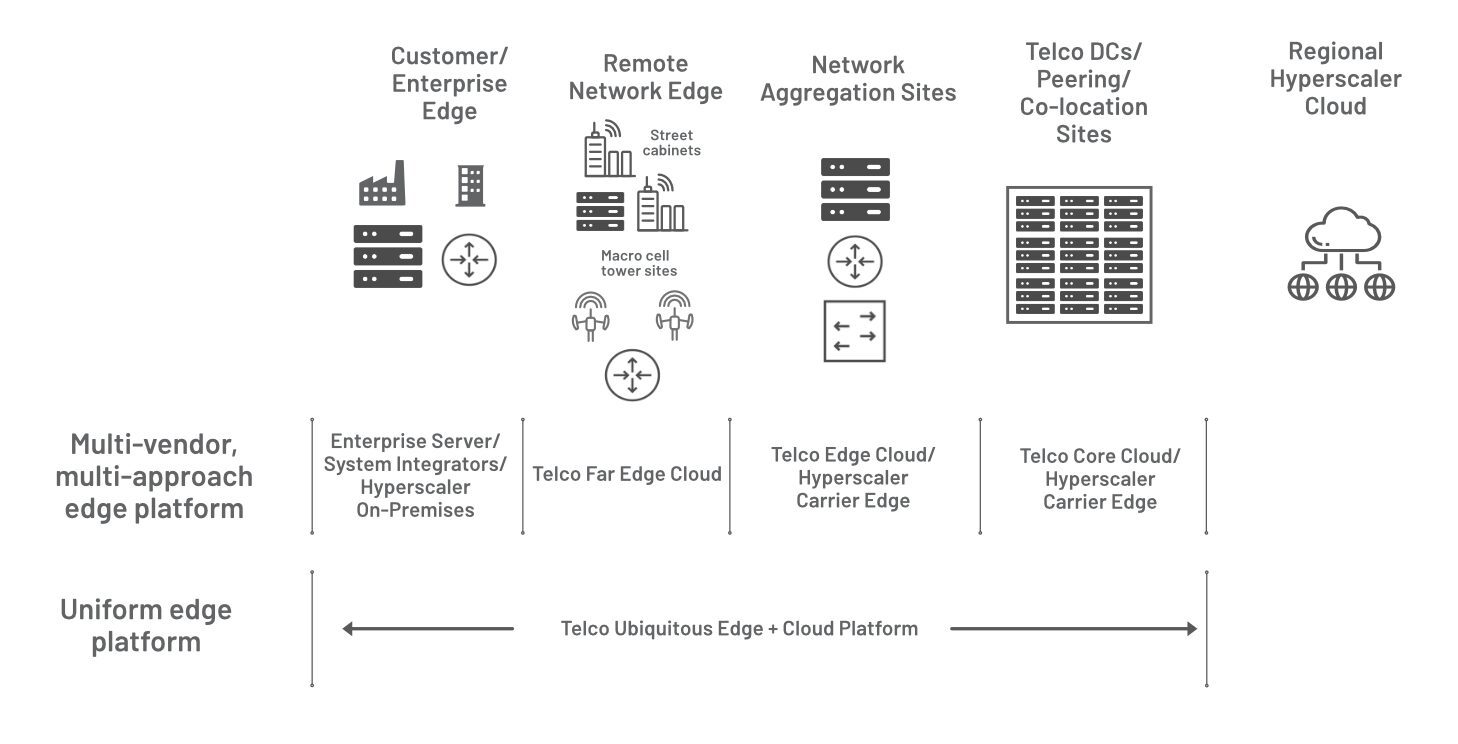
ZTE MEC Blog 2 Diagram

It may even be possible to host parts of hyperscale management or orchestration systems on the MEC platform or expose appropriate APIs, allowing these platforms to act as extensions of a hyperscale cloud. A similar managed services platform approach could be taken with the SIs for carrier-offered on-premises edge computing. In both scenarios, the carrier would maintain more control than in other configurations.

Real-World Examples

Instead of discussing the hypothetical, we will examine MEC customers China Telecom and China Mobile. Both are customers of ZTE (sponsor of this blog post) and have deployed the ZTE Common Edge MEC platform.

China Telecom used ZTE’s Common Edge to build a deployment model for smart manufacturing. The MEC platform was deployed at the CPE, as well as near the RAN, and in the regional cloud. By leveraging different locations, China Telecom demonstrated a 70-80% reduction in video processing delay for industrial robot control.

China Mobile leveraged the ZTE Common Edge solution to create an MEC platform for Tencent’s cloud games. As a result, Tencent reduced game-rendering latency from 120ms to 20ms, saving backhaul bandwidth costs. Further, by providing edge rendering services, Tencent could accommodate handsets with lower processing capabilities, expanding its market reach.

Getting Started with a Uniform MEC Platform

Carriers have many choices regarding their MEC solution and many potential partners and technology suppliers. In this series, we’ve described a uniform MEC approach and provided real-world examples of how this could play out. The benefits of this approach can be substantial, and we at AvidThink believe it merits consideration as part of any carrier’s MEC strategy.

Roy Chua Square

Roy Chua is founder and principal at AvidThink, an independent research and advisory service formed in 2018 out of SDxCentral’s research arm. Roy was previously co-founder at SDxCentral where he ran both the research and product teams. Roy was formerly a management consultant working with both Fortune 500 and startup technology companies on go-to-market and product consulting. As an early proponent of the software-defined infrastructure movement, Roy is a frequent speaker at events in the telco and cloud space and a regular contributor to leading technology publications. A graduate of UC Berkeley’s electrical engineering and computer science program and MIT’s Sloan School of Business, Chua has 20+ years of experience in telco and enterprise cloud computing, networking and security, including founding several Silicon Valley startups.


You Might Also Like
  • The (agentic) future of AI-to-AI connectivity (Reader Forum)
  • Netgear’s quiet reinvention as a B2B and SaaS company (Analyst Angle)
  • Friday (telco diary) | Telco reset, RAN reboot, P5G reality check
  • How operations leaders see 5G as vital for mission-critical workflows (Reader Forum)
  • Thursday (telco diary) | The plumbing is the product
  • Wednesday (telco diary) | Mobility matters for physical AI
Share 0 LinkedinEmail
Avatar of RCR Wireless News
RCR Wireless News

previous post
Citymesh strikes MVNO deal with Proximus to take private 5G nationwide in Belgium
next post
Kagan: Will T-Mobile TVision succeed in crowded pay TV space?

White Papers

  • Enea White Paper: Why Intelligent AAA is the Swiss Army Knife of Telecom

  • CSG White Paper: Telco AI Enabler: Mediation’s Defining Role

  • Enea White Paper: Scalable Database Design for 5G and Beyond

  • Supermicro and NVIDIA Whitepaper: Powering sovereign AI at scale

  • VIAVI Whitepaper: RAN scenario generators and their critical role for future-proofing AI-native RAN in Advanced 5G and 6G networks

Editorial Reports

  • Report: Scaling Optical Networks For The Hyperscale And AI Era

  • Test And Measurement Market Pulse Report

  • Editorial Report: Securing telecom infrastructure for the quantum era

Webinars

  • Webinar: Building 6G — aligning technology, policy and purpose

  • SIMCom Webinar: Scaling your next deployment – from plastic to provisioning

  • Webinar: Rethinking the RAN as AI, cloud and openness converge

  • Webinar: Scale-Up, Scale-Out, Scale-Across – Building AI-Era Network Fabrics

  • Webinar: NTN in motion – evolving standards, expanding services

Since 1982, RCR Wireless News has been providing wireless and mobile industry news, insights, and analysis to mobile and wireless industry professionals, decision makers, policy makers, analysts and investors.

Facebook Twitter Youtube Linkedin Envelope Rss

Useful Links

  • Subscribe
  • About RCR Wireless News
  • Contact Us
  • Advertise
  • Editorial Calendar
  • Archive
  • RSS
  • Wireless News Archive
  • Subscribe
  • About RCR Wireless News
  • Contact Us
  • Advertise
  • Editorial Calendar
  • Archive
  • RSS
  • Wireless News Archive

Edtior's Picks

Deutsche Telekom’s OpenAI partnership has scaled from pilot to full production
Prioritise AI outcomes over agent numbers, says Orange
The (agentic) future of AI-to-AI connectivity (Reader Forum)

Latest Articles

Deutsche Telekom’s OpenAI partnership has scaled from pilot to full production
Prioritise AI outcomes over agent numbers, says Orange
The (agentic) future of AI-to-AI connectivity (Reader Forum)
Monday (telco diary) | Consolidation, orchestration, automation

© 2026 RCR Wireless News All Right Reserved. Developed by Eight Hats.

Cookie Policy | Privacy Policy

RCR Wireless
  • News
  • Channels
    • 5G
    • 6G
    • BSS OSS
    • Carriers
    • IoT
    • Network Infrastructure
    • Open RAN
    • Private 5G
    • Telco AI
    • Telco Cloud
    • Test & Measurement
  • Resources
    • Reports
    • Webinars
    • White papers
    • AI Fundamentals
    • Analyst Angle
    • Editorial Calendar
    • Fundamentals
      • 5G NR Release 17
      • AI
        • Telco AI in 2025
    • Podcasts
      • Let’s Get Digital with Carrie Charles
      • Wireless Connectivity to Enable Industry 4.0 for the Middleprise
      • Well Technically…
      • Will 5G Change the World
      • Accelerating Industry 4.0 Digitalization
  • AI Infrastructure
  • Programs
  • Events
  • RCRtv
  • Advertise
  • Subscribe
RCR Wireless
  • News
  • Channels
    • 5G
    • 6G
    • BSS OSS
    • Carriers
    • IoT
    • Network Infrastructure
    • Open RAN
    • Private 5G
    • Telco AI
    • Telco Cloud
    • Test & Measurement
  • Resources
    • Reports
    • Webinars
    • White papers
    • AI Fundamentals
    • Analyst Angle
    • Editorial Calendar
    • Fundamentals
      • 5G NR Release 17
      • AI
        • Telco AI in 2025
    • Podcasts
      • Let’s Get Digital with Carrie Charles
      • Wireless Connectivity to Enable Industry 4.0 for the Middleprise
      • Well Technically…
      • Will 5G Change the World
      • Accelerating Industry 4.0 Digitalization
  • AI Infrastructure
  • Programs
  • Events
  • RCRtv
  • Advertise
  • Subscribe
@2020 - All Right Reserved. Designed and Developed by PenciDesign