
RCR Wireless
  • News
  • Channels
    • 5G
    • 6G
    • BSS OSS
    • Carriers
    • IoT
    • Network Infrastructure
    • Open RAN
    • Private 5G
    • Telco AI
    • Telco Cloud
    • Test & Measurement
  • Resources
    • Reports
    • Webinars
    • White papers
    • AI Fundamentals
    • Analyst Angle
    • Editorial Calendar
    • Fundamentals
      • 5G NR Release 17
      • AI
        • Telco AI in 2025
    • Podcasts
      • Let’s Get Digital with Carrie Charles
      • Wireless Connectivity to Enable Industry 4.0 for the Middleprise
      • Well Technically…
      • Will 5G Change the World
      • Accelerating Industry 4.0 Digitalization
  • AI Infrastructure
  • Programs
  • Events
  • RCRtv
  • Advertise
  • Subscribe
Tuesday, July 7, 2026
RCR Wireless
  • News
  • Channels
    • 5G
    • 6G
    • BSS OSS
    • Carriers
    • IoT
    • Network Infrastructure
    • Open RAN
    • Private 5G
    • Telco AI
    • Telco Cloud
    • Test & Measurement
  • Resources
    • Reports
    • Webinars
    • White papers
    • AI Fundamentals
    • Analyst Angle
    • Editorial Calendar
    • Fundamentals
      • 5G NR Release 17
      • AI
        • Telco AI in 2025
    • Podcasts
      • Let’s Get Digital with Carrie Charles
      • Wireless Connectivity to Enable Industry 4.0 for the Middleprise
      • Well Technically…
      • Will 5G Change the World
      • Accelerating Industry 4.0 Digitalization
  • AI Infrastructure
  • Programs
  • Events
  • RCRtv
  • Advertise
  • Subscribe
Add RCR Wireless as a preferred source on Google
  • Qualcomm 6G Insights
  • Huawei Content Hub
  • Qualcomm – 6G Vision
  • OSS/BSS Channel
RCR Wireless
RCR Wireless
  • Advanced Mimo
  • Mobile mmWave
  • 5G Positioning
  • Green Networks
  • Metaverse
  • Automotive
  • Industrial and Wide-area IoT
Copyright 2021 - All Right Reserved
Home - Securing the edge: More nodes, more problems
5GCarriersTelco Cloud

Securing the edge: More nodes, more problems

by Sean Kinney, Principal Analyst May 18, 2020
written by Sean Kinney, Principal Analyst May 18, 2020 Share
LinkedinEmail
Share 0LinkedinEmail
85

5G is many things, chief among them an exercise in managing complexity. The network is becoming more complex, the way the network is being used is becoming more complex and MEC is another line item on the list of complexities, albeit one with a very direct link to service revenue. 

Terry Young, director of service provider and 5G product marketing at A10 Networks, reflected on the work her company has done with operators deploying mobile edge computing infrastructure. There are a common set of decisions that have to be made on the front end, then another set of challenges that have be addressed in execution. 

Calling out the link between distributed computing, digital transformation and business success, Young said, “It seems like it’s getting crowded at the edge. Everybody wants to be part of this new ecosystem. For mobile operators, they are having to respond to the traffic demands, the devices, the subscriber applications…and having to manage multiple network transformations,” including MEC. But, “MEC is more than just a technology and more than just an architecture. MEC is a business strategy.” 

To effectively implement that strategy, Young laid out some of the key front-end considerations operators need to make:

  • What type of services do you want to offer?
  • What functions need to be deployed where?
  • Do you use existing sites, partner with enterprise and/or cloud providers, or a combination of both?
  • What form factor (virtual, physical, container or combination) best fits the strategy?

“How they deploy has a direct impact on what services they can offer,” she said. “The closer to the user, the lower the latency and therefore the different types of services.” Once you’ve answered these questions and come up with how MEC supports your business strategy, it’s time to go deploy–a process rife with another set of challenges. Young focused on three recurring hurdles: Space and power constraints, security vulnerabilities, and operational complexity. 

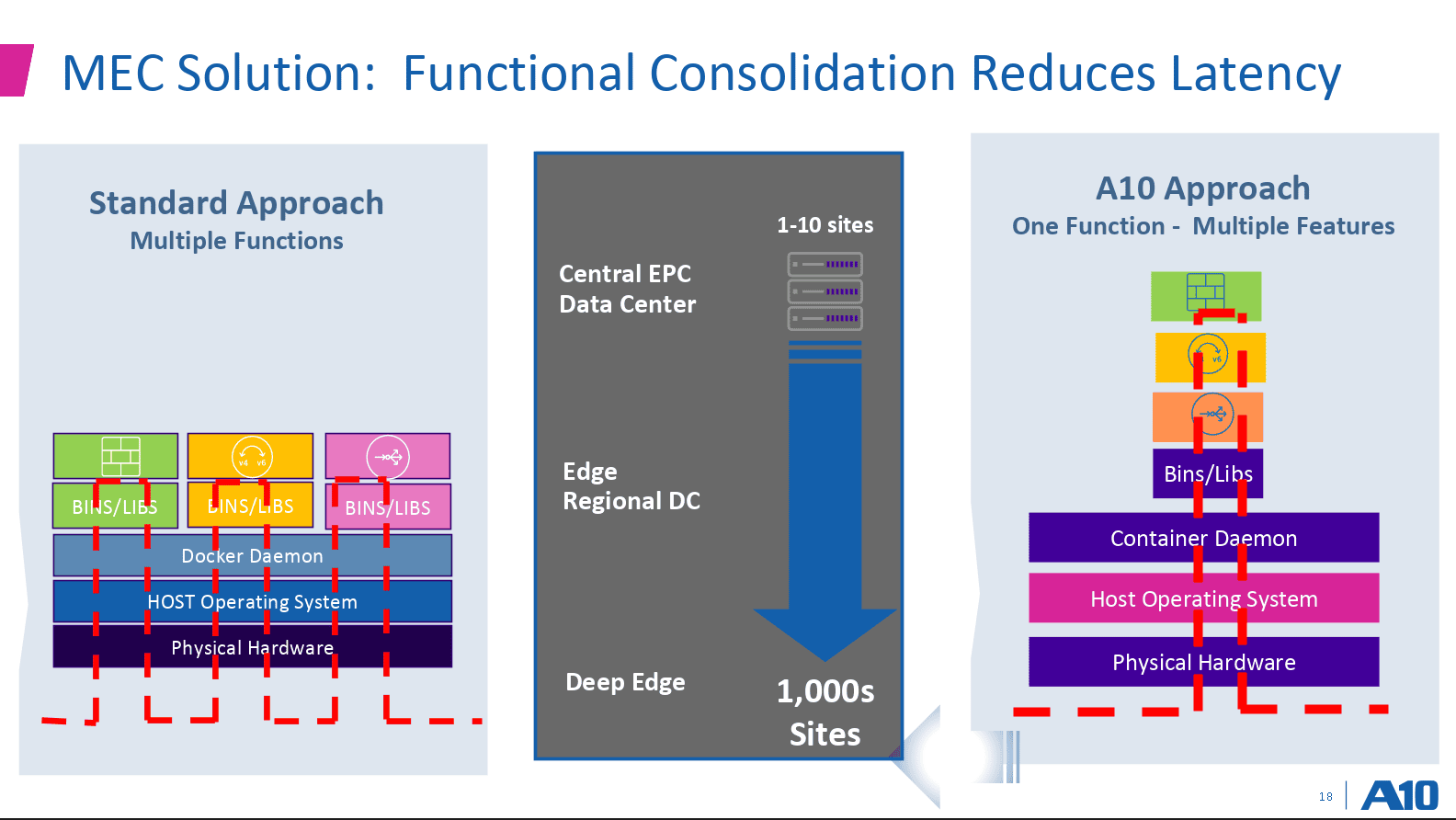
To the space and power point, Gi-LAN functions lie firewalls, traffic steering, load balancing, DDoS detection and mitigation, Deep Packet Inspection and more can require multiple physical appliances. As the number of sites increase with the move to the edge, this isn’t scalable. “So operators are really choosing to virtualize those functions,” Young said, and take the next step of functional consolidation via both form factor and software-related efficiencies.

To the security point, the simple explanation is that more equipment in more places equates to an increased attack surface. DDoS attacks are, in particular, a “significant threat to edge services,” Young said. To keep paces with evolving style and strategy of DDoS attacks, each edge location needs its own protection and the monitoring that goes along with it, which runs directly into the operational complexity problem, which runs directly into cost. 

Young gave the example of customer SK Telecom, which was an early mover on commercial 5G and has refined its MEC strategy by deploying 12 initial nodes to support service clusters defined by geographic, demographic and usage characteristics. “They’re doing this to more closely align investment resources with revenue opportunity and the requirements of those particular services.” 

You Might Also Like
  • What defines network performance in 5G and beyond? A CTO Perspective
  • Elisa says AI automation has cut network incidents by over 80%
  • Huawei outlines AI-centric network roadmap for telecom monetization
  • Why consolidation will reshape MDU connectivity (part 3/3) – Analyst Angle
  • Indosat outlines AI Grid vision as 5G modernization targets nationwide AI-ready network
  • Huawei shows how 5G and AI are reshaping tourism in China
Share 0 LinkedinEmail
Sean Kinney
Sean Kinney, Principal Analyst

Sean focuses on multiple subject areas including 5G, 6G, Open RAN, hybrid cloud, edge computing, and Industry 4.0. Prior to his work at RCR, Sean studied journalism and literature at the University of Mississippi then spent six years based in Key West, Florida, working as a reporter for the Miami Herald Media Company. He currently lives in Fayetteville, Arkansas.

previous post
The Sunday Brief: Implications of accelerated technology adoption and work/learn from home
next post
US government moves to cut Huawei off from global chip suppliers

White Papers

  • Enea White Paper: Why Intelligent AAA is the Swiss Army Knife of Telecom

  • CSG White Paper: Telco AI Enabler: Mediation’s Defining Role

  • Enea White Paper: Scalable Database Design for 5G and Beyond

  • Supermicro and NVIDIA Whitepaper: Powering sovereign AI at scale

  • VIAVI Whitepaper: RAN scenario generators and their critical role for future-proofing AI-native RAN in Advanced 5G and 6G networks

Editorial Reports

  • Report: Scaling Optical Networks For The Hyperscale And AI Era

  • Test And Measurement Market Pulse Report

  • Editorial Report: Securing telecom infrastructure for the quantum era

Webinars

  • Webinar: Rethinking the RAN as AI, cloud and openness converge

  • Webinar: Scale-Up, Scale-Out, Scale-Across – Building AI-Era Network Fabrics

  • Webinar: NTN in motion – evolving standards, expanding services

  • Webinar: Noise-Figure Measurements with RFmx and PXI VSTs

  • Qualcomm Webinar – Building the 6G Standard: Key developments to know

Since 1982, RCR Wireless News has been providing wireless and mobile industry news, insights, and analysis to mobile and wireless industry professionals, decision makers, policy makers, analysts and investors.

Facebook Twitter Youtube Linkedin Envelope Rss

Useful Links

  • Subscribe
  • About RCR Wireless News
  • Contact Us
  • Advertise
  • Editorial Calendar
  • Archive
  • RSS
  • Wireless News Archive
  • Subscribe
  • About RCR Wireless News
  • Contact Us
  • Advertise
  • Editorial Calendar
  • Archive
  • RSS
  • Wireless News Archive

Edtior's Picks

What defines network performance in 5G and beyond? A CTO Perspective
Elisa says AI automation has cut network incidents by over 80%
“We’re going after the operator channel” – Druid bets on simplicity to scale...

Latest Articles

What defines network performance in 5G and beyond? A CTO Perspective
Elisa says AI automation has cut network incidents by over 80%
“We’re going after the operator channel” – Druid bets on simplicity to scale private 5G
Enea White Paper: Why Intelligent AAA is the Swiss Army Knife of Telecom

© 2026 RCR Wireless News All Right Reserved. Developed by Eight Hats.

Cookie Policy | Privacy Policy

RCR Wireless
  • News
  • Channels
    • 5G
    • 6G
    • BSS OSS
    • Carriers
    • IoT
    • Network Infrastructure
    • Open RAN
    • Private 5G
    • Telco AI
    • Telco Cloud
    • Test & Measurement
  • Resources
    • Reports
    • Webinars
    • White papers
    • AI Fundamentals
    • Analyst Angle
    • Editorial Calendar
    • Fundamentals
      • 5G NR Release 17
      • AI
        • Telco AI in 2025
    • Podcasts
      • Let’s Get Digital with Carrie Charles
      • Wireless Connectivity to Enable Industry 4.0 for the Middleprise
      • Well Technically…
      • Will 5G Change the World
      • Accelerating Industry 4.0 Digitalization
  • AI Infrastructure
  • Programs
  • Events
  • RCRtv
  • Advertise
  • Subscribe
RCR Wireless
  • News
  • Channels
    • 5G
    • 6G
    • BSS OSS
    • Carriers
    • IoT
    • Network Infrastructure
    • Open RAN
    • Private 5G
    • Telco AI
    • Telco Cloud
    • Test & Measurement
  • Resources
    • Reports
    • Webinars
    • White papers
    • AI Fundamentals
    • Analyst Angle
    • Editorial Calendar
    • Fundamentals
      • 5G NR Release 17
      • AI
        • Telco AI in 2025
    • Podcasts
      • Let’s Get Digital with Carrie Charles
      • Wireless Connectivity to Enable Industry 4.0 for the Middleprise
      • Well Technically…
      • Will 5G Change the World
      • Accelerating Industry 4.0 Digitalization
  • AI Infrastructure
  • Programs
  • Events
  • RCRtv
  • Advertise
  • Subscribe
@2020 - All Right Reserved. Designed and Developed by PenciDesign