

5G, unlike previous generations of standards, will be more than just a cellular radio definition. Instead, it will be a broad platform which integrates multiple radio access technologies (RATs) in unlicensed, shared and licensed spectrum. Wi-Fi in general, and its latest amendment Wi-Fi 6 (based on the IEEE’s 802.11ax specifications), will play a crucial role in extending high quality, high speed, low latency wireless connectivity, especially indoors. So far, the 3GPP has dominated the specifications of the 5G standard with few contributions from the IEEE.
Current challenges for interworking
In this context, the WBA has partnered with the NGMN to identify areas that need to be addressed to help make the best of both technologies and include Wi-Fi in the 5G specifications—if not in release 16, then in future releases. The NGN has a long history working with the 3GPP. The two organizations issued a preliminary white paper to outline the current challenges for RAN convergence:
- Wi-Fi-only devices cannot connect to the 5G core
- Lack of interface to enable a certain level of network manageability and policy control between 5G core and Wi-Fi networks
- No mechanism for a client to route traffic over one or more access types in an intelligent way, making optimal use of the available connectivity
In the last 18 months, the WBA has done much work around the role of Wi-Fi in the 5G vision. It has laid out the merits of Wi-Fi in IMT-2020 requirements in a series of white papers.
In 2018, Orange and British Telecom (who are active in both the WBA and NGMN) agreed to create a joint task force and line up some objectives, as well as requirements to address the current gaps for Wi-Fi and non-SIM devices to become an integral part of the 5G network. We spoke to Kevin Holley (BT) and co-chair of WBA-NGMN Taskforce, Klaus Moschner from NGMN staff, as well as Tiago Rodriguez, General Manager for the WBA.
Tiago Rodriguez told us: “The WBA is fully committed to support and drive the rollout of Wi-Fi 6 for carriers, cities and enterprises to cost-effectively provide additional capabilities, coverage and capacity, mainly indoors, to address 5G use case requirements. Now it’s time for carriers to accelerate their HetNet strategies.”
Kevin Holley said “The RAN Convergence white paper calls for industry unification for 5G and Next Generation Wi-Fi, as we believe that convergence at a network level between these two technologies is essential. Convergence will allow the complementary capabilities of both RANs to be leveraged to provide seamless network services, bringing major benefits to cellular operators, enterprise Wi-Fi and public Wi-Fi solution providers.”
The WBA and NGMN are regular participants at 3GPP events and will provide the 3PP with recommendations. As “Market Representation Partners,” they will provide guidance on market dynamics and requirements to the 3GPP in a final paper to be released in Q2 2019; however, this may be too late for important recommendations to be submitted to 3GPP for release 16 since these require an official work item. Nevertheless, some minor recommendations may be included in time for release 16. The following chart shows the 3GPP development process:
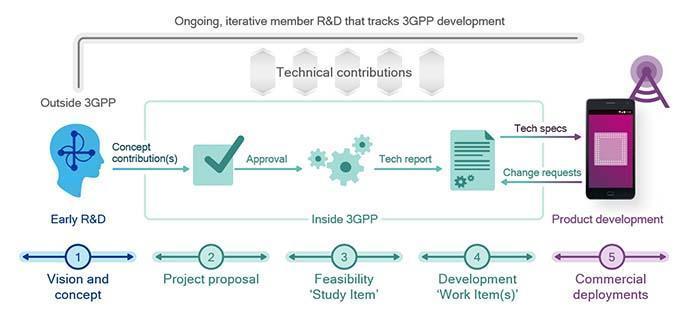
Image courtesy of Qualcomm.
Network manageability and policy control
Operators need to gain visibility into and control of what is happening in the Wi-Fi RAT, especially in the enterprise and public Wi-Fi areas. Kevin Holley indicated: “The collaboration between NGMN and WBA identifies a number of emerging opportunities and use cases that the industry can benefit from, but also highlights the key challenges which must first be addressed.”
There is a need to be able to dynamically allocate resources from both radio access technologies according to the needs and changing requirements. For example, a common interface between Wi-Fi and 5G can be used to set Wi-Fi bandwidth dedicated for 5G service traffic, configurations and QoS settings for a Wi-Fi slice dedicated for 5G services and devices allowed to access the dedicated Wi-Fi slice. Such an interface can also enable enterprise Wi-Fi vendors to set policies in the 5G core for handling traffic, or request network slices, for certain enterprise users and/or applications.
Challenges of cellular/Wi-Fi integration
Full interworking between 5G and Wi-Fi has never really materialized, despite several efforts and some limited progress. Some challenges to Wi-Fi/cellular integration include:
- Premature Wi-Fi Selection, which happens when devices connect to a known Wi-Fi network without first checking for better cellular and Wi-Fi options
- Unhealthy choices, which happen when devices select Wi-Fi connections even though those Wi-Fi networks are already straining under heavy loads
- Lower capabilities, which can lead to poor performance if a device connects to a Wi-Fi network with a lower bandwidth in the backhaul than the cellular base station presently serving the device
- Ping-Pong, which happens when a user ping-pongs between Wi-Fi and cellular networks
Interworking mechanisms
The WBA’s Hotspot 2.0 improves Wi-Fi network discovery and selection and supports SIM-based sign-in to Wi-Fi and some degree of seamlessness with cellular. The Passpoint program from the Wi-Fi Alliance on the device and equipment complements the work done by the WBA on the end-to-end side. The two complementary systems support seamless authentication, giving users a single log-in and a cellular-like convenience for both SIM and non-SIM devices, whether they are just on Wi-Fi or also roaming onto cellular. As of January 2019, the WFA reported 1387 devices certified for Passpoint Release 1, and 119 devices certified for Passpoint Release 2.
A complementary standard which was developed in situations where devices move between Wi-Fi and cellular is the 3GPP’s ANDSF. The ANDSF is a primary enabler of intelligent network selection between 3GPP and non-3GPP access networks. ANDSF is an optional network element in the 3GPP Evolved Packet Core (EPC), the purpose of which is to provide user devices with useful information and operator-defined policies to guide network selection decisions. The idea is to extend policy control from the core all the way to the device where the server indicates to the device which RAT to connect to and under what circumstances. However, ANDSF has not been widely deployed as it is deemed too complicated and costly to implement. Cisco and Smith Micro are some of the few vendors actively supporting it.
The 3GPP has also developed hand-off and interworking specifications—such as TWAG (Trusted Wireless Access Gateway) and non-trusted access—but none really took off.
3GPP Releases 15 and 16 will provide interworking between the 5G and Wi-Fi networks by enabling access to the 5G Core via untrusted and trusted non-3GPP access networks such as Wi-Fi. These efforts are focused on defining architecture and messaging to provide secure transport for the 5G control plane and data plane over non-3GPP access via gateway functions (N3IWF or TGNF).
The preliminary white paper indicates: “Further study is needed to ensure a tight integration between 5G and Wi-Fi networks, to better utilize resources from both access networks to meet requirements for a wide array of current and future 5G use cases.”
The paper adds: “A tighter integration between 5G and Wi-Fi may be able to improve session mobility control through better metrics and triggering mechanisms, reduce signaling complexity by providing better anchoring points, as well as improve data path support through the use of both accesses when those are available.”
Conclusion
The design of 5G networks will revolve around virtualization and programmability of networks and services. The advent of 5G would seem to be a good time to revisit the issue of interworking between 5G and Wi-Fi. A virtualized RAN, core, management and orchestration platform may be a good opportunity to incorporate Wi-Fi in a flexible way with common control, especially to serve the needs of indoor users.
Table of Contents

