

RCR Wireless
  • News
  • Channels
    • 5G
    • 6G
    • BSS OSS
    • Carriers
    • IoT
    • Network Infrastructure
    • Open RAN
    • Private 5G
    • Telco AI
    • Telco Cloud
    • Test & Measurement
  • Resources
    • Reports
    • Webinars
    • White papers
    • AI Fundamentals
    • Analyst Angle
    • Editorial Calendar
    • Fundamentals
      • 5G NR Release 17
      • AI
        • Telco AI in 2025
    • Podcasts
      • Let’s Get Digital with Carrie Charles
      • Wireless Connectivity to Enable Industry 4.0 for the Middleprise
      • Well Technically…
      • Will 5G Change the World
      • Accelerating Industry 4.0 Digitalization
  • AI Infrastructure
  • Programs
  • Events
  • RCRtv
  • Advertise
  • Subscribe
Wednesday, July 22, 2026
RCR Wireless
  • News
  • Channels
    • 5G
    • 6G
    • BSS OSS
    • Carriers
    • IoT
    • Network Infrastructure
    • Open RAN
    • Private 5G
    • Telco AI
    • Telco Cloud
    • Test & Measurement
  • Resources
    • Reports
    • Webinars
    • White papers
    • AI Fundamentals
    • Analyst Angle
    • Editorial Calendar
    • Fundamentals
      • 5G NR Release 17
      • AI
        • Telco AI in 2025
    • Podcasts
      • Let’s Get Digital with Carrie Charles
      • Wireless Connectivity to Enable Industry 4.0 for the Middleprise
      • Well Technically…
      • Will 5G Change the World
      • Accelerating Industry 4.0 Digitalization
  • AI Infrastructure
  • Programs
  • Events
  • RCRtv
  • Advertise
  • Subscribe
Add RCR Wireless as a preferred source on Google
  • Qualcomm 6G Insights
  • Huawei Content Hub
  • Qualcomm – 6G Vision
  • OSS/BSS Channel
  • RCRTech Roundtable: AI Infrastructure
RCR Wireless
RCR Wireless
  • Advanced Mimo
  • Mobile mmWave
  • 5G Positioning
  • Green Networks
  • Metaverse
  • Automotive
  • Industrial and Wide-area IoT
Copyright 2021 - All Right Reserved
Home - LTE IoT is starting to connect the massive IoT today, thanks to eMTC and NB-IoT
Internet of Things (IoT)LTEQualcomm 5GQualcomm 5G NewsQualcomm 5G Use Cases and EssentialsSponsored

LTE IoT is starting to connect the massive IoT today, thanks to eMTC and NB-IoT

by RCR Wireless News June 30, 2017
written by RCR Wireless News June 30, 2017 Share
LinkedinEmail
Share 0LinkedinEmail
139

We are at the dawn of 5G, a unified network envisioned to connect virtually everything around us. And to get there sooner, we are accelerating 5G NR (New Radio) — the global 5G standard — to usher in next-generation mobile broadband experiences for smartphones starting in 2019.

The first 5G NR release delivers eMBB (enhanced mobile broadband) and URLLC (ultra-reliable, low-latency communication), which can also address high-performance IoT use cases. However, it will not target the low-complexity IoT (also referred to as massive machine-type communication or mMTC).

So how will we realize the 5G vision of connecting the massive IoT? To be clear, the term “massive IoT” refers to the 10’s of billions of devices, objects, and machines that require ubiquitous connectivity even in the most remote locations, like sensors buried deep underground. To reach the massive scale (3GPP defines such as at least 1M devices per km2), mobile networks must more efficiently support the simplest devices that communicate infrequently, and are ultra-energy efficient so they can deliver extremely long, 10+ year battery life. Sound challenging? You bet! But we don’t have to wait for 5G to start connecting the massive IoT. Here’s why…

3GPP has already introduced a suite of two complementary narrowband LTE IoT technologies in Release 13: eMTC (enhanced machine-type communication) and NB-IoT (narrowband Internet of Things). Both are optimized for lower complexity/power, deeper coverage, and higher device density, while seamlessly coexisting with other LTE services such as regular mobile broadband.

Together, they expand the LTE technology portfolio to support an even wider range of low-power IoT use cases.
20170630 Qualcomm 1
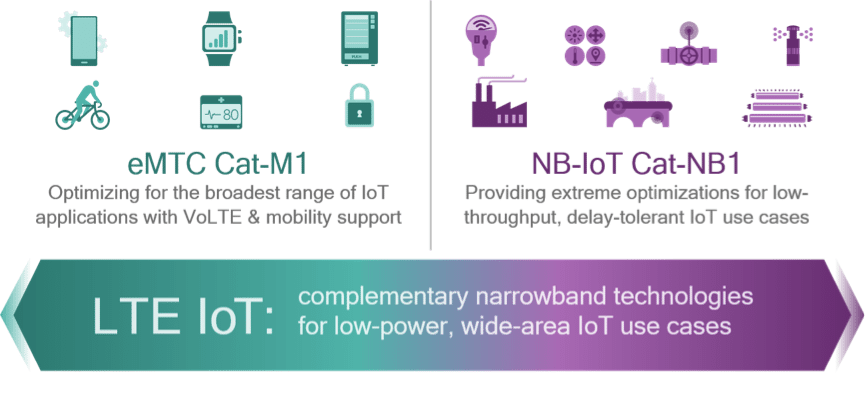
Figure 1: Complementary eMTC & NB-IoT address a wide range of IoT use cases

Do we really need both eMTC and NB-IoT to connect the massive IoT? The answer is yes, since complementary eMTC and NB-IoT are designed for different types of IoT use cases.

eMTC can deliver up to 1 Mbps of throughput utilizing just 1.4 MHz of bandwidth, and supports essential capabilities such as VoLTE and full mobility for a broad range of IoT use cases, including asset trackers and wearables. NB-IoT, on the other hand, scales down to extreme simplicity for low-throughput, delay-tolerant applications, such as meters and sensors. It enables data rate of just 10’s of kbps with 200 kHz of bandwidth, and can provide even deeper coverage. Furthermore, NB-IoT can be deployed within an existing LTE band, in guard-band between two regular LTE carriers, or in standalone mode, which provides an easy migration path for the re-farmed GSM (2G/GPRS) spectrum.

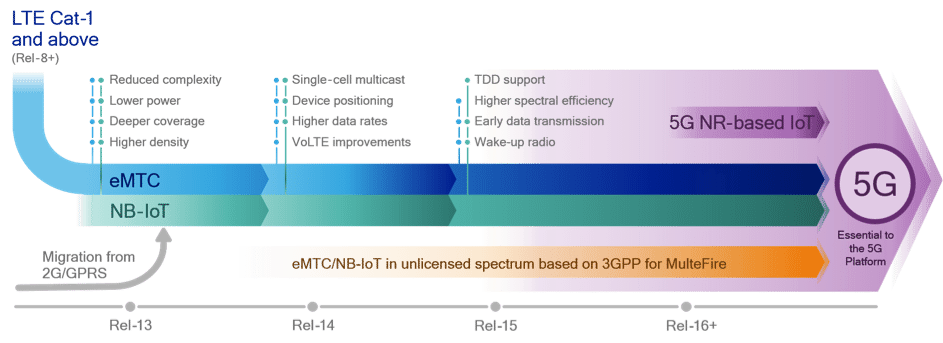
Beyond 3GPP Release 13, there is a rich roadmap of LTE IoT technology inventions that will deliver many further enhancements to meet tomorrow’s massive IoT connectivity needs. For example, Release 14 will bring new capabilities such as single-cell multicast to both eMTC and NB-IoT, enabling easy over-the-air firmware upgrades as well as enhanced device positioning for asset location tracking. In addition, there are two ongoing Release 15 work items that further enhance eMTC and NB-IoT, including new features such as wake-up receiver and TDD support for NB-IoT.
20170630 Qualcomm 2
Figure 2: LTE IoT evolution in 3GPP Release 13 and beyond

It should be clear that LTE IoT is starting to connect the massive IoT today and both eMTC and NB-IoT will certainly continue to evolve for years to come — leveraging the scale, longevity and global coverage of LTE networks (also to seamlessly enable migration from 2G). Eventually, there will be a 5G NR-based massive IoT solution. Some future advanced design elements will include NOMA (non-orthogonal multiple access), enabling grant-free transmissions leveraging RSMA (resources speared multiple access) — in which the device sends data whenever needed without asking for permission — and mesh networking that expands on LTE’s device-to-device capabilities.

Another exciting dimension is the expansion into unlicensed spectrum. The MulteFire Alliance is adapting LTE IoT to operate in the unlicensed spectrum to expand beyond mobile broadband and high-performance IoT supported by MulteFire 1.0. This will in turn bring new opportunities for private LTE networks and enable LPWA (low-power wide-area) use cases, leveraging narrowband LTE IoT technology.

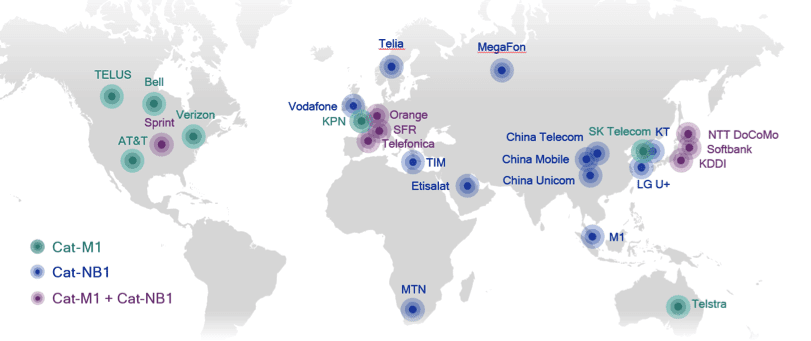
Today, we are delivering commercial multimode solutions that support eMTC’s device category Cat-M1, NB-IoT’s device category Cat-NB1, and E-GPRS. The Qualcomm MDM9206 is a flexible, single-SKU solution that enables global deployments with a single hardware, software, and RF design. And just a few weeks ago, we announced something very exciting — a joint field trial with Mobike and China Mobile — that will take advantage of our LTE IoT multi-mode solution. And mobile operators around the globe are also starting to launch commercial LTE IoT networks supporting both Cat-M1 and Cat-NB1 devices. At the time of writing this blog post, we see more than 20 mobile operators having publicly announced their commitment to deploy LTE IoT, with even more trialing eMTC and/or NB-IoT technologies in preparation for commercialization. All in all, the future of LTE IoT is bright, and we are excited to continue leading the LTE IoT evolution toward 5G.
20170630 Qualcomm 3
Figure 3: Strong global momentum for LTE IoT – operator commitments as of June 2017

Get the latest information and downloads, check out our LTE IoT evolution webpage, follow us on Twitter @qualcomm_tech, and sign up for our wireless newsletter.


You Might Also Like
  • Monday (telco diary) | Sovereign AI for Industry 4.0
  • From experiment to expectation: BAI on delivering private 5G across Australian industry
  • When the push becomes the pull – private 5G and physical AI
  • Fast-growing private 5G offers blueprint for AI-era telecoms
  • Monday (telco diary) | Consolidation, orchestration, automation
  • Wireless Logic’s 21st acquisition exposes IoT consolidation paradox
Share 0 LinkedinEmail
RCR Wireless News

previous post
Chicago smart lighting project to connect 250,000 street lights
next post
Qualcomm: 5G worth $12 trillion by 2035

White Papers

  • Norton eBook: The 2026 Telco Playbook

  • Enea White Paper: Why Intelligent AAA is the Swiss Army Knife of Telecom

  • CSG White Paper: Telco AI Enabler: Mediation’s Defining Role

  • Enea White Paper: Scalable Database Design for 5G and Beyond

  • Supermicro and NVIDIA Whitepaper: Powering sovereign AI at scale

Editorial Reports

  • Nvidia Report: The State of AI in Telecommunications: 2026 Trends

  • Report: Scaling Optical Networks For The Hyperscale And AI Era

  • Test And Measurement Market Pulse Report

Webinars

  • Webinar: Building 6G — aligning technology, policy and purpose

  • SIMCom Webinar: Scaling your next deployment – from plastic to provisioning

  • Webinar: Rethinking the RAN as AI, cloud and openness converge

  • Webinar: Scale-Up, Scale-Out, Scale-Across – Building AI-Era Network Fabrics

  • Webinar: NTN in motion – evolving standards, expanding services

Since 1982, RCR Wireless News has been providing wireless and mobile industry news, insights, and analysis to mobile and wireless industry professionals, decision makers, policy makers, analysts and investors.

Facebook Twitter Youtube Linkedin Envelope Rss

Useful Links

  • Subscribe
  • About RCR Wireless News
  • Contact Us
  • Advertise
  • Editorial Calendar
  • Archive
  • RSS
  • Wireless News Archive
  • Subscribe
  • About RCR Wireless News
  • Contact Us
  • Advertise
  • Editorial Calendar
  • Archive
  • RSS
  • Wireless News Archive

Edtior's Picks

South Korea launches AI-RAN project to advance industrial AI
Tuesday (telco diary) | Telco agents and outcomes
AT&T’s bets on “best tech” (fiber) pay off with record adds, improving margins 

Latest Articles

South Korea launches AI-RAN project to advance industrial AI
Tuesday (telco diary) | Telco agents and outcomes
AT&T’s bets on “best tech” (fiber) pay off with record adds, improving margins 
The most expensive wireless system is the one you install twice (Reader Forum)

© 2026 RCR Wireless News All Right Reserved. Developed by Eight Hats.

Cookie Policy | Privacy Policy

RCR Wireless
  • News
  • Channels
    • 5G
    • 6G
    • BSS OSS
    • Carriers
    • IoT
    • Network Infrastructure
    • Open RAN
    • Private 5G
    • Telco AI
    • Telco Cloud
    • Test & Measurement
  • Resources
    • Reports
    • Webinars
    • White papers
    • AI Fundamentals
    • Analyst Angle
    • Editorial Calendar
    • Fundamentals
      • 5G NR Release 17
      • AI
        • Telco AI in 2025
    • Podcasts
      • Let’s Get Digital with Carrie Charles
      • Wireless Connectivity to Enable Industry 4.0 for the Middleprise
      • Well Technically…
      • Will 5G Change the World
      • Accelerating Industry 4.0 Digitalization
  • AI Infrastructure
  • Programs
  • Events
  • RCRtv
  • Advertise
  • Subscribe
RCR Wireless
  • News
  • Channels
    • 5G
    • 6G
    • BSS OSS
    • Carriers
    • IoT
    • Network Infrastructure
    • Open RAN
    • Private 5G
    • Telco AI
    • Telco Cloud
    • Test & Measurement
  • Resources
    • Reports
    • Webinars
    • White papers
    • AI Fundamentals
    • Analyst Angle
    • Editorial Calendar
    • Fundamentals
      • 5G NR Release 17
      • AI
        • Telco AI in 2025
    • Podcasts
      • Let’s Get Digital with Carrie Charles
      • Wireless Connectivity to Enable Industry 4.0 for the Middleprise
      • Well Technically…
      • Will 5G Change the World
      • Accelerating Industry 4.0 Digitalization
  • AI Infrastructure
  • Programs
  • Events
  • RCRtv
  • Advertise
  • Subscribe
@2020 - All Right Reserved. Designed and Developed by PenciDesign