

RCR Wireless
  • News
  • Channels
    • 5G
    • 6G
    • BSS OSS
    • Carriers
    • IoT
    • Network Infrastructure
    • Open RAN
    • Private 5G
    • Telco AI
    • Telco Cloud
    • Test & Measurement
  • Resources
    • Reports
    • Webinars
    • White papers
    • AI Fundamentals
    • Analyst Angle
    • Editorial Calendar
    • Fundamentals
      • 5G NR Release 17
      • AI
        • Telco AI in 2025
    • Podcasts
      • Let’s Get Digital with Carrie Charles
      • Wireless Connectivity to Enable Industry 4.0 for the Middleprise
      • Well Technically…
      • Will 5G Change the World
      • Accelerating Industry 4.0 Digitalization
  • AI Infrastructure
  • Programs
  • Events
  • RCRtv
  • Advertise
  • Subscribe
Tuesday, August 11, 2026
RCR Wireless
  • News
  • Channels
    • 5G
    • 6G
    • BSS OSS
    • Carriers
    • IoT
    • Network Infrastructure
    • Open RAN
    • Private 5G
    • Telco AI
    • Telco Cloud
    • Test & Measurement
  • Resources
    • Reports
    • Webinars
    • White papers
    • AI Fundamentals
    • Analyst Angle
    • Editorial Calendar
    • Fundamentals
      • 5G NR Release 17
      • AI
        • Telco AI in 2025
    • Podcasts
      • Let’s Get Digital with Carrie Charles
      • Wireless Connectivity to Enable Industry 4.0 for the Middleprise
      • Well Technically…
      • Will 5G Change the World
      • Accelerating Industry 4.0 Digitalization
  • AI Infrastructure
  • Programs
  • Events
  • RCRtv
  • Advertise
  • Subscribe
Add RCR Wireless as a preferred source on Google
  • Qualcomm 6G Insights
  • Huawei Content Hub
  • Qualcomm – 6G Vision
  • OSS/BSS Channel
  • RCRTech Roundtable: AI Infrastructure
RCR Wireless
RCR Wireless
  • Advanced Mimo
  • Mobile mmWave
  • 5G Positioning
  • Green Networks
  • Metaverse
  • Automotive
  • Industrial and Wide-area IoT
Copyright 2021 - All Right Reserved
Home - The Indoor Coverage Hardware Challenge – Hype vs. Reality
IBW Featured PostsNetwork InfrastructureSponsored

The Indoor Coverage Hardware Challenge – Hype vs. Reality

by RCR Wireless News April 25, 2018
written by RCR Wireless News April 25, 2018 Share
LinkedinEmail
Share 0LinkedinEmail
enterprise unified communications
122


There are many reasons why in-building cellular coverage can be challenging. The placement of cell towers, geographical terrain, or building materials can all play a role in poor in-building coverage. Even where there is a proliferation of cellular towers, there can be topographic or interference issues that can make cellular service a challenge. Phones hop from one tower to another, which can cause jitter, warble, or even disruptions in service.

There are plenty of options for tackling the in-building cellular coverage challenges enterprises continue to face today. As with any technology, there is also plenty of hype around what solutions can do, versus their actual capabilities.

So here’s a quick rundown of the hype and the reality around the available options.

Wi-Fi Calling

The Hype: Wi-Fi Calling can be used everywhere.

The Reality: No, it can’t.

Wi-Fi Calling is only available in some contexts. An underlying problem is that many enterprises experience poor Quality of Service (QoS). Wi-Fi is a “best effort” service, not a managed service like cellular. In a business context Wi-Fi is great as a data layer. Wi-Fi Calling only works with certain cellular devices, and carriers, and those devices need to be attached to the WLAN. Enterprise networks are becoming less accessible than ever as security concerns escalate. There can also be issues relating to the handover of cellular calls when a caller is on the move. Managed Wi-Fi services are evolving, and they can help, but Wi-Fi calling may not be good enough for many enterprise business processes. 

Small Cell

The Hype: Call your carrier, order a small cell or two. Simply drop them into your building, and connect them to the internet. Problem solved!

The Reality: It’s not quite that simple.

Small cells continue to improve each year with advanced technologies such as interference cancellation and SON (self-organizing network) capabilities. Unlike Wi-Fi, which can be quite inexpensive, small cells (i.e. femtocells and picocells) are typically $3K to $5K each for the hardware. Not all small cells are created equal in terms of ease of setup and performance.

There are a few significant issues related to small cells. First, similar to Wi-Fi, the coverage footprint is highly dependent on the interior layout of the indoor space, specific alignments, and other factors that may inhibit the spread of the signal.

Second is backhaul. In addition to a dedicated bandwidth requirement, some small cells actually require specific and detailed IP settings that may require professional-grade IT skills to install, setup, and maintain.

Third is performance. Although small cells have improved greatly, users can still experience dead or low-performance spots within a facility as a result of interference.

Active DAS (aDAS)

The Hype: aDAS is expensive, but high performance. In all but the largest installations (500,000 square feet and above), DAS is not a viable solution.

The Reality: There’s some truth to that, with exceptions.

In some areas the hype and the reality are fairly well-aligned. aDAS is expensive and it is high performance. Some aDAS providers are working on smaller footprint solutions for the middleprise (mid-sized enterprise) space. While capex costs are coming down, aDAS still requires an infrastructure ecosystem, which adds to the cost and time to deploy:
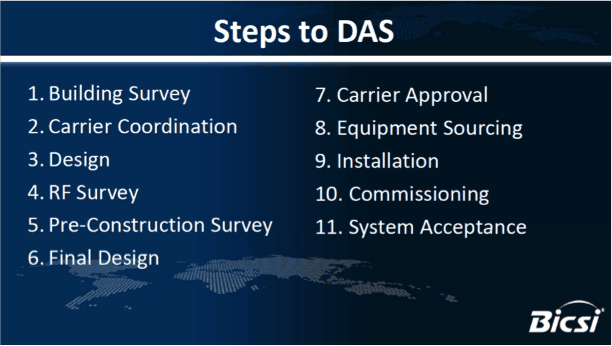
Steps to DAS

One of the biggest challenges with any DAS installation is establishing the signal source(s). Typically, multiple network operators need to be included to support a maximum number of users, so it is not uncommon for a DAS project to require 12 to 18 months before it even gets off the ground.

Passive DAS (pDAS)

 The Hype: Passive DAS is the most cost-effective way to improve medium or large in-building cellular coverage.

The Reality: It has its limits and can cost you more than you think.

Passive DAS differs from active DAS in that it pulls its donor signal (the signal source) off-air or “over-the-air” (OTA) from the macro network. It requires less equipment, setup, and maintenance than aDAS, but does require many of the same skills, and personnel. These costs can drive pDAS beyond an acceptable ROI for the enterprise. What’s often not mentioned is that pDAS doesn’t add capacity to the macro network – a problem in environments with a large number of active users, and one reason network operators are not enthusiastic about pDAS.

One additional note: pDAS is an analog system in which cellular signals are distributed over coax cable, and transmitted through regular antennas, adding to installation costs.

Active DAS Hybrid

The Hype: It’s disrupting in-building cellular coverage for enterprise.

The Reality: It’s disrupting in-building cellular coverage for enterprise.

Newer active DAS hybrid systems are increasingly being deployed to address the in-building cellular coverage demands of the middleprise market, where venues range in size from 25,000 to 500,000 sq. ft.

These systems can be used in off-air mode or tethered to a small cell to achieve uniform coverage and capacity distribution for venues up to 500,000 sq. ft., both at a far lower price than traditional DAS.

Using a lossless digital distribution method, Cat5 (LAN) cable, both simplifies the installation process and assures performance when complete. Active DAS hybrid systems eliminate issues relating to interference and macro network dominance, solving QoS issues that can remain with other technology solutions.

The small cell/active DAS hybrid configuration creates a “Supercell” (i.e. a large single cell versus multiple small cells) that provides uniform access to the capacity introduced by the small cell. Supercells are inherently uncomplicated from a planning and deployment point of view and are far more resilient to the potential of interference or performance degradation considerations.

For more information, download the Nextivity white paper: Simplifying Cellular Coverage for the Middleprise with Cel-Fi QUATRA.

 About the Author

Joe Schmelzer has 20 years’ experience driving the creation of products and solutions for chipset vendors, device OEMs, and service providers, including Sony, Qualcomm, Google, Verizon Wireless, AT&T, Dell, and HP. Mr. Schmelzer has previously held positions with Wavecom, Sierra Wireless, and Novatel Wireless. He was also a founding member of CTIA’s Wireless Internet Caucus. For more information, contact [email protected] or visit www.cel-fi.com

You Might Also Like
  • Monday (telco diary) | Digging in, moving up – lessons from Lumen
  • ‘We think of them as hometown ISPs’ – WISPA chief on BEAD, Starlink, CBRS
  • Thursday (telco diary) | APAC telcos pile into AI infrastructure
  • Starlink Mobile – what is Musk actually building, beyond the chatter?
  • SpaceX targets US carriers with small-cell terrestrial rollout and mega demand from physical AI
  • Tuesday (telco diary) | More about ISAC – on battlefields and sportsfields

Table of Contents

  • Active DAS (aDAS)
    • The Hype: aDAS is expensive, but high performance. In all but the largest installations (500,000 square feet and above), DAS is not a viable solution.
  • Passive DAS (pDAS)
    •  The Hype: Passive DAS is the most cost-effective way to improve medium or large in-building cellular coverage.
  • Active DAS Hybrid
Share 0 LinkedinEmail
RCR Wireless News

previous post
Fixed wireless broadband expected to grow 30% in 2018
next post
AT&T to deploy small cells in San Jose; signs new macro tower deal

White Papers

  • Norton eBook: The 2026 Telco Playbook

  • Enea White Paper: Why Intelligent AAA is the Swiss Army Knife of Telecom

  • CSG White Paper: Telco AI Enabler: Mediation’s Defining Role

  • Enea White Paper: Scalable Database Design for 5G and Beyond

  • Supermicro and NVIDIA Whitepaper: Powering sovereign AI at scale

Editorial Reports

  • Report: NTN in motion — evolving standards, expanding services

  • Market Pulse Report: Telco AI in 2026 – Trends, Challenges and Opportunities

  • Nvidia Report: The State of AI in Telecommunications: 2026 Trends

Webinars

  • Webinar: Building 6G — aligning technology, policy and purpose

  • SIMCom Webinar: Scaling your next deployment – from plastic to provisioning

  • Webinar: Rethinking the RAN as AI, cloud and openness converge

  • Webinar: Scale-Up, Scale-Out, Scale-Across – Building AI-Era Network Fabrics

  • Webinar: NTN in motion – evolving standards, expanding services

Since 1982, RCR Wireless News has been providing wireless and mobile industry news, insights, and analysis to mobile and wireless industry professionals, decision makers, policy makers, analysts and investors.

Facebook Twitter Youtube Linkedin Envelope Rss

Useful Links

  • Subscribe
  • About RCR Wireless News
  • Contact Us
  • Advertise
  • Editorial Calendar
  • Archive
  • RSS
  • Wireless News Archive
  • Subscribe
  • About RCR Wireless News
  • Contact Us
  • Advertise
  • Editorial Calendar
  • Archive
  • RSS
  • Wireless News Archive

Edtior's Picks

Monday (telco diary) | Digging in, moving up – lessons from Lumen
Deutsche Telekom expands AI, fiber investment as growth continues
‘We think of them as hometown ISPs’ – WISPA chief on BEAD, Starlink,...

Latest Articles

Monday (telco diary) | Digging in, moving up – lessons from Lumen
Deutsche Telekom expands AI, fiber investment as growth continues
‘We think of them as hometown ISPs’ – WISPA chief on BEAD, Starlink, CBRS
Friday (telco diary) | Friday night fare – private 5G to go

© 2026 RCR Wireless News All Right Reserved. Developed by Eight Hats.

Cookie Policy | Privacy Policy

RCR Wireless
  • News
  • Channels
    • 5G
    • 6G
    • BSS OSS
    • Carriers
    • IoT
    • Network Infrastructure
    • Open RAN
    • Private 5G
    • Telco AI
    • Telco Cloud
    • Test & Measurement
  • Resources
    • Reports
    • Webinars
    • White papers
    • AI Fundamentals
    • Analyst Angle
    • Editorial Calendar
    • Fundamentals
      • 5G NR Release 17
      • AI
        • Telco AI in 2025
    • Podcasts
      • Let’s Get Digital with Carrie Charles
      • Wireless Connectivity to Enable Industry 4.0 for the Middleprise
      • Well Technically…
      • Will 5G Change the World
      • Accelerating Industry 4.0 Digitalization
  • AI Infrastructure
  • Programs
  • Events
  • RCRtv
  • Advertise
  • Subscribe
RCR Wireless
  • News
  • Channels
    • 5G
    • 6G
    • BSS OSS
    • Carriers
    • IoT
    • Network Infrastructure
    • Open RAN
    • Private 5G
    • Telco AI
    • Telco Cloud
    • Test & Measurement
  • Resources
    • Reports
    • Webinars
    • White papers
    • AI Fundamentals
    • Analyst Angle
    • Editorial Calendar
    • Fundamentals
      • 5G NR Release 17
      • AI
        • Telco AI in 2025
    • Podcasts
      • Let’s Get Digital with Carrie Charles
      • Wireless Connectivity to Enable Industry 4.0 for the Middleprise
      • Well Technically…
      • Will 5G Change the World
      • Accelerating Industry 4.0 Digitalization
  • AI Infrastructure
  • Programs
  • Events
  • RCRtv
  • Advertise
  • Subscribe
@2020 - All Right Reserved. Designed and Developed by PenciDesign