

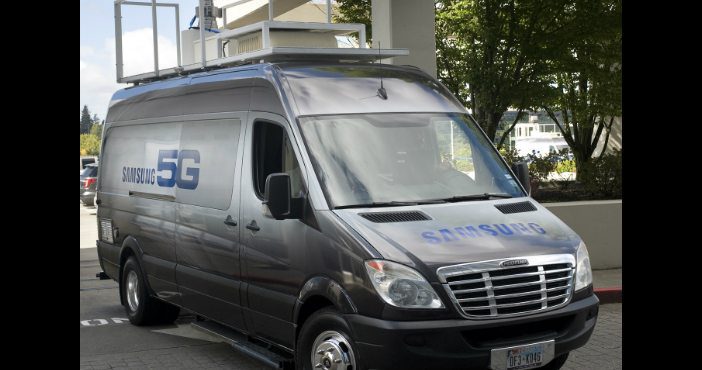
Seen as the first phase of 5G, fixed wireless access can help solve the last mile problem with FTTH and FTTP deployments, while incorporating future 5G air interfaces, spectrum, radios and antenna systems into existing networks
Although not yet standardized, 5G promises to incorporate a range of disparate applications and requirements–from NB-IoT and M2M communications to ultra low latency, high-bandwidth use cases like autonomous vehicles and remote industrial control–in a single network. SDN- and NFV-based network components will automatically create bespoke data pipes that are optimized to a particular application; these application-specific slices will exist virtually in a single, unified network.
But before the standards are set and the full vision of mobile 5G is realized, operators are working to refine understanding of the technological components while establishing the use and business cases needed to create a return on the massive R&D spend that will ultimately result in a global 5G standard.
In the U.S., industry leaders Verizon and AT&T have both identified 5G fixed wireless access (FWA) as the first phase of deploying next-generation networks; timelines suggest this first wave of 5G FWA is tracking for commercialization in 2017, well ahead of the standardization goal of 2019. As consumer demand for broadband to support emerging applications like streaming 4K video and virtual reality gaming grows with no signs of slowing, service providers are investing heavily in fiber-to-the-home, which is a costly proposition.
To solve for the last mile problem associated with FTTH, some operators are looking to 5G FWA, which will provide fiber-like speeds without the need to roll trucks to every house in a neighborhood or every unit in an apartment complex. Further, 5G FWA can help speed up commercialization of new services, and create new revenue opportunities. And, because 5G FWA will be available prior to standardization, deployment experience will help operators prepare for mobile 5G while informing the important progress of standardization with real world experience.
Ovum Principal Analyst Daryl Schoolar stressed the benefits to operators of 5G FWA in a recent whitepaper titled “5G Fixed Wireless Access.”
“Early experience…can help speed up full 5G deployments once the standards are set. Also, early exposure to 5G technologies will allow operators to have greater influence on the final standard. Once standards are set, mobile operators should be able to reuse some of their 5G FWA assets to support other 5G applications. Beyond the radio aspects of 5G, FWA deployments allow operators to work on new network architecture with SDN/NFV and network slicing, which are also important parts of 5G. So 5G FWA not only allows operators to expand into new service areas, it also helps operators better prepare to deploy 5G once standards are set.”
Schoolar also hit on the importance of a robust vendor ecosystem and use of millimeter wave (mmWave) to the success of 5G FWA. We’ll address those one at a time.
Spectrum in the 28 GHz band and above provide much greater capacity than the lower bands used for LTE services. That capacity increase is the key to providing fiber-like speeds in a wireless network. Schoolar, noting the importance of government support to harnessing mmWave spectrum, lauded the July move by the U.S. Federal Communications Commission of opening up 11 gigahertz of spectrum above 24 GHz for 5G.
In an interview with Schoolar, AT&T SVP of Wireless Network and Architecture Tom Keathley explained the important lessons 5G FWA could help the operator learn. “This very-high-frequency spectrum will have propagation challenges but will provide very large bandwidths. Generally, the 5G FWA deployments hold the promise of much higher throughput performance, although the distance covered could be substantially less than LTE and other wireless deployments due to the propagation characteristics of the spectrum. For mmWave systems, it will be important to understand several areas: percentage of homes covered by a site, throughput consistency, seasonal effects (foliage, rain, snow, obstructions, etc.), and potential for self-install versus technician install.”
Adam Koeppe, VP of technology planning for Verizon, commented on the potential for 5G FWA to help solve for last mile fiber deployment challenges. “Early results indicate it is certainly possible. Field technical trials based on FWA use case have been built to mimic FTTx environment, and so far we have seen delivery of 1Gbps speeds and higher. We have to prove this can be done reliably. With a higher order of MIMO and beamforming, you can better aim the radio pattern down to something like a pencil point. This gives us a very narrow, concentrated beam to the CPE or end-user device.”
In discussing the importance of an end-to-end support from chipset, CPE and network vendors, Schoolar said that, “Looking at the current pace of the market, 5G fixed wireless access service could be available in a few years. It will need a robust ecosystem in order to drive innovation, keep prices down, and ensure a strong multi-vendor environment, and attract broad operator interest. Strong ecosystem support is a major factor in any standard’s success. It also gives operators confidence in the technology.”
In that regard, Samsung occupies a unique position in the 5G space. In addition to working in the U.S. with a major operator such as AT&T, Verizon and T-Mobile on testing 5G FWA in real-world conditions and planning a 5G trial service for the 2018 Winter Olympics in PyeongChang, Korea, the company is working through a White House-led initiative to advance 5G wireless technologies. As visualized in the figure below, wireless access, data center and core expertise, coupled with extensive CPE, chipsets and consumer device offerings positions Samsung as a one-stop, end-to-end 5G ecosystem provider.
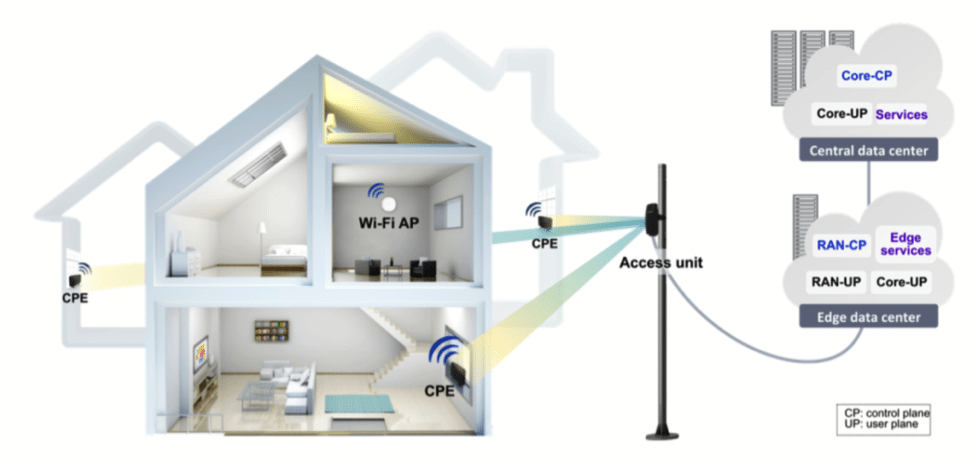
Samsung is focused on practical technology innovation extends to developing small-form-factor equipment for 5G. In June 2016, Samsung announced its success developing key RF technology of 5G-ready chipset, which are intended to be applied to both 5G base stations and devices using mmWave spectrum, to enable 5G systems and devices in commercial/compact size.
Specific to the development of mmWave’s role in 5G, Samsung recently hosted a meeting of standards body 3GPP during which a mmWave channel model was approved. Samsung contributed 90% of the technical topics in the paper as 5G standardization work continues in earnest.
As Mark Louison, SVP and General Manager of Samsung Networks explained: “Samsung brings unparalleled, end-to-end expertise to 5G. We have developed a holistic 5G FWA product that includes core and radio access network in addition to customer premise equipment. Our 5G FWA solution is a part of our broader fixed-to-mobile strategy that enables us to offer an integrated, stable and adaptive solution in these early stages of the technology and beyond as Samsung is working to pave the way for commercialization of 5G.”
Click here to learn more about Samsung’s portfolio of network solutions including its 5G FWA portfolio.

