


RCR Wireless
  • News
  • Channels
    • 5G
    • 6G
    • BSS OSS
    • Carriers
    • IoT
    • Network Infrastructure
    • Open RAN
    • Private 5G
    • Telco AI
    • Telco Cloud
    • Test & Measurement
  • Resources
    • Reports
    • Webinars
    • White papers
    • AI Fundamentals
    • Analyst Angle
    • Editorial Calendar
    • Fundamentals
      • 5G NR Release 17
      • AI
        • Telco AI in 2025
    • Podcasts
      • Let’s Get Digital with Carrie Charles
      • Wireless Connectivity to Enable Industry 4.0 for the Middleprise
      • Well Technically…
      • Will 5G Change the World
      • Accelerating Industry 4.0 Digitalization
  • AI Infrastructure
  • Programs
  • Events
  • RCRtv
  • Advertise
  • Subscribe
Friday, July 24, 2026
RCR Wireless
  • News
  • Channels
    • 5G
    • 6G
    • BSS OSS
    • Carriers
    • IoT
    • Network Infrastructure
    • Open RAN
    • Private 5G
    • Telco AI
    • Telco Cloud
    • Test & Measurement
  • Resources
    • Reports
    • Webinars
    • White papers
    • AI Fundamentals
    • Analyst Angle
    • Editorial Calendar
    • Fundamentals
      • 5G NR Release 17
      • AI
        • Telco AI in 2025
    • Podcasts
      • Let’s Get Digital with Carrie Charles
      • Wireless Connectivity to Enable Industry 4.0 for the Middleprise
      • Well Technically…
      • Will 5G Change the World
      • Accelerating Industry 4.0 Digitalization
  • AI Infrastructure
  • Programs
  • Events
  • RCRtv
  • Advertise
  • Subscribe
Add RCR Wireless as a preferred source on Google
  • Qualcomm 6G Insights
  • Huawei Content Hub
  • Qualcomm – 6G Vision
  • OSS/BSS Channel
  • RCRTech Roundtable: AI Infrastructure
RCR Wireless
RCR Wireless
  • Advanced Mimo
  • Mobile mmWave
  • 5G Positioning
  • Green Networks
  • Metaverse
  • Automotive
  • Industrial and Wide-area IoT
Copyright 2021 - All Right Reserved
Home - 5 connectivity challenges for drones
EMEAInternet of Things (IoT)LTE

5 connectivity challenges for drones

by David Pringle August 2, 2016
written by David Pringle August 2, 2016 Share
LinkedinEmail
Share 0LinkedinEmail
amazon drones
138

Amazon’s ambitions will push delivery drones’ battery lives to the limit and maybe beyond

Last week, Amazon announced a partnership with the U.K. government to explore how to enable the delivery of parcels by small drones. Crucially, the U.K. has agreed to let Amazon test “beyond line of sight operations” in rural and suburban areas – a mode of operation that isn’t yet allowed in the U.S. – as well as sensor performance to make sure the drones can identify and avoid obstacles, and flights where just one person operates multiple highly automated drones.
The ultimate aim is for Amazon to cut delivery costs and speed up delivery times by giving drones as much autonomy as possible. Amazon is seeking to win regulatory approval for its Prime Air delivery system, which is designed to safely get packages up to five pounds to customers in 30 minutes or less using small drones.
But regulation is not the only obstacle. Although the enabling connectivity technologies for such drones exist today, they will eat into the limited battery power that is available for actually flying the drone. Unless battery technology makes some major leaps forward, delivery drones may be limited to journeys of just a few miles, implying Amazon will need a vast network of drone delivery stations.
The U.K. government sees the Amazon trial as an opportunity to help identify the operating rules and safety regulations needed to help move the drone industry forward. But Amazon has already proposed that drones operating beyond line of sight will need to be equipped with some advanced and demanding technologies: geospatial data for safe separation from known hazards; online flight planning and management; a reliable internet connection, collaborative vehicle-to-vehicle sense-and-avoid systems; and noncollaborative sensor-based sense-and-avoid systems. These capabilities are further detailed in the “Best class” shown in the table below, drawn up by Amazon.
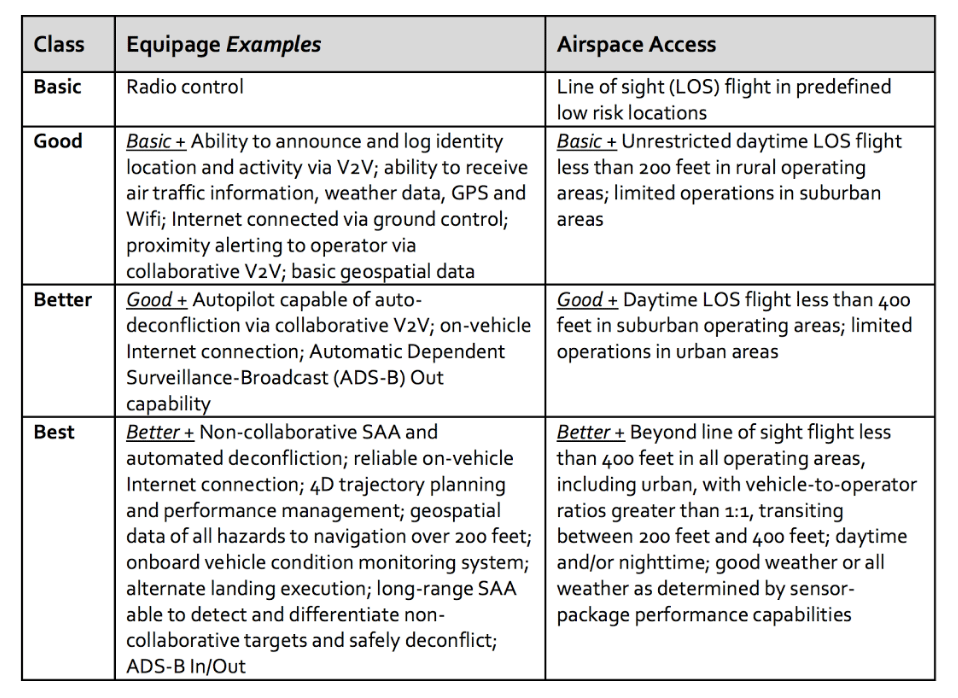
amazon drones
To meet its own requirements, Amazon will need to address the following five key connectivity challenges without asking too much of drones’ batteries:  

  1. Maintaining an internet connection: Although they won’t be controlled directly by a human operator, the delivery drones will need to able to receive air traffic control information and instructions in real time. For example, the airspace regulator may want to instruct all drones to stay out of a specific geographic area because a helicopter is coming in to land. Unless regulators set aside dedicated spectrum, drones will probably have to use a combination of Wi-Fi and cellular networks to maintain internet connection. This will make them vulnerable to network congestion, as well as eat into battery power. The deployment of new low-power, wide-area networks will certainly help, but a key question for the U.K. trial is how long a drone can safely be without an internet connection. Amazon envisions that the drones would also use the Automatic Dependent Surveillance – Broadcast system to periodically broadcast the drone’s location, enabling it to be tracked.
  1. Managing intermittent GPS connections: Delivery drones will use GPS signals to establish their exact locations, but these signals depend on a line of sight between the GPS satellites and the drone. Tall buildings, extreme weather and landscape features, such as canyons, can interfere with these signals and GPS consumes a lot of battery power – as players of Pokemon Go will attest. A key question is how often drones will need to check their location via GPS.
  1. Drone-to-drone communication: In time, the air could be buzzing with a wide range of commercial and leisure drones, delivering parcels, taking photographs, monitoring property and, eventually, carrying human passengers. These drones will need to be able to automatically avoid each other using vehicle-to-vehicle systems. Such systems will rely on very frequent exchanges of information (multiple times per second) between vehicles using short-range wireless technologies, which also will consume considerable battery power.
  1. Obstacle avoidance: Drones will need to be able to avoid obstacles, such as trees and birds, that aren’t transmitting wireless signals. This is why Amazon sees the need for “non-collaborative sensor-based sense-and-avoid systems.” Again, such sensors will need to be as frugal as possible with battery life.
  1. Establishing standardized protocols: To limit the number of technologies a drone will need to support and enable manufacturers to achieve economies of scale, the drone industry needs to agree to and adopt standardized protocols for the systems outlined above. At a conference in the U.S. last year, Gur Kimchi, VP of Amazon Prime Air, highlighted the urgent need for standards. “Imagine the internet without HTTP and TCP/IP,” Kimchi said, according to The Washington Post. “That’s basically where we are now. So we’re putting our foot down, and we’d like everybody to feel an urgent need to come together and create these standards and adapt them.” In practice, Amazon’s push to develop its own delivery drones suggests it is seeking to establish de facto standards in the hope that the rest of the industry will then adopt them.

Although all of the challenges outlined above are individually surmountable, the aggregate impact on drones’ battery life isn’t yet clear. For this reason, the results of the Amazon U.K. trials will be worth watching closely. How Amazon goes about minimizing the power consumption of its drones could provide some important insights and lessons for the broader “internet of things.”
Still, it seems likely that the stringent safety requirements recognized by Amazon itself will put severe limits on delivery drones’ commercial viability. For the rest of this decade at least, Amazon and its rivals will probably need to rely on human controllers far more than they would like. And the trials now kicking off in the U.K. may run and run.


You Might Also Like
  • Monday (telco diary) | Sovereign AI for Industry 4.0
  • When the push becomes the pull – private 5G and physical AI
  • Fast-growing private 5G offers blueprint for AI-era telecoms
  • Monday (telco diary) | Consolidation, orchestration, automation
  • Wireless Logic’s 21st acquisition exposes IoT consolidation paradox
  • Thursday (telco diary) | The plumbing is the product
Share 0 LinkedinEmail
David Pringle

A highly experienced and accomplished business and technology journalist, David Pringle runs Pringle Media, which provides analytical, writing and editing services to organizations in the telecoms, media and technology sectors. A regular moderator of panel discussions at major industry conferences, David has worked on Mobile World Live television at the past six editions of the Mobile World Congress. Based in London, David also serves as an associate director at research and advisory firm STL Partners. Prior to founding Pringle Media in 2009, David worked at the GSMA, providing media relations support to the CEO, chairman and other senior executives in the mobile industry. Between 2000 and 2005, David was the European technology and telecommunications correspondent for The Wall Street Journal covering Vodafone, Nokia, Ericsson, British Telecom and other major multinationals. He has also served as deputy editor of Information Strategy, a pan-European title owned by The Economist Group.

previous post
Five connectivity challenges for drones
next post
Qualcomm White Paper: 5G – Vision for the next generation of connectivity

White Papers

  • Norton eBook: The 2026 Telco Playbook

  • Enea White Paper: Why Intelligent AAA is the Swiss Army Knife of Telecom

  • CSG White Paper: Telco AI Enabler: Mediation’s Defining Role

  • Enea White Paper: Scalable Database Design for 5G and Beyond

  • Supermicro and NVIDIA Whitepaper: Powering sovereign AI at scale

Editorial Reports

  • Market Pulse Report: Telco AI in 2026 – Trends, Challenges and Opportunities

  • Nvidia Report: The State of AI in Telecommunications: 2026 Trends

  • Report: Scaling Optical Networks For The Hyperscale And AI Era

Webinars

  • Webinar: Building 6G — aligning technology, policy and purpose

  • SIMCom Webinar: Scaling your next deployment – from plastic to provisioning

  • Webinar: Rethinking the RAN as AI, cloud and openness converge

  • Webinar: Scale-Up, Scale-Out, Scale-Across – Building AI-Era Network Fabrics

  • Webinar: NTN in motion – evolving standards, expanding services

Since 1982, RCR Wireless News has been providing wireless and mobile industry news, insights, and analysis to mobile and wireless industry professionals, decision makers, policy makers, analysts and investors.

Facebook Twitter Youtube Linkedin Envelope Rss

Useful Links

  • Subscribe
  • About RCR Wireless News
  • Contact Us
  • Advertise
  • Editorial Calendar
  • Archive
  • RSS
  • Wireless News Archive
  • Subscribe
  • About RCR Wireless News
  • Contact Us
  • Advertise
  • Editorial Calendar
  • Archive
  • RSS
  • Wireless News Archive

Edtior's Picks

The Agentic Network — Rakuten Mobile on turning data into outcomes
AI drives new demands on optical networks, Ciena says
Market Pulse Report: Telco AI in 2026 – Trends, Challenges and Opportunities

Latest Articles

The Agentic Network — Rakuten Mobile on turning data into outcomes
AI drives new demands on optical networks, Ciena says
Market Pulse Report: Telco AI in 2026 – Trends, Challenges and Opportunities
Nokia nips and tucks, and sees supercycle upside – as AI and cloud orders double

© 2026 RCR Wireless News All Right Reserved. Developed by Eight Hats.

Cookie Policy | Privacy Policy

RCR Wireless
  • News
  • Channels
    • 5G
    • 6G
    • BSS OSS
    • Carriers
    • IoT
    • Network Infrastructure
    • Open RAN
    • Private 5G
    • Telco AI
    • Telco Cloud
    • Test & Measurement
  • Resources
    • Reports
    • Webinars
    • White papers
    • AI Fundamentals
    • Analyst Angle
    • Editorial Calendar
    • Fundamentals
      • 5G NR Release 17
      • AI
        • Telco AI in 2025
    • Podcasts
      • Let’s Get Digital with Carrie Charles
      • Wireless Connectivity to Enable Industry 4.0 for the Middleprise
      • Well Technically…
      • Will 5G Change the World
      • Accelerating Industry 4.0 Digitalization
  • AI Infrastructure
  • Programs
  • Events
  • RCRtv
  • Advertise
  • Subscribe
RCR Wireless
  • News
  • Channels
    • 5G
    • 6G
    • BSS OSS
    • Carriers
    • IoT
    • Network Infrastructure
    • Open RAN
    • Private 5G
    • Telco AI
    • Telco Cloud
    • Test & Measurement
  • Resources
    • Reports
    • Webinars
    • White papers
    • AI Fundamentals
    • Analyst Angle
    • Editorial Calendar
    • Fundamentals
      • 5G NR Release 17
      • AI
        • Telco AI in 2025
    • Podcasts
      • Let’s Get Digital with Carrie Charles
      • Wireless Connectivity to Enable Industry 4.0 for the Middleprise
      • Well Technically…
      • Will 5G Change the World
      • Accelerating Industry 4.0 Digitalization
  • AI Infrastructure
  • Programs
  • Events
  • RCRtv
  • Advertise
  • Subscribe
@2020 - All Right Reserved. Designed and Developed by PenciDesign