


RCR Wireless
  • News
  • Channels
    • 5G
    • 6G
    • BSS OSS
    • Carriers
    • IoT
    • Network Infrastructure
    • Open RAN
    • Private 5G
    • Telco AI
    • Telco Cloud
    • Test & Measurement
  • Resources
    • Reports
    • Webinars
    • White papers
    • AI Fundamentals
    • Analyst Angle
    • Editorial Calendar
    • Fundamentals
      • 5G NR Release 17
      • AI
        • Telco AI in 2025
    • Podcasts
      • Let’s Get Digital with Carrie Charles
      • Wireless Connectivity to Enable Industry 4.0 for the Middleprise
      • Well Technically…
      • Will 5G Change the World
      • Accelerating Industry 4.0 Digitalization
  • AI Infrastructure
  • Programs
  • Events
  • RCRtv
  • Advertise
  • Subscribe
Wednesday, July 29, 2026
RCR Wireless
  • News
  • Channels
    • 5G
    • 6G
    • BSS OSS
    • Carriers
    • IoT
    • Network Infrastructure
    • Open RAN
    • Private 5G
    • Telco AI
    • Telco Cloud
    • Test & Measurement
  • Resources
    • Reports
    • Webinars
    • White papers
    • AI Fundamentals
    • Analyst Angle
    • Editorial Calendar
    • Fundamentals
      • 5G NR Release 17
      • AI
        • Telco AI in 2025
    • Podcasts
      • Let’s Get Digital with Carrie Charles
      • Wireless Connectivity to Enable Industry 4.0 for the Middleprise
      • Well Technically…
      • Will 5G Change the World
      • Accelerating Industry 4.0 Digitalization
  • AI Infrastructure
  • Programs
  • Events
  • RCRtv
  • Advertise
  • Subscribe
Add RCR Wireless as a preferred source on Google
  • Qualcomm 6G Insights
  • Huawei Content Hub
  • Qualcomm – 6G Vision
  • OSS/BSS Channel
  • RCRTech Roundtable: AI Infrastructure
RCR Wireless
RCR Wireless
  • Advanced Mimo
  • Mobile mmWave
  • 5G Positioning
  • Green Networks
  • Metaverse
  • Automotive
  • Industrial and Wide-area IoT
Copyright 2021 - All Right Reserved
Home - EMEA: Automotive Ethernet – safe or sorry?
Connected CarsEMEAWireless

EMEA: Automotive Ethernet – safe or sorry?

by Claudia Bacco December 15, 2014
written by Claudia Bacco December 15, 2014 Share
LinkedinEmail
Share 0LinkedinEmail
EMEA
100

Claudia Bacco, Managing Director – EMEA for RCR Wireless News, has spent her entire career in telecom, IT and security. Having experience as an operator, software and hardware vendor and as a well-known industry analyst, she has many opinions on the market. She’ll be sharing those opinions along with ongoing trend analysis for RCR Wireless News.

The Automotive OPEN Alliance SIG is a nonprofit industry alliance established to drive wider adoption of Ethernet-based automotive connectivity. This past week they have announced the establishment of additional technical committees focused on the following topics related to Ethernet use in vehicles in order to move the technology adoption forward:

  • Automotive XMI interfaces
  • Gigabit automotive Ethernet over Plastic Optical Fiber
  • Tests for one-pair Ethernet ECUs
  • Channel components for Gigabit copper Ethernet.

The automotive industry has selected Ethernet as the connectivity technology for use in the next generation of vehicles for the car’s network backbone, deployment of advanced safety and infotainment features and to enable a truly connected experience while on the road. Frost & Sullivan predicts that by 2020 the average luxury car will have over 100 Ethernet nodes and more mass-market models will have between 50 and 60. In looking at the total cars on the road this figure equates to about 400 million Ethernet ports.

What is this technology?
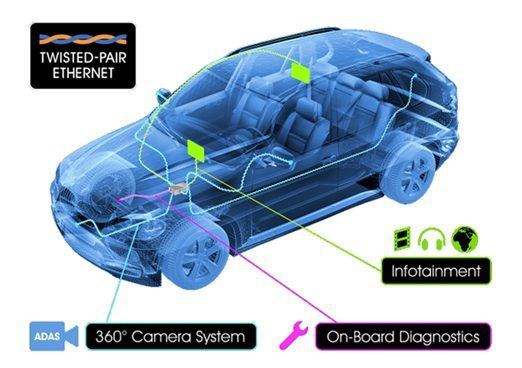
Automotive EthernetOne pair Ethernet or BroadR-Reach® Ethernet technology allows multiple in-vehicle systems (such as infotainment, automated driver assistance and on- board diagnostics) to simultaneously access information over a single unshielded twisted-pair cable. This will ultimately reduce costs for the OEMs due to the technology allowing multiple functions to travel the same network (up to 80% reduction in cost projected) and reducing the weight of cabling (up to 30% reduction in weight projected) within cars. Broadcom, Freescale and NXP currently offer this solution, which allows for dedicated bandwidth per port, advanced cable diagnostics for each link and IEEE standard support for entertainment audio/video processing.

Why isn’t Ethernet widespread in the automotive industry?

Before new options such as the one mentioned above, the functionality did not align with industry requirements. For example, Ethernet created too much RF noise, didn’t allow for dedicated bandwidth for different streams of data, didn’t allow for more than one device to sample data at the same time nor provide low enough latency performance.

As cars evolve they get more complicated due to a larger number of sensors with higher bandwidth requirements that need to communicate with each other. As more requirements enter the scene, the weight of the wiring harness increases, adding cost and weight to the car. Currently the wiring harness is the third-highest item in weight and cost within the car – increase either would not be acceptable. Today, multiple proprietary standards are used with potentially a single wire going to each component and Ethernet is only used for diagnostics and firmware upgrades.

In the next year it is expected that Ethernet will be more widely used for the in-car camera (driver assist) and infotainment systems, which would still consist of a single connection per component and not a shared infrastructure. BMW and Hyundai have already committed to this solution.

By 2020 it’s estimated that the cost of electronics in cars will rise to 40% of total component costs, accounting for an 8% increase from today. As the number of electronic components rises, the need for a shared network becomes imperative.

Safe or sorry?

It’s all about security. There’s been a lot of talk about the security of data in the connected car and the opportunity for malicious hacking to occur. As I’ve spoken with various organizations around the industry, the answer seems quite universal that today the open infotainment-like content traveling via Bluetooth or wireless connections is the cause for concern and the network within the vehicle to support functions related to its operation is quite safe due to all of the proprietary solutions and individual connections. So what happens when there now comes a shared Ethernet network? In April Tesla was in the news for having its Ethernet hacked. But this was via a physical connection and not done remotely.

There’s been a great deal of discussion at industry conferences on this topic throughout the year and the vulnerabilities all point to the need for a physical connection to the car. But in the same breath, security is rated as one of the highest priorities for the OEMs. GM even named a cybersecurity chief this September being the first of the OEMs to do and signaling the priority they place on this topic.

It seems everyone agrees it’s a topic for concern, but also feels the OEMs are up to the task of ensuring the concern isn’t warranted. Keeping the driving public safe, not only physically but also its data, is one of their highest priorities, if not the highest.

You Might Also Like
  • Verizon’s Srini Kalapala on betting on AI and edge computing
  • T-Mobile bets on hybrid broadband with 5G FWA and Starlink
  • Emerson/NI White Paper: 2026 Technology Trends Impacting the Wireless Communications Industry
  • AT&T on the connectivity strategy behind Mitsubishi’s 5G-enabled outlander
  • Further Nokia jobs to go in Greece and Italy, as European workers protest
  • #TBT: A ‘flurry’ of spectrum activity; busting fixed wireless myths; Vitesse talks Ethernet in cars … this week in 2015

Table of Contents

  • What is this technology?
  • Why isn’t Ethernet widespread in the automotive industry?
  • Safe or sorry?
Share 0 LinkedinEmail
Claudia Bacco

Contributing [email protected] Originally from Boston, now living in Munich, Germany, Claudia Bacco has a wealth of corporate marketing, branding and positioning experience within technology companies such as Nokia Networks, Juniper Networks, Verizon and AGT International. Claudia has also worked as a consultant advising organizations on their strategic messaging and positioning needs. As a former industry analyst, she worked with startups being a member of their advisory boards during their funding and market launch activities.

previous post
EMEA: Driving with Here
next post
Reader Forum: Exceeding customer expectations in a multidevice world

White Papers

  • Norton eBook: The 2026 Telco Playbook

  • Enea White Paper: Why Intelligent AAA is the Swiss Army Knife of Telecom

  • CSG White Paper: Telco AI Enabler: Mediation’s Defining Role

  • Enea White Paper: Scalable Database Design for 5G and Beyond

  • Supermicro and NVIDIA Whitepaper: Powering sovereign AI at scale

Editorial Reports

  • Market Pulse Report: Telco AI in 2026 – Trends, Challenges and Opportunities

  • Nvidia Report: The State of AI in Telecommunications: 2026 Trends

  • Report: Scaling Optical Networks For The Hyperscale And AI Era

Webinars

  • Webinar: Building 6G — aligning technology, policy and purpose

  • SIMCom Webinar: Scaling your next deployment – from plastic to provisioning

  • Webinar: Rethinking the RAN as AI, cloud and openness converge

  • Webinar: Scale-Up, Scale-Out, Scale-Across – Building AI-Era Network Fabrics

  • Webinar: NTN in motion – evolving standards, expanding services

Since 1982, RCR Wireless News has been providing wireless and mobile industry news, insights, and analysis to mobile and wireless industry professionals, decision makers, policy makers, analysts and investors.

Facebook Twitter Youtube Linkedin Envelope Rss

Useful Links

  • Subscribe
  • About RCR Wireless News
  • Contact Us
  • Advertise
  • Editorial Calendar
  • Archive
  • RSS
  • Wireless News Archive
  • Subscribe
  • About RCR Wireless News
  • Contact Us
  • Advertise
  • Editorial Calendar
  • Archive
  • RSS
  • Wireless News Archive

Edtior's Picks

The Agentic Network — Cisco on the platform path to agentic operations
Private 5G – hype, hope, and (some) hard maths 
Network agents are “ready” for commercial use, but are telcos? (Analyst Angle)

Latest Articles

The Agentic Network — Cisco on the platform path to agentic operations
Private 5G – hype, hope, and (some) hard maths 
Network agents are “ready” for commercial use, but are telcos? (Analyst Angle)
Monday (telco diary) | ‘A new telco growth profile’?

© 2026 RCR Wireless News All Right Reserved. Developed by Eight Hats.

Cookie Policy | Privacy Policy

RCR Wireless
  • News
  • Channels
    • 5G
    • 6G
    • BSS OSS
    • Carriers
    • IoT
    • Network Infrastructure
    • Open RAN
    • Private 5G
    • Telco AI
    • Telco Cloud
    • Test & Measurement
  • Resources
    • Reports
    • Webinars
    • White papers
    • AI Fundamentals
    • Analyst Angle
    • Editorial Calendar
    • Fundamentals
      • 5G NR Release 17
      • AI
        • Telco AI in 2025
    • Podcasts
      • Let’s Get Digital with Carrie Charles
      • Wireless Connectivity to Enable Industry 4.0 for the Middleprise
      • Well Technically…
      • Will 5G Change the World
      • Accelerating Industry 4.0 Digitalization
  • AI Infrastructure
  • Programs
  • Events
  • RCRtv
  • Advertise
  • Subscribe
RCR Wireless
  • News
  • Channels
    • 5G
    • 6G
    • BSS OSS
    • Carriers
    • IoT
    • Network Infrastructure
    • Open RAN
    • Private 5G
    • Telco AI
    • Telco Cloud
    • Test & Measurement
  • Resources
    • Reports
    • Webinars
    • White papers
    • AI Fundamentals
    • Analyst Angle
    • Editorial Calendar
    • Fundamentals
      • 5G NR Release 17
      • AI
        • Telco AI in 2025
    • Podcasts
      • Let’s Get Digital with Carrie Charles
      • Wireless Connectivity to Enable Industry 4.0 for the Middleprise
      • Well Technically…
      • Will 5G Change the World
      • Accelerating Industry 4.0 Digitalization
  • AI Infrastructure
  • Programs
  • Events
  • RCRtv
  • Advertise
  • Subscribe
@2020 - All Right Reserved. Designed and Developed by PenciDesign
