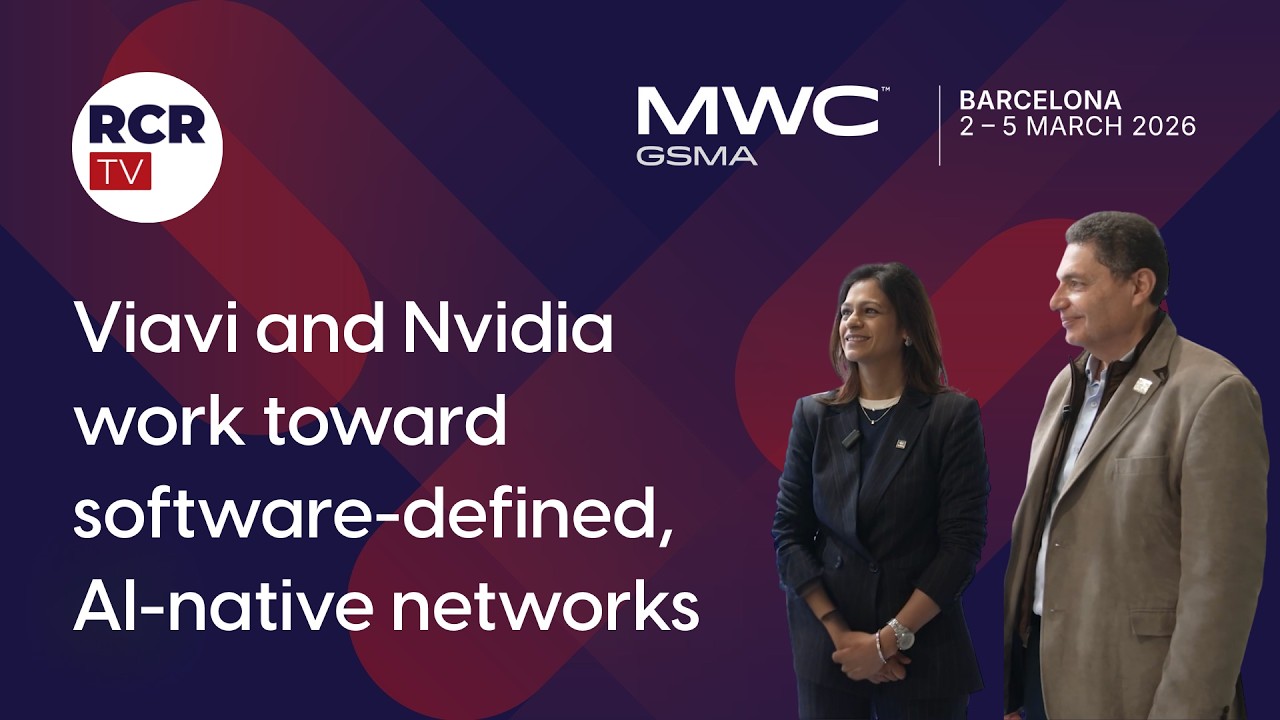
The companies’ collaboration has yielded agentic AI blueprints, RAN digital twins and a strategy for moving customers toward autonomous networks and AI-native 6G wireless networks.
VIAVI CTO Sameh Yamany and NVIDIA senior director of telecom marketing Kanika Atri spoke to Sean Kinney at MWC in Barcelona about the ways in which VIAVI Solutions and NVIDIA are collaborating to develop AI-native 6G wireless networks and autonomous infrastructure, with a primary focus on integrating VIAVI’s network testing and simulation tools with NVIDIA’s AI and digital twin platforms to optimize network performance and energy efficiency.
“Operators are realizing the opportunity for enhancement with AI capabilities for empowering platforms and moving from theory to actual implementation,” said Yamany.
NVIDIA’s Kanika Atri, senior director, telecom marketing, agrees, adding that the nature of inquiries has shifted from whether the benefits are there and do they make sense to questions about actual implementations, rollouts, commercialization and ecosystems. “Last year, companies wanted to see the benefits of efficiency use cases, but now the conversation centers on growth use cases and the drivers for spectral efficiency and performance,” says Atri, who says she is “blown away by the pace of innovation in AI for RAN. “I’m part of the AI-RAN Alliance, and with 2x throughput gains and with AI bringing changes 30 orders of magnitude better in terms of performance and efficiency, we now see it being applied at layer 1 and now in layer 2. That is exciting operators.”
With their collaborative work around energy efficiency and spectral efficiency, there has been an emphasis on the evolution toward 6G, Open 6G, and how AI will play in the RAN so that agentic AI not only improves efficiencies and overall performance, but also moves toward automation of the whole system, and how to measure it.
“With tools in the hands of the innovators to test the use cases, we can provide a blueprint that helps people see how to play at their own game and solve their own problems,” said Yamany.
Gaining efficiency on the operating side and service expansion will lead to the next step of bringing AI into the operations layers. “That will be a slam dunk – a no-brainer, and every operator should be doing it,” said Atri, who says the two companies announced a strategic expansion of their partnership focused on autonomous telecommunications networks. The companies will shift from simple automation (predefined workflows) to what they call “true autonomy,” where networks can reason, understand operator intent, and make independent decisions.
Agentic RAN Digital Twins
“Autonomy is not the same as automation,” saysAtri, who defines autonomy as self-configure, self-optimize, self-heal. “We will provide the blueprints and workflows so that agents can do the heavy litting. For that to work, the end user has to trust the actions the agents take. That’s where digital twins come in.”
To that end, VIAVI and NVIDIA are working to integrate digital twins as part of the agentic workflow. “So an agent that is looking to optimize energy efficiency KPIs, as an example, can come up with a recommendation to change ‘xyz’, running it through a simulation in a real digital twin that validates that yes, I gave a good recommendation,” explains Atri. The agent would then bring a human onto the loop to approve the change, even explaining the reasons behind the change and the process that got the agent to the change. In other words, VIAVI and NVIDIA, as well as other partners, are looking at how AI-native networks can be born in simulation first, with digital twins as a fundamental partner for network planning for the entire operations workflow and made avail is something everyone will adopt.
To get to a “closed loop” where autonomous and agentic systems make the decisions without human intervention or approval will take trust. Both Yamany and Atri see that trust building. “With humans, it’s a journey. They will go in the weeds to see how the AI came to the conclusion, but eventually will come to trust it,” adds Atri.
She says trust is explainability and transparency. “The way AI is being built now is with trust by design,” which is the process of learning to trust. Every time an agent makes a recommendation, validates that recommendation in the twin, explains how it came to those recommendations, and shows it works, the human will trust a little more and time.
According to Yamany, trust of autonomous will come with the constant feedback and transparency. “You don’t want to implement something and find out it doesn’t work, so that’s why we’re doing this with real data, and a digital twin with data from the real network…the platform and the blueprint on which we build the confidence.”
He says he sees a rapid change in behavior among end users, as they are now overwhelmingly accepting that the process is changing as they become familiar with AI, and AI gets familiar with their ways of using it. “Customers are all on an accelerated journey with AI, and agentic platforms to build the performance and the scale,” says Yamany, who says AI is learning from the real-time feedback from the network. “The humans see how AI is getting better, and they are more tuned to the process and learn while AI learns,” says Yamany.
Looking forward to a software-defined world
Next year, Atri believes most in the industry will be in the “field trial stage,” with many NVIDIA partners already announcing next moves. “The technology benchmarks will get broken again and again and faster and faster. The art of the possible with a software-defined architecture and next levels of performance and greater efficiencies are next,” she says.
She also predicts “edge AI applications that natively get served better on a distributed network will come about, and maybe a killer app will emerge to take people by surprise. The shift will be happening faster.”
Yamany agrees that software-defined networks are no longer an option, but a necessity because of the pace of AI and the need for growth opportunities and monetization. “We talk of Moore’s law, but I think the new law is that reasoning is going to double every 6 months, and operators will see that the use cases they have been wanting are going to be happening faster and being validated faster.” He thinks next year will be about tangible use cases.
To make those use cases possible, VIAVI and NVIDIA will continue to collaborate on an AI-native, software-defined foundation for the future. “We partner with VIAVI across multiple levels: building digital twins, birthing 6G in simulation first and on the network operations lifecycle as part of agentic workflows. We are building the best labs and making network data – both synthetic and real-time data – available for a wide ecosystem to build on and innovate across the full stack,” says Atri.
Yamany agrees, adding, “We are opening up for the whole industry to use the blueprint, pushing to use the lab and test all ideas to improve and bring innovation to the entire industry.”
Table of Contents