


Ericsson’s networks chief Per Narvinger offered a measured view of AI’s impact on telecoms at MWC: fiber may lead the infrastructure boom today, but AI will also shift through the mid-cycle 5G evolution in AI-driven RAN optimisation.
In sum – what to know:
New traffic – despite the AI focus on fiber, today, mobile networks will face major changes as AI services drive new traffic patterns, particularly uplink demand.
Mid cycle – rather than just talk (at MWC) about 6G, Ericsson is focused on extracting more juice out of 5G – through APIs, enterprise cases, and network upgrades.
AI RAN – embedded AI in RAN link adaptation, together with RAN neural accelerators, is already boosting spectrum efficiency at customers by around 10 percent.
Did you see the MWC piece with Cisco last week – as well as the Nokia one, to an extent? If you did, and if you’ve been following the fiber coverage in these pages of late, then you will know the RCR view on this: that, despite all the future-gazing at MWC, the big telco story in AI infrastructure right now is not really about mobile networks. Instead, it is mostly about fiber. As such, it was interesting to get Ericsson’s viewpoint in Barcelona – to bounce the idea, very simple, off a traditional pure-play mobile network vendor; in person, in a meeting room, away from the bluster.
But did RCR bounce the idea off Ericsson, actually? Looking back at the transcript, it seems like it was only a sub-plot in the discussion, perhaps. (Whereas it was central to conversations with Ciena, Verizon, Microsoft, others.) But Ericsson’s responses, articulated by Per Narvinger, head of networks at the Swedish firm, might be considered in the same context anyway – about the mid-term schedule re-design mobile networks to serve the AI revolution. And to its credit, Ericsson talked mostly in measured terms, squarely focused on “mid-cycle 5G”, and constant evolution.
On its approach – sensible, deliberate, confident – it is helpful, maybe, to make an observation, a little anecdotal, about its strategy in the private networks market: that Ericsson made the same “half-time” reference at MWC two years ago, when Nokia was on a tear-up, and Ericsson was practically nowhere – as if it was timing its run, and no one starts a marathon with a sprint. In other words, Ericsson would enter the private 5G market when the private 5G market was ready, it suggested – which it has now done, very smartly, while Nokia has pulled-up, and pulled-out.

RCR suggests this to Narvinger at the show, when the talk veers towards APIs, as part of the “first theme” to help its operator customers to monetize their 5G networks. But we’ve been talking about APIs for years – is the response. “It takes a bit of time to make sure those APIs are implemented by a sufficient number of operators so you get enough volume for developers. So there’s a bit of a lead time on it,” reflects Narvinger.
So where are we on that lead time? Are we seeing those returns yet? “Yes, there are good examples now of how to make use of 5G,” he says.
He references cases in public safety and defense, and “using APIs to make use of the capabilities in the networks”. He adds: “There are lots of those discussions here – about good ways of creating these new use cases.” Again, Ericsson seems to be at ease with the timeline; otherwise, and clearly, the focus from Narvinger is on the second half of the 5G game, and not much about this new 6G sport. RCR draws the parallel with its private-networks play, and suggests Ericsson is taking the Apple line: that timing is everything. “We are still early in the journey,” he says.
“There is a sense this industry starts to talk about things way before they are actually available in the network. Which means there is a lead time, and when it starts happening, it feels like old news – because it has been talked about for five years already. But I agree with you.” Good to hear a dose of realism, and nice to have it confirmed. So there’s an angle on the mobile story, about radio networks for AI – from the only tier-one western pure-play mobile vendor. The vendors are talking about 6G, and the operators aren’t – very much. But neither is Ericsson, actually.
Narvinger responds: “Because 6G will happen in volume around 2030, and many things will materialize before that. We would rather talk about how to make use of all the capabilities [in 5G].” Again, the sense is the mobile industry is given to future-gazing – especially at events like this – and that the hyped “capabilities” discussed five-or-more years ago, at the start of the 5G cycle, are just coming available. “Has it happened in volume yet? No. But applications we’ve talked about for many, many years are starting to gain traction. Fixed wireless access, say, has good volume.”
He says: “Public safety is starting to use mobile 3GPP networks – instead of proprietary systems. The defense sector is thinking about 5G for connectivity on [military] bases. We have talked about those things for many years, and now they are happening. Even if they are a few years away, more use cases will come out.” More broadly, the discussion with Ericsson at MWC is framed around networks for AI and AI for networks – all in service, ultimately, of mobile network monetization (“theme one”). “Monetization is starting to happen,” says Narvinger, per the above cases.
Networks for AI
In the context of the original statement – about new networks for new AI workloads, and how fiber systems will be engaged first – the argument is fairly inconsequential for Ericsson, presumably. Nokia’s point on Sunday night that most AI traffic originates / terminates on mobile phones is right enough, and there is work to do in the radio access network to manage the coming storm and chaos. “There are three pillars [to AI infrastructure]: the model, the compute, the connectivity. [AI will] be on the move – so you use your chatbot or agent everywhere,” says Narvinger.
“So connectivity becomes even more important in the AI paradigm. And it changes the traffic, which changes the network. Right now, we use mobile as an entertainment machine [for] broadcast videos. With AI, you send stuff to the data center – so the uplink becomes more important… Today, most AI is text-based; plus a little bit of voice, maybe. But that [doesn’t drive] so-much load on the network. So we still have time. But think about (Ray-Ban) Meta Glasses, and asking directions via a chatbot [and a camera], then [the traffic demand on the network starts to change].”
Hmm, not sure; still sounds futuristic, or just unlikely – as a mass market proposition; versus a niche point solution for galleries and events. “I don’t think it is that far away – that you will start seeing more traffic in the uplink. [But] it doesn’t have to be [Meta Glasses], right?” There is some talk about uploading photos to a chatbot in an edge-cloud to get directions, like it is different from AR spectacles. Later, he says: “Whether it is glasses or something else, there is so much potential use of the technology that hasn’t happened yet.”
He also talks about stadiums, specifically – more concrete, and logical perhaps. “The way the world works, you need to send a video to show you’re there, right? Otherwise it doesn’t count. So you’re on the uplink… [and] the traffic changes.” An aside again, about private networks; hinting at a bigger point, which doesn’t materialize: is the future AI uplink model in the macro network mapped / informed by OT patterns on private 5G? “That might be an example. Because it is more like a fixed network – with a more uplink compared to mobile. But I’dd take the stadium example.”
Probably it’s our fault – some woolly questions in there – but most of this part of the discussion with Ericsson at MWC (network monetization, networks for AI) feels rather speculative: important, of course, but mid-term, hard to pin down. The conversation is clearer when it covers this third “theme” – about AI in networks, or AI for networks. Here, in a back-room at MWC, Ericsson sounds like it is making real leaps – notably with its “AI-native” link adaptation and with a stable of new “AI‑ready” radios with neural network accelerators.
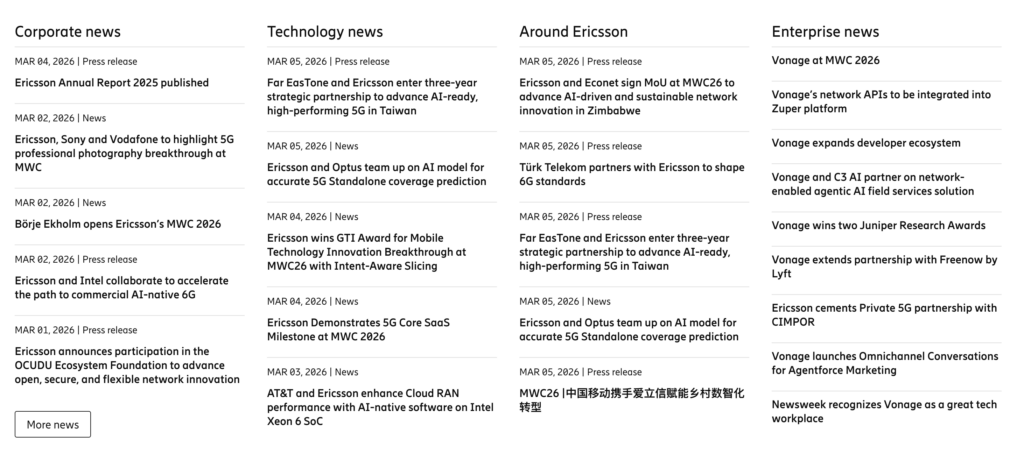
Of course, there was a ton of stuff from Ericsson at MWC (and from Vonage pre-MWC), but this is where the conversation focused. For the rest, click on the image below.
“The third thing is how we make use of AI in the network,” said Narvinger. “We have been investing there for many years. Telecom is quite advanced compared to many other industries. Out on the (MWC) floor, you see examples of how we have created an AI model that improves very basic algorithms in the network. So you can get 10 percent more out of your spectrum. Spectrum is one of the largest spends a mobile operator has. So if you can use an AI model to squeeze out 10 percent more, it delivers huge value.” It is a classic AI-RAN case, he suggests.
Bell Canada ran field tests last April (2025), the first anywhere – said the press note at the time; it announced the same with AT&T at MWC on the carrier’s Intel-based “target” cloud RAN stack. “We have demonstrated with many,” said Narvinger. The link adaptation technology integrates AI in its sub-components – rather than as an add-on (qualifying it as AI-native) – and executes the spectrum algorithm on the baseband unit in real-time to optimize performance in challenging scenarios – such as interference and medium and poor channel quality.
“The thing is, that is an algorithm we’ve optimized for 30 years in a deterministic way. And then we change to an AI model, and improve it by 10 percent. Which is quite extraordinary – to optimize something for 30 years, and then, with AI, you get 10 percent more. Think of the cost of spectrum,” says Narvinger, pointing to the $17 billion SpaceX paid for EchoStar’s 2 GHz/AWS-4 spectrum last September to run mobile satellite services (plus the $2.6 billion in November for EchoStar’s AWS-3 licenses). “What’s 10 percent value out of that – $1.7 billion? It’s enormous.”
AI for networks
At MWC, Ericsson also presented AI-geared RAN software enhancements for ‘beamforming’, outdoor positioning, and coverage prediction, plus new radios featuring its own custom (Ericsson Silicon) chips with neural accelerators. Narvinger slides its new silicon hardware across the desk, leans back, and talks about boosting “on‑site AI inference capabilities in massive MIMO radios for real‑time optimization and full-stack fully-distributed AI.” Showcased at its pre-MWC event in London a couple of weeks back, it will be out by summer, he says (“first half this year”).
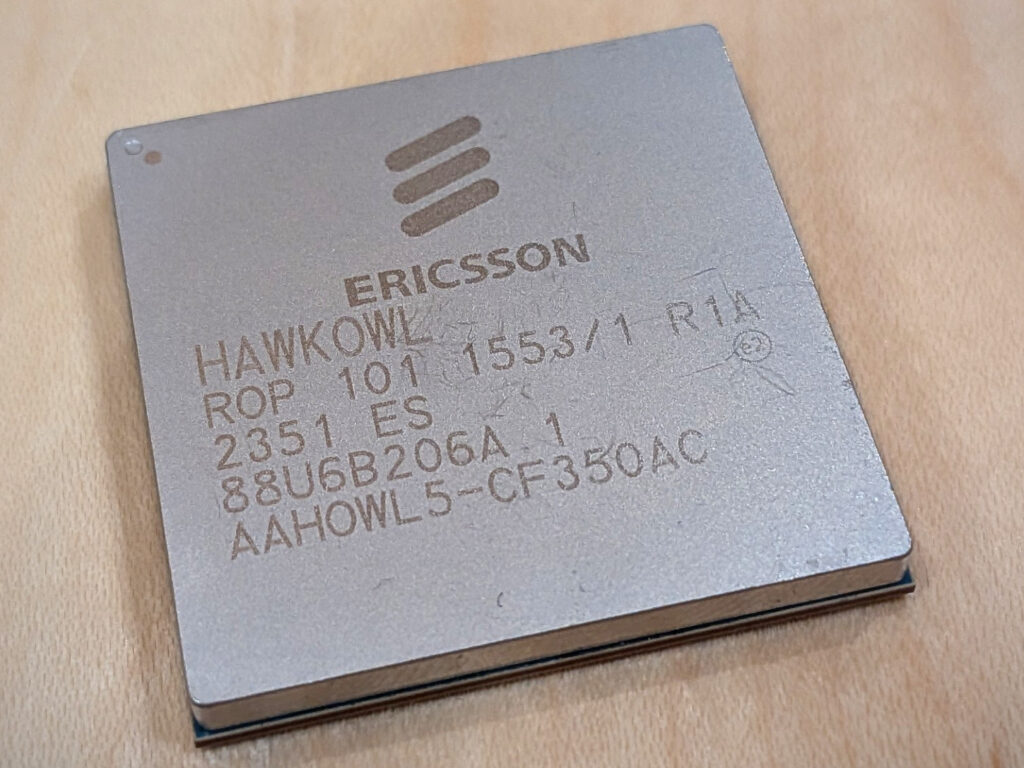
“We have had purpose-built ASICs (application-specific integrated circuits) for many years; the addition of neural network accelerators [makes this] an extremely powerful AI compute fabric.” Ericsson has one-such “AI-ready” radio in the market.
“By the end of the year, I will have 10,” says Narvinger. “That means more and more customers can make use of even more powerful radios to squeeze out capacity in the network. AI is not a PowerPoint thing, or a just vision in telecom; it is happening here now. That is the theme of the show – that AI is here now.”
He adds: “Last year was more about the vision, and discussion about how it can be applied. We’re demonstrating the benefits now, and we’ll put it in networks this year… But it is [also] an evolution. I like the comparison with what Nvidia did with GPUs – originally aimed at graphics, which is a parallel compute system. Telecom is also a parallel compute system. And by adding AI accelerators, you suddenly get a very powerful AI fabric.” In the interview, the clock is ticking; time for a couple of last questions – about capital constraints, NSA to SA to 6G, and open RAN.
Narvinger responds to the first, about the appetite for mobile operators to spend, more and again, to take advantage of AI in their networks to drive efficiencies and optimize their networks to support AI traffic, and hopefully monetize their wares along the way. “There is so much more to happen with 5G before 6G comes, which is still a few years out. 6G won’t be a total disruption – where you throw everything away. It will be an incremental journey. And even if new use cases don’t materialize, traffic is still growing in networks. So operators still need to increase capacity.”
He adds: “If they can get gains with AI, they will do it. If they can do it with an AI model on existing equipment for 10 percent more spectrum efficiency, they will do it. I am pretty confident most of our customers will take that software and put it in their networks this year. And when they buy a new radio unit to modernize a site, they will pick one that can do even more AI in the future. Networks are not built, once, and then left for 10 years for the next generation. They are being constantly modernized where more capacity is required.”
All of which might be filtered back through the start of the conversation. The response to the other question, specifically about whether Ericsson’s participation in the Linux Foundation’s OCUDU project, as a home to centralised and distributed (CU and DU) open source RAN software functions, impacts the future (or lack thereof) of open RAN – and, as extension, whether its initiatives around sovereign defense use cases are an adaptation of its commercial 5G/6G development or something different – is short, before time is called.
Narvinger says simply: “They are two slightly different things. Open RAN is done. We have already implemented it. It is being used. What is now happening with the OCUDU is open source, Linux Foundation; and we have been working with open source for many years, and this is an opportunity to see if we can do more with it. For us, whenever you can create an open source community that drives the industry forward, it is a good thing, right? This is one more initiative, trying to get even more traction.” And there you have it.


