

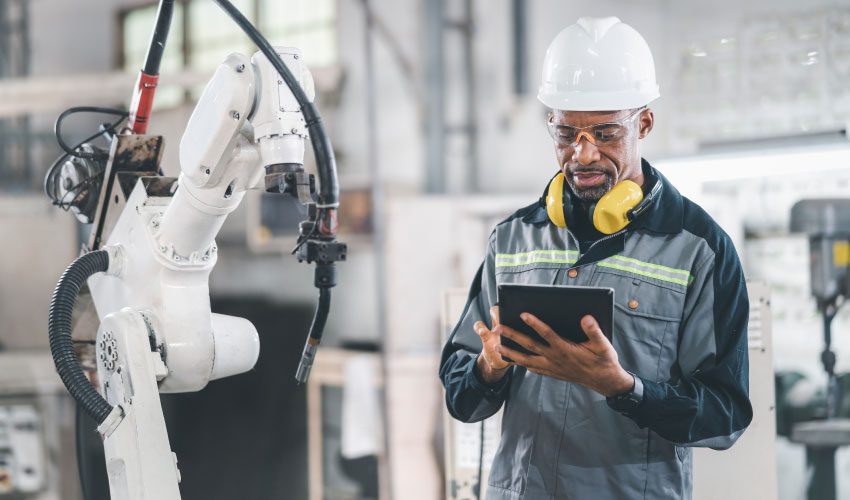
Partnerships with Nvidia, Microsoft, AWS, and industrial IoT specialist Geoforce show how AT&T is positioning fibre, edge infrastructure, and enterprise connectivity to support AI workloads from data centre to factory floor.
In sum – what to know:
Smart factories – AT&T’s new ‘Connected AI’ platform combines 5G, IoT, and generative AI with accelerated computing from Nvidia and edge AI capabilities from Microsoft Azure.
Cloud-linked AI – Initiative with AWS links AT&T fibre and 5G directly into AWS environments to support enterprise AI workloads, while expanding fibre capacity for distributed AI infra.
IoT expansion – Collaboration with Geoforce sees AT&T extend its Industry 4.0 portfolio with asset-tracking services for rugged equipment, targeting oil and gas, construction, rail, logistics.
Picking up a few more bits from AT&T, here, released around MWC week (March 2-5), which confirm the US operator’s drive to connect and manage enterprise AI workloads, notably in industrial markets. The firm has said it is working with MicroAI, Nvidia, and Microsoft to connect and analyse data from industrial assets in factories, warehouses, and plants. It has a new platform, called Connected AI, that somehow “unifies “5G, IoT, and generative AI” to help “manufacturers see more, know more, and do more right at the edge”.
It is pitched for ‘smart manufacturing. Its launch comes on the heels of a new enterprise edge proposition, Connected Spaces, which combines equipment, sensors, cameras, and devices into a single architecture – covered here, together with notice from MWC of a “preview”, available shortly, of a last-mile enterprise AI connectivity offering with AWS. The latter brings its fiber and 5G systems “directly” into AWS environments in service of enterprise AI workloads, and fits with a major theme at MWC this week.
The AWS tie-up, as covered, will expand its fibre capacity to 1.6Tbps across metro and long‑haul routes; it goes with a parallel announcement about interconnectivity between AWS-owned ‘AI factories’, plus an agreement to migrate AT&T workloads at its data center facilities to AWS Outposts, the hyperscaler’s edge-cloud hardware for private and co-location facilities. AT&T is using agentic AI services from AWS to migrate network service enablement to AWS. AT&T will also look to use Amazon Leo for satellite services.
At the same time, AT&T has announced work with industrial IoT analytics firm Geoforce to offer tracking solutions in the Industry 4.0 space, to smarten-up logistics operations, in and out of enterprise-owned premises, and more broadly across its public network in the US. All combined, the rush of news from AT&T makes clear how it is approaching the AI infrastructure story – as a build project, with a major focus on fibre connectivity, to serve AI workloads, between data centres, but also as they go to the edge.
The rush of inference work – starting already, but expected to spiral, and even dwarf training loads – brings strategy around “AI‑ready” networking into regional and metropolitan edge infrastructure, running across ‘distributed’ compute engines, and further along into private local data centres and devices in enterprise environments themselves. It is broadly the same strategy as Verizon Business, most notably among US carriers, has been articulating very well for some time; T-Mobile US has also started to reevaluate.
It appears – just from its latest press missives – that AT&T is picking AWS for its cloud-connected networking strategy, and Microsoft Azure for its closer enterprise-edge setups. Connected Spaces, a more general purpose edge architecture, is available via Microsoft Azure, and uses Azure AI to combine assets in a single topology for analytics and insights. Its other Connected AI platform for Industry 4.0 is also a Microsoft collaboration, using Microsoft Azure Open AI for generative AI at the edge.
The service combines “secure, low latency comms, and edge processing”, it said; but AT&T says nothing of private 5G, for example, with or without independent CBRS connectivity in the US; actually, its only reference to ‘private’ connectivity for enterprises over the past week is made, in passing (VPN), in another news announcement about a tie-up with golf league TGL presented by SoFi – covered briefly at the bottom, here.
The Connected AI solution bundles in Nvidia’s accelerated computing, AI hardware and software, and video search and summarization (VSS) tools. It is geared to orchestrate insights between “machines, sensors, and systems, but also between humans and machines”, it said – to deliver the “real-time AI performance” on “traditional streaming analytics telemetry” for industrial monitoring “from edge to cloud”. It has presented use cases for predictive maintenance and overall equipment effectiveness (OEE).
It also suggests improved cybersecurity at the edge – by learning “baseline” asset behaviour and flagging anomalies. AT&T reckons “early results… in controlled pilot deployments under test operating conditions” have delivered “up to a 70 percent” reduction in waste on injection molding lines for customers, and a reduction also of between two-and-a-half and four hours for lead times for pre-failure fault detection. It also claims a 35 percent improvement in fulfillment centre efficiency.
Results have varied between “deployment environment, integration scope, and operational practices”, it said. AT&T stated: “This platform delivers AI powered insights to boost productivity, cut downtime, and… strengthen security from the shop floor to the back office.”
Cameron Coursey, vice president of connected solutions at AT&T, remarked: “[This] puts AT&T’s network and AI expertise to work for the factory floor. By connecting machines with communications designed for security and low latency performance and layering in generative AI at the edge, we are helping to turn raw telemetry into timely insights so that machine operators can act sooner and produce better.” The service is available today with flexible engagement models – “from fast POCs to multi-plant deployments”, it said.
Meanwhile, the deal with Geoforce around asset tracking of rugged, non-powered industrial IoT equipment is an extension of existing vehicle and IoT tracking on its LTE-M network. AT&T carries about one exabyte of data per day on its networks, globally, it says. This places it “among a small group of tier-one networks capable of supporting large-scale enterprise IoT environments”, it stated. Geoforce tracks 300,000 assets across 110 countries, notably in the oil and gas, construction, military and defense, rail and transport, and waste management sectors.
Its platform serves “non-powered equipment to activate containers, tanks, trailers, and other jobsite assets”. Customers of AT&T Business can now access the platform. James MacLean, chief executive at Geoforce, said: “Industrial asset management has reached a point where scale, reliability, and enterprise alignment matter as much as the technology itself. Organizations are no longer experimenting. They are standardizing. We believe this collaboration with AT&T Business reflects that shift toward solutions designed to operate as part of long-term enterprise systems, not standalone tools.”
Separately, in a rather less rugged enterprise space, AT&T has been named as a founding partner and connectivity provider of TGL Presented by SoFi to deliver immersive fan context and “amplify” the venue atmosphere, said a press notice. Kellyn Smith Kenny, chief marketing and growth officer at AT&T, commented: “We’re extending the energy of the venue far beyond its walls – connecting fans everywhere to every moment with the scale, speed and reliability of AT&T’s network.”
AT&T has helped design and deliver the league’s “connectivity blueprint”, it said, around match, venue, and broadcast technology. It task list has included: high-capacity internet backbone; venue Wi-Fi coverage for fans, ticketing, point-of-sale, and venue operations; fibre connectivity for broadcasting; private VPN connectivity to cloud services; and business voice services.

