

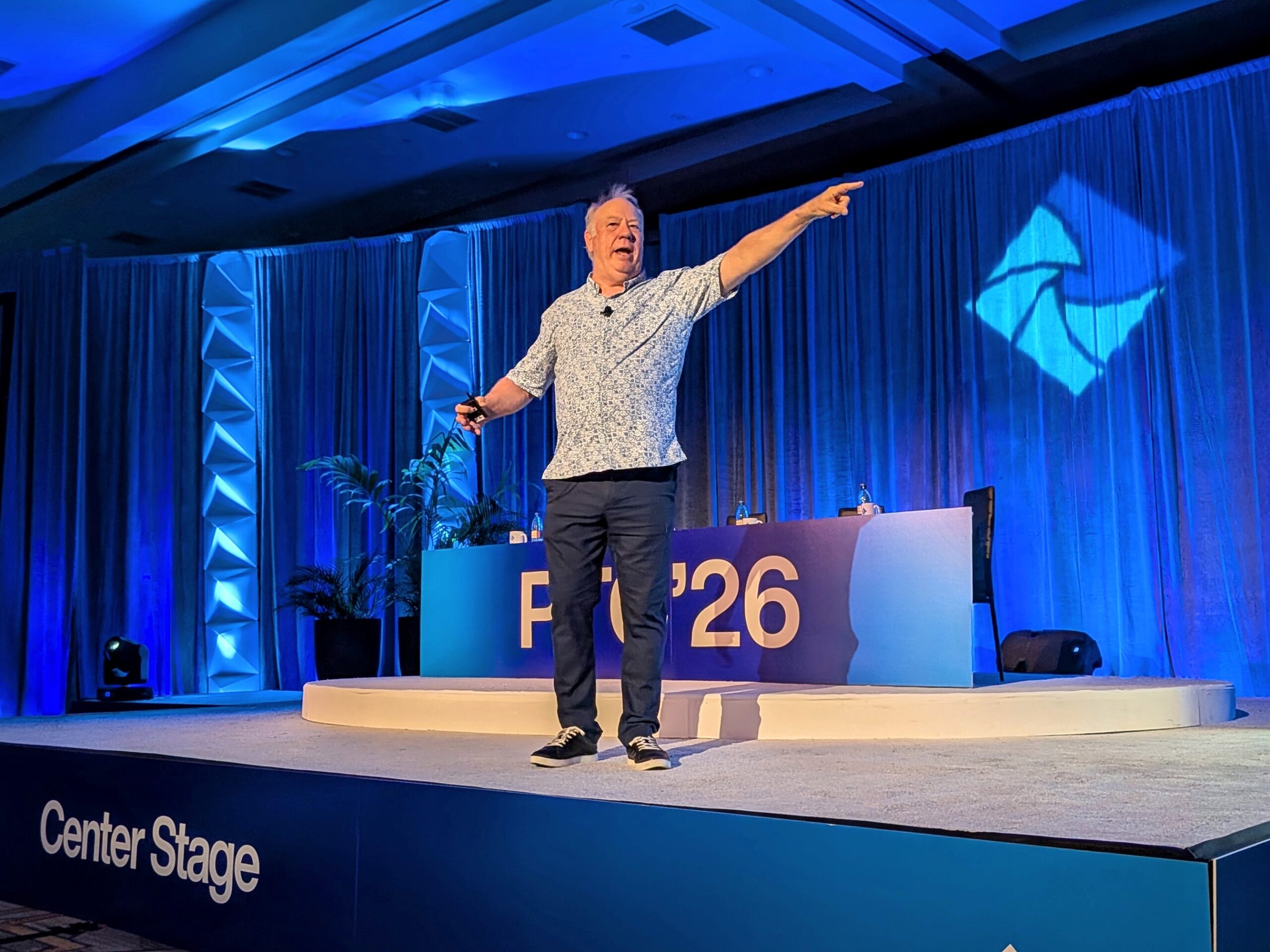
PTC, once a small and sunny telecoms event, is now a fully-fledged AI infrastructure show. The 2026 version, in Honolulu, opened with familiar fanfare about the scale of the global AI build-out. But between the big numbers and flashy pyrotechnics, there was a bracing reality check – about the digital divide between the tech sector and every other industrial market, and in the tech sector itself as critical telcos struggle for a share of the pie.
In sum – what to know:
Digital divide – global economy is seeing a “k-shaped” divergence between AI companies and everyone else.
Critical telecoms – fibre infrastructure underpins the AI boom, but faces its own historical growth challenges.
Choke points – jeopardy comes with power supplies, chip wars, capital constraints, collapsing asset lifecycles.
All the money, all the power, all the promise. The tech industry has never been so omnipotent – in case we need reminding. “It is the end of the world as we know it,” said Bill Barney, founder and chief executive at Asian Century Equity at PTC’26 in Hawaii, yesterday (January 19). He said it repeatedly. It was a lively opening to the Honolulu showcase, as Barney, a fixture on the scene, talked a mile-a-minute about the state of the AI infrastructure market.
“None of us have seen this before,” he said, also repeatedly. PTC’26, once a sunny new-year jaunt for the US telecoms industry, is now about AI infrastructure. The opening keynote and subsequent ‘centre-stage’ sessions mostly discussed the data-centre build-out for hyperscalers to train frontier models; there was stuff about terrestrial and subsea fibre, but there was more about power infrastructure, for example – as the deal breaker for big AI builds.
Barney detailed the economic set-up: that the big eight US tech stocks, up 50 percent in the year, are propping up the global economy, to the point US growth would be flat, or marginally down, otherwise; that the whole of geopolitics, practically, hinges on their fortunes, notably against their present and future equivalents in China. To his credit, Barney was not mincing words: the “canaries and digital coal mines”, the “things that keep you up at night”.
Which is the bit about telecoms, and the eternal struggle to monetize it. “The capital we’re spending doesn’t match what we need to get done… Subscribers aren’t paying what needs to be paid to build these networks,” he said. More broadly, and terribly, there is this “k-shaped economy”, he said, where the tech industry is raking it in, hand-over-fist, while everything else goes south. “The rest of the industries are kind of going like this,” he said, pointing down.
It is the elephant in the room – besides the geopolitics, which cleaves to this industry-splitting digital divide, and the health of the planet, tied to discussion about how to fuel the AI boom. “Tech companies are accelerating, while the rest of the stock market… is declining. Bricks-and-mortar companies are not doing that well. And it’s not just the US; it’s around the world. Which is causing a lot of the challenges, not only with the economy, but also with politics.”
Barney went on: “There’s two groups: the people that are making money and the people that aren’t… Unfortunately, whether we like it or not, we are at the centre of a lot of the problems that are happening across the US and around the world – as caused by the economic situation… Most of the people in this room are happy because their stocks are going up. But a lot of people around the world aren’t so happy about where things are going.”
Digital divide
It was a moment for pause, maybe, for an industry watching fireworks on a paradise island in the Pacific Ocean, which surely cannot believe its luck – and which is, personally and collectively, in thrall to this new economic engine. So Barney’s point that this digital divide between industries extends directly into the tech industry as well, to
He reflected: “Twenty years ago [at this event], we only talked about networks – voice networks, then data networks. This is the Pacific Telecom Conference, right? It was always about telecom. But the telcos have become a very small piece of the ecosystem. They’ve become a utility that transports [the data]… [And yet they] also have to be stronger, faster, and more powerful, [even as] telecoms gets less and less and less of the pie.
“[It’s a] very difficult spot. Fibre operators and mobile operators are seeing a capital crunch. Even though the tech industry is doing very well, [even as] data centers [are] accelerating, it is a hard slog for them. It’s a fight just to keep operating, or even to grow a little – even as the industry is exploding. They are getting the least amount. But they play probably the most critical role. If you don’t have the networks, you can’t transport the applications.”
This is a retelling, of course; Barney also detailed the awesome scale and unknowable potential of this global AI building project. For its part, PTC is breaking records, he said: the biggest show ever, in 50 years history; standing room only in the submarine sessions on Sunday; 6,000 people for the Nokia-sponsored reception on Monday night, he said – the first time the event had hosted fireworks since 2001 (“and we all know what happened after that”).
Otherwise, the industry is building gigawatt AI data centres in 19 months – where it used to take five years to build a cloud data centre with a fraction of the processing requirements. “We are in a new place, and it’s a great place with a lot of positive elements, as well as negative things. Our industry is the leading and fastest growing part of the economy, and we are changing people’s lives. We will change human lives.” You get the idea.
More interesting, always, is the mechanics of it, to see how to finish the project, and see where it actually goes – and to assess the jeopardy along the way. And Barney’s address pointed to all the pitstops. “Not to scare people, but there are some things we’ve got to keep in the back of our minds as we go forward,” he said. The biggest challenge, maybe, is power. “We’ve got a situation where we need electricity very, very fast.”
He said: “In the US, there’s a 20-30 percent gap between the power that’s going to show up and the power that’s needed. So a big problem is how to accelerate that side of the industry.” Gas? Steam? Nuclear? Everything’s on the table, and nothing is straightforward. Microsoft’s new Fairwater data centre complex in Wisconsin uses more power than the city of LA – monster urban power centre, by any stretch.
There will be seven such campuses in the US by the end of 2026, and 19 by the end of 2027. “This is the beginning of the future,” he said. Anthropic has just built a data centre (somewhere) in “less than two years”, he said. “Which is unheard of… It requires a gigawatt of power, and the power industry can’t get to a gigawatt of power in two years. As an industry, we’re becoming highly efficient; the challenge is whether the infrastructure can keep pace.”
The situation has forced Google’s hand. Late December, its parent, Alphabet, spent $4.75 billion to buy renewable energy developer Intersect Power in the US to bypass grid issues. “It is the first time a hyperscaler has bought a power company, and, I think, the first in a series of [such deals] over time.” As an aside, it is an example, as well, of how over-the-top software giants from the internet age are becoming capital-intensive infrastructure companies.
Tech order
Just like telcos. And Barney posed a question, here, about whether this AI build-out will create a new tech order – or rather, implicitly, whether the same internet giants will be top when it does. He pointed to a changing of the guard among bricks-and-mortar data-centre companies, at least. “If you look at the top of the chart,” he said, pointing to another (great) slide (see above), “that’s Digital Realty, which has been the leader for the last few decades.
“Going forward, new data centre operators will be bigger than Digital Realty, and they’ll do it with just two campuses or two buildings. The reality is we could be in a position at some point where this entire chart, these companies, these darlings of the internet on the stock market, might not even be in the top one, two, three; they could drop four or five slots. And that could happen in the next two or three years.”
Which supposes, perhaps, that the next five years of infrastructure building will continue to be about centralised AI training centres, as much as about distributed hybrid infrastructure for inference and private edge control. Either way, the message was that change is happening fast, and everything is up for grabs. It was a packed presentation; Barney skipped about the neocloud providers (“I call them nouveau tech, because they don’t like to be called neoclouds”), the submarine industry, the chips sector, and the whole China story, as well.
He commented: “Digital infrastructure is changing. How we operate the data center is very different from even just two years ago. Which has an impact in terms of investment. If you look at the ecosystem, you start to realize there are some very big chinks in the armour as we start to look at the digital ecosystem as it goes forward.” RCR Tech will get into the bones of it as it unpacks other sessions and interviews at PTC’26 over the next weeks.
But to leave it here, for some further pause, Barney addressed another choke point for the market: the shelf life of GPUs. He said: “A data centre used to be a cloud data centre; now it is an AI data centre. [Which means] the bricks and mortar piece is a lot less in terms of the whole ecosystem [and] GPUs are a much larger component… The problem is the life of a GPU is a year, two years, three years. Typically, you’d have five year cycles with these chips.
“Now you’re getting cycles of less than a year in some cases – and then they become obsolete. So just from a financing perspective, you’ve got growth in low life assets, which don’t live very long, and a decline in long term assets, in the actual infrastructure to build the data centres. Which creates a new situation where it’s going to be more difficult to finance data centers using debt. It will happen over time, but this is a reality.”
About PTC: The Pacific Telecommunications Council (PTC) conference is a four-day event held annually in January in Honolulu, Hawaii. It serves as a major hub for global digital infrastructure, telecommunications, and ICT (Information and Communication Technology) industry leaders to collaborate, connect, and discuss industry trends like AI, subsea cables, and satellite networks.

