In a world where everything is mission-critical, no one can afford a failed connection
Every access technology fails — fiber cuts, power outages, overloaded 5G cells. Further, user expectations have changed; home connectivity today is mission-critical: remote work, school assignments, telehealth, payments, streaming, gaming. When fiber drops and everyone switches to their phone hotspot, 5G collapses too. But a hybrid gateway, MediaTek’s Vice President of Product and Technology Marketing James Chen said, allows dynamic failover to maintain usable connectivity under any condition.
According to MediaTek Vice President of Product and Technology Marketing James Chen, hybrid gateways are designed to solve a structural problem in today’s connectivity model: overreliance on a single last-mile technology. “Technologies, even though they’re tried and true, may sometimes fail,” Chen said. And today, “everything is mission critical. There’s nothing non-mission critical anymore.”
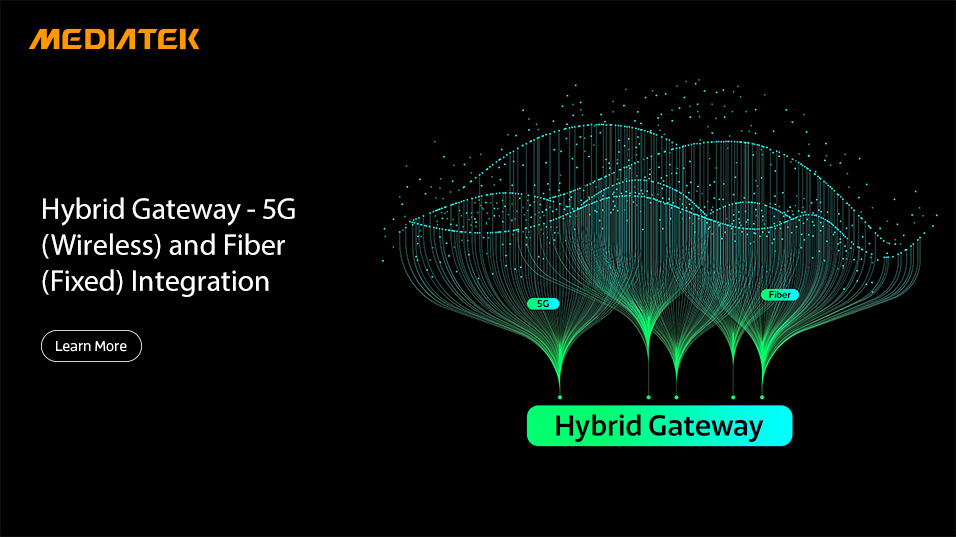
A hybrid home gateway isn’t simply a fiber router with a 5G backup connection. Chen described it as a fundamentally new architecture — one that integrates multiple access technologies inside a single device and dynamically shifts traffic between them as conditions change. Fiber may be the primary connection, but when it degrades or fails, traffic can move seamlessly to 5G. Over time, that architecture is expected to expand further, incorporating satellite connectivity as non-terrestrial networks (NR-NTN) become more mainstream.
The goal is constant connectivity, regardless of which access layer is compromised.
Satellite as the next failover layer
“In the future, the backup could be 5G terrestrial, but also satellite,” said Chen, pointing to recent industry moves that underscore why satellite is becoming part of the hybrid conversation. Elon Musk’s acquisition of spectrum assets from EchoStar, for example, signals that satellite is no longer a niche service but a strategic component of future connectivity portfolios.
Satellite’s biggest advantage is independence. Unlike fiber and cellular networks, it isn’t tied to local power grids or terrestrial infrastructure. In scenarios where storms, wildfires, or grid failures knock out both wired and wireless networks simultaneously, satellite can provide a resilient backstop. In a hybrid gateway model, satellite becomes less of a last resort and more of a built-in insurance policy.
Demand cuts across demographics
While hybrid connectivity might sound like a premium feature for power users, Chen emphasized that demand spans virtually every household segment:
- Remote workers who can’t miss live meetings or deadlines
- Students whose assignments, collaboration tools, and testing platforms live entirely in the cloud
- Families reliant on streaming, smart-home systems, and connected entertainment
- Small and home-based businesses that depend on cloud services, point-of-sale systems, and security cameras
In many ways, the modern home now carries availability requirements that rival — or exceed — those of traditional enterprises.
MediaTek believes it is well-positioned to lead this transition. “MediaTek is the only chipset vendor that has consistently invested in both fiber and 5G over the last 20+ years,” Chen said. That dual heritage allows the company to design platforms that natively support hybrid architectures rather than bolting technologies together after the fact.
As connectivity expectations continue to rise, the question is no longer whether failures will happen, but how gracefully networks respond when they do. Hybrid home gateways represent a shift toward resilience by design — acknowledging that in a mission-critical world, connectivity can no longer afford a single point of failure.
Table of Contents