
Table of Contents
One year after the reintroduction of the ANDREW brand to the market—now part of Amphenol—the company is sharpening its role in an industry facing a new set of realities.
In this context, Pedro Torres, CTO Europe at ANDREW, shares his perspective on how the mobile ecosystem is evolving—offering his insights in the following Q&A.
Mobile networks are at a pivotal moment. Demand for traditional services is flattening, while the need to monetize new forms of connectivity is growing. At the same time, expectations for ubiquitous, high-performing networks—both outdoors and indoors—are high.
New technologies, including AI, are transforming network design and operations, while enhanced satellite capabilities are introducing new dynamics of cooperation and competition with terrestrial networks.
The key challenge is clear: networks must deliver more—with greater efficiency, adaptability, and intelligence.
What is the role of ANDREW in the mobile ecosystem?
ANDREW’s role is to enable high performing and efficient networks everywhere, from a packed stadium to a rural community, from downtown financial districts to residential areas. In practical terms this means
- Developing a wide portfolio of solutions in collaboration with our business partners.
- Combining global scale with local expertise, which allows us to turn new ideas quickly into innovative products and share best practices with our customers.
What does “from the tower top to deep indoors” mean?
From the tower top to deep indoors refers to a comprehensive approach to network performance that ensures continuity of coverage, capacity, and efficiency across all environments. For us, at ANDREW it’s all about continuity.
The first building blocks of high-performing networks are found at the cell site: antennas, RF conditioning, power solutions, and the telecom cabinets that protect and support this equipment under different environmental and operational conditions. These elements play a critical role in shaping user experience, both outdoors and indoors, by delivering coverage and capacity while optimizing energy consumption.The other key building blocks are dedicated solutions typically deployed in special locations with high business impact (stadiums, airports, metro…). They leverage our ERA® DAS system.
How will mobile networks evolve in the next few years?
The key trend is that challenges are increasing.
Spectrum is limited, yet the number of bands deployed grows. Site constraints persist. And energy efficiency is no longer optional. The focus is shifting from simply adding more hardware to designing smarter networks. Performance needs to be engineered within those constraints.
At the same time, networks are becoming more automated and demand a constant supply of high-quality data to AI enabled systems.
This is something we can already address today. Our antennas, equipped with sensors, can assist in the installation, troubleshooting, and network optimization. These sensors can feed data into AI-enabled systems, supporting digital twin implementations, as well as more advanced planning and optimization features. In the future, they may even be able to sense their surroundings.
The future of network performance lies in intelligence, adaptability and programmability. Our products also evolve in the same direction.
What defines a leading antenna manufacturer?
A leading antenna manufacturer is defined by its long-term vision, scale, ability to innovate and to deliver. This requires:
- Deep understanding of mobile networks and technologies
- Strong R&D capability to quickly turn ideas into real products
- A comprehensive portfolio to serve different deployment scenarios
- A resilient, regionally diversified manufacturing and supply-chain model to mitigate risks arising from geopolitical and trade uncertainties
From a product perspective evaluation has evolved significantly. As an example, traditionally, the focus for antennas was on specific parameters like gain or beamwidth. These still matter, but they no longer tell a full story.
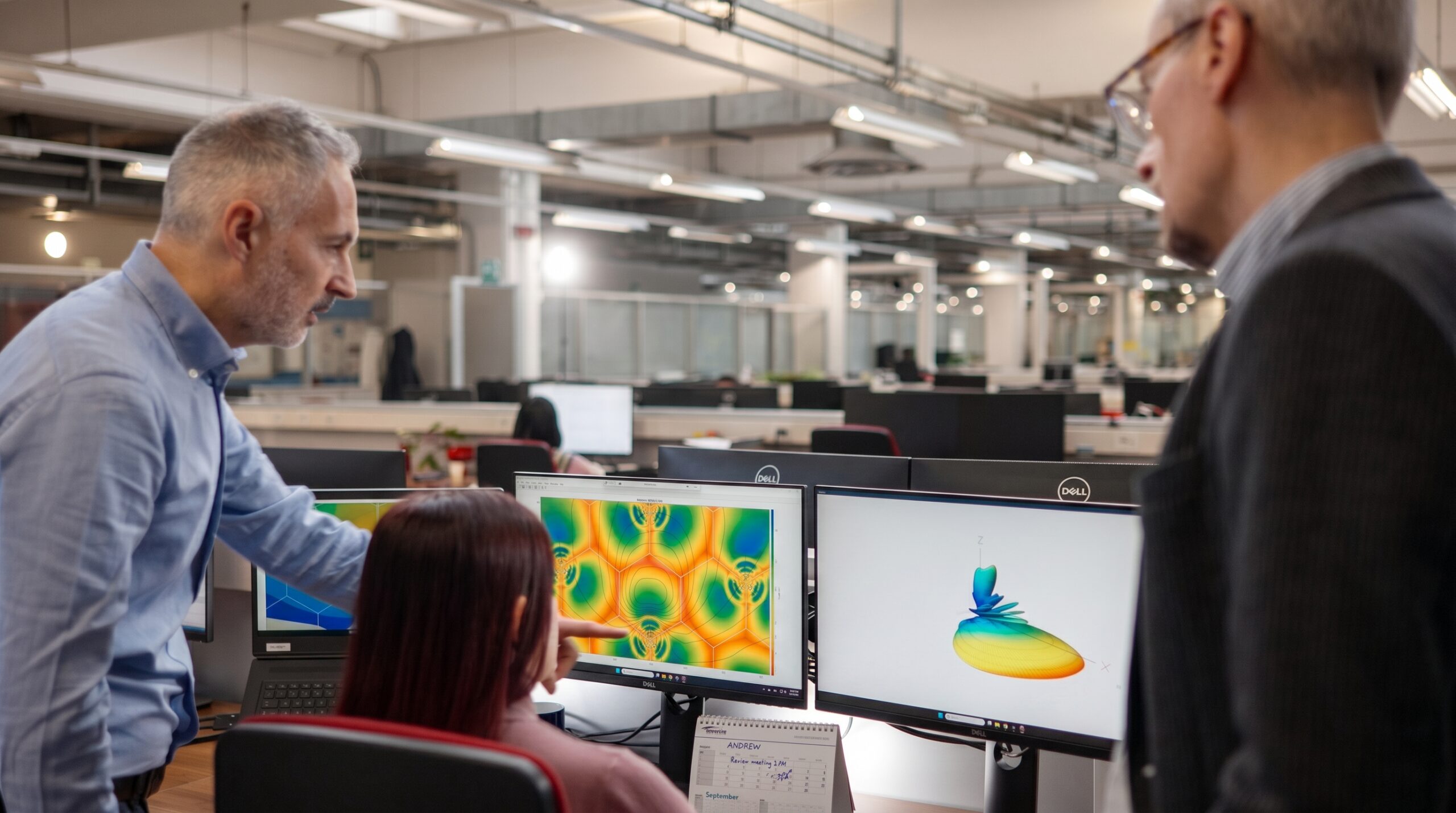
Having a good understanding of the relationship between 3D antenna patterns and network performance is a must. At ANDREW we have conducted extensive research in this field and have summarized the key findings in a white paper published in 2025 (link). This paper reflects the importance of antennas for mobile networks and the implications on coverage and capacity. The shift is clear: performance must be evaluated at system level, not just antenna level.
What are the key pillars of antenna innovation today?
Antenna innovation today is driven by three main pillars:
- Efficiency – spectral efficiency, energy consumption, space, windload
- Precision – enabling accurate beam shaping and reducing interference
- Simplification – reducing deployment complexity and footprint
These pillars translate into tangible solutions:
- SEED® technology enhances network performance and energy efficiency
- CleanBeam™ improves beam accuracy and minimizes sidelobes
- MOSAIC® platform simplifies active antennas’ deployment
Innovation is no longer about adding features—it is about delivering measurable improvements in real network performance.
What does the cell site of the future look like?
The cell site of the future is designed and built with efficient and sustainable solutions that enable a cost-effective RAN evolution and improved user experience. It can serve one or multiple operators and is equipped with features enabling automation.
What should operators prioritize today?
Different operators have different business strategies, but in general they focus on three strategic priorities:
Simplicity – reducing complexity in deployment and operation
Scalability – ensuring networks can grow with demand
Sustainability – optimizing energy consumption and long-term value
The goal is to balance performance today with the flexibility to adapt tomorrow.