


The O-RAN Alliance was developed to drive advancements in RAN by separating the management and control plane from the user data processing plane
3GPP Radio Access Network (RAN) technology has evolved from the second through third, fourth and fifth generations, to significantly increase air-interface efficiency while supporting new services. During that time, commercial RAN deployments surged globally as operators rushed to expand network capacity to meet the ever-increasing user throughput demand.
While commercial rollouts were significantly increasing, the operations and management efforts were getting exponentially complicated. Lack of open interfaces and proprietary vendor solutions prevented the potential gains of Automation and Self Organizing Network (SON) from being fully realized.
This prompted the industry, mainly driven by network operators, to form the O-RAN Alliance to drive advancements in RAN by separating the management and control plane from the user data processing plane. This new disaggregated and open RAN architecture, utilizing software driven cloud technologies, leveraging open interfaces, intelligence and automation, laid the foundation to empower network operators to efficiently manage and operate their networks without being constrained by vendor proprietary solutions.
The cornerstone of the Open RAN architecture, the RAN Intelligent Controller (RIC), brings artificial intelligence to the wireless access network by leveraging advanced analytics and machine learning to make data-driven decisions. This capability enables more sophisticated optimization strategies, predictive maintenance and automated network adjustments.
Figure 1. O-RAN architecture overview
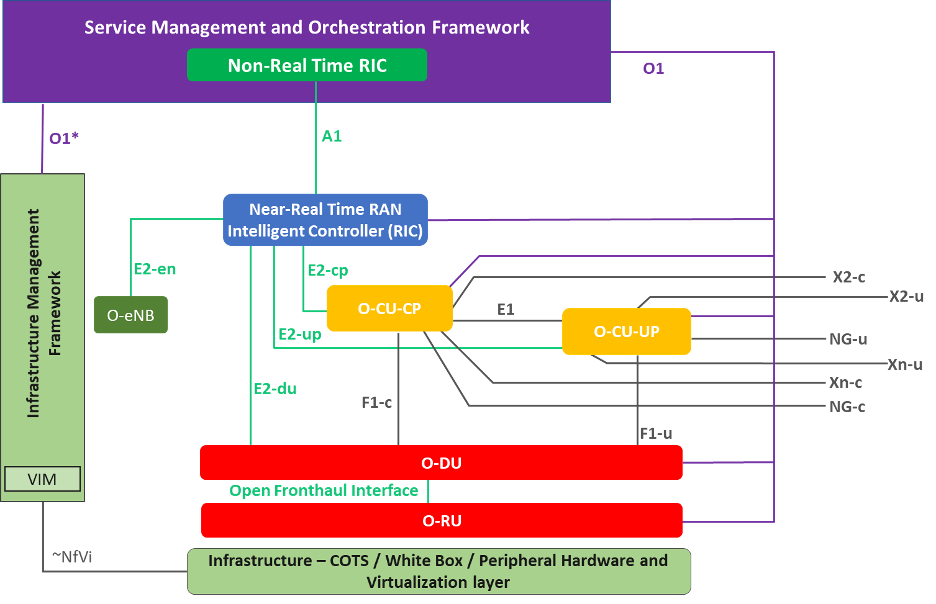
Driven by the different time scales required for real-time adjustments and modifications that impact long-term network behavior, RIC is split into two platforms:
- Non-Real-Time RIC (Non-RT RIC) provides policy-based management and long-term network planning and optimization; it operates on timescales greater than 1 second.
- Near-Real-Time RIC (Near-RT RIC) offers dynamic control and resource optimization of radio resources, while making rapid decisions within the 10 milliseconds to 1 second time scale.
To eliminate vendor lock-in, both RIC platforms rely on open interfaces that utilize publicly available and widely adopted protocols and open data models. For business logic (rApps) delivered by the Non-RT RIC, the REST (Representational State Transfer) paradigm is followed for the R1, A1 and O1 interfaces, while for time critical engineering logic (xApps), delivered by the Near-RT RIC, the SCTP (Stream Control Transmission Protocol) is used over the E2 interface.
Furthermore, MLOps features like data pipelining, model management, training and inference functions are also supported by the RIC, enabling an AI native network control and operations.
Use cases and implementations
Aimed to improve operational efficiency, network performance and vendor interoperability, several use cases have been defined and demonstrated at events like Mobile World Congress (MWC), the Linux Networking Foundation (LNF) and The National Telecommunications and Information Administration (NTIA) RIC Forum.
These demonstrations span across:
- Radio resource utilization and optimization including coverage, capacity, optimization, load balancing, traffic steering and slice resource optimization
- Quality of experience optimization
- Energy savings
- Spectrum sharing
- Verticals (i.e., UAV, V2X)
Furthermore, to bring forward novel use cases, advance development and foster interoperability between RIC, rApp and xApp implementations take the stage, twice a year during the bi-annual O-RAN Global PlugFests. CableLabs has been a participating host lab since 2021 driving innovation and standardization in radio access networks.
Emerging Trends and Future Directions
Looking forward, several prominent themes are beginning to shape the landscape of RAN Intelligent Controller.
- Leverage cutting edge AI/ML advancements. Recent standardization efforts enable the exposure of machine learning workflows like model training, registration and deployment over the R1 and A1 interfaces, allowing for independent lifecycle management between the application logic (rApp, xApp) and ML models. As a result, engineers can iterate on model training without modifying the underlying application code, leading to faster model iteration. This also simplifies model updates and replacements, without affecting the application codebase. By decoupling machine learning from application logic, operators can leverage the latest advancements in artificial intelligence and machine learning to deploy enhanced capabilities such as predictive maintenance and ultimately autonomous network management sooner.
- Greater interoperability across vendors. While most RIC use cases are still implemented on single vendor solutions, there is growing demand within the O-RAN Certification and Badging program to finalize certification criteria, including security, for the A1, R1 and E2 interfaces. This will facilitate the development of a robust multi-vendor ecosystem for xApps and rApps, empowering operators to select best-of-breed solutions tailored to their specific network needs.
- Shared spectrum. Existing shared spectrum management challenges in CBRS and upcoming bands like 3.1 GHz could be addressed by the RIC, enabling efficient dynamic spectrum sharing between the government and private sector through regulator approved xApps, rApps and potentially dApps (when sub-ms control of radio resources is required).
- Seamless connectivity In the network of the future, also described in CableLabs’ Technology Vision, users will be able to access information anywhere, on any device, regardless of the underlying access technology. To deliver this seamless connectivity, service providers will evolve beyond traditional roaming agreements to offer integrated-access services. We foresee the future evolution of RIC playing an important role in orchestrating and coordinating resources across diverse and heterogenous network environments tailored to a user or application QoE profile.
Challenges and open issues
Despite significant progress in standardization, testing and live demonstrations over the past few years, RIC still faces challenges to deliver the operational efficiencies operators urgently need. Key areas requiring attention are:
- Deployment challenges: The widespread deployment of radio resources of 4G and 5G on vendor-proprietary hardware and software has created a significant barrier to RIC. deployment. The lack of a clear migration path from these legacy systems, combined with the long baseband hardware refresh cycle, hinders the transition to Open RAN architecture.
- Security concerns related to AI and the threats they may pose to network operations. ML models will need safeguards to avoid misbehavior. Additionally, a trusted repository where these applications can be vetted for conformance, interoperability and security may be needed.
- Lack of publicly available open datasets for training ML models that would power rApps and xApps.
Conclusion
As cloudification and softwarization continue to transform the wireless industry, the evolved Radio Intelligent Controller (RIC) will be a key component of future radio networks enabled by a robust interoperable multi-vendor ecosystem, leveraging AI/ML to offer ubiquitous and seamless connectivity while unlocking the hidden opportunities of shared spectrum.
Table of Contents

