

RCR Wireless
  • News
  • Channels
    • 5G
    • 6G
    • BSS OSS
    • Carriers
    • IoT
    • Network Infrastructure
    • Open RAN
    • Private 5G
    • Telco AI
    • Telco Cloud
    • Test & Measurement
  • Resources
    • Reports
    • Webinars
    • White papers
    • AI Fundamentals
    • Analyst Angle
    • Editorial Calendar
    • Fundamentals
      • 5G NR Release 17
      • AI
        • Telco AI in 2025
    • Podcasts
      • Let’s Get Digital with Carrie Charles
      • Wireless Connectivity to Enable Industry 4.0 for the Middleprise
      • Well Technically…
      • Will 5G Change the World
      • Accelerating Industry 4.0 Digitalization
  • AI Infrastructure
  • Programs
  • Events
  • RCRtv
  • Advertise
  • Subscribe
Monday, July 6, 2026
RCR Wireless
  • News
  • Channels
    • 5G
    • 6G
    • BSS OSS
    • Carriers
    • IoT
    • Network Infrastructure
    • Open RAN
    • Private 5G
    • Telco AI
    • Telco Cloud
    • Test & Measurement
  • Resources
    • Reports
    • Webinars
    • White papers
    • AI Fundamentals
    • Analyst Angle
    • Editorial Calendar
    • Fundamentals
      • 5G NR Release 17
      • AI
        • Telco AI in 2025
    • Podcasts
      • Let’s Get Digital with Carrie Charles
      • Wireless Connectivity to Enable Industry 4.0 for the Middleprise
      • Well Technically…
      • Will 5G Change the World
      • Accelerating Industry 4.0 Digitalization
  • AI Infrastructure
  • Programs
  • Events
  • RCRtv
  • Advertise
  • Subscribe
Add RCR Wireless as a preferred source on Google
  • Qualcomm 6G Insights
  • Huawei Content Hub
  • Qualcomm – 6G Vision
  • OSS/BSS Channel
RCR Wireless
RCR Wireless
  • Advanced Mimo
  • Mobile mmWave
  • 5G Positioning
  • Green Networks
  • Metaverse
  • Automotive
  • Industrial and Wide-area IoT
Copyright 2021 - All Right Reserved
Home - RIC reality check—what’s working, what needs more work?
Open RANFundamentals

RIC reality check—what’s working, what needs more work?

by Sean Kinney, Principal Analyst November 18, 2024
written by Sean Kinney, Principal Analyst November 18, 2024 Share
LinkedinEmail
Share 0LinkedinEmail
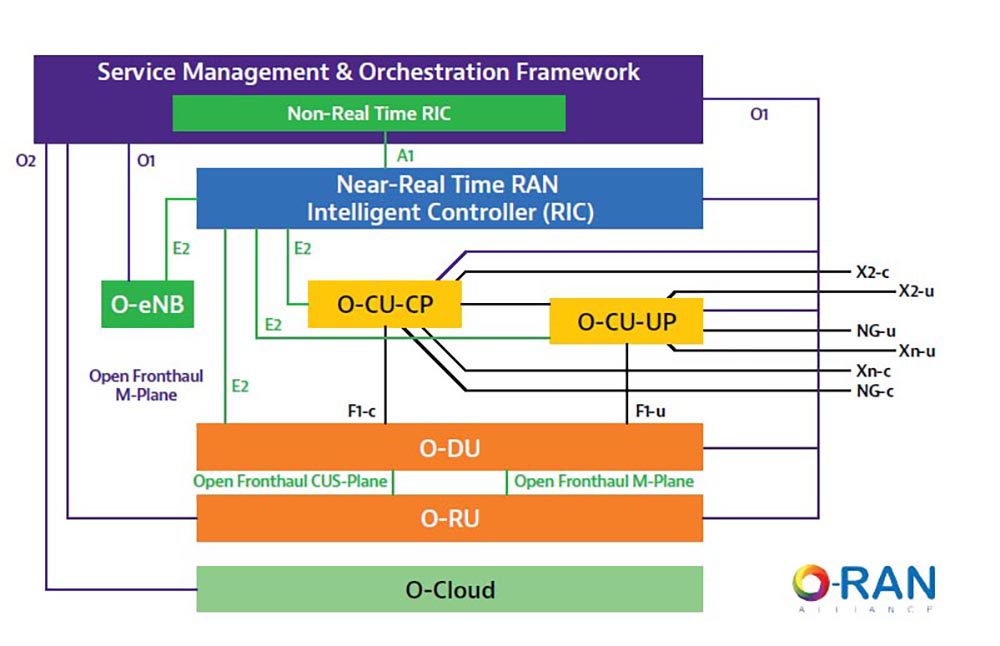
RIC architecture
Image courtesy of the O-RAN Alliance.
181

The RIC can support quick wins but further standardization, and a more coherent approach to AI/ML integration, is needed to foster trust

Back to this idea referenced in the introduction—how to leverage Open RAN interfaces for real-world innovation—it all comes down to the RAN Intelligent Controller (RIC) and the growing pool of rApps and xApps being developed for the non-real time and near-real time RICs, respectively. And with the injection of more powerful, domain-specific AI and ML tooling, this platform for intelligence has broad implications for how networks are dynamically controlled and optimized for the benefit of both operators and users. . 

VIAVI’s Owen O’Donnell, TeraVM marketing manager, listed off a number of RIC use cases, including traffic steering, energy saving, anomaly detection, network slicing, massive MIMO and beamsteering—all “types of features where these tend to be the top of the operators’ use case lists because they’re quick wins and they don’t need operator intervention to run them. And that’s the important thing.” 

He noted that many of the capabilities are evolutions of features previously associated with C-SON and D-SON, and that now need to be migrated to the RIC. O’Donnell gave the example of pairing anomaly detection with traffic steering; one is looking for anomalies then using ML to figure out what associated patterns go along with those anomalies; armed with that information, traffic can be manipulated to ensure service continuity while the issue is mitigated in a more proactive fashion. “It’s a lovely example of two apps working together to spot a KPI, see an issue, improve the situation by making the change, and all automatically within a couple milliseconds without operator intervention or approval required. That’s what’s critical for early deployment—that these apps can be trusted to do a job without making a mess.” 

Covering off the role of the RIC in supporting network slicing and location-based services, O’Donnell, again, got it back to operators trusting the system. He said network slicing is “one of the more realistic 5G killer apps that can be actually delivered,” and operators understand the revenue-generating capabilities of dedicated quality for a particular service. “The biggest concern to operators though is how to guarantee the quality of the session for as long as it’s required. And this an ideal use case for a RIC app…They’re all about revenue generation and faster time-to-market for new features. With network slicing they see exactly this, but their fear is in ensuring the network slice adheres to the SLA they’ve made to the user.” 

With regard to location-based services, O’Donnell pointed out that VIAVI, in addition to its extensive testing work, is also developing applications. He said device location is essentially an additional contextual data input to the RIC and its apps that enable the platform to decide on the best action to take. “The more inputs, the more feeds you have, the better the decision you’re going to make.” 

Ganesh Shenbagaraman, head of standards, regulatory affairs and ecosystems at Radisys, was generally bullish on the future ability of the RIC to deliver meaningful new capabilities to operators, but he was clear that there’s a good deal of standardization work that needs to be done before real-world deployments accelerate at scale. He noted that implementations have to degrees gone ahead of standardization resulting in a bit of a “mixed situation.” 

Looking specifically at challenges around integration of xApps and rApps with CUs and DUs, Shenbagaraman noted that with standardization maturity and more clearly-defined use cases, “the interoperability becomes easier…[But], this is one of the reasons where it is being taken a little slowly into the network.” Operators, he said, are “a little too worried about the impacts and the intended and unintended consequences of the actions being taken.” He likened the maturation curve to Open RAN fronthaul which, after more than five years of standardization, compromise and testing, is now being deployed broadly in commercial networks. 

Considering the importance of AI and ML in the RIC and attendant apps, Shenbagaraman said the telecoms industry at large needs to figure out how to move away from business confidential data and establish a larger, anonymized data pool; this, he said, would accelerate the broader development and adoption of the RIC and its app ecosystem. “I think the networks are moving to 5G SA now and that becomes a pre-condition for testing more and more scenarios…for these various xApps and rApps…The AI and ML is definitely there and we are going to leverage that.” 

In a bit of sobering, but also lighthearted and hopeful commentary, Michele Polese, a research professor for Open RAN, 5G and 6G at Northeastern University, said that for the RIC, “Right now the expectations are quite low…but I think this is the piece of the overall O-RAN architecture that has the potential to change the most how we interact, deploy and optimize cellular networks.” 

For more from the Open RAN Global Forum, register to view the event on demand.

You Might Also Like
  • Qualcomm Webinar: Agentic RAN Management: Delivering OPEX efficiency and a path to 6G
  • Open Interfaces, Smarter Networks: The O-RAN Advantage for Indoor Deployments
  • Beyond the black box: How TELUS and P.I. Works are redefining network intelligence for the open RAN era
  • Department of War takes aim at closed RAN stacks with open source
  • Rakuten Mobile to deploy 3,000 open mMIMO radios in Japan
  • ‘Beacons of innovation’ — Samsung, Orange expand European vRAN, Open RAN deployments
Share 0 LinkedinEmail
Sean Kinney
Sean Kinney, Principal Analyst

Sean focuses on multiple subject areas including 5G, 6G, Open RAN, hybrid cloud, edge computing, and Industry 4.0. Prior to his work at RCR, Sean studied journalism and literature at the University of Mississippi then spent six years based in Key West, Florida, working as a reporter for the Miami Herald Media Company. He currently lives in Fayetteville, Arkansas.

previous post
Carr tapped as Trump’s choice to lead FCC
next post
Open RAN fronthaul testing considerations—automation is key

White Papers

  • Enea White Paper: Why Intelligent AAA is the Swiss Army Knife of Telecom

  • CSG White Paper: Telco AI Enabler: Mediation’s Defining Role

  • Enea White Paper: Scalable Database Design for 5G and Beyond

  • Supermicro and NVIDIA Whitepaper: Powering sovereign AI at scale

  • VIAVI Whitepaper: RAN scenario generators and their critical role for future-proofing AI-native RAN in Advanced 5G and 6G networks

Editorial Reports

  • Report: Scaling Optical Networks For The Hyperscale And AI Era

  • Test And Measurement Market Pulse Report

  • Editorial Report: Securing telecom infrastructure for the quantum era

Webinars

  • Webinar: Rethinking the RAN as AI, cloud and openness converge

  • Webinar: Scale-Up, Scale-Out, Scale-Across – Building AI-Era Network Fabrics

  • Webinar: NTN in motion – evolving standards, expanding services

  • Webinar: Noise-Figure Measurements with RFmx and PXI VSTs

  • Qualcomm Webinar – Building the 6G Standard: Key developments to know

Since 1982, RCR Wireless News has been providing wireless and mobile industry news, insights, and analysis to mobile and wireless industry professionals, decision makers, policy makers, analysts and investors.

Facebook Twitter Youtube Linkedin Envelope Rss

Useful Links

  • Subscribe
  • About RCR Wireless News
  • Contact Us
  • Advertise
  • Editorial Calendar
  • Archive
  • RSS
  • Wireless News Archive
  • Subscribe
  • About RCR Wireless News
  • Contact Us
  • Advertise
  • Editorial Calendar
  • Archive
  • RSS
  • Wireless News Archive

Edtior's Picks

Enea White Paper: Why Intelligent AAA is the Swiss Army Knife of Telecom
Huawei outlines AI-centric network roadmap for telecom monetization
Why consolidation will reshape MDU connectivity (part 3/3) – Analyst Angle

Latest Articles

Enea White Paper: Why Intelligent AAA is the Swiss Army Knife of Telecom
Huawei outlines AI-centric network roadmap for telecom monetization
Why consolidation will reshape MDU connectivity (part 3/3) – Analyst Angle
Quantum Safe Networks Forum 2026

© 2026 RCR Wireless News All Right Reserved. Developed by Eight Hats.

Cookie Policy | Privacy Policy

RCR Wireless
  • News
  • Channels
    • 5G
    • 6G
    • BSS OSS
    • Carriers
    • IoT
    • Network Infrastructure
    • Open RAN
    • Private 5G
    • Telco AI
    • Telco Cloud
    • Test & Measurement
  • Resources
    • Reports
    • Webinars
    • White papers
    • AI Fundamentals
    • Analyst Angle
    • Editorial Calendar
    • Fundamentals
      • 5G NR Release 17
      • AI
        • Telco AI in 2025
    • Podcasts
      • Let’s Get Digital with Carrie Charles
      • Wireless Connectivity to Enable Industry 4.0 for the Middleprise
      • Well Technically…
      • Will 5G Change the World
      • Accelerating Industry 4.0 Digitalization
  • AI Infrastructure
  • Programs
  • Events
  • RCRtv
  • Advertise
  • Subscribe
RCR Wireless
  • News
  • Channels
    • 5G
    • 6G
    • BSS OSS
    • Carriers
    • IoT
    • Network Infrastructure
    • Open RAN
    • Private 5G
    • Telco AI
    • Telco Cloud
    • Test & Measurement
  • Resources
    • Reports
    • Webinars
    • White papers
    • AI Fundamentals
    • Analyst Angle
    • Editorial Calendar
    • Fundamentals
      • 5G NR Release 17
      • AI
        • Telco AI in 2025
    • Podcasts
      • Let’s Get Digital with Carrie Charles
      • Wireless Connectivity to Enable Industry 4.0 for the Middleprise
      • Well Technically…
      • Will 5G Change the World
      • Accelerating Industry 4.0 Digitalization
  • AI Infrastructure
  • Programs
  • Events
  • RCRtv
  • Advertise
  • Subscribe
@2020 - All Right Reserved. Designed and Developed by PenciDesign
