
RCR Wireless
  • News
  • Channels
    • 5G
    • 6G
    • BSS OSS
    • Carriers
    • IoT
    • Network Infrastructure
    • Open RAN
    • Private 5G
    • Telco AI
    • Telco Cloud
    • Test & Measurement
  • Resources
    • Reports
    • Webinars
    • White papers
    • AI Fundamentals
    • Analyst Angle
    • Editorial Calendar
    • Fundamentals
      • 5G NR Release 17
      • AI
        • Telco AI in 2025
    • Podcasts
      • Let’s Get Digital with Carrie Charles
      • Wireless Connectivity to Enable Industry 4.0 for the Middleprise
      • Well Technically…
      • Will 5G Change the World
      • Accelerating Industry 4.0 Digitalization
  • AI Infrastructure
  • Programs
  • Events
  • RCRtv
  • Advertise
  • Subscribe
Tuesday, July 7, 2026
RCR Wireless
  • News
  • Channels
    • 5G
    • 6G
    • BSS OSS
    • Carriers
    • IoT
    • Network Infrastructure
    • Open RAN
    • Private 5G
    • Telco AI
    • Telco Cloud
    • Test & Measurement
  • Resources
    • Reports
    • Webinars
    • White papers
    • AI Fundamentals
    • Analyst Angle
    • Editorial Calendar
    • Fundamentals
      • 5G NR Release 17
      • AI
        • Telco AI in 2025
    • Podcasts
      • Let’s Get Digital with Carrie Charles
      • Wireless Connectivity to Enable Industry 4.0 for the Middleprise
      • Well Technically…
      • Will 5G Change the World
      • Accelerating Industry 4.0 Digitalization
  • AI Infrastructure
  • Programs
  • Events
  • RCRtv
  • Advertise
  • Subscribe
Add RCR Wireless as a preferred source on Google
  • Qualcomm 6G Insights
  • Huawei Content Hub
  • Qualcomm – 6G Vision
  • OSS/BSS Channel
RCR Wireless
RCR Wireless
  • Advanced Mimo
  • Mobile mmWave
  • 5G Positioning
  • Green Networks
  • Metaverse
  • Automotive
  • Industrial and Wide-area IoT
Copyright 2021 - All Right Reserved
Home - How to test timing and synchronization in an Open RAN network
FundamentalsOpen RANTest and Measurement

How to test timing and synchronization in an Open RAN network

by Sean Kinney, Principal Analyst May 14, 2024
written by Sean Kinney, Principal Analyst May 14, 2024 Share
LinkedinEmail
Share 0LinkedinEmail
timing and synchronization viavi
Image courtesy of VIAVI Solutions.
306

The rise of Open RAN, where multi-vendor radio systems comprising centralized, distributed and radio units are made interoperable, is now decidedly mainstream. Following early commercial deployments from greenfield operators, Open RAN is scaling out in brownfield networks. In addition to the pre-deployment interoperability work, there’s also a need for tight focus on test and measurement for timing and synchronization given the architectural shifts brought about by radio access network (RAN) disaggregation. 

During the recent Test and Measurement Forum (available here on demand), VIAVI Solutions Senior Manager Reza Vaez-Ghaemi took a deep dive into test and measurement for timing and synchronization in increasingly dynamic, disaggregated wireless networks. Citing the relevant (and extensive) associated standards from 3GPP and ITU-T, Vaez-Ghaemi noted the importance of conformance to standards across networking domains. 

Specific to Open RAN, Vaez-Ghaemi said, “O-RAN introduced four lower-layer split (LLS) synchronization configuration modes (LL1-C1 [through] LLS-C4), added requirements for time/phase and frequency budgets, node behavior guidelines and detailed error budget analysis aspects. It also brought in an Open Fronthaul Management plane that defines synchronization attributes that further help more smoothly interoperate solutions from different vendors.” 

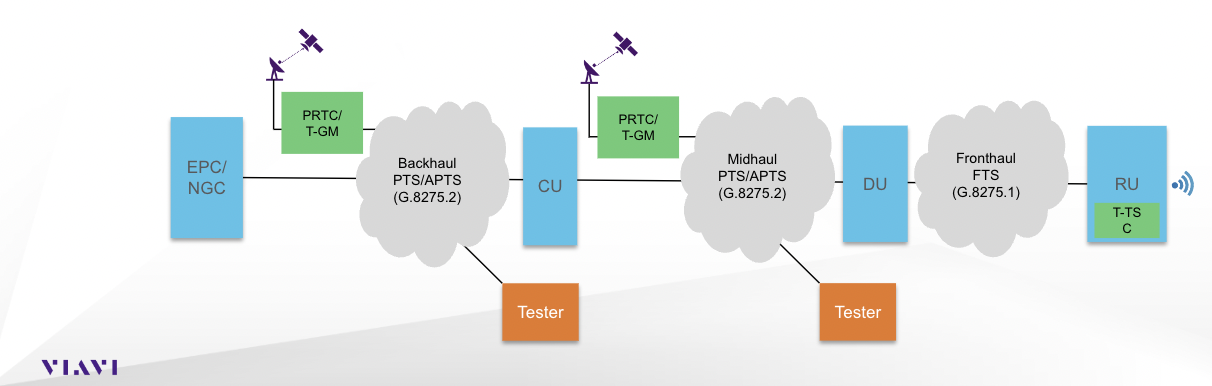
In addition to conformance testing for open distributed units and open radio units, an end-to-end view comes into focus with interoperability testing for fronthaul and midhaul, as well as test requirements for transport networks in fronthaul, midhaul and backhaul. 

In terms of relevant synchronization metrics, Time Alignment Error (TAE) includes relative and absolute figures; time error (TE) is defined as the time differences at a user network interface (UNI) compared to another UNI or based on a Primary Reference Time Clock (PRTC). To put that in context, MIMO diversity transmissions at each frequency need a relative TAE of 65 nanoseconds and 5G intra- and inter-band, non-contiguous carrier aggregation needs a relative TAE of 3 microseconds. 

“The more we get into these advanced wireless services and capabilities, the synchronization requirements increase significantly,” Vaez-Ghaemi said. “We see all these requirements becoming tighter and tighter.” 

In terms of the entire timing and synchronization chain, and how to test across it, the workflow is as follows: 

  • GNSS/GPS installation verification, including antenna location, receiver functionality, cabling integrity, satellite availability and signal strength. Then ensure accurate antenna cable delay is measured and respective bias value is entered into the attached PTP primary.
  • Fronthaul network synchronization testing, including verification of GPS, connection and configuration of sync parameters, and synchronization applications—emulate Precision Time Protocol (PTP) secondary and perform time error measurements, then emulate Synchronous Ethernet (SyncE) and validate frequency offset and Ethernet Synchronization Message Channel (ESMC). 
  • Midhaul/backhaul synchronization testing wherein operators may deploy (Assisted) Partial Timing Support (APTS), emulate Precision Time Protocol (PTP) secondary, and perform two-way packet selected time error and floor packet percentile measurements.
  • SyncE testing, including functionality and configuration of Ethernet Equipment Clock (EEC) in the synchronization path, SyncE Wander Analysis to measure dynamic frequency error in the network, and use the Synchronization Status Message (SSM) to help establish whether the device under test is transmitting the proper quality level
  • Finally, over the air (OTA) synchronization measurement to verify that the radio sync conforms to the appropriate synchronized mode and delivers the expected outcome in terms of frequency and time error versus GPS and time error versus GPS. 

“At the end,” Vaez-Ghaemi said, “this whole thing is about the air interface. That measurement measures basically time/phase and frequency against the GPS or another reference…[It] should be then within that limit 3GPP defined both for frequency and time error.” 

You Might Also Like
  • Real-world network emulation is critical for 5G deployments (Reader Forum)
  • Complexity, convergence, AI and the demand for trust are reshaping telecom testing
  • Test And Measurement Market Pulse Report
  • Anterix: ‘Terrific’ results from NTN testing with Lynk Global
  • Opensignal on fixed broadband: Cable upload speeds jump, FWA improves
  • Qualcomm Webinar: Agentic RAN Management: Delivering OPEX efficiency and a path to 6G
Share 0 LinkedinEmail
Sean Kinney
Sean Kinney, Principal Analyst

Sean focuses on multiple subject areas including 5G, 6G, Open RAN, hybrid cloud, edge computing, and Industry 4.0. Prior to his work at RCR, Sean studied journalism and literature at the University of Mississippi then spent six years based in Key West, Florida, working as a reporter for the Miami Herald Media Company. He currently lives in Fayetteville, Arkansas.

previous post
‘Not a hockey stick, and never was’ – but IoT market to more than double in 10 years
next post
Why Wi-Fi offloading needs a reboot in 2024 (Reader Forum)

White Papers

  • Enea White Paper: Why Intelligent AAA is the Swiss Army Knife of Telecom

  • CSG White Paper: Telco AI Enabler: Mediation’s Defining Role

  • Enea White Paper: Scalable Database Design for 5G and Beyond

  • Supermicro and NVIDIA Whitepaper: Powering sovereign AI at scale

  • VIAVI Whitepaper: RAN scenario generators and their critical role for future-proofing AI-native RAN in Advanced 5G and 6G networks

Editorial Reports

  • Report: Scaling Optical Networks For The Hyperscale And AI Era

  • Test And Measurement Market Pulse Report

  • Editorial Report: Securing telecom infrastructure for the quantum era

Webinars

  • Webinar: Rethinking the RAN as AI, cloud and openness converge

  • Webinar: Scale-Up, Scale-Out, Scale-Across – Building AI-Era Network Fabrics

  • Webinar: NTN in motion – evolving standards, expanding services

  • Webinar: Noise-Figure Measurements with RFmx and PXI VSTs

  • Qualcomm Webinar – Building the 6G Standard: Key developments to know

Since 1982, RCR Wireless News has been providing wireless and mobile industry news, insights, and analysis to mobile and wireless industry professionals, decision makers, policy makers, analysts and investors.

Facebook Twitter Youtube Linkedin Envelope Rss

Useful Links

  • Subscribe
  • About RCR Wireless News
  • Contact Us
  • Advertise
  • Editorial Calendar
  • Archive
  • RSS
  • Wireless News Archive
  • Subscribe
  • About RCR Wireless News
  • Contact Us
  • Advertise
  • Editorial Calendar
  • Archive
  • RSS
  • Wireless News Archive

Edtior's Picks

Enea White Paper: Why Intelligent AAA is the Swiss Army Knife of Telecom
Huawei outlines AI-centric network roadmap for telecom monetization
Why consolidation will reshape MDU connectivity (part 3/3) – Analyst Angle

Latest Articles

Enea White Paper: Why Intelligent AAA is the Swiss Army Knife of Telecom
Huawei outlines AI-centric network roadmap for telecom monetization
Why consolidation will reshape MDU connectivity (part 3/3) – Analyst Angle
Quantum Safe Networks Forum 2026

© 2026 RCR Wireless News All Right Reserved. Developed by Eight Hats.

Cookie Policy | Privacy Policy

RCR Wireless
  • News
  • Channels
    • 5G
    • 6G
    • BSS OSS
    • Carriers
    • IoT
    • Network Infrastructure
    • Open RAN
    • Private 5G
    • Telco AI
    • Telco Cloud
    • Test & Measurement
  • Resources
    • Reports
    • Webinars
    • White papers
    • AI Fundamentals
    • Analyst Angle
    • Editorial Calendar
    • Fundamentals
      • 5G NR Release 17
      • AI
        • Telco AI in 2025
    • Podcasts
      • Let’s Get Digital with Carrie Charles
      • Wireless Connectivity to Enable Industry 4.0 for the Middleprise
      • Well Technically…
      • Will 5G Change the World
      • Accelerating Industry 4.0 Digitalization
  • AI Infrastructure
  • Programs
  • Events
  • RCRtv
  • Advertise
  • Subscribe
RCR Wireless
  • News
  • Channels
    • 5G
    • 6G
    • BSS OSS
    • Carriers
    • IoT
    • Network Infrastructure
    • Open RAN
    • Private 5G
    • Telco AI
    • Telco Cloud
    • Test & Measurement
  • Resources
    • Reports
    • Webinars
    • White papers
    • AI Fundamentals
    • Analyst Angle
    • Editorial Calendar
    • Fundamentals
      • 5G NR Release 17
      • AI
        • Telco AI in 2025
    • Podcasts
      • Let’s Get Digital with Carrie Charles
      • Wireless Connectivity to Enable Industry 4.0 for the Middleprise
      • Well Technically…
      • Will 5G Change the World
      • Accelerating Industry 4.0 Digitalization
  • AI Infrastructure
  • Programs
  • Events
  • RCRtv
  • Advertise
  • Subscribe
@2020 - All Right Reserved. Designed and Developed by PenciDesign

