


RCR Wireless
  • News
  • Channels
    • 5G
    • 6G
    • BSS OSS
    • Carriers
    • IoT
    • Network Infrastructure
    • Open RAN
    • Private 5G
    • Telco AI
    • Telco Cloud
    • Test & Measurement
  • Resources
    • Reports
    • Webinars
    • White papers
    • AI Fundamentals
    • Analyst Angle
    • Editorial Calendar
    • Fundamentals
      • 5G NR Release 17
      • AI
        • Telco AI in 2025
    • Podcasts
      • Let’s Get Digital with Carrie Charles
      • Wireless Connectivity to Enable Industry 4.0 for the Middleprise
      • Well Technically…
      • Will 5G Change the World
      • Accelerating Industry 4.0 Digitalization
  • AI Infrastructure
  • Programs
  • Events
  • RCRtv
  • Advertise
  • Subscribe
Thursday, July 30, 2026
RCR Wireless
  • News
  • Channels
    • 5G
    • 6G
    • BSS OSS
    • Carriers
    • IoT
    • Network Infrastructure
    • Open RAN
    • Private 5G
    • Telco AI
    • Telco Cloud
    • Test & Measurement
  • Resources
    • Reports
    • Webinars
    • White papers
    • AI Fundamentals
    • Analyst Angle
    • Editorial Calendar
    • Fundamentals
      • 5G NR Release 17
      • AI
        • Telco AI in 2025
    • Podcasts
      • Let’s Get Digital with Carrie Charles
      • Wireless Connectivity to Enable Industry 4.0 for the Middleprise
      • Well Technically…
      • Will 5G Change the World
      • Accelerating Industry 4.0 Digitalization
  • AI Infrastructure
  • Programs
  • Events
  • RCRtv
  • Advertise
  • Subscribe
Add RCR Wireless as a preferred source on Google
  • Qualcomm 6G Insights
  • Huawei Content Hub
  • Qualcomm – 6G Vision
  • OSS/BSS Channel
  • RCRTech Roundtable: AI Infrastructure
RCR Wireless
RCR Wireless
  • Advanced Mimo
  • Mobile mmWave
  • 5G Positioning
  • Green Networks
  • Metaverse
  • Automotive
  • Industrial and Wide-area IoT
Copyright 2021 - All Right Reserved
Home - 6G foundry: Rethinking the control plane
5G6G

6G foundry: Rethinking the control plane

by Qualcomm and RCR Wireless News (Sponsored) April 15, 2024
written by Qualcomm and RCR Wireless News (Sponsored) April 15, 2024 Share
LinkedinEmail
Share 0LinkedinEmail
6G foundry: Rethinking the control plane
145

As we gear up for the next generation of wireless connectivity, we’re building on everything we’ve learned

Welcome to the first installment of 6G foundry, a new limited series of OnQ blog posts where we explore the next generation of wireless connectivity. We’ll share how we can apply the lessons learned from the current and previous generations of mobile communication technology to shape a more efficient and flexible network for the future. Today, we start with a look at the evolution of network control and the development of the logical channel used to carry control traffic — the control plane.  
Qualcomm Image 1
6G foundry: Rethinking the control plane 9

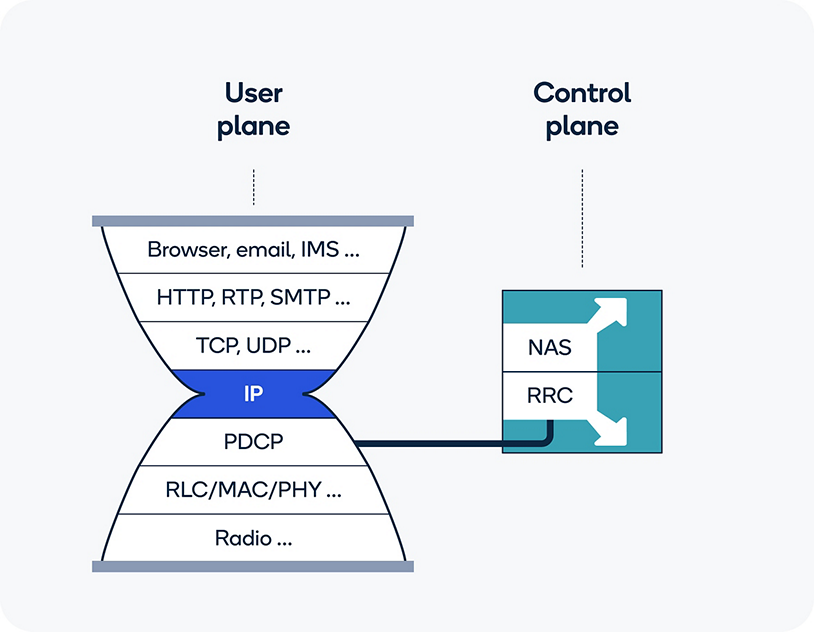
The 4G and 5G user plane stack reflects the Internet’s “hourglass model.”

Where are we at with 5G now and how did we get here?

The evolution towards 6G has its origins in the convergence of two separate systems: data networks (internet) and cellular networks (2G). These networks had distinct design paradigms during their inception. Data networks were built to scale and serve heterogeneous devices for various services, while cellular networks were designed for homogeneous devices for a single service — primarily voice communication.

The emergence of smartphones, coupled with the adoption of the Internet’s “hourglass model” as a design driver for data connectivity, played a significant role in the success of 4G. By supporting IP in the user plane, 4G revolutionized how the world communicates by connecting a mobile device (e.g., smartphone) to the Internet. However, the architecture and design philosophy introduced in 3G, including a separate control plane, were largely retained in 4G and subsequently 5G.

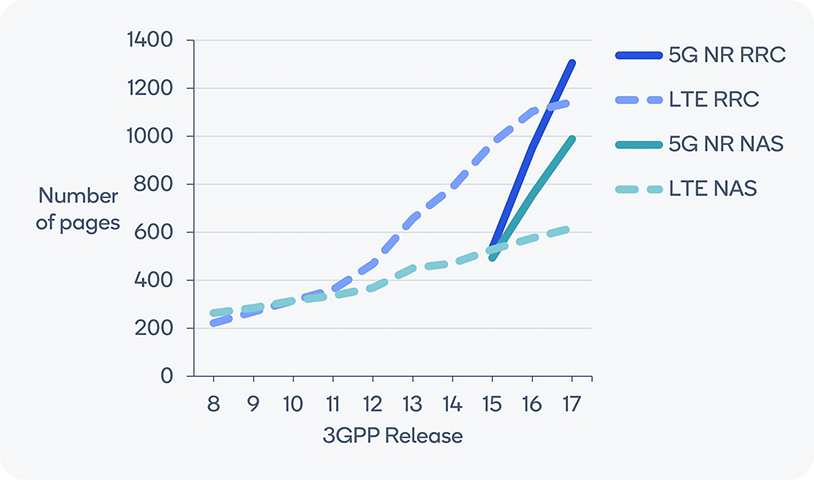
While 4G adopted the IP model for the user plane, it continued to rely on a separate control plane as was first introduced in 3G. The non-access stratum (NAS) and radio resource control (RRC) protocols for the control plane grew in complexity with more services in each 3GPP release.

As 4G evolved, new features were introduced to expand capabilities of the system that led to the expansion of the control plane. Some of the complexity was required to support new horizontal features on the link such as carrier aggregation and dual connectivity, while additional support was defined for new verticals including Internet of Things (IoT) and Vehicle-to-Everything (V2X). However, other features were introduced to the protocol stack to enable services to be hosted as part of the NAS/RRC control plane protocols, e.g., NAS protocol services included location while RRC protocol services included data collection, such as minimization of drive tests (MDTs).

“Introducing new control-plane services is challenging because they often impact various network entities.”

Also, services on top of NAS or RRC require specialized knowledge for development, introduction, testing and maintenance compared to the more mainstream IP-based services. While the control plane feature set became richer, their adoption remained limited in part because of the impact to existing network entities. This not only poses a challenge for new market entrants wanting to develop these services but also to operators wanting to deploy these services, including the additional cost of upgrading of legacy infrastructure.

Taking a step in the right direction, one of the key themes of the 5G standard was the service-based architecture (SBA). 5G SBA replaced complex and domain-specific protocols like GTP-C with mainstream protocols such as HTTP/2 for transport and JavaScript Object Notation (JSON) as the serialization protocol. However, while this was a paradigm shift, it only applied to core network entities and fell short of benefitting network services involving the user equipment (UE).

As we transition from 4G to 5G, we find that 5G has largely followed the same trajectory as its predecessor. The NAS and RRC protocol stacks in 5G have become even more complex. While the feature set has grown substantially, the adoption of control plane services continues to remain sparse. The limited success of 5G-based control plane services poses obstacles to operators wanting to address promising new business opportunities.
Qualcomm Image 2
6G foundry: Rethinking the control plane 10

Growth of the control plane as the 3GPP standard evolved.

Essential steps towards 6G development

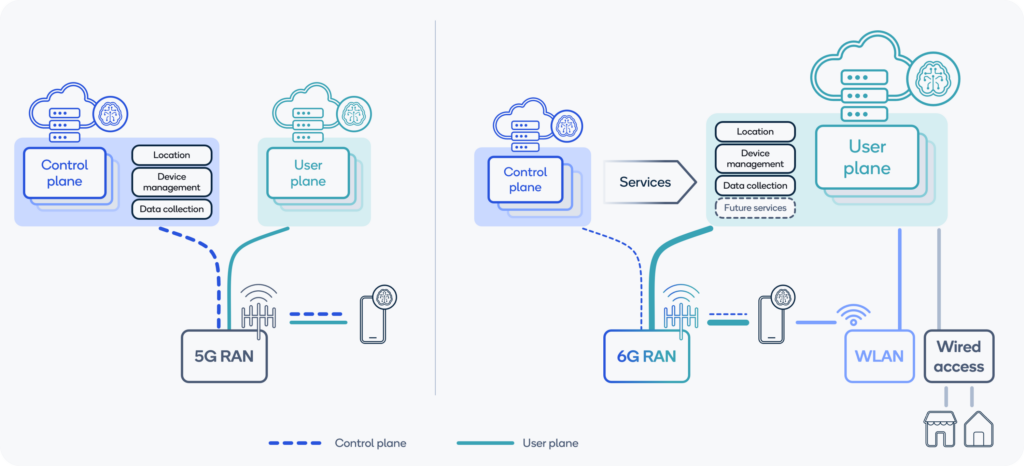
To overcome these challenges, we propose a user plane-first design approach for 6G to enable unified access to services. At the center of a user plane-first design approach is a lean control plane that only addresses the aspects fundamental to maintaining connectivity and establishing data services, such as security, mobility and session management. We can then simplify the architecture and enable operators to introduce and operate services more efficiently.

“In the 6G network architecture, services such as location, data collection, industrial IoT and other future 6G services could run as IP-based services over the user plane.”

This approach could benefit from the scale and ecosystem of Internet services and protocols, expanding the development landscape for network services. It would also simplify the introduction and operation of services, benefiting both operators and users.

Furthermore, this user plane-first design approach naturally aligns with the new cloud-based deployments, eliminating the need for additional hardware. It also allows for “G-agnostic” services that can work seamlessly across different generations of cellular networks. Additionally, it opens the possibility of backporting services to previous generations or cross-porting them to other wireless technologies such as Wi-Fi networks and even wired access technologies like fiber and cable.
Qualcomm 3
6G foundry: Rethinking the control plane 11

Prioritizing user plane services and a lean control plane for higher service adoption.

What’s next for 6G technology?

As we embark on the journey towards 6G, it is essential to learn from the past and embrace a new approach in network architecture design. By adopting a user plane-first design strategy for network services and leveraging the design principles of the Internet, we can create a more efficient, scalable and innovative 6G network.

In our upcoming blog posts for 6G foundry, we will delve deeper into how 6G networks could be deployed and how they could bring value to end users with new experiences. Join us as we unravel the possibilities and shape the future of wireless connectivity. Stay tuned for our next installment of 6G foundry.


Sign up for our wireless technology newsletter
Follow us on X

You Might Also Like
  • Huawei sees Mobile AI driving new wave of uplink network investment
  • South Korea launches AI-RAN project to advance industrial AI
  • Rakuten Mobile expands O-RAN footprint with 1Finity radios
  •  VodafoneThree puts P.I. Works’ SMO at the center of network transformation
  • Monday (telco diary) | Consolidation, orchestration, automation
  • Mimosa Networks and Viaero Wireless demonstrate scalable 5 GHz and 6 GHz fixed wireless broadband with AFC

Table of Contents

  • As we gear up for the next generation of wireless connectivity, we’re building on everything we’ve learned
    • Where are we at with 5G now and how did we get here?
  • “Introducing new control-plane services is challenging because they often impact various network entities.”
    • Essential steps towards 6G development
  • “In the 6G network architecture, services such as location, data collection, industrial IoT and other future 6G services could run as IP-based services over the user plane.”
    • What’s next for 6G technology?
Share 0 LinkedinEmail
Qualcomm and RCR Wireless News (Sponsored)

previous post
High demand and good growth for smart-city tech – but same challenges remain
next post
Kagan: US Cellular now offers private wireless for the enterprise

White Papers

  • Norton eBook: The 2026 Telco Playbook

  • Enea White Paper: Why Intelligent AAA is the Swiss Army Knife of Telecom

  • CSG White Paper: Telco AI Enabler: Mediation’s Defining Role

  • Enea White Paper: Scalable Database Design for 5G and Beyond

  • Supermicro and NVIDIA Whitepaper: Powering sovereign AI at scale

Editorial Reports

  • Market Pulse Report: Telco AI in 2026 – Trends, Challenges and Opportunities

  • Nvidia Report: The State of AI in Telecommunications: 2026 Trends

  • Report: Scaling Optical Networks For The Hyperscale And AI Era

Webinars

  • Webinar: Building 6G — aligning technology, policy and purpose

  • SIMCom Webinar: Scaling your next deployment – from plastic to provisioning

  • Webinar: Rethinking the RAN as AI, cloud and openness converge

  • Webinar: Scale-Up, Scale-Out, Scale-Across – Building AI-Era Network Fabrics

  • Webinar: NTN in motion – evolving standards, expanding services

Since 1982, RCR Wireless News has been providing wireless and mobile industry news, insights, and analysis to mobile and wireless industry professionals, decision makers, policy makers, analysts and investors.

Facebook Twitter Youtube Linkedin Envelope Rss

Useful Links

  • Subscribe
  • About RCR Wireless News
  • Contact Us
  • Advertise
  • Editorial Calendar
  • Archive
  • RSS
  • Wireless News Archive
  • Subscribe
  • About RCR Wireless News
  • Contact Us
  • Advertise
  • Editorial Calendar
  • Archive
  • RSS
  • Wireless News Archive

Edtior's Picks

Beyond the Hype: Ilissa Miller on Responsible Growth, Data Centers and AI
The rise of agentic infra – why NetOps must outpace AI ambitions (Reader...
The 6G AI uplink panic (Analyst Angle)

Latest Articles

Beyond the Hype: Ilissa Miller on Responsible Growth, Data Centers and AI
The rise of agentic infra – why NetOps must outpace AI ambitions (Reader Forum)
The 6G AI uplink panic (Analyst Angle)
Tuesday (telco diary) | D2D in 3D – Amazon appeals to telcos

© 2026 RCR Wireless News All Right Reserved. Developed by Eight Hats.

Cookie Policy | Privacy Policy

RCR Wireless
  • News
  • Channels
    • 5G
    • 6G
    • BSS OSS
    • Carriers
    • IoT
    • Network Infrastructure
    • Open RAN
    • Private 5G
    • Telco AI
    • Telco Cloud
    • Test & Measurement
  • Resources
    • Reports
    • Webinars
    • White papers
    • AI Fundamentals
    • Analyst Angle
    • Editorial Calendar
    • Fundamentals
      • 5G NR Release 17
      • AI
        • Telco AI in 2025
    • Podcasts
      • Let’s Get Digital with Carrie Charles
      • Wireless Connectivity to Enable Industry 4.0 for the Middleprise
      • Well Technically…
      • Will 5G Change the World
      • Accelerating Industry 4.0 Digitalization
  • AI Infrastructure
  • Programs
  • Events
  • RCRtv
  • Advertise
  • Subscribe
RCR Wireless
  • News
  • Channels
    • 5G
    • 6G
    • BSS OSS
    • Carriers
    • IoT
    • Network Infrastructure
    • Open RAN
    • Private 5G
    • Telco AI
    • Telco Cloud
    • Test & Measurement
  • Resources
    • Reports
    • Webinars
    • White papers
    • AI Fundamentals
    • Analyst Angle
    • Editorial Calendar
    • Fundamentals
      • 5G NR Release 17
      • AI
        • Telco AI in 2025
    • Podcasts
      • Let’s Get Digital with Carrie Charles
      • Wireless Connectivity to Enable Industry 4.0 for the Middleprise
      • Well Technically…
      • Will 5G Change the World
      • Accelerating Industry 4.0 Digitalization
  • AI Infrastructure
  • Programs
  • Events
  • RCRtv
  • Advertise
  • Subscribe
@2020 - All Right Reserved. Designed and Developed by PenciDesign
