The Wireless Broadband Alliance (WBA), handling Wi-Fi industry cooperation and initiatives, has said Wi-Fi HaLow is ready to rock in “commercial IoT deployments across a range of sectors”. As such, it has issued a new white paper with a bunch of likely deployment scenarios in different verticals – including in smart homes, cities, buildings, retail, industry, and agriculture. Its pitch is that the low-power Wi-Fi HaLow technology extends Wi-Fi into more IoT applications, and goes up against the likes of short-range Bluetooth and Zigbee and long-range LoRa, NB-IoT, and LTE-M.
Repeatedly, the white paper pushes the extended range, better propagation, bigger capacity, and longer battery life of Wi-Fi HaLow, versus other low-power short-range and wide-area technologies for IoT. A WBA project team will test use cases and applications in various enterprise verticals in the coming months, it said, and present a detailed analysis of its performance – in terms of coverage, capacity, throughput, and reliability. It will also evaluate the cost of deployment and management of Wi-Fi HaLow solutions versus rival technologies.
Wi-Fi HaLow (802.11ah) uses sub-GHz spectrum frequencies in global ISM bands, between 850 MHz and 950 MHz. These offer advantages over the unlicensed 2.4 GHz and 5 GHz bands, where Wi-Fi traditionally plays, insofar as the spectrum is less congested and lower frequency, improving reliability, propagation, and coverage. As a consequence, the HaLow version makes Wi-Fi viable effectively for lower-power wider-area IoT cases. Fans of the technology – Morse Micro, for starters – claim it offers a 10-times advance in terms of range, compared with conventional Wi-Fi.
The marketing also suggests a 100-times advance in terms of coverage area, and 1,000-times advance in terms of coverage volumes. Morse Micro states: “The rapid growth of the IoT has forced a rethinking of Wi-Fi, revealing technological gaps in range and power efficiency and what role Wi-Fi should play in an all-encompassing connected world… Wi-Fi HaLow… solves these challenges for Wi-Fi connectivity in IoT applications. It claims its MM6108 silicon, now sampling, is the “fastest, smallest, lowest-power, and longest-range” Wi-Fi HaLow chip in the market.
Tiago Rodrigues, chief executive at the Wireless Broadband Alliance, said: “The move to demonstrate Wi-Fi HaLow in real-world scenarios is an important milestone… Each scenario will highlight how Wi-Fi HaLow solves connectivity problems, which previously may have required non-standard radio technology, or incurred higher costs of ownership. A detailed analysis… will inform new deployment guides, helping the wider industry to successfully roll-out IoT without having to resort to proprietary or non-IP technologies to gain the automation, insights and business benefits.”
As a taster, RCR Wireless has cribbed from the white paper to summarise (in quotes) the WBA’s view on Wi-Fi HaLow applicability in six key markets, as below.
1 | SMART HOME
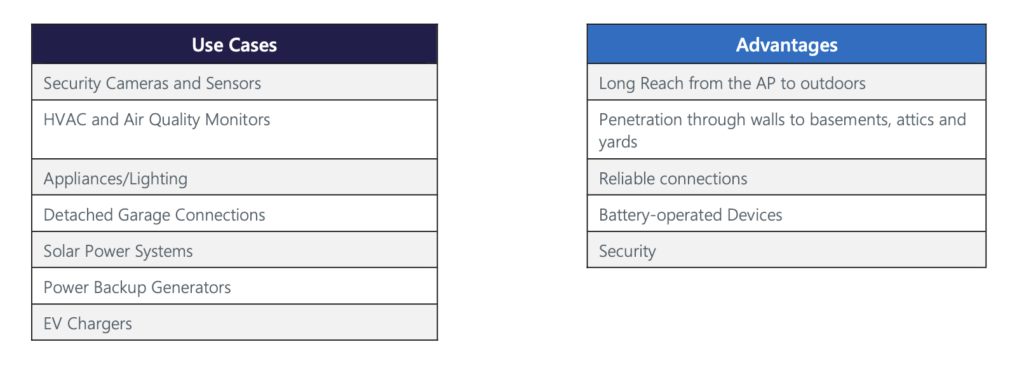
“HaLow solves several problems for smart home products. Sub-GHz… signals reach further and penetrate better… [compared to Wi-Fi in] 2.4 GHz, 5 GHz, and 6 GHz frequencies… Less energy is required to send these signals across longer distances. Large homes… can be served by a single access point. Devices in garages, basements, attics, and outside… can struggle to communicate [at] 2.4 GHz… [and] slow down the home network… Smooth out-of-the-box installation… reduces product returns and technical support… [and] benefits self-installed security cameras [and] hard-to-wire equipment in outdoor locations.
“IP-based protocols are natively supported by Wi-Fi HaLow. This simplifies the installation and management… For devices that need to connect to the cloud, the setup can be made as easily as for other Wi-Fi devices. (There is no need for a proprietary hub to convert to the IP network, such as what is needed for Zigbee, BLE or Z-wave network technology.) Wi-Fi HaLow can support up to 8,191 devices per a single access point. It can support the various smart home ecosystems and products compliant with the CSA Matter specification. [It] also leverages the highest level of security defined by the Wi-Fi Alliance (WPA3).”
2 | SMART CITY
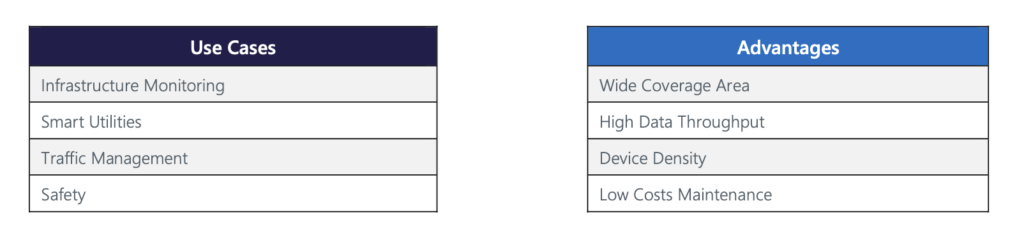
“Wi-Fi HaLow can connect all types of smart-city IoT devices. Examples include bus stops, traffic lights, cameras, utility meters, leak detectors, temperature sensors, and vibration sensors. High capacity [means] multiple… systems can be attached to a single access point… [It] has the ability to cover large areas. Where more coverage is needed, the area can be expanded with a mesh configuration. With non-licensed spectrum, IP-based connectivity, and low operating costs, [it] can enable municipal IoT networks at a lower price than cellular… [It] is a simple and low-cost way to aggregate IoT devices… over a cellular backhaul.
“Wi-Fi HaLow has far greater data throughput [than] other LPWAN technologies, allowing for a greater number of devices and a greater number of use cases on a city-wide network. [Its] low-energy features… can help ensure battery operated devices can remain in service without maintenance for months or years…. This would help the city to utilize monitoring devices in areas that may not have access to power – such as water meters or safety sensors… Solar power can be used for IoT devices with long transmit times, such as cameras or digital displays. Lastly, Wi-Fi HaLow has low latency to support emergency services.”
3 | SMART BUILDINGS
“When it comes to providing full-building coverage, Wi-Fi HaLow offers several advantages over traditional technologies. Its signal penetration can reach through four or more floors, enabling a single access point to cover most buildings. This simplifies the architecture [and] avoids issues with existing technologies. Its IP-native technology makes installation in existing buildings quick and simple. Its signal penetration and range also make it suitable for a wide variety of IoT apps, inside and outside – [such as] a camera to monitor a back gate or control the direction of chilled air in ventilation ducts…
“It creates ubiquitous coverage… more simply than… Wi-Fi, BLE, or Zigbee… [Its] trifecta of penetration, range, and [capacity]… simplifies the deployment of smart devices in new buildings and retrofitting older ones…. Furthermore, Wi-Fi HaLow boasts great security, using the same WPA3 standard as Wi-Fi. Finally, Wi-Fi HaLow’s ability to avoid interference from… 2.4/5 GHz devices… [means] cell phones, smartwatches, and wearables won’t cause connection issues or disrupt service… With all these benefits, Wi-Fi HaLow is future-proof for the mass adoption of smart cameras, devices, and sensors in any smart building.”
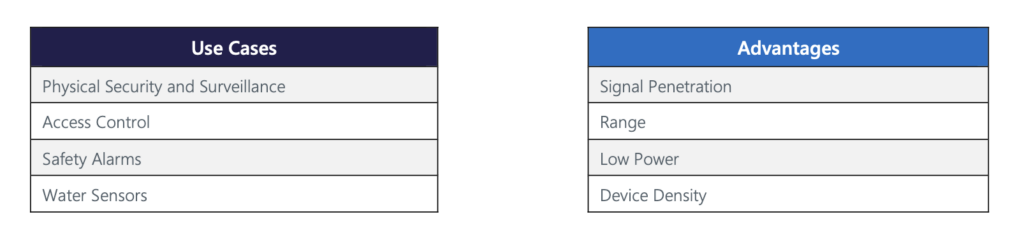
4 | SMART RETAIL
“From suppliers of the finished goods traveling through the logistics networks, to store clerks stocking and selling merchandise, to the consumer in the store or restaurant,… Wi-Fi-HaLow [can help]. One of the first benefits to retailers is an overall reduction of infrastructure costs [to add] new capabilities to a building. Longer-reaching Wi-Fi HaLow requires only one or two access points to provide coverage in warehouses and distribution centers of 250,000 square feet. Adding a Wi-Fi HaLow AP to a building can be as easy as connecting to a PoE Passthrough or USB connector on an existing Wi-Fi AP in the building.
“Managing the connectivity is accomplished via traditional wireless switches and servers. In a restaurant environment, where staff might have to serve customers outside in a patio area, electronic point-of-sale equipment such as tablets and printers have a more reliable connection to a single indoor HaLow AP. A large retailer installing electronic shelf labels (ESLs), active shelf edge video displays and security cameras can be serviced on the 915 MHz band channel, which is not affected by the overburdened 2.4 GHz spectrum being used for other high-speed devices.”
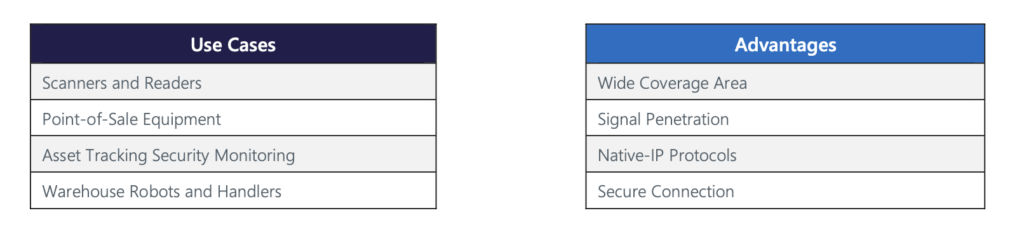
5 | SMART INDUSTRY
“Nothing blocks Wi-Fi and Bluetooth like machinery and structures… Instead of running wire to an additional access point, Wi-Fi HaLow operates at a lower frequency…, allowing for better propagation… One access point [can] cover an entire large building or industrial site. [It] is simple to implement, [as] a sub-GHz iteration of Wi-Fi, and can add a bandwidth layer for IoT that won’t disrupt 2.4/5 GHz signals. [It] could be used to cover mining or lumber operations, connecting through and around objects at longer ranges. The ability of an access point to handle over 8,000 devices means… support for multiple IoT solutions.
“The low-power capabilities of Wi-Fi HaLow allow for battery-operated devices in the field to have a lifespan of years… The high data rate allows for more data-intensive applications,,. The use cases [for] Industrial IoT are practically endless… Wi-Fi HaLow’s robust feature set can standardize connectivity for a wide variety of types of IoT devices. This single standard can displace many different connectivity technologies, potentially reducing overall IoT infrastructure costs and simplifying the network structure. On top of that, the features of Wi-Fi HaLow could solve the connectivity portion of new and better IoT solutions for Industrial IoT.”
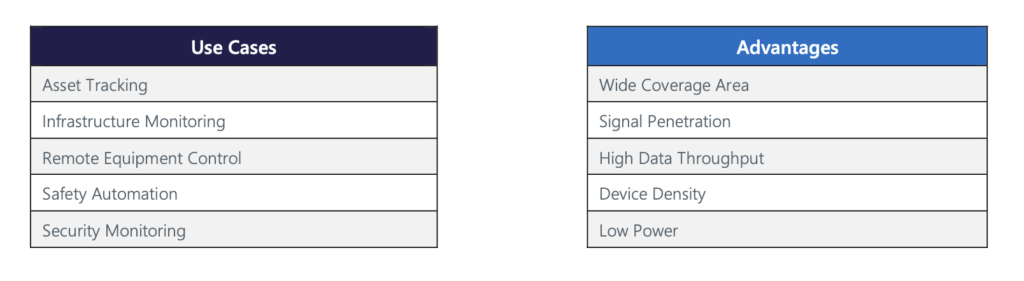
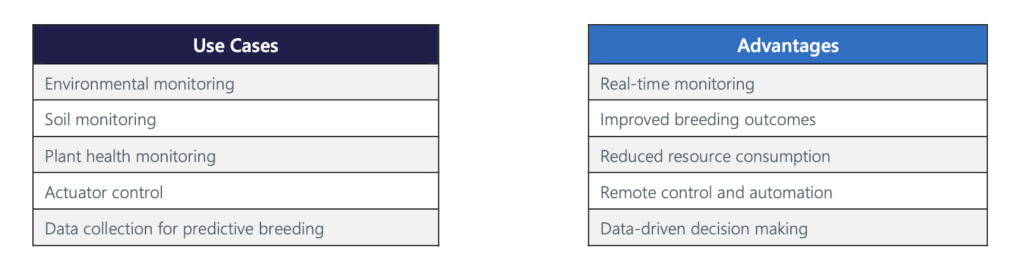
6 | SMART AGRICULTURE
“A specific use case where Wi-Fi HaLow would outperform other protocols is in a smart agriculture or precision farming system. In this scenario, a large farm has multiple sensor nodes and actuators spread over a vast area to monitor and control various aspects of farming operations [such as for] soil moisture, temperature and humidity, nutrient levels, water level, and cameras and location/biometrics sensors to monitor crops and livestock. Actuators might include irrigation valves, nutrient dispensers, and pumps and gates in reservoirs, wells, or waterways. Wi-Fi HaLow’s range, power, and scalability make it an ideal choice.
“A farm can span several kilometers; the long-range capabilities of Wi-Fi HaLow [mean] even the most distant nodes and actuators can maintain a reliable connection… [Its] ability to penetrate trees, vegetation, and structures [means] connectivity is stable. Many nodes and actuators… are battery-powered or use energy harvesting, so low-power is crucial… A [farm] might have hundreds or even thousands of nodes and actuators [and] Wi-Fi HaLow’s ability to support [lots] of devices… ensures the system can scale. Zigbee, LoRaWAN, or NB-IoT could also be used, [but] Wi-Fi HaLow’s long-range, low power, and Wi-Fi compatibility makes it a compelling choice.”