

RCR Wireless
  • News
  • Channels
    • 5G
    • 6G
    • BSS OSS
    • Carriers
    • IoT
    • Network Infrastructure
    • Open RAN
    • Private 5G
    • Telco AI
    • Telco Cloud
    • Test & Measurement
  • Resources
    • Reports
    • Webinars
    • White papers
    • AI Fundamentals
    • Analyst Angle
    • Editorial Calendar
    • Fundamentals
      • 5G NR Release 17
      • AI
        • Telco AI in 2025
    • Podcasts
      • Let’s Get Digital with Carrie Charles
      • Wireless Connectivity to Enable Industry 4.0 for the Middleprise
      • Well Technically…
      • Will 5G Change the World
      • Accelerating Industry 4.0 Digitalization
  • AI Infrastructure
  • Programs
  • Events
  • RCRtv
  • Advertise
  • Subscribe
Sunday, July 26, 2026
RCR Wireless
  • News
  • Channels
    • 5G
    • 6G
    • BSS OSS
    • Carriers
    • IoT
    • Network Infrastructure
    • Open RAN
    • Private 5G
    • Telco AI
    • Telco Cloud
    • Test & Measurement
  • Resources
    • Reports
    • Webinars
    • White papers
    • AI Fundamentals
    • Analyst Angle
    • Editorial Calendar
    • Fundamentals
      • 5G NR Release 17
      • AI
        • Telco AI in 2025
    • Podcasts
      • Let’s Get Digital with Carrie Charles
      • Wireless Connectivity to Enable Industry 4.0 for the Middleprise
      • Well Technically…
      • Will 5G Change the World
      • Accelerating Industry 4.0 Digitalization
  • AI Infrastructure
  • Programs
  • Events
  • RCRtv
  • Advertise
  • Subscribe
Add RCR Wireless as a preferred source on Google
  • Qualcomm 6G Insights
  • Huawei Content Hub
  • Qualcomm – 6G Vision
  • OSS/BSS Channel
  • RCRTech Roundtable: AI Infrastructure
RCR Wireless
RCR Wireless
  • Advanced Mimo
  • Mobile mmWave
  • 5G Positioning
  • Green Networks
  • Metaverse
  • Automotive
  • Industrial and Wide-area IoT
Copyright 2021 - All Right Reserved
Home - NXP intros family of UWB chip solutions for automotive manufacturers
IoTInternet of Things (IoT)

NXP intros family of UWB chip solutions for automotive manufacturers

by James Blackman December 1, 2023
written by James Blackman December 1, 2023 Share
LinkedinEmail
Share 0LinkedinEmail
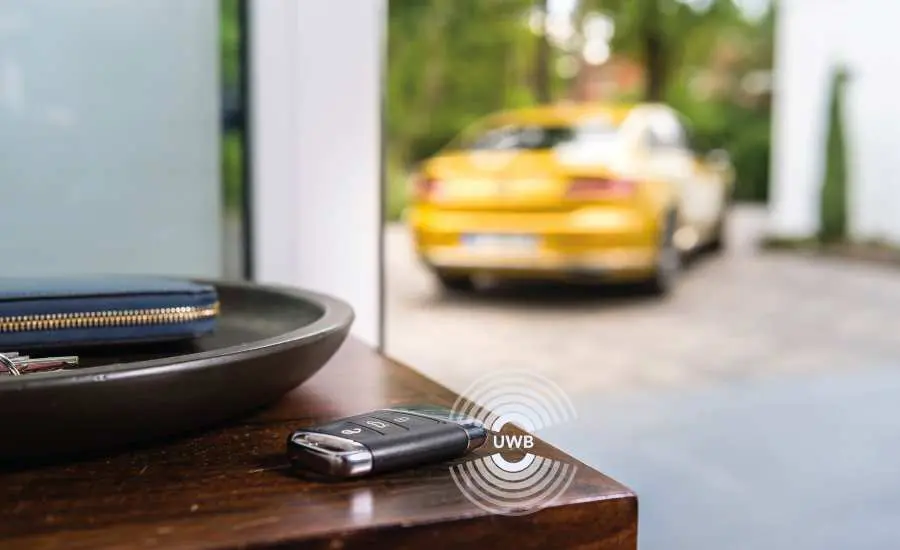
(Image: NXP Semiconductor)
506

NXP Semiconductors has introduced a new ultra-wideband (UWB) family of integrated circuits (ICs) for the automotive industry. Its new Trimension NCJ29D6 solutions bring the real-time localisation with short-range radar characteristics of UWB technology into the Dutch firm’s automotive portfolio to support use cases including secure car access, child presence detection, intrusion alert, and gesture recognition. The introduction of UWB complements support for Bluetooth Low Energy (BLE) and near-field comms (NFC) in its range of automotive ICs.

NXP has launched two Trimension NCJ29D6 products. The single-chip NCJ29D6B offers precise real-time localization for secure car access – “with enhanced system performance, reduced system cost ,and higher security”, the company said. The pin-to-pin compatible Trimension NCJ29D6A is the first monolithic UWB chip for automotive markets to combine secure localization and short-range radar with an integrated microcontroller unit (MCU). This will allow automotive manufacturers to utilize one UWB system for multiple use cases, it said.

UWB, based on the IEEE 802.15.4 standard, enables granular low-power short range positioning (‘fine ranging’) of objects in three-dimensional space – to about 10 centimetres, from a distance of about 200 metres. It uses wide spectrum (500 MHz to several GHz) and high frequency (between 6.5 GHz and 9 GHz), at a remove from the busy ISM band at 2.4 GHz. The technology has evolved from an orthogonal frequency-division multiplexing (OFDM) protocol for high data-rate communications to an impulse-based ‘see-through-walls’ radar-imaging tech. 

As well as locating objects with high precision, it can track them using distance measurements between radios, and calculate time arrival and angle of movement. NXP said its new Trimension UWB radar and ranging solutions will hit the road with automotive manufacturers (OEMs) by 2025.

NXP said: “The new NCJ29D6B enables enhanced secure car access, allowing users to access their car hands-free through a digital key on a UWB-enabled mobile phone. [It] delivers a number of performance enhancements to deliver maximum design flexibility for OEMs and help future-proof secure car access capabilities. Higher RF sensitivity and two simultaneous operating receiver chains support antenna diversity and angle of arrival concepts to detect small changes in distance or direction of movement of other UWB-enabled devices.”

It said of the twin NCJ29D6A solution: “[It is] the first automotive device to combine [UWB location and ranging] features within a single chip with an integrated MCU… This allows OEMs to transform a single UWB-based system into a multi-purpose platform, enabling multiple use cases with the same hardware. In addition to secure car access, automotive OEMs can integrate in-cabin sensing for child presence detection and seat belt reminder, kick sensor for automatic trunk opening, as well as various kinds of smart gesture recognition.”

Markus Staeblein, senior vice president and general manager for secure car access at NXP, commented: “UWB will drive new advancements in the consumer automotive experience, and this is only the beginning of what it will enable. Automotive OEMs… will benefit from a single system that can deliver multiple new software-defined experiences… over time. Building on our expertise and standardization efforts in bodies such as the Car Connectivity Consortium (CCC) and the FiRa Consortium, we are helping UWB become an essential part of the automotive ecosystem.”

NXP is a founding member of the FiRa (fine-ranging) Consortium, along with Bosch, Samsung, and STMicro. It says UWB outperforms other short-range technologies in terms of accuracy, reliability, and power consumption – “by a wide margin”. Ranging is achieved by time-of-flight (ToF) measurements of radar signals between devices. The process uses a large channel and short pulses, of about two nanoseconds each – issued 200-1,000 times per second. It makes location finding a real-time function. 

A UWB-enabled system is more resistant to interference, says the consortium, on the grounds UWB pulses resist ‘multi-path effect’, where signals reach the receiver by more than one path due to reflection or refraction, and are immune to fading and jamming. Security is higher, too. A key addition to UWB is an extra portion of the physical layer (PHY), used to send and receive data packets, which adds cryptography, random number generation, and other techniques to make it harder to attack or manipulate UWB systems. 

UWB use cases transfer easily into industrial IoT, and other sectors. The FiRa Consortium is developing specific protocols for multiple verticals and defining the necessary parameters for a range of applications, including physical access control, location-based services, device-to-device services, and others.


You Might Also Like
  • Monday (telco diary) | Sovereign AI for Industry 4.0
  • When the push becomes the pull – private 5G and physical AI
  • Fast-growing private 5G offers blueprint for AI-era telecoms
  • Monday (telco diary) | Consolidation, orchestration, automation
  • Wireless Logic’s 21st acquisition exposes IoT consolidation paradox
  • How operations leaders see 5G as vital for mission-critical workflows (Reader Forum)
Share 0 LinkedinEmail
James Blackman
James Blackman

James Blackman has been writing about the technology and telecoms sectors for over a decade. He has edited and contributed to a number of European news outlets and trade titles. He has also worked at telecoms company Huawei, leading media activity for its devices business in Western Europe. He is based in London.

previous post
Kagan: CES2024 shows off private wireless, 5G-A, FWA, 5G home internet
next post
Canada mid-band spectrum auction concludes, bringing in more than $2.1 billion

White Papers

  • Norton eBook: The 2026 Telco Playbook

  • Enea White Paper: Why Intelligent AAA is the Swiss Army Knife of Telecom

  • CSG White Paper: Telco AI Enabler: Mediation’s Defining Role

  • Enea White Paper: Scalable Database Design for 5G and Beyond

  • Supermicro and NVIDIA Whitepaper: Powering sovereign AI at scale

Editorial Reports

  • Market Pulse Report: Telco AI in 2026 – Trends, Challenges and Opportunities

  • Nvidia Report: The State of AI in Telecommunications: 2026 Trends

  • Report: Scaling Optical Networks For The Hyperscale And AI Era

Webinars

  • Webinar: Building 6G — aligning technology, policy and purpose

  • SIMCom Webinar: Scaling your next deployment – from plastic to provisioning

  • Webinar: Rethinking the RAN as AI, cloud and openness converge

  • Webinar: Scale-Up, Scale-Out, Scale-Across – Building AI-Era Network Fabrics

  • Webinar: NTN in motion – evolving standards, expanding services

Since 1982, RCR Wireless News has been providing wireless and mobile industry news, insights, and analysis to mobile and wireless industry professionals, decision makers, policy makers, analysts and investors.

Facebook Twitter Youtube Linkedin Envelope Rss

Useful Links

  • Subscribe
  • About RCR Wireless News
  • Contact Us
  • Advertise
  • Editorial Calendar
  • Archive
  • RSS
  • Wireless News Archive
  • Subscribe
  • About RCR Wireless News
  • Contact Us
  • Advertise
  • Editorial Calendar
  • Archive
  • RSS
  • Wireless News Archive

Edtior's Picks

AT&T says its network is already built for the agentic AI wave
AT&T and Ericsson use network sensing to spot drones with ordinary 5G towers
Huawei sees Mobile AI driving new wave of uplink network investment

Latest Articles

AT&T says its network is already built for the agentic AI wave
AT&T and Ericsson use network sensing to spot drones with ordinary 5G towers
Huawei sees Mobile AI driving new wave of uplink network investment
Spectrum supercycle – US opens floodgates; UK shares it out

© 2026 RCR Wireless News All Right Reserved. Developed by Eight Hats.

Cookie Policy | Privacy Policy

RCR Wireless
  • News
  • Channels
    • 5G
    • 6G
    • BSS OSS
    • Carriers
    • IoT
    • Network Infrastructure
    • Open RAN
    • Private 5G
    • Telco AI
    • Telco Cloud
    • Test & Measurement
  • Resources
    • Reports
    • Webinars
    • White papers
    • AI Fundamentals
    • Analyst Angle
    • Editorial Calendar
    • Fundamentals
      • 5G NR Release 17
      • AI
        • Telco AI in 2025
    • Podcasts
      • Let’s Get Digital with Carrie Charles
      • Wireless Connectivity to Enable Industry 4.0 for the Middleprise
      • Well Technically…
      • Will 5G Change the World
      • Accelerating Industry 4.0 Digitalization
  • AI Infrastructure
  • Programs
  • Events
  • RCRtv
  • Advertise
  • Subscribe
RCR Wireless
  • News
  • Channels
    • 5G
    • 6G
    • BSS OSS
    • Carriers
    • IoT
    • Network Infrastructure
    • Open RAN
    • Private 5G
    • Telco AI
    • Telco Cloud
    • Test & Measurement
  • Resources
    • Reports
    • Webinars
    • White papers
    • AI Fundamentals
    • Analyst Angle
    • Editorial Calendar
    • Fundamentals
      • 5G NR Release 17
      • AI
        • Telco AI in 2025
    • Podcasts
      • Let’s Get Digital with Carrie Charles
      • Wireless Connectivity to Enable Industry 4.0 for the Middleprise
      • Well Technically…
      • Will 5G Change the World
      • Accelerating Industry 4.0 Digitalization
  • AI Infrastructure
  • Programs
  • Events
  • RCRtv
  • Advertise
  • Subscribe
@2020 - All Right Reserved. Designed and Developed by PenciDesign