

RCR Wireless
  • News
  • Channels
    • 5G
    • 6G
    • BSS OSS
    • Carriers
    • IoT
    • Network Infrastructure
    • Open RAN
    • Private 5G
    • Telco AI
    • Telco Cloud
    • Test & Measurement
  • Resources
    • Reports
    • Webinars
    • White papers
    • AI Fundamentals
    • Analyst Angle
    • Editorial Calendar
    • Fundamentals
      • 5G NR Release 17
      • AI
        • Telco AI in 2025
    • Podcasts
      • Let’s Get Digital with Carrie Charles
      • Wireless Connectivity to Enable Industry 4.0 for the Middleprise
      • Well Technically…
      • Will 5G Change the World
      • Accelerating Industry 4.0 Digitalization
  • AI Infrastructure
  • Programs
  • Events
  • RCRtv
  • Advertise
  • Subscribe
Friday, August 7, 2026
RCR Wireless
  • News
  • Channels
    • 5G
    • 6G
    • BSS OSS
    • Carriers
    • IoT
    • Network Infrastructure
    • Open RAN
    • Private 5G
    • Telco AI
    • Telco Cloud
    • Test & Measurement
  • Resources
    • Reports
    • Webinars
    • White papers
    • AI Fundamentals
    • Analyst Angle
    • Editorial Calendar
    • Fundamentals
      • 5G NR Release 17
      • AI
        • Telco AI in 2025
    • Podcasts
      • Let’s Get Digital with Carrie Charles
      • Wireless Connectivity to Enable Industry 4.0 for the Middleprise
      • Well Technically…
      • Will 5G Change the World
      • Accelerating Industry 4.0 Digitalization
  • AI Infrastructure
  • Programs
  • Events
  • RCRtv
  • Advertise
  • Subscribe
Add RCR Wireless as a preferred source on Google
  • Qualcomm 6G Insights
  • Huawei Content Hub
  • Qualcomm – 6G Vision
  • OSS/BSS Channel
  • RCRTech Roundtable: AI Infrastructure
RCR Wireless
RCR Wireless
  • Advanced Mimo
  • Mobile mmWave
  • 5G Positioning
  • Green Networks
  • Metaverse
  • Automotive
  • Industrial and Wide-area IoT
Copyright 2021 - All Right Reserved
Home - Postcards from the edge | The critical 5G edge is ‘best of both worlds’, says Siemens
Industry 4.0Internet of Things (IoT)IoTPrivate 5GPrivate Networks

Postcards from the edge | The critical 5G edge is ‘best of both worlds’, says Siemens

by James Blackman September 19, 2023
written by James Blackman September 19, 2023 Share
LinkedinEmail
Share 0LinkedinEmail
Background image: Siemens
186

If you want to know about what to do with sensitive data in operational technology (OT) systems – how to prioritise and segment it, where to place it between the edge and the cloud, and how to retrieve it at both ends (and anywhere between) – then you could do worse than ask Siemens. Which is what RCR Wireless did, in pursuit of definitive answers about the ‘critical edge’, in particular as it plays with new private (and possibly public) 5G systems. 

What follows is a transcript of an email interview with Marc Fischer, the company’s global marketing manager for the industrial edge, and Yiyao Fu, presented as an ‘industrial 5G expert’ at the Germany-based industrial giant. Their answers will be threaded into a new editorial report on the critical 5G edge, out later this month, which is also attended by a webinar next week (September 27) on the same subject; you can sign up to the webinar here.

…

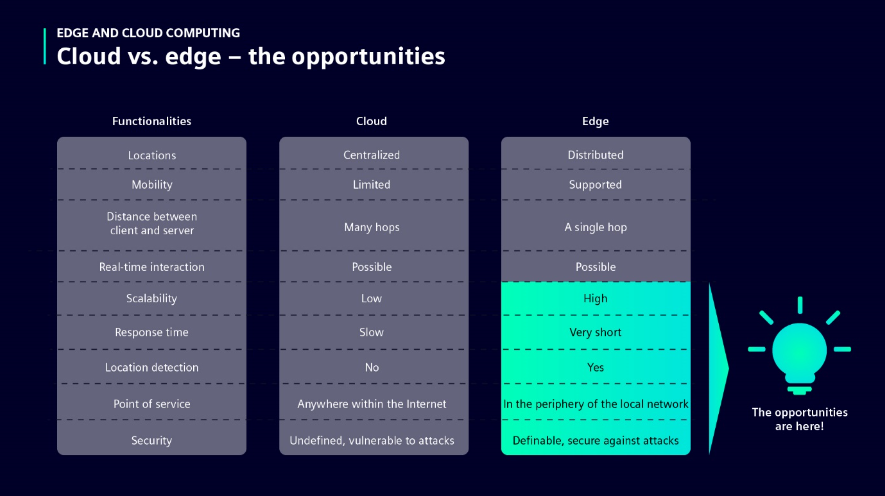
How should one rationalise usage of edge and cloud (and in-between) compute resources for processing critical Industry 4.0 workloads?

Marc Fischer
Fischer – there are no rules, but there are certain guides

Fischer: “When considering IoT/OT workloads, there are key factors to consider, as follow:

– Latency | Edge computing reduces delays, while cloud computing may introduce latency through data transmission.

– Bandwidth | Edge computing conserves bandwidth by processing data locally, ideal for limited network capacity.

– Privacy / security | Edge computing keeps sensitive data closer, reducing exposure during transmission.

– Resources | Edge computing eases strain on limited cloud resources, useful for restricted connectivity or computational capabilities.

– Operation | Edge computing allows applications to function without the internet, which is crucial when constant cloud connection is uncertain.

“While the decision may vary depending on industry requirements, a hybrid approach that combines both edge and cloud computing can ultimately achieve the desired outcomes for critical IoT/OT workloads. But very sensitive or critical industries such as pharmaceuticals or public infrastructure providers typically seek to keep all or most of the data on premise to maintain the high IT security requirements – also important, given their legal constraints. 

“By contrast, in non-sensitive consumer goods industries – such as warehouses or electronics [production], for example – it is often the case that certain applications may run more or less equally on the premises or in the cloud; it just depends on the company’s individual strategies.”

Is there a rule-of-thumb for when IoT / OT data should be retained at the on-site edge, and when it can be diverted by the cloud?

Fischer: “There is no rule of thumb. Companies need to carefully evaluate the key factors, as outlined above. It depends on the real-time or near-time requirements of the applications – whether they run directly at the machine or in the private / public cloud. If you look at a computer vision application, for example, which tracks the quality of processes or produced goods, then the AI runs directly near the machine as it is closely connected to the PLC and camera information. 

“But, typically the training of these AI algorithms is done in the cloud, where nearly unlimited storage and processing power is available. The below matrix shows which use cases / applications (in which industries) will be handled at the edge and in the cloud.”
Eva7sHNfQZy9WeW3xaq2OwU 4kKrvwo0P19riRHn hUV9t4J6MezXH0Nq8R2lZYWw3vNXnk2vFzxx

Are there Industry 4.0 scenarios where the data will stay on the edge, all the time, separately of the public internet? Can you give examples?

Fischer: “Yes, as follow:

– Machine-to-machine communication in single production networks in sensitive companies;

– AI-based applications that require real/near-time information (machine vision, anomaly detection etc);

– Automation control in connected applications such as virtual PLCs, closed loop AI applications, virtualized sensors etc;

– Connectivity / interaction with local MES or SCADA systems;

– Additional information on top of a human-machine interface (HMI), such as development of forces and anomalies, and so on – which is to be available to the station or machine operator only.”

Will all-edge private 5G networks, where cellular is required, always be used in these cases? 

Fu: “A private 5G network can be operated with or without an internet connection. Enterprises need to make that decision themselves. The advantage of private 5G networks is that companies know exactly where the 5G system is hosted and can assure no external parties can access private data or intellectual property within the network. Of course, when it comes to edge or cloud, private 5G networks are only the transport mechanism for the data within the space – and public 5G or wireless LAN (Wi-Fi) or Ethernet are all alternatives.”

Can you say (again, rule-of-thumb / on paper) how latency reduces with 5G from the cloud to the edge, in terms of networking and computing, when employed separately and together?

Fu: “It is a combination of both – the ‘best of both worlds’. For low latency, 5G is much better than 4G-LTE, say. But 5G and edge/cloud dov not necessarily correlate – it depends on how the customer uses the technologies and configures the network. 5G is just one of the technologies that can be used to connect the edge to the cloud.”

All of this, presumably, makes clear how complex Industry 4.0 deployments can be, and how important ecosystem consultancy and collaboration is. Is this right? Can you comment? 

“Ecosystems are very important. Industry 4.0 deployments can be complex. 5G can be used to facilitate deployments [in a different way] than previous mobile standards. Our own private 5G infrastructure is designed as an open ecosystem, which allows connection of third-party devices. We will offer support, testing and certification for those devices to ensure a smooth operation on the shop-floor. Furthermore, our 5G routers can be run on third party 5G networks, both private and public. The industry needs interoperability to make sure that devices on the shop-floor interact smoothly with each other. So interoperability is essential for us.”

For more on this topic, tune in to the upcoming webinar on Critical 5G Edge Workloads on September 27 – with ABI Research, Kyndryl, Southern California Edison, and Volt Active Data.

Critical Edge
Postcards from the edge | The critical 5G edge is ‘best of both worlds’, says Siemens 9

All entries in the Postcards from the Edge series are available below.

Postcards from the edge | Compute is critical, 5G is useful (sometimes) – says NTT
Postcards from the edge | Cloud is (quite) secure, edge is not (always) – says Factry
Postcards from the edge | Rules-of-thumb for critical Industry 4.0 workloads – by Kyndryl
Postcards from the edge | No single recipe for Industry 4.0 success – says PwC
Postcards from the edge | Ultra (‘six nines’) reliability – and why it’s madness (Reader Forum)
Postcards from the edge | Private 5G is reshaping the Industry 4.0 edge, says Nokia
Postcards from the edge | Something strange at the 5G edge, says Southern California Edison

You Might Also Like
  • Tuesday (telco diary) | More about ISAC – on battlefields and sportsfields
  • From missiles to pizzas – why 6G drone sensing has been fast-tracked for 5G
  • Physical AI is exposing a data sovereignty gap (Reader Forum)
  • Japan’s private 5G market is finally moving beyond demo experiments (Analyst Angle)
  • Private 5G – hype, hope, and (some) hard maths 
  • The most expensive wireless system is the one you install twice (Reader Forum)
Share 0 LinkedinEmail
James Blackman
James Blackman

James Blackman has been writing about the technology and telecoms sectors for over a decade. He has edited and contributed to a number of European news outlets and trade titles. He has also worked at telecoms company Huawei, leading media activity for its devices business in Western Europe. He is based in London.

previous post
M&A: Who’s investing in observability, analytics and automation?
next post
The Role of Cloud and Generative AI in the Telco Industry with Ishwar Parulkar of Amazon Web Services (AWS)

White Papers

  • Norton eBook: The 2026 Telco Playbook

  • Enea White Paper: Why Intelligent AAA is the Swiss Army Knife of Telecom

  • CSG White Paper: Telco AI Enabler: Mediation’s Defining Role

  • Enea White Paper: Scalable Database Design for 5G and Beyond

  • Supermicro and NVIDIA Whitepaper: Powering sovereign AI at scale

Editorial Reports

  • Report: NTN in motion — evolving standards, expanding services

  • Market Pulse Report: Telco AI in 2026 – Trends, Challenges and Opportunities

  • Nvidia Report: The State of AI in Telecommunications: 2026 Trends

Webinars

  • Webinar: Building 6G — aligning technology, policy and purpose

  • SIMCom Webinar: Scaling your next deployment – from plastic to provisioning

  • Webinar: Rethinking the RAN as AI, cloud and openness converge

  • Webinar: Scale-Up, Scale-Out, Scale-Across – Building AI-Era Network Fabrics

  • Webinar: NTN in motion – evolving standards, expanding services

Since 1982, RCR Wireless News has been providing wireless and mobile industry news, insights, and analysis to mobile and wireless industry professionals, decision makers, policy makers, analysts and investors.

Facebook Twitter Youtube Linkedin Envelope Rss

Useful Links

  • Subscribe
  • About RCR Wireless News
  • Contact Us
  • Advertise
  • Editorial Calendar
  • Archive
  • RSS
  • Wireless News Archive
  • Subscribe
  • About RCR Wireless News
  • Contact Us
  • Advertise
  • Editorial Calendar
  • Archive
  • RSS
  • Wireless News Archive

Edtior's Picks

Chunghwa Telecom expands AI infra with new DC
Starlink Mobile – what is Musk actually building, beyond the chatter?
Report: NTN in motion — evolving standards, expanding services

Latest Articles

Chunghwa Telecom expands AI infra with new DC
Starlink Mobile – what is Musk actually building, beyond the chatter?
Report: NTN in motion — evolving standards, expanding services
Wednesday (telco diary) | Starlink – a weak hand and a big mouth?

© 2026 RCR Wireless News All Right Reserved. Developed by Eight Hats.

Cookie Policy | Privacy Policy

RCR Wireless
  • News
  • Channels
    • 5G
    • 6G
    • BSS OSS
    • Carriers
    • IoT
    • Network Infrastructure
    • Open RAN
    • Private 5G
    • Telco AI
    • Telco Cloud
    • Test & Measurement
  • Resources
    • Reports
    • Webinars
    • White papers
    • AI Fundamentals
    • Analyst Angle
    • Editorial Calendar
    • Fundamentals
      • 5G NR Release 17
      • AI
        • Telco AI in 2025
    • Podcasts
      • Let’s Get Digital with Carrie Charles
      • Wireless Connectivity to Enable Industry 4.0 for the Middleprise
      • Well Technically…
      • Will 5G Change the World
      • Accelerating Industry 4.0 Digitalization
  • AI Infrastructure
  • Programs
  • Events
  • RCRtv
  • Advertise
  • Subscribe
RCR Wireless
  • News
  • Channels
    • 5G
    • 6G
    • BSS OSS
    • Carriers
    • IoT
    • Network Infrastructure
    • Open RAN
    • Private 5G
    • Telco AI
    • Telco Cloud
    • Test & Measurement
  • Resources
    • Reports
    • Webinars
    • White papers
    • AI Fundamentals
    • Analyst Angle
    • Editorial Calendar
    • Fundamentals
      • 5G NR Release 17
      • AI
        • Telco AI in 2025
    • Podcasts
      • Let’s Get Digital with Carrie Charles
      • Wireless Connectivity to Enable Industry 4.0 for the Middleprise
      • Well Technically…
      • Will 5G Change the World
      • Accelerating Industry 4.0 Digitalization
  • AI Infrastructure
  • Programs
  • Events
  • RCRtv
  • Advertise
  • Subscribe
@2020 - All Right Reserved. Designed and Developed by PenciDesign