

RCR Wireless
  • News
  • Channels
    • 5G
    • 6G
    • BSS OSS
    • Carriers
    • IoT
    • Network Infrastructure
    • Open RAN
    • Private 5G
    • Telco AI
    • Telco Cloud
    • Test & Measurement
  • Resources
    • Reports
    • Webinars
    • White papers
    • AI Fundamentals
    • Analyst Angle
    • Editorial Calendar
    • Fundamentals
      • 5G NR Release 17
      • AI
        • Telco AI in 2025
    • Podcasts
      • Let’s Get Digital with Carrie Charles
      • Wireless Connectivity to Enable Industry 4.0 for the Middleprise
      • Well Technically…
      • Will 5G Change the World
      • Accelerating Industry 4.0 Digitalization
  • AI Infrastructure
  • Programs
  • Events
  • RCRtv
  • Advertise
  • Subscribe
Sunday, July 19, 2026
RCR Wireless
  • News
  • Channels
    • 5G
    • 6G
    • BSS OSS
    • Carriers
    • IoT
    • Network Infrastructure
    • Open RAN
    • Private 5G
    • Telco AI
    • Telco Cloud
    • Test & Measurement
  • Resources
    • Reports
    • Webinars
    • White papers
    • AI Fundamentals
    • Analyst Angle
    • Editorial Calendar
    • Fundamentals
      • 5G NR Release 17
      • AI
        • Telco AI in 2025
    • Podcasts
      • Let’s Get Digital with Carrie Charles
      • Wireless Connectivity to Enable Industry 4.0 for the Middleprise
      • Well Technically…
      • Will 5G Change the World
      • Accelerating Industry 4.0 Digitalization
  • AI Infrastructure
  • Programs
  • Events
  • RCRtv
  • Advertise
  • Subscribe
Add RCR Wireless as a preferred source on Google
  • Qualcomm 6G Insights
  • Huawei Content Hub
  • Qualcomm – 6G Vision
  • OSS/BSS Channel
  • RCRTech Roundtable: AI Infrastructure
RCR Wireless
RCR Wireless
  • Advanced Mimo
  • Mobile mmWave
  • 5G Positioning
  • Green Networks
  • Metaverse
  • Automotive
  • Industrial and Wide-area IoT
Copyright 2021 - All Right Reserved
Home - Four pillars of a service-based architecture
Telco Cloud5GTest & Measurement

Four pillars of a service-based architecture

by Sean Kinney, Principal Analyst April 10, 2023
written by Sean Kinney, Principal Analyst April 10, 2023 Share
LinkedinEmail
Share 1LinkedinEmail
service-based architecture EXFO 5G Standalone
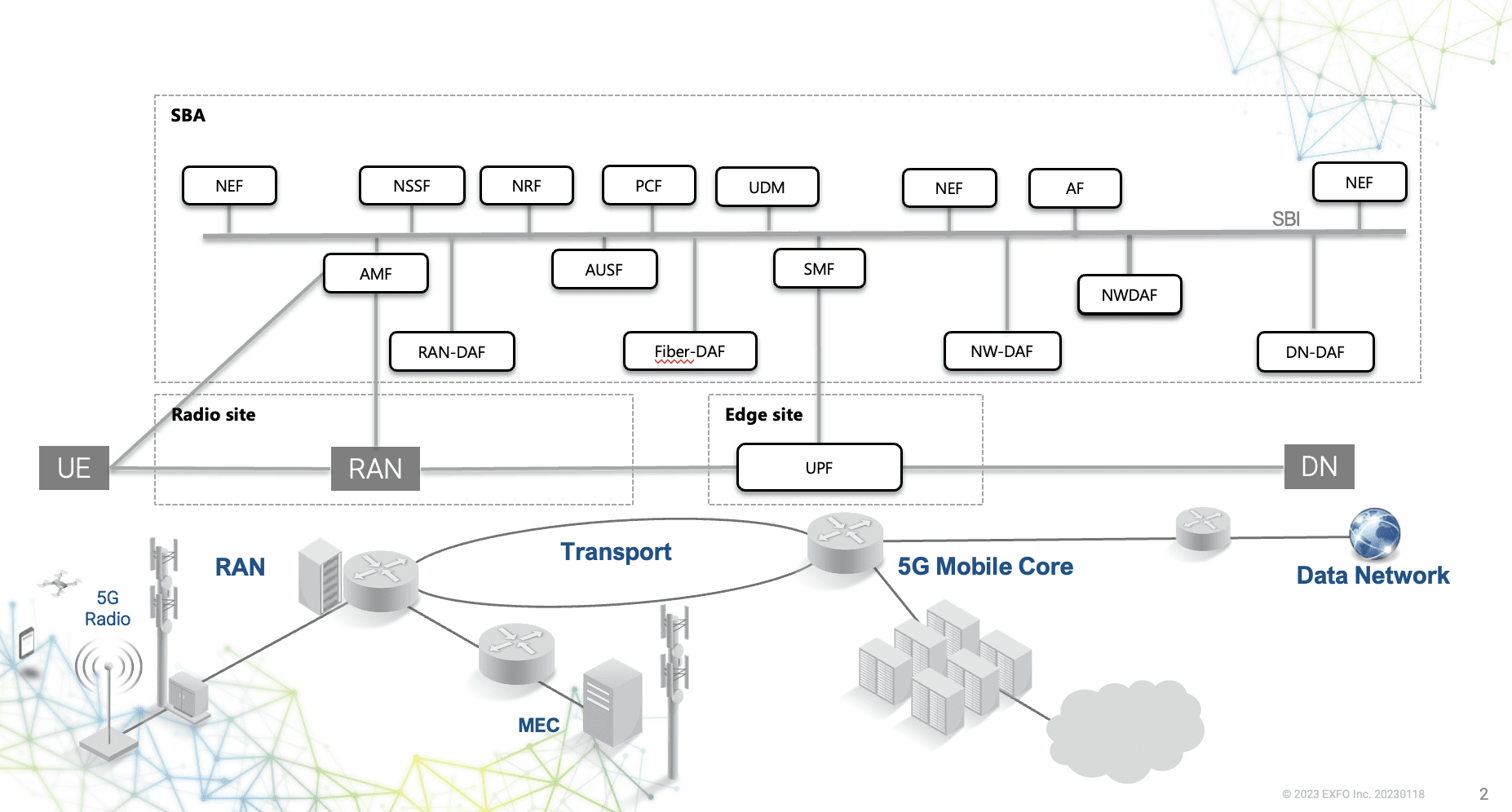
Image courtesy of EXFO.
181

With the move to a service-based architecture, what does it take for operators to become cloud native? 

With meaningful new 5G revenues failing to materialize with the Non-standalone architecture, operators are now increasingly moving to a 5G Standalone service-based architecture. In this transition, there are a number of key technological and operating changes needed to fully leverage the investment in becoming cloud-native. 

Speaking during the recent Telco Cloud and Edge Forum (available on-demand), EXFO Director of Strategic Innovation Sylvian Nadeau described a service-based architecture as “the framework that defines the network functions and their interactions in a 5G network. It is based on the principle of service-oriented architecture that represents a significant departure from the traditional monolithic architecture used in previous generations of mobile networks. The network functions in the 5G SBA are implemented as software services that can be deployed and scaled independently of each other.” 

And why should operators do this? “It allows the network operator to optimize the performance and the resource utilization based on the needs of the application and the service that those network functions support.” 

With the what and why answered, Nadeau laid out what he sees as the four primary pillars of a service-based architecture

  • Cloud-native “which means that with this architecture we need to use microservices and containers to deploy the network functions. This approach provides a greater flexibility, scalability, and agility to the network.” 
  • Network slicing which “enables the creation of multiple virtual networks on a single network infrastructure. This is critical for customization of network services for different applications that serve different customers.” 
  • Edge computing to enable “the capability to perform computing closer to the source. “This approach reduces the latency, improve the performance of the application, because more and more applications will require real-time support.” 
  • Automation; “5G has to come with automation” to manage complexity.

What does it mean to be a fully cloud-native telco? 

Operators pursuing the transition to a service-based architecture, 5G Standalone, telco cloud, edge computing and everything that involves will (ideally) become at some point fully cloud native. Beyond the technology piece, Nadeau said, “It requires a cultural shift to embrace the DevOps practices and agile methodology. This includes adopting practices such as infrastructure as code, for example.”

He also provided a big-picture roadmap for telcos to become cloud native. First, containerize network functions so they can be properly scaled upon deployment. Second, define the underlying infrastructure you need to use, including consideration of cloud providers. Finally operators need to implement a DevOps and SecOps mindset—”You need to put in place a CI/CD pipeline…so you can get into this continuous release mechanism.” 

Nadeau also highlighted how full-stack service assurance evolves with a service-based architecture dependent on centralized and distributed cloud infrastructure; the key point is that now service assurance needs to cover the underlying IT-like infrastructure as well as everything that traditionally sits in the telco domain. 

In terms of deploying network functions on a cloud infrastructure, Nadeau stressed the importance of Kubernetes for the deployment and management of functions and applications. “It gives the ability to orchestrate the network functions, automate the service delivery, enable network slicing, and facilitate edge computing.

For identifying and mitigating problems in the underlying infrastructure, he explained EXFO’s collaboration with Intel that allows for integration of telemetry from Intel’s platform into EXFO’s adaptive service assurance solution. Nadeau said this data integration lets the user “perform a cross-domain [machine learning]-driven analysis that provides the capability to identify the origin of problems…from the underlying infrastructure.” Beyond the infrastructure, EXFO uses passive monitoring, active testing, fiber and RAN monitoring, and analysis of the network topology. 

“With the full stack assurance, we actually can address the gap that is created between the cloud and compute infrastructure and the telecom domain,” Nadeau said. “This visibility gap makes it very difficult to correlate quality of experience with this underlying infrastructure. What we need to understand here is the infrastructure becomes a new domain to manage, it has to be monitored and it has now to become part of what we assure to guarantee good network performance.” 

You Might Also Like
  •  VodafoneThree puts P.I. Works’ SMO at the center of network transformation
  • Mimosa Networks and Viaero Wireless demonstrate scalable 5 GHz and 6 GHz fixed wireless broadband with AFC
  • What defines network performance in 5G and beyond? A CTO Perspective
  • Elisa says AI automation has cut network incidents by over 80%
  • Huawei outlines AI-centric network roadmap for telecom monetization
  • Indosat outlines AI Grid vision as 5G modernization targets nationwide AI-ready network
Share 1 LinkedinEmail
Sean Kinney
Sean Kinney, Principal Analyst

Sean focuses on multiple subject areas including 5G, 6G, Open RAN, hybrid cloud, edge computing, and Industry 4.0. Prior to his work at RCR, Sean studied journalism and literature at the University of Mississippi then spent six years based in Key West, Florida, working as a reporter for the Miami Herald Media Company. He currently lives in Fayetteville, Arkansas.

previous post
Verizon updates asset tracking management platform
next post
Open RAN spectrum policy should aim to grow both private and public network ecosystems (Reader Forum)

White Papers

  • Norton eBook: The 2026 Telco Playbook

  • Enea White Paper: Why Intelligent AAA is the Swiss Army Knife of Telecom

  • CSG White Paper: Telco AI Enabler: Mediation’s Defining Role

  • Enea White Paper: Scalable Database Design for 5G and Beyond

  • Supermicro and NVIDIA Whitepaper: Powering sovereign AI at scale

Editorial Reports

  • Nvidia Report: The State of AI in Telecommunications: 2026 Trends

  • Report: Scaling Optical Networks For The Hyperscale And AI Era

  • Test And Measurement Market Pulse Report

Webinars

  • Webinar: Building 6G — aligning technology, policy and purpose

  • SIMCom Webinar: Scaling your next deployment – from plastic to provisioning

  • Webinar: Rethinking the RAN as AI, cloud and openness converge

  • Webinar: Scale-Up, Scale-Out, Scale-Across – Building AI-Era Network Fabrics

  • Webinar: NTN in motion – evolving standards, expanding services

Since 1982, RCR Wireless News has been providing wireless and mobile industry news, insights, and analysis to mobile and wireless industry professionals, decision makers, policy makers, analysts and investors.

Facebook Twitter Youtube Linkedin Envelope Rss

Useful Links

  • Subscribe
  • About RCR Wireless News
  • Contact Us
  • Advertise
  • Editorial Calendar
  • Archive
  • RSS
  • Wireless News Archive
  • Subscribe
  • About RCR Wireless News
  • Contact Us
  • Advertise
  • Editorial Calendar
  • Archive
  • RSS
  • Wireless News Archive

Edtior's Picks

Red Hat outlines AI-RAN roadmap
Ericsson wins role in £8bn UK’s defense upgrade as private 5G moves to...
Thursday (telco diary) | Satellite versus terrestrial

Latest Articles

Red Hat outlines AI-RAN roadmap
Ericsson wins role in £8bn UK’s defense upgrade as private 5G moves to frontline
Thursday (telco diary) | Satellite versus terrestrial
The Agentic Network — Deutsche Telekom on APIs for trusted AI

© 2026 RCR Wireless News All Right Reserved. Developed by Eight Hats.

Cookie Policy | Privacy Policy

RCR Wireless
  • News
  • Channels
    • 5G
    • 6G
    • BSS OSS
    • Carriers
    • IoT
    • Network Infrastructure
    • Open RAN
    • Private 5G
    • Telco AI
    • Telco Cloud
    • Test & Measurement
  • Resources
    • Reports
    • Webinars
    • White papers
    • AI Fundamentals
    • Analyst Angle
    • Editorial Calendar
    • Fundamentals
      • 5G NR Release 17
      • AI
        • Telco AI in 2025
    • Podcasts
      • Let’s Get Digital with Carrie Charles
      • Wireless Connectivity to Enable Industry 4.0 for the Middleprise
      • Well Technically…
      • Will 5G Change the World
      • Accelerating Industry 4.0 Digitalization
  • AI Infrastructure
  • Programs
  • Events
  • RCRtv
  • Advertise
  • Subscribe
RCR Wireless
  • News
  • Channels
    • 5G
    • 6G
    • BSS OSS
    • Carriers
    • IoT
    • Network Infrastructure
    • Open RAN
    • Private 5G
    • Telco AI
    • Telco Cloud
    • Test & Measurement
  • Resources
    • Reports
    • Webinars
    • White papers
    • AI Fundamentals
    • Analyst Angle
    • Editorial Calendar
    • Fundamentals
      • 5G NR Release 17
      • AI
        • Telco AI in 2025
    • Podcasts
      • Let’s Get Digital with Carrie Charles
      • Wireless Connectivity to Enable Industry 4.0 for the Middleprise
      • Well Technically…
      • Will 5G Change the World
      • Accelerating Industry 4.0 Digitalization
  • AI Infrastructure
  • Programs
  • Events
  • RCRtv
  • Advertise
  • Subscribe
@2020 - All Right Reserved. Designed and Developed by PenciDesign
