

Tech trends in the logistics sector, in general, have not changed much in the past few years, and IoT remains in the spotlight. However, the accent has shifted. 2022 showed how vulnerable a logistics network really is, with unprecedented disruptions to supply chains, closures of manufacturing sites, a shipping crisis, shortages of vehicles and essentials, and calls for strikes by carriers. Can enterprise IoT solutions help deal with all this legacy chaos?
IoT is not just a network of smart devices, but a whole concept that enables identifying and extracting value from tons of data, which has been collected by sensors and analyzed in the cloud. IoT ecosystems are always customized for the industry, and for the enterprise. For example, you can design a machine vision system to go inside a vehicle to help drivers detect obstacles on the road, or connect to a Blockchain network that is highly-valued by logistics – to increase the reliability of operations.
This makes IoT convenient as a platform for increasing the digitalization of the industry and eliminating its bottlenecks. For now, logistics is one of the richest fields for IoT adoption because of three interconnected components.
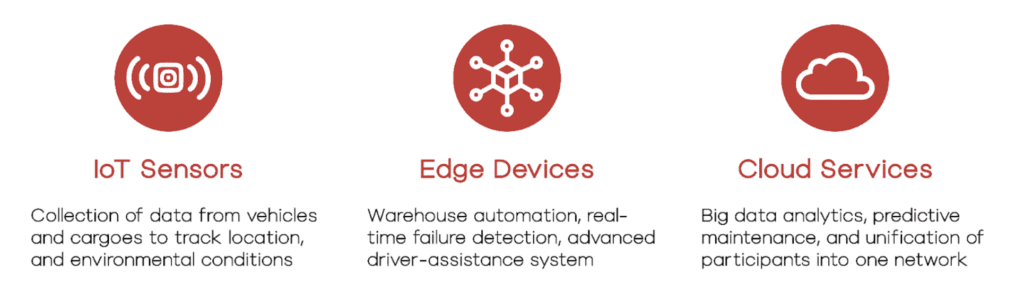
In logistics, the broad IoT ecosystem enables the creation of a consistent digital supply chain in which all participants – vehicles, warehouses, and cargo – interact. This is fully compatible with the recent course for the industry, which requires to increase the sustainability and transparency of its supply chains. Let us consider those urgent needs, and determine where exactly the ubiquitous capacities of IoT should be directed in the logistics sector in 2023.
1 | IoT for advanced analytics
Unexpected economic and political crises, and a lack of flexibility in supply chains, have led to cargo being trapped in ports for weeks and even months. Could these blockages have been predicted? Yes, and this is perhaps the main advantage that IoT gives to logistics. Advanced analytics tools based on artificial intelligence and machine learning use modern databases to process data from all departments within a business.
They compare this data with global trends in lots of ways. As a result, enterprises can receive precise reports and predictions applicable to their particular circumstances. The real target here is to predict price increases, shortages of raw materials, or strikes. As a result, IoT enables better demand planning, distribution of resources, production capacity, and so on. As the economy suffers from inflation, recession, and excess supply, so the supply chain needs more precise planning.
2 | IoT for flexible logistics
A necessary step to flexible supply chains is to adapt logistics warehouses and transport routes to unexpected change without reducing their throughput. The below IoT-related trends can help to achieve this.
- Multimodal Transportation. Although sea shipping is still the busiest mode for logistics, companies like to have an alternative in case their containers get stuck. IoT affords a holistic view of multimodal transportation – to improve cargo tracking and work coordination, increase security, and automate paperwork through it. Cargo under IoT-based control is visible at all stages, while transportation management is just as simple.
- Real-Time Monitoring. When logistics companies have real-time delivery data, they can better match demand with human resources or freight capacity. This creates a level of intelligent automation across the entire network, and allows supply chain managers to respond quickly to disruptions and unforeseen events. Cloud-based IoT platforms manage data about freight and vehicles in real-time. Corresponding access rights gives parties a view of the whole supply chain, and lets them change its components if something goes wrong.
- Predictive Asset Management. In 2023, companies are advised to move to the concept of ‘just in case’ logistics for inventory planning. Strict IoT-based control helps to know the exact location, quantity, and condition of goods. The most common way to ensure this is to mark cargo with RFID tags. By comparing global forecasts with internal predictions, it is possible to strike a balance between inventory optimization and reserves for to cover any unforeseen situations.
3 | IoT versus staff shortages
A lack of labor is not a new problem in logistics, especially among truck drivers. Minimizing risks can make the industry more attractive to them. IoT analytics tools allow companies to predict crises and reroute fleets – which means avoiding traffic jams and eliminating missed shipments for drivers. IoT-based predictive maintenance solutions help eliminate breakdowns on the way, and detailed tracking of vehicles eliminates false accusations against drivers. When traveling long distances, IoT-based wearables can help to monitor their health – to also avoid accidents on the road.
Moreover, in the last year, the problem of a shortage of specialists who would manage complex logistics and minimize risks has become acute. But IoT-based analytics is a specialist resource, as well. In the absence of qualified personnel, it can help to make more effective management decisions based on the data analyzed. The more data in the analysis, the more accurate the predictions it delivers. Which helps plan transportation for the future – resulting, again, in making optimal usage of existing cargo capacity and fewer inefficiencies.
4 | IoT for warehouses automation
The pandemic drove wider adoption of smart-warehouse technologies. It used to be a promising technology, and now it is becoming a global trend. Warehouse automation is based on accurate, real-time information about the location of goods, which is transmitted to the cloud using RFID tags, for example. Autonomous mobile robots (AMRs) know exactly the location and quantity of items to be transported. Data about cargo in and out of the warehouse is continuously updated.
Maintenance of vehicles is hugely helpful. IoT diagnostic devices can collect data about vehicles, and assess the condition of their components by analyzing noises and vibrations, tracking fluid levels, and monitoring driver behavior. An aggressive driving style, for example, can be detected by registering excessive acceleration, sharp cornering, and hard braking. Devices can be optimized with just an accelerometer, gyroscope, or inclination sensor – or any combination. Which is the elegance of IoT.
Automation of transport vehicles is supposed to be more sci-fi, but it is already tangible today. This is especially true for last-mile delivery using drones or specialized vehicles. By obtaining data on cargo, they know exactly what to deliver and to whom.
5 | IoT for the green future
The UK, Canada, Japan, and a few other countries have already committed to net-zero CO2 emissions by 2050. Since logistics is responsible for about 11 percent of global CO2 emissions, the “greening” trend is also inevitable here. If companies focus primarily on asset electrification, then IoT sensors will help to track the emissions accurately. By having the full data on emissions from each vehicle and logistics site, it is easier to build a strategy for their gradual reduction.
This trend is popular with people: 85 percent of consumers globally have already developed more environmentally friendly purchasing behaviors. So, what should we expect in the future? IoT analytics tools help to track the moods and behavior of your customers in order not to underestimate the “green” trend among others.
Keeping up with IoT in logistics
Think trends in IoT are changing too fast? Well, it is partly true, and so PSA recommends evaluating business needs first and existing technologies afterwards. The IoT ecosystem is a convenient highly-customizable platform compatible with the digital trends of today and the future. In the near future, logistics companies will definitely benefit if you implement the following:
- IoT data-collecting for having all the assets at a glance
- IoT data-processing for smart automation of warehouses and real-time control
- IoT data-analyzing for predictive maintenance and precise SC planning
Those who analyze big data, including data from IoT sensors, have an advantage. This trend will remain with us for a long time. And if you can master analytics with IoT logistics solutions, then you will be able to predict logistical trends by yourself.
Julia Mitchell is a Business Operations Manager at Professional Software Associates. She has over eight years of experience in the enterprise IoT development industry. She has been involved in projects for the automotive, energy, and logistics sectors.

