


RCR Wireless
  • News
  • Channels
    • 5G
    • 6G
    • BSS OSS
    • Carriers
    • IoT
    • Network Infrastructure
    • Open RAN
    • Private 5G
    • Telco AI
    • Telco Cloud
    • Test & Measurement
  • Resources
    • Reports
    • Webinars
    • White papers
    • AI Fundamentals
    • Analyst Angle
    • Editorial Calendar
    • Fundamentals
      • 5G NR Release 17
      • AI
        • Telco AI in 2025
    • Podcasts
      • Let’s Get Digital with Carrie Charles
      • Wireless Connectivity to Enable Industry 4.0 for the Middleprise
      • Well Technically…
      • Will 5G Change the World
      • Accelerating Industry 4.0 Digitalization
  • AI Infrastructure
  • Programs
  • Events
  • RCRtv
  • Advertise
  • Subscribe
Tuesday, July 7, 2026
RCR Wireless
  • News
  • Channels
    • 5G
    • 6G
    • BSS OSS
    • Carriers
    • IoT
    • Network Infrastructure
    • Open RAN
    • Private 5G
    • Telco AI
    • Telco Cloud
    • Test & Measurement
  • Resources
    • Reports
    • Webinars
    • White papers
    • AI Fundamentals
    • Analyst Angle
    • Editorial Calendar
    • Fundamentals
      • 5G NR Release 17
      • AI
        • Telco AI in 2025
    • Podcasts
      • Let’s Get Digital with Carrie Charles
      • Wireless Connectivity to Enable Industry 4.0 for the Middleprise
      • Well Technically…
      • Will 5G Change the World
      • Accelerating Industry 4.0 Digitalization
  • AI Infrastructure
  • Programs
  • Events
  • RCRtv
  • Advertise
  • Subscribe
Add RCR Wireless as a preferred source on Google
  • Qualcomm 6G Insights
  • Huawei Content Hub
  • Qualcomm – 6G Vision
  • OSS/BSS Channel
RCR Wireless
RCR Wireless
  • Advanced Mimo
  • Mobile mmWave
  • 5G Positioning
  • Green Networks
  • Metaverse
  • Automotive
  • Industrial and Wide-area IoT
Copyright 2021 - All Right Reserved
Home - Nokia integrates Wi-Fi 6/6E and private 5G – plus switching mechanic to go between
5GBuildingsCarriersConnected CarsData AnalyticsEnterpriseInfrastructureInternet of Things (IoT)LTENews & Event CoveragePlatformsSensorsSmart CitiesSmart FactoryWi-FiWired Networks, Fiber

Nokia integrates Wi-Fi 6/6E and private 5G – plus switching mechanic to go between

by James Blackman May 19, 2022
written by James Blackman May 19, 2022 Share
LinkedinEmail
Share 0LinkedinEmail
241

Nokia has added Wi-Fi 6 and 6E to its seminal Digital Automation Cloud (DAC) private LTE and 5G networking product, available from the fourth quarter of 2022. DAC support for Wi-Fi is included for non-critical industrial applications, it said; the Finnish outfit maintains cellular DAC connectivity – from easily-available LTE, through early 3GPP Release 15-era 5G broadband, and on to incoming 16-through-18 level industrial 5G connectivity – should be preferred for mission and business critical operations.

In tandem, Nokia has introduced a new performance booster, called MX Boost, to allow enterprises to automatically switch between optimal local-area LTE/5G and Wi-Fi radio tech and spectrum. The MX Boost product, patented by Nokia Bell Labs, plugs into Nokia’s broader MX Industrial Edge (MXIE) platform, which also houses the DAC system, and offers enterprises a control window to aggregate their cellular LTE/5G and Wi-Fi 6/6E resources to boost throughput and reliability (determinism) by combining radio links or switching to the strongest tech.

A statement said: “MX Boost automatically selects the strongest radio link and delivers the combined radio stream to either boost throughput in challenging radio conditions, or determinism.” MX Boost works at the IP layer – making it “very easy to aggregate very different connectivity technologies without complexity”, said Nokia. It works with any Wi-Fi system, said Nokia. The firm suggested, also, that the boost mechanic works to combine terrestrial networking tech with satellite networking tech, as well, to offer “endless combination possibilities”. 

MX Boost is already being used by Nokia in critical “train-to-ground” comms in urban and metro railways, where its multipath functionality allows trains, for example, to hand over between operator networks, at high speed, and through tunnels, busy stations, and varied landscapes. Its routing functions will be made available as an application in the MXIE platform. Nokia said it will launch new field routers as part of a range of industrial devices at Hannover Messe in a couple of weeks. 

Everything is being offered as-a-service, Nokia said, with newly-available (“indoor and ruggedized outdoor”) Wi-Fi 6/6E access points (see image) offered free of charge as part of the MXIE/DAC bundle. The Wi-Fi extension in DAC provides an easy mechanism for enterprises looking at Wi-Fi 6/6E “for IT and non-business critical OT”, said Nokia, as well as a pathway to test and deploy private LTE and 5G networks; the MX Boost facility offers flexibility, it said, for enterprises to order and allocate disparate radio tech in challenging RF conditions, such as in ports, factories, and mines.
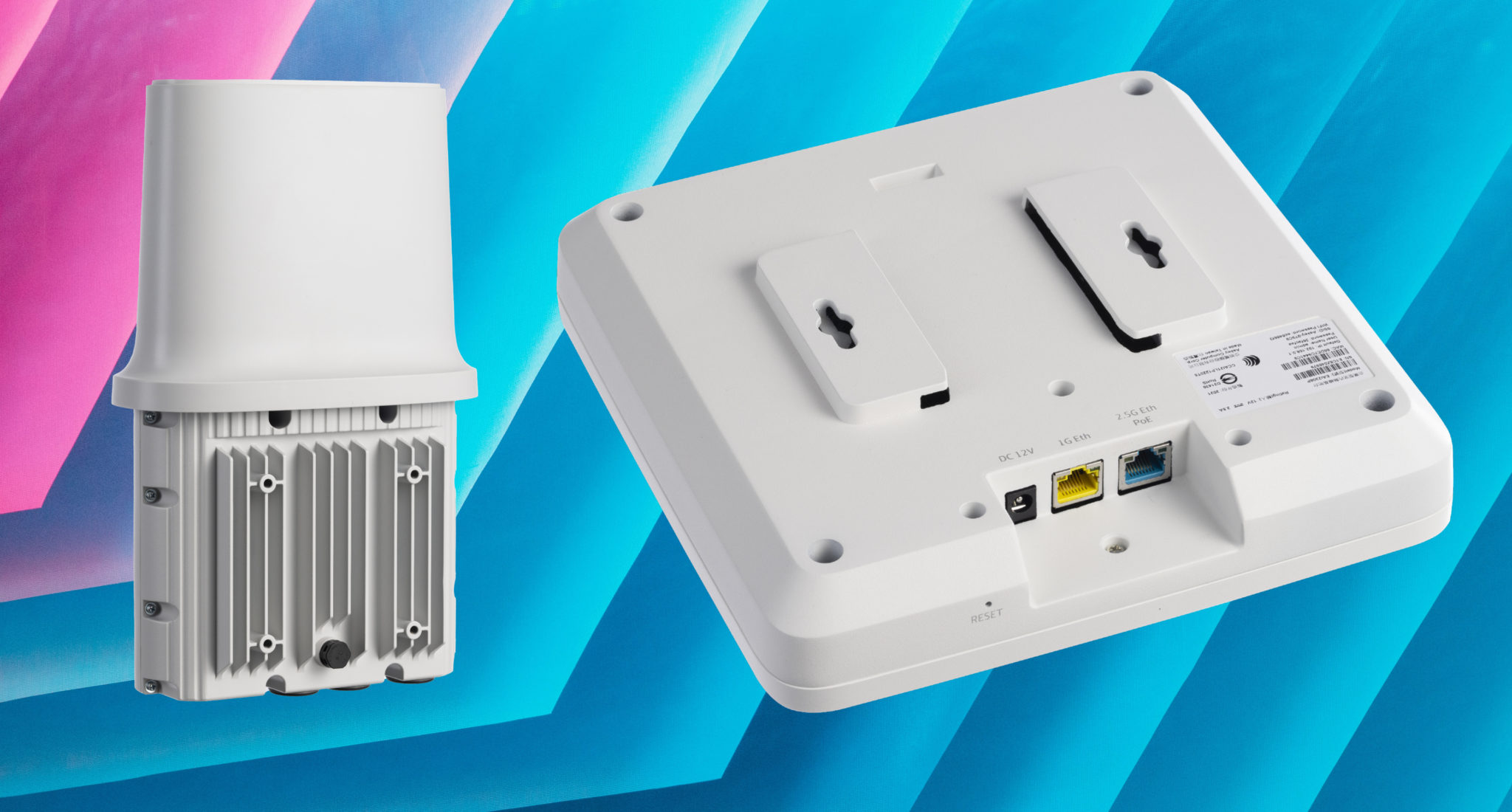
Nokia WI Fi access points scaled 1

As a consequence, Nokia is offering all classes of industrial cellular and enterprise Wi-Fi in all (most, anyway) global spectrum frequencies – including LTE and 5G in sundry public-licensed, private-licensed, and share-licensed cellular bands; LTE-based MulteFire (and 5G in future, with development of 5G NR-U) in the 5 GHz unlicensed band; and Wi-Fi in the 2.4 GHz, 5 GHz, and (with versions 6, 6E, and 7) 6 GHz unlicensed bands. All combinations, it said, can now be managed and authenticated in the MXIE cloud platform, and put to work in optimal fashion by use-case.

Nokia said in a statement: “Many [enterprises] are upgrading to Wi-Fi 6 to improve… legacy assets and services. With the… DAC Wi-Fi solution, [they] can tap into licence-free spectrum to augment private networks and support non-critical OT workflows, such as deskless workforce instructions and… machine maintenance data. [They] can… add plug-and-play private LTE/5G for real-time reliable connectivity, or boost capacity with Wi-Fi 6 for other connectivity needs. This provides unparalleled flexibility [and] significant cost efficiencies.”

Stephan Litjens, vice president of enterprise solutions at Nokia, said: “[With] the Nokia DAC Wi-Fi connectivity solution… we broaden our support for connecting machines, sensors, and people to accelerate… [the] Industry 4.0 journey. With all data into our MXIE [platform], we also make it easier for application developers and system integrators to create intelligent solutions as they can process data in real-time on our open compute platform… [We are placing] choice firmly in the hands of customers.”

“We want to deliver the most innovative solutions… Private LTE/5G… support(s) demanding applications, and, in many cases, deployments leveraging multiple layers and frequency bands. Nokia MX Boost can aggregate and integrate those layers to super-charge performance and reliability. It operates over any Wi-Fi network, as well as with the new Nokia DAC Wi-Fi, to allow companies the greatest choice in… their digital transformation.”

Nokia is one of a hard core of telecoms stalwarts that has made a second home, of late, at the Hannover Messe trade fair in Germany, where it will show its latest DAC offer, plus its bolstered MXIE edge product, and a range of new industrial 5G devices. The firm has started in earnest in industrial devices, including via its HMD licencing tie-up on smartphones, to meet the shortfall in available 5G devices for industrial clients buying its private networks; it sees a tangential opportunity, it would appear, in devices again, just as private 5G networks have given the firm a lift.

A press statement included quotes from a couple of analysts. Leo Gergs, senior analyst at ABI Research, commented: “While the appetite for enterprise connectivity – and private networks – is growing steadily, potential implementers are often overwhelmed by having to choose from an array of different technologies. The key to fostering enterprise connectivity is to offer an easily deployable solution that takes away this complex decision and lets enterprises focus on what they can do best. 

“Nokia MX Boost… [is] the first [example] of a simple technology that breaks the boundaries between Wi-Fi and LTE/5G. It means enterprises no longer need to worry about having to choose the right technology for their use cases, thanks to [its] ability… to combine different tech – including legacy Wi-Fi – into a single connectivity system. MX Boost… offers many opportunities to combine technologies and address heterogenous use-cases, while always keeping the determinism and deep coverage of private wireless.”

Michele Mackenzie, principal analyst at Analysys Mason, said: “Private wireless is likely to dominate critical OT connectivity over time, but Wi-Fi is likely to remain part of the connectivity mix in industrial plants for a long time to come. The recent evolution to Wi-Fi 6 and 6E, which helps make Wi-Fi more deterministic, also makes it more suitable for less-critical high-bandwidth OT applications. The addition of Wi-Fi to Nokia’s [DAC and MXIE] solutions is a natural evolution that allows Nokia to offer enterprises a single platform that unifies Wi-Fi and 5G.”


You Might Also Like
  • Huawei outlines AI-centric network roadmap for telecom monetization
  • Why consolidation will reshape MDU connectivity (part 3/3) – Analyst Angle
  • Indosat outlines AI Grid vision as 5G modernization targets nationwide AI-ready network
  • Huawei shows how 5G and AI are reshaping tourism in China
  • Tuesday | Vertical build-outs, horizontal break-ups (Editorial Diary)
  • ‘You can’t tame it’ – private networks, open standards and the AI proof for IoT
Share 0 LinkedinEmail
James Blackman
James Blackman

James Blackman has been writing about the technology and telecoms sectors for over a decade. He has edited and contributed to a number of European news outlets and trade titles. He has also worked at telecoms company Huawei, leading media activity for its devices business in Western Europe. He is based in London.

previous post
#TBT: AT&T, Sprint launch IoT networks; T-Mo wins ‘Tappy’ lawsuit; FCC rolls back net neutrality … this week in 2017
next post
Kagan: 5G fixed wireless access growth potential

White Papers

  • Enea White Paper: Why Intelligent AAA is the Swiss Army Knife of Telecom

  • CSG White Paper: Telco AI Enabler: Mediation’s Defining Role

  • Enea White Paper: Scalable Database Design for 5G and Beyond

  • Supermicro and NVIDIA Whitepaper: Powering sovereign AI at scale

  • VIAVI Whitepaper: RAN scenario generators and their critical role for future-proofing AI-native RAN in Advanced 5G and 6G networks

Editorial Reports

  • Report: Scaling Optical Networks For The Hyperscale And AI Era

  • Test And Measurement Market Pulse Report

  • Editorial Report: Securing telecom infrastructure for the quantum era

Webinars

  • Webinar: Rethinking the RAN as AI, cloud and openness converge

  • Webinar: Scale-Up, Scale-Out, Scale-Across – Building AI-Era Network Fabrics

  • Webinar: NTN in motion – evolving standards, expanding services

  • Webinar: Noise-Figure Measurements with RFmx and PXI VSTs

  • Qualcomm Webinar – Building the 6G Standard: Key developments to know

Since 1982, RCR Wireless News has been providing wireless and mobile industry news, insights, and analysis to mobile and wireless industry professionals, decision makers, policy makers, analysts and investors.

Facebook Twitter Youtube Linkedin Envelope Rss

Useful Links

  • Subscribe
  • About RCR Wireless News
  • Contact Us
  • Advertise
  • Editorial Calendar
  • Archive
  • RSS
  • Wireless News Archive
  • Subscribe
  • About RCR Wireless News
  • Contact Us
  • Advertise
  • Editorial Calendar
  • Archive
  • RSS
  • Wireless News Archive

Edtior's Picks

Enea White Paper: Why Intelligent AAA is the Swiss Army Knife of Telecom
Huawei outlines AI-centric network roadmap for telecom monetization
Why consolidation will reshape MDU connectivity (part 3/3) – Analyst Angle

Latest Articles

Enea White Paper: Why Intelligent AAA is the Swiss Army Knife of Telecom
Huawei outlines AI-centric network roadmap for telecom monetization
Why consolidation will reshape MDU connectivity (part 3/3) – Analyst Angle
Quantum Safe Networks Forum 2026

© 2026 RCR Wireless News All Right Reserved. Developed by Eight Hats.

Cookie Policy | Privacy Policy

RCR Wireless
  • News
  • Channels
    • 5G
    • 6G
    • BSS OSS
    • Carriers
    • IoT
    • Network Infrastructure
    • Open RAN
    • Private 5G
    • Telco AI
    • Telco Cloud
    • Test & Measurement
  • Resources
    • Reports
    • Webinars
    • White papers
    • AI Fundamentals
    • Analyst Angle
    • Editorial Calendar
    • Fundamentals
      • 5G NR Release 17
      • AI
        • Telco AI in 2025
    • Podcasts
      • Let’s Get Digital with Carrie Charles
      • Wireless Connectivity to Enable Industry 4.0 for the Middleprise
      • Well Technically…
      • Will 5G Change the World
      • Accelerating Industry 4.0 Digitalization
  • AI Infrastructure
  • Programs
  • Events
  • RCRtv
  • Advertise
  • Subscribe
RCR Wireless
  • News
  • Channels
    • 5G
    • 6G
    • BSS OSS
    • Carriers
    • IoT
    • Network Infrastructure
    • Open RAN
    • Private 5G
    • Telco AI
    • Telco Cloud
    • Test & Measurement
  • Resources
    • Reports
    • Webinars
    • White papers
    • AI Fundamentals
    • Analyst Angle
    • Editorial Calendar
    • Fundamentals
      • 5G NR Release 17
      • AI
        • Telco AI in 2025
    • Podcasts
      • Let’s Get Digital with Carrie Charles
      • Wireless Connectivity to Enable Industry 4.0 for the Middleprise
      • Well Technically…
      • Will 5G Change the World
      • Accelerating Industry 4.0 Digitalization
  • AI Infrastructure
  • Programs
  • Events
  • RCRtv
  • Advertise
  • Subscribe
@2020 - All Right Reserved. Designed and Developed by PenciDesign