

RCR Wireless
  • News
  • Channels
    • 5G
    • 6G
    • BSS OSS
    • Carriers
    • IoT
    • Network Infrastructure
    • Open RAN
    • Private 5G
    • Telco AI
    • Telco Cloud
    • Test & Measurement
  • Resources
    • Reports
    • Webinars
    • White papers
    • AI Fundamentals
    • Analyst Angle
    • Editorial Calendar
    • Fundamentals
      • 5G NR Release 17
      • AI
        • Telco AI in 2025
    • Podcasts
      • Let’s Get Digital with Carrie Charles
      • Wireless Connectivity to Enable Industry 4.0 for the Middleprise
      • Well Technically…
      • Will 5G Change the World
      • Accelerating Industry 4.0 Digitalization
  • AI Infrastructure
  • Programs
  • Events
  • RCRtv
  • Advertise
  • Subscribe
Thursday, July 23, 2026
RCR Wireless
  • News
  • Channels
    • 5G
    • 6G
    • BSS OSS
    • Carriers
    • IoT
    • Network Infrastructure
    • Open RAN
    • Private 5G
    • Telco AI
    • Telco Cloud
    • Test & Measurement
  • Resources
    • Reports
    • Webinars
    • White papers
    • AI Fundamentals
    • Analyst Angle
    • Editorial Calendar
    • Fundamentals
      • 5G NR Release 17
      • AI
        • Telco AI in 2025
    • Podcasts
      • Let’s Get Digital with Carrie Charles
      • Wireless Connectivity to Enable Industry 4.0 for the Middleprise
      • Well Technically…
      • Will 5G Change the World
      • Accelerating Industry 4.0 Digitalization
  • AI Infrastructure
  • Programs
  • Events
  • RCRtv
  • Advertise
  • Subscribe
Add RCR Wireless as a preferred source on Google
  • Qualcomm 6G Insights
  • Huawei Content Hub
  • Qualcomm – 6G Vision
  • OSS/BSS Channel
  • RCRTech Roundtable: AI Infrastructure
RCR Wireless
RCR Wireless
  • Advanced Mimo
  • Mobile mmWave
  • 5G Positioning
  • Green Networks
  • Metaverse
  • Automotive
  • Industrial and Wide-area IoT
Copyright 2021 - All Right Reserved
Home - The big 5G problem – not networks, not spectrum, but devices (Talking 5G Blues)
5GBuildingsCarriersChipsetsConnected CarsData AnalyticsEnterpriseFundamentalsInfrastructureInternet of Things (IoT)LTENews & Event CoverageSmart CitiesSmart FactoryStandardsTransportation: Airports, Rail, PortsWired Networks, Fiber

The big 5G problem – not networks, not spectrum, but devices (Talking 5G Blues)

by James Blackman April 20, 2022
written by James Blackman April 20, 2022 Share
LinkedinEmail
Share 0LinkedinEmail
188

Note, for more on this topic, and to hear more from MFA and others, join the Enterprise IoT Insights webinar on Industrial 5G (From Setting Standard to Becoming Standard) on April 28 – also featuring speakers from ABI Research, Schneider Electric, and Vodafone; check back here, also, for the editorial report on the same topic.

The problem with industrial-grade cellular is not with networks, anymore, really; 5G network equipment is variously available, and 5G network infrastructure is increasingly well deployed. The excitement in the private 5G market shows this. The problem is with devices, instead – insofar as there just aren’t that many of them. Most-anything badged currently as ‘industrial 5G’ is probably a Release-15 level consumer unit in ruggedised industrial garb.

They are ‘industrial’ in form, but not in function. In terms of their features – supposed to animate industrial machines and processes, and make cellular a springboard for new Industry 4.0 pyrotechnics – there just ain’t that much happening, as yet. Release 16-level private networks are going in, with some of these new capabilities, but there are scarcely any Release 16-level enterprise devices (a couple of routers, perhaps) to attach to them.

Is this a problem? Is there a delay? Not according to the 3GPP schedule, which says everything is time-tabled, and on track. And not, really, according to most (of the multiplying new-wave of) network vendors, which are selling private networks hand-over-fist – that is, hand-over-fist for recent-startups and late-comers, at least, likely stretched by their spluttering CBRS exploits or else just happy to have grown beyond limited indoor DAS installations.

Ouch; not necessary. And even Nokia – whose enterprise division is, arguably, its prime business for growth and innovation – appears to be having a high old time in the private networks space. Except this is not completely true. Nokia, like everyone, is betting on a much bigger market; it has counted out its industrial targets, and settled on a market of 14 million sites, potentially, including 10 million factories and three million warehouses.
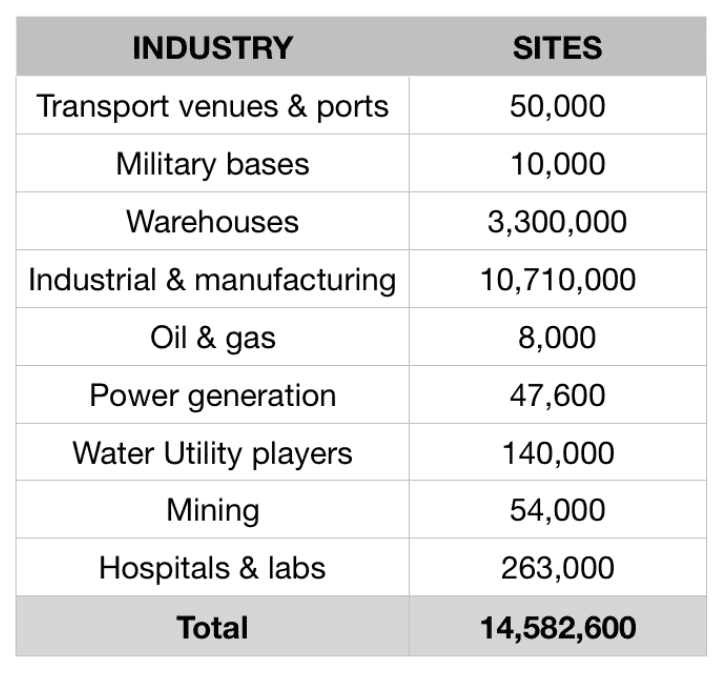
Nokia Private Network Targets

Source: Nokia

These ‘verticals’ define the Industry 4.0 epicentre, and these verticals reckon there is a delay with devices. This is why most of the CBRS activity in the US, as the first market for private networks, has been concerned with school districts and hospitality venues, and similarly prosaic Industry 4.0 affairs – which make consumer-like broadband their primary concern. Because this is not Industry 4.0 at all; and every factory in the world is waiting on 5G devices.

This goes for the early adopters, too, crowing about how 5G (LTE) saved their businesses. (Note, it never did, and they never said so; the headline was changed, and the story says devices are a problem.) This is why Siemens – a bellwether for big-ticket Industry 4.0 – is happy enough to tinker with its own 5G system until sometime after 2023, when Release 16 is popularised in devices and Release 17 is in the offing (whatever it says at Hannover Messe).

But we should be clearer: 5G NR already works for industry, in Releases 15 and 16. Harder-nosed control and automation provisions will come with Releases 17 and 18, but there are very decent industrial-grade features that could be better leveraged – if devices were available. Instead, Industry 4.0 is making do – quite well, as it goes – with go-faster functions appropriated from the latest consumer-geared mobile broadband (eMBB) service category.

This is where private 5G has found purchase in industry – with the likes of Lufthansa Technik, referenced above, and with plenty of others. Indeed, there is enough in eMBB for the industrial set to justify early commercial rollouts of private 5G networks; there just isn’t enough in it to do more, and certainly not enough to animate whole factories. Again, the reason is a lack of industrial 5G devices that draw-down on 5G NR specs outside of the consumer realm.

Not because the standardisation process is delayed, but because the IoT supply chain has failed. This is the tale the MulteFire Alliance (MFA) is telling – on behalf of network vendor-members like Nokia and Ericsson, but also for the broader Industry 4.0 community. “We have Release 15 devices, but they don’t have the right features for Industry 4.0 – because we haven’t had the blueprints. We don’t have any Release 16 devices yet; maybe sometime soon, maybe in pilot mode. But the important thing, again, is these blueprints.”

So says Asimakis Kokkos, chair of the technical specification working group at MFA. But what blueprints? And how will these blueprints make 5G work for industry – so that industrial 5G devices connect to industrial 5G networks to spring industrial 5G solutions, in new ways?

To be continued…

For more on this subject – and to hear from Asimakis Kokkos at MFA, alongside speakers from ABI Research, Schneider Electric, and Vodafone – sign up for the Enterprise IoT Insights webinar on April 28 on Industrial 5G (From Setting Standard to Becoming Standard) – plus the editorial report on the same subject.


You Might Also Like
  • South Korea launches AI-RAN project to advance industrial AI
  • AT&T’s bets on “best tech” (fiber) pay off with record adds, improving margins 
  • The most expensive wireless system is the one you install twice (Reader Forum)
  • The Agentic Network — Cisco on earning trust in autonomous operations
  • Blue Planet intros AI agents to fight OSS configuration drift – and stand-up telco trust
  • Rakuten Mobile expands O-RAN footprint with 1Finity radios
Share 0 LinkedinEmail
James Blackman
James Blackman

James Blackman has been writing about the technology and telecoms sectors for over a decade. He has edited and contributed to a number of European news outlets and trade titles. He has also worked at telecoms company Huawei, leading media activity for its devices business in Western Europe. He is based in London.

previous post
Public cloud spending to hit almost $500B this year – report
next post
EE, Qualcomm test seven-carrier aggregation to boost 5G

White Papers

  • Norton eBook: The 2026 Telco Playbook

  • Enea White Paper: Why Intelligent AAA is the Swiss Army Knife of Telecom

  • CSG White Paper: Telco AI Enabler: Mediation’s Defining Role

  • Enea White Paper: Scalable Database Design for 5G and Beyond

  • Supermicro and NVIDIA Whitepaper: Powering sovereign AI at scale

Editorial Reports

  • Nvidia Report: The State of AI in Telecommunications: 2026 Trends

  • Report: Scaling Optical Networks For The Hyperscale And AI Era

  • Test And Measurement Market Pulse Report

Webinars

  • Webinar: Building 6G — aligning technology, policy and purpose

  • SIMCom Webinar: Scaling your next deployment – from plastic to provisioning

  • Webinar: Rethinking the RAN as AI, cloud and openness converge

  • Webinar: Scale-Up, Scale-Out, Scale-Across – Building AI-Era Network Fabrics

  • Webinar: NTN in motion – evolving standards, expanding services

Since 1982, RCR Wireless News has been providing wireless and mobile industry news, insights, and analysis to mobile and wireless industry professionals, decision makers, policy makers, analysts and investors.

Facebook Twitter Youtube Linkedin Envelope Rss

Useful Links

  • Subscribe
  • About RCR Wireless News
  • Contact Us
  • Advertise
  • Editorial Calendar
  • Archive
  • RSS
  • Wireless News Archive
  • Subscribe
  • About RCR Wireless News
  • Contact Us
  • Advertise
  • Editorial Calendar
  • Archive
  • RSS
  • Wireless News Archive

Edtior's Picks

South Korea launches AI-RAN project to advance industrial AI
Tuesday (telco diary) | Telco agents and outcomes
AT&T’s bets on “best tech” (fiber) pay off with record adds, improving margins 

Latest Articles

South Korea launches AI-RAN project to advance industrial AI
Tuesday (telco diary) | Telco agents and outcomes
AT&T’s bets on “best tech” (fiber) pay off with record adds, improving margins 
The most expensive wireless system is the one you install twice (Reader Forum)

© 2026 RCR Wireless News All Right Reserved. Developed by Eight Hats.

Cookie Policy | Privacy Policy

RCR Wireless
  • News
  • Channels
    • 5G
    • 6G
    • BSS OSS
    • Carriers
    • IoT
    • Network Infrastructure
    • Open RAN
    • Private 5G
    • Telco AI
    • Telco Cloud
    • Test & Measurement
  • Resources
    • Reports
    • Webinars
    • White papers
    • AI Fundamentals
    • Analyst Angle
    • Editorial Calendar
    • Fundamentals
      • 5G NR Release 17
      • AI
        • Telco AI in 2025
    • Podcasts
      • Let’s Get Digital with Carrie Charles
      • Wireless Connectivity to Enable Industry 4.0 for the Middleprise
      • Well Technically…
      • Will 5G Change the World
      • Accelerating Industry 4.0 Digitalization
  • AI Infrastructure
  • Programs
  • Events
  • RCRtv
  • Advertise
  • Subscribe
RCR Wireless
  • News
  • Channels
    • 5G
    • 6G
    • BSS OSS
    • Carriers
    • IoT
    • Network Infrastructure
    • Open RAN
    • Private 5G
    • Telco AI
    • Telco Cloud
    • Test & Measurement
  • Resources
    • Reports
    • Webinars
    • White papers
    • AI Fundamentals
    • Analyst Angle
    • Editorial Calendar
    • Fundamentals
      • 5G NR Release 17
      • AI
        • Telco AI in 2025
    • Podcasts
      • Let’s Get Digital with Carrie Charles
      • Wireless Connectivity to Enable Industry 4.0 for the Middleprise
      • Well Technically…
      • Will 5G Change the World
      • Accelerating Industry 4.0 Digitalization
  • AI Infrastructure
  • Programs
  • Events
  • RCRtv
  • Advertise
  • Subscribe
@2020 - All Right Reserved. Designed and Developed by PenciDesign