
RCR Wireless
  • News
  • Channels
    • 5G
    • 6G
    • BSS OSS
    • Carriers
    • IoT
    • Network Infrastructure
    • Open RAN
    • Private 5G
    • Telco AI
    • Telco Cloud
    • Test & Measurement
  • Resources
    • Reports
    • Webinars
    • White papers
    • AI Fundamentals
    • Analyst Angle
    • Editorial Calendar
    • Fundamentals
      • 5G NR Release 17
      • AI
        • Telco AI in 2025
    • Podcasts
      • Let’s Get Digital with Carrie Charles
      • Wireless Connectivity to Enable Industry 4.0 for the Middleprise
      • Well Technically…
      • Will 5G Change the World
      • Accelerating Industry 4.0 Digitalization
  • AI Infrastructure
  • Programs
  • Events
  • RCRtv
  • Advertise
  • Subscribe
Sunday, August 9, 2026
RCR Wireless
  • News
  • Channels
    • 5G
    • 6G
    • BSS OSS
    • Carriers
    • IoT
    • Network Infrastructure
    • Open RAN
    • Private 5G
    • Telco AI
    • Telco Cloud
    • Test & Measurement
  • Resources
    • Reports
    • Webinars
    • White papers
    • AI Fundamentals
    • Analyst Angle
    • Editorial Calendar
    • Fundamentals
      • 5G NR Release 17
      • AI
        • Telco AI in 2025
    • Podcasts
      • Let’s Get Digital with Carrie Charles
      • Wireless Connectivity to Enable Industry 4.0 for the Middleprise
      • Well Technically…
      • Will 5G Change the World
      • Accelerating Industry 4.0 Digitalization
  • AI Infrastructure
  • Programs
  • Events
  • RCRtv
  • Advertise
  • Subscribe
Add RCR Wireless as a preferred source on Google
  • Qualcomm 6G Insights
  • Huawei Content Hub
  • Qualcomm – 6G Vision
  • OSS/BSS Channel
  • RCRTech Roundtable: AI Infrastructure
RCR Wireless
RCR Wireless
  • Advanced Mimo
  • Mobile mmWave
  • 5G Positioning
  • Green Networks
  • Metaverse
  • Automotive
  • Industrial and Wide-area IoT
Copyright 2021 - All Right Reserved
Home - Green business is good business – the six most sustainable smart factories
5GConnected CarsData AnalyticsEnergyEnterpriseFundamentalsInfrastructureInternet of Things (IoT)LTENB-IoTNews & Event CoverageOil & GasPlatformsSensorsSmart CitiesSmart FactoryWired Networks, Fiber

Green business is good business – the six most sustainable smart factories

by James Blackman March 30, 2022
written by James Blackman March 30, 2022 Share
LinkedinEmail
Share 0LinkedinEmail
Image: 123rf
373

It is a silly headline, and an opt-in competition, but the World Economic Forum’s list of ‘lighthouse factories’, acknowledged for their use of Industry 4.0 kit, now stretches to 103 manufacturing facilities, and includes at least six sites that have been separately acclaimed for their environmental records. It is worth making a fuss of their factory owners, for taking a lead on “tech-infused industry transformation for a positive impact on people and the planet”.

The lighthouse list, organised with consulting firm McKinsey & Company, identifies – or mainly reviews entries from – industrial companies that are making use of Industry 4.0 technologies, notably big data analytics and ‘artificial intelligence’, but also, very clearly, private cellular and edge computing tech, plus all manner of IoT gear, including autonomous guided vehicles (AGVs) and unmanned aerial vehicles (UAVs, or drones) at the top end.

And, of course, you can shunt most other software wizardry and hardware gadgetry into the mix, including lower-level IoT for industrial sensing, enterprise AR / VR gear for remote assistance, and digital thread / twin solutions for process simulations. The World Economic Forum wants its ‘lighthouse’ factories to show the way for industrial outfits to land these technology solutions, and to drive efficiency and productivity – and make the sector greener.

By 2020, 83 countries had reported 700 policies related to “sustainable consumption and production” to limit the rise in global temperature to less than 2°C above pre-industrial levels, and more ambitiously to less than 1.5°C, as per the Paris Agreement, but only 40 had reported policies to increase the sustainability of supply chains, among other measures. This failure should be considered as “code red for humanity”, the UN has responded.

But a handful of lighthouse factories, at least, are showing the way in the industrial supply chain. “Members are applying advanced technologies to increase supply chain resilience, augment green measures, and boost workforce engagement while bolstering productivity,” says the World Economic Forum. More tellingly, it says one thing drives the other – insofar as industrial efficiency in the end relates directly to environmental efficiency.

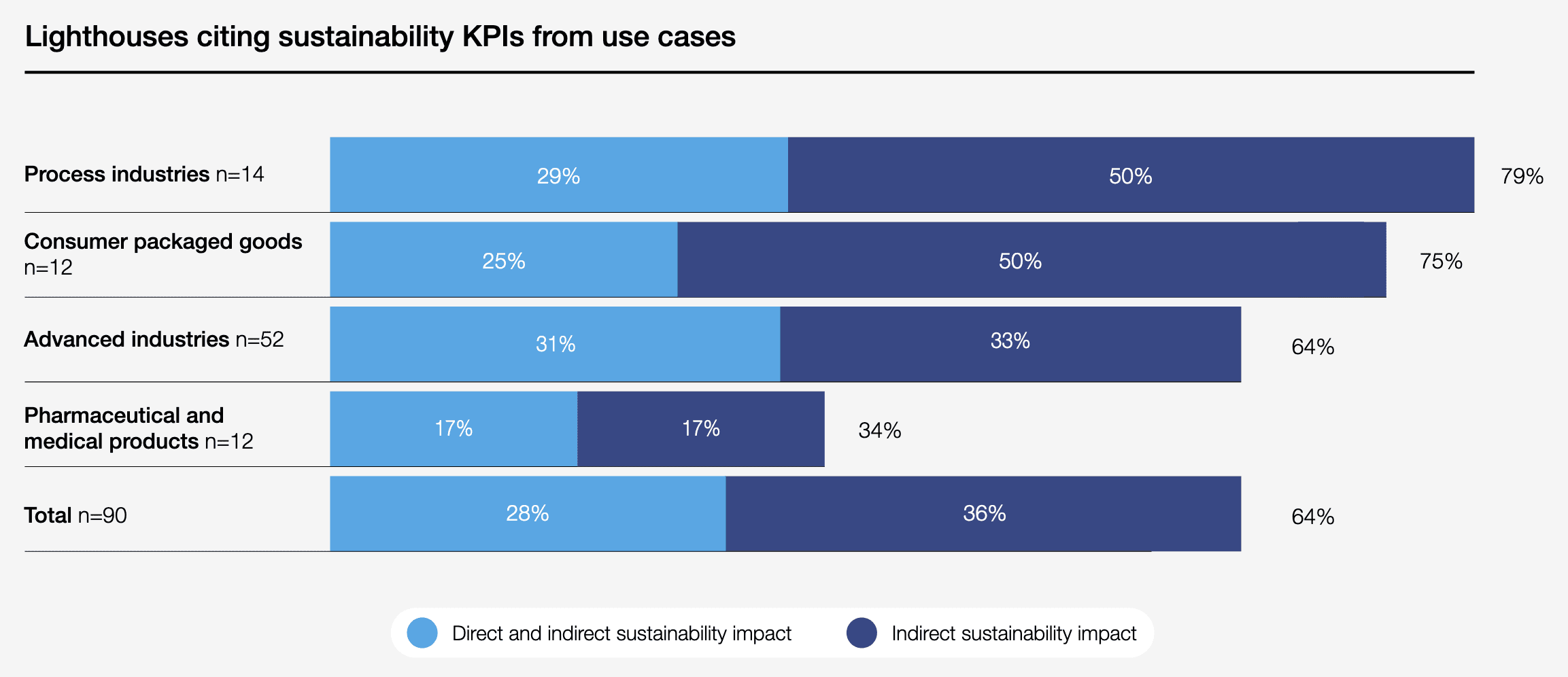
“Eco-efficiency is the outcome of 4IR technologies which, when directed to solve business problems, simultaneously boost productivity and sustainability. As companies achieve eco-efficiency, they challenge the notion that environmental responsibility is inherently at odds with increasing operational performance,” it says. Well over half of its lighthouse factories (64%) claim sustainability impact, deriving from both direct and indirect use cases (see graphic).

It states: “Of the 14 lighthouse factories engaged in ‘process industries’, 29 percent report sustainability gains on KPIs deriving from direct sustainability cases, but 50 percent report indirect impact from other cases. [And] while 25 percent of the 12 consumer packaged-goods ‘lighthouses’ cite direct sustainability use-case impact, a full 50 percent report impact from indirect use cases – [from Industry 4.0] efforts aimed at solving different business problems.”

The report, available here, contains much more of interest, but we will leave it there, for now; below are the best in the sustainability business, fully quoted, according to the World Economic Forum and McKinsey & Company. As an aside, it might be noted this short-list of six companies does not reflect the same geographic bias as the longer list of the 103 smartest factories, which is dominated by Asia-based entrants.

Here, based on smart manufacturing for sustainability above all else, half of the entries are based in Europe, a third are based in the US, and none are in China.
 

WEF McKinsey Sustainability Factory

The Janssen Pharmaceutical Companies of Johnson & Johnson (Cork, Ireland)
Janssen Sciences Ireland Unlimited Company has been long supporting regional initiatives for sustainability improvement and now enabling the corporate 2030 pledge of carbon neutrality. Through Fourth Industrial Revolution-enabled real-time release, adaptive process control and other sustainability efforts, the site has optimized its processes and reduced carbon emissions per kg of product by 56%, while the site footprint has expanded by 34% to meet growing business needs.

Schneider Electric (Le Vaudreuil, France)
Schneider Electric Le Vaudreuil has implemented industrial internet of things (IIoT) sensors connected to digital platforms, unlocking data to optimize energy management by 25%, reduce material waste by 17% and minimize CO2 emissions by 25%, with the objective to be net-zero carbon by 2025, without offset and ahead of the global Schneider Electric pledge. The smart factory is equipped with a zero-reject water recycling station connected to cloud analytics and monitored by an artificial intelligence (AI) model to predict process drifts, leading globally to 64% in water reduction.

Western Digital (Penang, Malaysia)
Western Digital achieved a reduction in energy by 41%, water consumption by 45% and material waste by 16% through a vertically integrated smart factory. Fourth Industrial Revolution technologies, such as internet of things (IoT) sensors, digital twin modelling, analytics powered plant management system and lights-out automation with machine learning, increased their sustainability impacts, while the site grew 43% (Compound Annual Growth Rate) in the last four years. This concerted effort enabled the Malaysia Green Building Index (GBI) certification for the site.

Ericsson (Lewisville, US)
Ericsson’s greenfield 5G factory is powered 100% by renewable electricity from on-site solar and green-e certified renewable electricity from the utility grid. The smart factory integrates sustainable technologies such as thermal ice storage tanks with the IIoT stack to proactively monitor energy usage and is designed to utilize 24% less energy and 75% less indoor water usage, avoiding 97% operational carbon emission than comparable buildings. This year it became Ericsson’s first factory globally to achieve LEED Gold certification.

Henkel (Düsseldorf, Germany)
In an effort to improve visibility into factory consumption to drive better decision-making, Henkel deployed utility meters on machines integrated in a digital twin that connects and benchmarks 30 factories and prescribes real-time sustainability actions that has led to 38% less energy (kWh/tonne) used, and has reduced water consumption 28% (m 3 /tonne), and waste 20% (kg/tonne) across factory baselines set in 2010.

Schneider Electric (Lexington, US)
In order to capture greater energy consumption granularity, when and where it happens in the plant, the Lexington smart factory leveraged IoT connectivity with power meters and predictive analytics to optimize energy cost, and as a result led to 26% energy reduction (GWh), 30% net CO2 reduction, and 20% water use reduction and Superior Energy Performance 50001TM certification by the US Department of Energy.

You Might Also Like
  • Bell advances AIDC strategy as fiber and enterprise AI drive Q2
  • Tuesday (telco diary) | More about ISAC – on battlefields and sportsfields
  • From missiles to pizzas – why 6G drone sensing has been fast-tracked for 5G
  • Cellnex sees AI, 5G and digital sovereignty driving Europe’s next infrastructure cycle
  • Poste deal advances as TIM eyes growth in AI services, mission-critical industries
  • Physical AI is exposing a data sovereignty gap (Reader Forum)
Share 0 LinkedinEmail
James Blackman
James Blackman

James Blackman has been writing about the technology and telecoms sectors for over a decade. He has edited and contributed to a number of European news outlets and trade titles. He has also worked at telecoms company Huawei, leading media activity for its devices business in Western Europe. He is based in London.

previous post
China leads smart-factory hall of fame – US way behind as Industry 4.0 powerhouse
next post
Nextivity Delivers In-building RF Tools for System Integrator Efficiency and Profitability with Cel-Fi Solutions

White Papers

  • Norton eBook: The 2026 Telco Playbook

  • Enea White Paper: Why Intelligent AAA is the Swiss Army Knife of Telecom

  • CSG White Paper: Telco AI Enabler: Mediation’s Defining Role

  • Enea White Paper: Scalable Database Design for 5G and Beyond

  • Supermicro and NVIDIA Whitepaper: Powering sovereign AI at scale

Editorial Reports

  • Report: NTN in motion — evolving standards, expanding services

  • Market Pulse Report: Telco AI in 2026 – Trends, Challenges and Opportunities

  • Nvidia Report: The State of AI in Telecommunications: 2026 Trends

Webinars

  • Webinar: Building 6G — aligning technology, policy and purpose

  • SIMCom Webinar: Scaling your next deployment – from plastic to provisioning

  • Webinar: Rethinking the RAN as AI, cloud and openness converge

  • Webinar: Scale-Up, Scale-Out, Scale-Across – Building AI-Era Network Fabrics

  • Webinar: NTN in motion – evolving standards, expanding services

Since 1982, RCR Wireless News has been providing wireless and mobile industry news, insights, and analysis to mobile and wireless industry professionals, decision makers, policy makers, analysts and investors.

Facebook Twitter Youtube Linkedin Envelope Rss

Useful Links

  • Subscribe
  • About RCR Wireless News
  • Contact Us
  • Advertise
  • Editorial Calendar
  • Archive
  • RSS
  • Wireless News Archive
  • Subscribe
  • About RCR Wireless News
  • Contact Us
  • Advertise
  • Editorial Calendar
  • Archive
  • RSS
  • Wireless News Archive

Edtior's Picks

The Agentic Network — NVIDIA on the full-stack path to telecom autonomy
Ericsson named sole global tech partner in SK Telecom-led AI-RAN pilot
Bell advances AIDC strategy as fiber and enterprise AI drive Q2

Latest Articles

The Agentic Network — NVIDIA on the full-stack path to telecom autonomy
Ericsson named sole global tech partner in SK Telecom-led AI-RAN pilot
Bell advances AIDC strategy as fiber and enterprise AI drive Q2
Context before control – Blue Planet maps AI architecture for autonomous networks

© 2026 RCR Wireless News All Right Reserved. Developed by Eight Hats.

Cookie Policy | Privacy Policy

RCR Wireless
  • News
  • Channels
    • 5G
    • 6G
    • BSS OSS
    • Carriers
    • IoT
    • Network Infrastructure
    • Open RAN
    • Private 5G
    • Telco AI
    • Telco Cloud
    • Test & Measurement
  • Resources
    • Reports
    • Webinars
    • White papers
    • AI Fundamentals
    • Analyst Angle
    • Editorial Calendar
    • Fundamentals
      • 5G NR Release 17
      • AI
        • Telco AI in 2025
    • Podcasts
      • Let’s Get Digital with Carrie Charles
      • Wireless Connectivity to Enable Industry 4.0 for the Middleprise
      • Well Technically…
      • Will 5G Change the World
      • Accelerating Industry 4.0 Digitalization
  • AI Infrastructure
  • Programs
  • Events
  • RCRtv
  • Advertise
  • Subscribe
RCR Wireless
  • News
  • Channels
    • 5G
    • 6G
    • BSS OSS
    • Carriers
    • IoT
    • Network Infrastructure
    • Open RAN
    • Private 5G
    • Telco AI
    • Telco Cloud
    • Test & Measurement
  • Resources
    • Reports
    • Webinars
    • White papers
    • AI Fundamentals
    • Analyst Angle
    • Editorial Calendar
    • Fundamentals
      • 5G NR Release 17
      • AI
        • Telco AI in 2025
    • Podcasts
      • Let’s Get Digital with Carrie Charles
      • Wireless Connectivity to Enable Industry 4.0 for the Middleprise
      • Well Technically…
      • Will 5G Change the World
      • Accelerating Industry 4.0 Digitalization
  • AI Infrastructure
  • Programs
  • Events
  • RCRtv
  • Advertise
  • Subscribe
@2020 - All Right Reserved. Designed and Developed by PenciDesign