
RCR Wireless
  • News
  • Channels
    • 5G
    • 6G
    • BSS OSS
    • Carriers
    • IoT
    • Network Infrastructure
    • Open RAN
    • Private 5G
    • Telco AI
    • Telco Cloud
    • Test & Measurement
  • Resources
    • Reports
    • Webinars
    • White papers
    • AI Fundamentals
    • Analyst Angle
    • Editorial Calendar
    • Fundamentals
      • 5G NR Release 17
      • AI
        • Telco AI in 2025
    • Podcasts
      • Let’s Get Digital with Carrie Charles
      • Wireless Connectivity to Enable Industry 4.0 for the Middleprise
      • Well Technically…
      • Will 5G Change the World
      • Accelerating Industry 4.0 Digitalization
  • AI Infrastructure
  • Programs
  • Events
  • RCRtv
  • Advertise
  • Subscribe
Sunday, August 9, 2026
RCR Wireless
  • News
  • Channels
    • 5G
    • 6G
    • BSS OSS
    • Carriers
    • IoT
    • Network Infrastructure
    • Open RAN
    • Private 5G
    • Telco AI
    • Telco Cloud
    • Test & Measurement
  • Resources
    • Reports
    • Webinars
    • White papers
    • AI Fundamentals
    • Analyst Angle
    • Editorial Calendar
    • Fundamentals
      • 5G NR Release 17
      • AI
        • Telco AI in 2025
    • Podcasts
      • Let’s Get Digital with Carrie Charles
      • Wireless Connectivity to Enable Industry 4.0 for the Middleprise
      • Well Technically…
      • Will 5G Change the World
      • Accelerating Industry 4.0 Digitalization
  • AI Infrastructure
  • Programs
  • Events
  • RCRtv
  • Advertise
  • Subscribe
Add RCR Wireless as a preferred source on Google
  • Qualcomm 6G Insights
  • Huawei Content Hub
  • Qualcomm – 6G Vision
  • OSS/BSS Channel
  • RCRTech Roundtable: AI Infrastructure
RCR Wireless
RCR Wireless
  • Advanced Mimo
  • Mobile mmWave
  • 5G Positioning
  • Green Networks
  • Metaverse
  • Automotive
  • Industrial and Wide-area IoT
Copyright 2021 - All Right Reserved
Home - 5G Open RAN: How operators can avoid opening a pandora’s box of problems (Reader Forum)
Reader Forum5GOpen RANOpinion

5G Open RAN: How operators can avoid opening a pandora’s box of problems (Reader Forum)

by Shamik Mishra, Chief Technology Officer Connectivity, Capgemini Engineering, and Sameh Yamany, Chief Technology Officer, VIAVI Solutions January 26, 2022
written by Shamik Mishra, Chief Technology Officer Connectivity, Capgemini Engineering, and Sameh Yamany, Chief Technology Officer, VIAVI Solutions January 26, 2022 Share
LinkedinEmail
Share 0LinkedinEmail
315

As the evolution to 5G technology advances worldwide, network operators are increasingly interested in exploring open radio access network (Open RAN) technology. Open RAN is promoted as offering a host of business benefits for both incumbent and new mobile operators, including greater agility and supply chain diversification.

Most importantly in this highly competitive market, lower total cost of ownership (TCO) and faster time to market with new services are among the key benefits touted for migrating to an Open RAN architecture, according to a survey conducted by industry analyst firm Analysys Mason.

The key aspects of Open RAN architecture are the virtualization and increased cloudification of the radio network. The network virtualization done over the past several years focused on the core rather than the RAN. The cost of the radio network is a major part of the overall cost of the end-to-end wireless network. Virtualization and cloudification of the RAN make it possible to leverage commercial off-the-shelf (COTS) servers for running the baseband software.

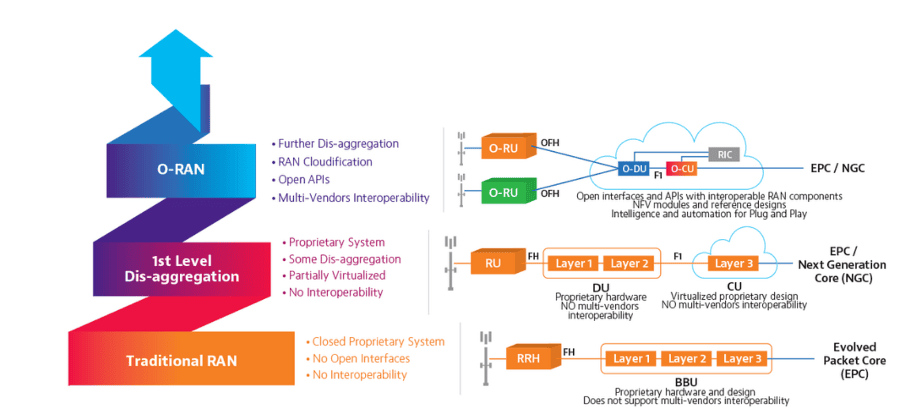
Although the terms Open RAN and vRAN sometimes are used interchangeably, they encompass different concepts. Open RAN — especially as promoted by the Open RAN Alliance — goes beyond vRAN by providing a framework for open interfaces and interoperability in a multi-vendor environment. Organizations such as the Open RAN Alliance and Telecom Infra Project (TIP) are working with the broader ecosystem to standardize and define Open RAN architecture, enabling true disaggregation and greater virtualization — capabilities that allow operators to reduce deployment costs by up to 50%.

Figure 1:
Picture1 1
Courtesy of VIAVI Solutions

That disaggregation highlights another potential  benefit of Open RAN: freedom from vendor lock-in. But the ability to mix best-of-breed hardware and software comes with a very big caveat: Operators now bear the responsibility of system integration in a highly complex, multi-vendor environment. If that weren’t enough, they are doing this integration with a brand-new technology — 5G — which has its own learning curve. And the risks associated with this need to be carefully managed.

Consumers and business customers don’t know that Open RAN exists. But they do know that 5G is supposed to provide a user experience that’s superior to 4G, such as in terms of faster speeds and lower latency, in addition to driving business improvements across a wide variety of industries — from private networks for industrial manufacturing and enterprises, to assisted driving, smart parking, smart ports, connected grid, connected health, etc. As a result, operators also need to do two things: ensure that their 5G network meets those expectations and ensure that the roll out of their Open RAN 5G network doesn’t undermine the performance of their 4G RAN.

How to ensure a successful Open RAN deployment

Testing has always been critical for ensuring network performance and subscriber quality of experience. But network test and validation are particularly important when Open RAN  architecture means mobile networks are more complex than ever. Agility, interoperability and precision are key principles for demanding new use cases, such as autonomous vehicles that require latencies lower than 5 milliseconds. Compare that with the “handshake” process in a 4G mobile network that can take 50 milliseconds just to establish connectivity.

These capabilities also help operators pursue enterprise applications with strict service-level agreements (SLAs). By helping to ensure that the Open RAN 5G network meets those marketplace requirements, testing directly improves an operator’s competitive position and revenue opportunities.

Introducing Open RAN into the network has several major challenges and considerations:

  • The performance has to be at least as good as the legacy RAN.
  • The multi-vendor architecture has to work seamlessly.
  • Operators need access to granular network data in order to enable service assurance.
  • Brownfield operators have to ensure seamless swap and optimization of the network.
  • A snapshot in time of the performance may not be enough and continuous monitoring and verification would be needed to adapt the dynamic changes in the Open RAN network.

To overcome these challenges, network equipment providers and operators are using specialized labs to test Open RAN hardware and software in a wide variety of scenarios prior to commercial launch. They are also emphasizing the need to bring real deployment field data back to the lab to enrich the verification process continuously and dynamically. There are already 5G networking and interoperability test labs that focus on multi-vendor integration, verification, interoperability and performance. They will play a key role in ensuring that Open RAN 5G lives up to its potential.

You Might Also Like
  • Thursday (telco diary) | APAC telcos pile into AI infrastructure
  • Wednesday (telco diary) | Starlink – a weak hand and a big mouth?
  • Agentic AI is exposing telecom’s visibility problem (Reader Forum)
  • Tuesday (telco diary) | More about ISAC – on battlefields and sportsfields
  • From missiles to pizzas – why 6G drone sensing has been fast-tracked for 5G
  • Cellnex sees AI, 5G and digital sovereignty driving Europe’s next infrastructure cycle
Share 0 LinkedinEmail
Avatar of Reader Forum
Shamik Mishra, Chief Technology Officer Connectivity, Capgemini Engineering, and Sameh Yamany, Chief Technology Officer, VIAVI Solutions

previous post
BT, Nokia trial Open RAN RIC in Hull, UK
next post
AT&T looks to mid-year timeframe for scaling its midband deployments

White Papers

  • Norton eBook: The 2026 Telco Playbook

  • Enea White Paper: Why Intelligent AAA is the Swiss Army Knife of Telecom

  • CSG White Paper: Telco AI Enabler: Mediation’s Defining Role

  • Enea White Paper: Scalable Database Design for 5G and Beyond

  • Supermicro and NVIDIA Whitepaper: Powering sovereign AI at scale

Editorial Reports

  • Report: NTN in motion — evolving standards, expanding services

  • Market Pulse Report: Telco AI in 2026 – Trends, Challenges and Opportunities

  • Nvidia Report: The State of AI in Telecommunications: 2026 Trends

Webinars

  • Webinar: Building 6G — aligning technology, policy and purpose

  • SIMCom Webinar: Scaling your next deployment – from plastic to provisioning

  • Webinar: Rethinking the RAN as AI, cloud and openness converge

  • Webinar: Scale-Up, Scale-Out, Scale-Across – Building AI-Era Network Fabrics

  • Webinar: NTN in motion – evolving standards, expanding services

Since 1982, RCR Wireless News has been providing wireless and mobile industry news, insights, and analysis to mobile and wireless industry professionals, decision makers, policy makers, analysts and investors.

Facebook Twitter Youtube Linkedin Envelope Rss

Useful Links

  • Subscribe
  • About RCR Wireless News
  • Contact Us
  • Advertise
  • Editorial Calendar
  • Archive
  • RSS
  • Wireless News Archive
  • Subscribe
  • About RCR Wireless News
  • Contact Us
  • Advertise
  • Editorial Calendar
  • Archive
  • RSS
  • Wireless News Archive

Edtior's Picks

The Agentic Network — NVIDIA on the full-stack path to telecom autonomy
Ericsson named sole global tech partner in SK Telecom-led AI-RAN pilot
Bell advances AIDC strategy as fiber and enterprise AI drive Q2

Latest Articles

The Agentic Network — NVIDIA on the full-stack path to telecom autonomy
Ericsson named sole global tech partner in SK Telecom-led AI-RAN pilot
Bell advances AIDC strategy as fiber and enterprise AI drive Q2
Context before control – Blue Planet maps AI architecture for autonomous networks

© 2026 RCR Wireless News All Right Reserved. Developed by Eight Hats.

Cookie Policy | Privacy Policy

RCR Wireless
  • News
  • Channels
    • 5G
    • 6G
    • BSS OSS
    • Carriers
    • IoT
    • Network Infrastructure
    • Open RAN
    • Private 5G
    • Telco AI
    • Telco Cloud
    • Test & Measurement
  • Resources
    • Reports
    • Webinars
    • White papers
    • AI Fundamentals
    • Analyst Angle
    • Editorial Calendar
    • Fundamentals
      • 5G NR Release 17
      • AI
        • Telco AI in 2025
    • Podcasts
      • Let’s Get Digital with Carrie Charles
      • Wireless Connectivity to Enable Industry 4.0 for the Middleprise
      • Well Technically…
      • Will 5G Change the World
      • Accelerating Industry 4.0 Digitalization
  • AI Infrastructure
  • Programs
  • Events
  • RCRtv
  • Advertise
  • Subscribe
RCR Wireless
  • News
  • Channels
    • 5G
    • 6G
    • BSS OSS
    • Carriers
    • IoT
    • Network Infrastructure
    • Open RAN
    • Private 5G
    • Telco AI
    • Telco Cloud
    • Test & Measurement
  • Resources
    • Reports
    • Webinars
    • White papers
    • AI Fundamentals
    • Analyst Angle
    • Editorial Calendar
    • Fundamentals
      • 5G NR Release 17
      • AI
        • Telco AI in 2025
    • Podcasts
      • Let’s Get Digital with Carrie Charles
      • Wireless Connectivity to Enable Industry 4.0 for the Middleprise
      • Well Technically…
      • Will 5G Change the World
      • Accelerating Industry 4.0 Digitalization
  • AI Infrastructure
  • Programs
  • Events
  • RCRtv
  • Advertise
  • Subscribe
@2020 - All Right Reserved. Designed and Developed by PenciDesign