

RCR Wireless
  • News
  • Channels
    • 5G
    • 6G
    • BSS OSS
    • Carriers
    • IoT
    • Network Infrastructure
    • Open RAN
    • Private 5G
    • Telco AI
    • Telco Cloud
    • Test & Measurement
  • Resources
    • Reports
    • Webinars
    • White papers
    • AI Fundamentals
    • Analyst Angle
    • Editorial Calendar
    • Fundamentals
      • 5G NR Release 17
      • AI
        • Telco AI in 2025
    • Podcasts
      • Let’s Get Digital with Carrie Charles
      • Wireless Connectivity to Enable Industry 4.0 for the Middleprise
      • Well Technically…
      • Will 5G Change the World
      • Accelerating Industry 4.0 Digitalization
  • AI Infrastructure
  • Programs
  • Events
  • RCRtv
  • Advertise
  • Subscribe
Thursday, July 16, 2026
RCR Wireless
  • News
  • Channels
    • 5G
    • 6G
    • BSS OSS
    • Carriers
    • IoT
    • Network Infrastructure
    • Open RAN
    • Private 5G
    • Telco AI
    • Telco Cloud
    • Test & Measurement
  • Resources
    • Reports
    • Webinars
    • White papers
    • AI Fundamentals
    • Analyst Angle
    • Editorial Calendar
    • Fundamentals
      • 5G NR Release 17
      • AI
        • Telco AI in 2025
    • Podcasts
      • Let’s Get Digital with Carrie Charles
      • Wireless Connectivity to Enable Industry 4.0 for the Middleprise
      • Well Technically…
      • Will 5G Change the World
      • Accelerating Industry 4.0 Digitalization
  • AI Infrastructure
  • Programs
  • Events
  • RCRtv
  • Advertise
  • Subscribe
Add RCR Wireless as a preferred source on Google
  • Qualcomm 6G Insights
  • Huawei Content Hub
  • Qualcomm – 6G Vision
  • OSS/BSS Channel
  • RCRTech Roundtable: AI Infrastructure
RCR Wireless
RCR Wireless
  • Advanced Mimo
  • Mobile mmWave
  • 5G Positioning
  • Green Networks
  • Metaverse
  • Automotive
  • Industrial and Wide-area IoT
Copyright 2021 - All Right Reserved
Home - Inside Corning Optical’s new smart building
In-Building TechSmart Buildings

Inside Corning Optical’s new smart building

by Juan Pedro Tomás July 28, 2020
written by Juan Pedro Tomás July 28, 2020 Share
LinkedinEmail
Share 0LinkedinEmail
Corning smart building
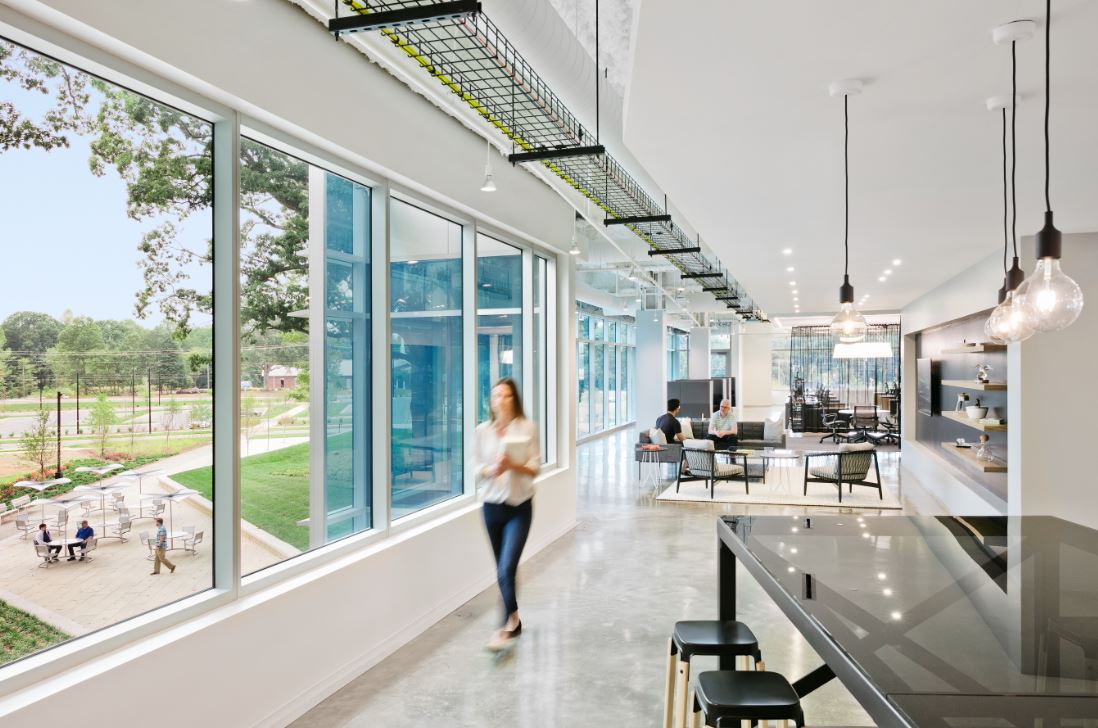
Corning deployed an all-optical network in its Optical Communications headquarters in Charlotte, N.C., driving power and high bandwidth capabilities to the edge while reducing energy consumption and taking up less space. Corning composite cable, visible near the ceiling in this 2019 photo, can run up to 2,000 feet to Software-Defined Access Nodes at the far reaches of the network.
192

Corning Optical Communications implemented a smart building strategy at its new headquarters with the main aim of improving the firm?s productive workplace environment.

Corning deployed an all-optical network in its Optical Communications headquarters in Charlotte, North Carolina, in order to drive power and high bandwidth capabilities to the edge while reducing energy consumption and taking up less space, according to the company. Corning composite cable, visible near the ceiling?in the above 2019 photo, can run up to 2,000 feet to Software-Defined Access Nodes at the far reaches of the network.

In-Building Tech interviewed Brian Davis, global market development director, in-building networks, at Corning Optical Communications to know more about this project.

Q: Why did Corning decide to develop a smart building project for its Optical Communications headquarters in Charlotte?

A: There are a few things to note here. We wanted to enhance our productive workplace environment and we know that network technology plays a huge role in that. We wanted our workforce to always have a connection to the network ? regardless of device ? and that connection needed to be reliable, so that our teams spend their time being productive with technology, instead of fighting with technology. We also wanted a building that would be efficient in its use of materials, energy and resources. 

We chose to deploy and use exactly what we are offering in the market. We also realize the dependency upon networks, the evolving use cases, and the need to be prepared for what?s coming in the future.

By deploying an all-fiber network architecture, we were able to realize day 1 capital savings, as well as day 2 and beyond operational savings. The traditional methodology is to connect each device on the network with long runs of copper cable that all come back to a central point on each floor. Capitalizing on the reach of fiber cable enables multiple devices to connect via a single cable that can reach back to a common central point that can serve multiple floors. So, I can collapse my cabling infrastructure — using less cabling and all the apparatus and spaces it takes to support it. And the cool thing about using a fiber architecture is that it doesn’t require a complete changeover of the devices at the edge. You get all the benefits of reach, unlimited bandwidth, and space savings of fiber and the ability to connect with the existing PoE (power over ethernet) devices such as wireless access points, cellular access points, security cameras, sound masking, etc., that are prevalent in the ecosystem today.

Q: What are the main pillars of Corning?s smart building and what were the main challenges of this initiative?

A: The main pillars are robust network architecture, collapsed backbone, fiber to the edge, scalable, future-ready, multiple connectivity options: wired, Wi-Fi, cellular.

The main challenges are driving a change in mindset away from 30 years of traditional methodology. The key to that mindset change is to clearly communicate to all stakeholders the substantial benefits of a fiber-deep architecture.

Q: Can you describe the main features of the deployments in order to guarantee in-building wireless coverage at the building?

We are operating on a wireless first network. So, we have a fairly dense Wi-Fi network, approximately 1 WAP per 1200 square feet, as well as a cellular network.We are using both small cells and DAS in the building, which is atypical, but we wanted to showcase both technologies.The DAS serves the first three floors while small cells are serving the top three floors.

JCI was the master integrator on the project, and they used several other integrators, each for specific applications such as cellular, Wi-Fi, etc.

Q: What are the main features of the small cells network and the DAS implemented at the building?

As I mentioned, we deployed both DAS and Small Cells in the building. We are currently supporting two carriers. We used our own signal source (SpiderCloud) for both the DAS and the Small Cell distribution. By using our own signal source, we are able to cut down on the complexity and time that it normally takes to get carrier signals in the building. Building owners are sometimes surprised to learn that the technology choices, usually reserved for later in the design cycle, can actually enhance the architecture and energy efficiency of the building itself. Technology plays such a key role now; it has a more far-reaching effect than in the past.

Q: Did IoT tech play any role in this smart building project? Are you considering deployment of further smart building features in the future?

A: We are currently deploying many different applications on a fiber-deep, software defined LAN. Instead of running a separate layer of infrastructure for each application, we are converging Wi-Fi, Cellular, Sound Masking, Security, Building Controls, A/V — all on the same network infrastructure. Adding more applications and devices to the network is very easy due to the bandwidth capabilities and easy expansion resulting from having power and fiber all the way to the edge of the network.

Fiber, with its virtually unlimited bandwidth, satisfies the high bandwidth and low latency demands of 5G ? providing an easy upgrade path over existing infrastructure as we see 5G becoming more prevalent in buildings as the engine for expanding IoT applications.


You Might Also Like
  • SOLiD gets NTIA grant for O-RAN development project
  • Boldyn to buy Apogee to expand connectivity in US higher-ed campuses
  • Siemens samples own sustainability meds at smart campus in Switzerland
  • How Nextivity is bringing private LTE to the middleprise
  • Cellular vs. Wi-Fi—making the case for mobility
  • How private cellular networks enable Industry 4.0 
Share 0 LinkedinEmail
Juan Pedro Tomás

Juan Pedro covers Global Carriers and Global Enterprise IoT. Prior to RCR, Juan Pedro worked for Business News Americas, covering telecoms and IT news in the Latin American markets. He also worked for Telecompaper as their Regional Editor for Latin America and Asia/Pacific. Juan Pedro has also contributed to Latin Trade magazine as the publication's correspondent in Argentina and with political risk consultancy firm Exclusive Analysis, writing reports and providing political and economic information from certain Latin American markets. He has a degree in International Relations and a master in Journalism and is married with two kids.

previous post
Global 5G infra market to generate $8.1 billion in revenues this year: Study
next post
Ericsson to supply mmWave equipment, services to US Cellular

White Papers

  • Enea White Paper: Why Intelligent AAA is the Swiss Army Knife of Telecom

  • CSG White Paper: Telco AI Enabler: Mediation’s Defining Role

  • Enea White Paper: Scalable Database Design for 5G and Beyond

  • Supermicro and NVIDIA Whitepaper: Powering sovereign AI at scale

  • VIAVI Whitepaper: RAN scenario generators and their critical role for future-proofing AI-native RAN in Advanced 5G and 6G networks

Editorial Reports

  • Report: Scaling Optical Networks For The Hyperscale And AI Era

  • Test And Measurement Market Pulse Report

  • Editorial Report: Securing telecom infrastructure for the quantum era

Webinars

  • Webinar: Building 6G — aligning technology, policy and purpose

  • SIMCom Webinar: Scaling your next deployment – from plastic to provisioning

  • Webinar: Rethinking the RAN as AI, cloud and openness converge

  • Webinar: Scale-Up, Scale-Out, Scale-Across – Building AI-Era Network Fabrics

  • Webinar: NTN in motion – evolving standards, expanding services

Since 1982, RCR Wireless News has been providing wireless and mobile industry news, insights, and analysis to mobile and wireless industry professionals, decision makers, policy makers, analysts and investors.

Facebook Twitter Youtube Linkedin Envelope Rss

Useful Links

  • Subscribe
  • About RCR Wireless News
  • Contact Us
  • Advertise
  • Editorial Calendar
  • Archive
  • RSS
  • Wireless News Archive
  • Subscribe
  • About RCR Wireless News
  • Contact Us
  • Advertise
  • Editorial Calendar
  • Archive
  • RSS
  • Wireless News Archive

Edtior's Picks

SoftBank is deploying OpenAI-powered security agents across Japan’s critical infrastructure
Nokia and Taiwan Mobile are building an AI-native 5G network
Nokia preps AI-RAN in 2027, promises 100% spectral gain in 2028 – but...

Latest Articles

SoftBank is deploying OpenAI-powered security agents across Japan’s critical infrastructure
Nokia and Taiwan Mobile are building an AI-native 5G network
Nokia preps AI-RAN in 2027, promises 100% spectral gain in 2028 – but will operators buy it?
Agentic AI to reshape network demand, KPMG says

© 2026 RCR Wireless News All Right Reserved. Developed by Eight Hats.

Cookie Policy | Privacy Policy

RCR Wireless
  • News
  • Channels
    • 5G
    • 6G
    • BSS OSS
    • Carriers
    • IoT
    • Network Infrastructure
    • Open RAN
    • Private 5G
    • Telco AI
    • Telco Cloud
    • Test & Measurement
  • Resources
    • Reports
    • Webinars
    • White papers
    • AI Fundamentals
    • Analyst Angle
    • Editorial Calendar
    • Fundamentals
      • 5G NR Release 17
      • AI
        • Telco AI in 2025
    • Podcasts
      • Let’s Get Digital with Carrie Charles
      • Wireless Connectivity to Enable Industry 4.0 for the Middleprise
      • Well Technically…
      • Will 5G Change the World
      • Accelerating Industry 4.0 Digitalization
  • AI Infrastructure
  • Programs
  • Events
  • RCRtv
  • Advertise
  • Subscribe
RCR Wireless
  • News
  • Channels
    • 5G
    • 6G
    • BSS OSS
    • Carriers
    • IoT
    • Network Infrastructure
    • Open RAN
    • Private 5G
    • Telco AI
    • Telco Cloud
    • Test & Measurement
  • Resources
    • Reports
    • Webinars
    • White papers
    • AI Fundamentals
    • Analyst Angle
    • Editorial Calendar
    • Fundamentals
      • 5G NR Release 17
      • AI
        • Telco AI in 2025
    • Podcasts
      • Let’s Get Digital with Carrie Charles
      • Wireless Connectivity to Enable Industry 4.0 for the Middleprise
      • Well Technically…
      • Will 5G Change the World
      • Accelerating Industry 4.0 Digitalization
  • AI Infrastructure
  • Programs
  • Events
  • RCRtv
  • Advertise
  • Subscribe
@2020 - All Right Reserved. Designed and Developed by PenciDesign