
RCR Wireless
  • News
  • Channels
    • 5G
    • 6G
    • BSS OSS
    • Carriers
    • IoT
    • Network Infrastructure
    • Open RAN
    • Private 5G
    • Telco AI
    • Telco Cloud
    • Test & Measurement
  • Resources
    • Reports
    • Webinars
    • White papers
    • AI Fundamentals
    • Analyst Angle
    • Editorial Calendar
    • Fundamentals
      • 5G NR Release 17
      • AI
        • Telco AI in 2025
    • Podcasts
      • Let’s Get Digital with Carrie Charles
      • Wireless Connectivity to Enable Industry 4.0 for the Middleprise
      • Well Technically…
      • Will 5G Change the World
      • Accelerating Industry 4.0 Digitalization
  • AI Infrastructure
  • Programs
  • Events
  • RCRtv
  • Advertise
  • Subscribe
Thursday, July 9, 2026
RCR Wireless
  • News
  • Channels
    • 5G
    • 6G
    • BSS OSS
    • Carriers
    • IoT
    • Network Infrastructure
    • Open RAN
    • Private 5G
    • Telco AI
    • Telco Cloud
    • Test & Measurement
  • Resources
    • Reports
    • Webinars
    • White papers
    • AI Fundamentals
    • Analyst Angle
    • Editorial Calendar
    • Fundamentals
      • 5G NR Release 17
      • AI
        • Telco AI in 2025
    • Podcasts
      • Let’s Get Digital with Carrie Charles
      • Wireless Connectivity to Enable Industry 4.0 for the Middleprise
      • Well Technically…
      • Will 5G Change the World
      • Accelerating Industry 4.0 Digitalization
  • AI Infrastructure
  • Programs
  • Events
  • RCRtv
  • Advertise
  • Subscribe
Add RCR Wireless as a preferred source on Google
  • Qualcomm 6G Insights
  • Huawei Content Hub
  • Qualcomm – 6G Vision
  • OSS/BSS Channel
RCR Wireless
RCR Wireless
  • Advanced Mimo
  • Mobile mmWave
  • 5G Positioning
  • Green Networks
  • Metaverse
  • Automotive
  • Industrial and Wide-area IoT
Copyright 2021 - All Right Reserved
Home - Hello, HaLow – all about the new Wi-Fi HaLow tech for low-power mid-range IoT
FundamentalsInternet of Things (IoT)NB-IoTSensorsSmart CitiesSmart FactoryWi-FiWired Networks, Fiber

Hello, HaLow – all about the new Wi-Fi HaLow tech for low-power mid-range IoT

by James Blackman July 24, 2020
written by James Blackman July 24, 2020 Share
LinkedinEmail
Share 0LinkedinEmail
chip migration
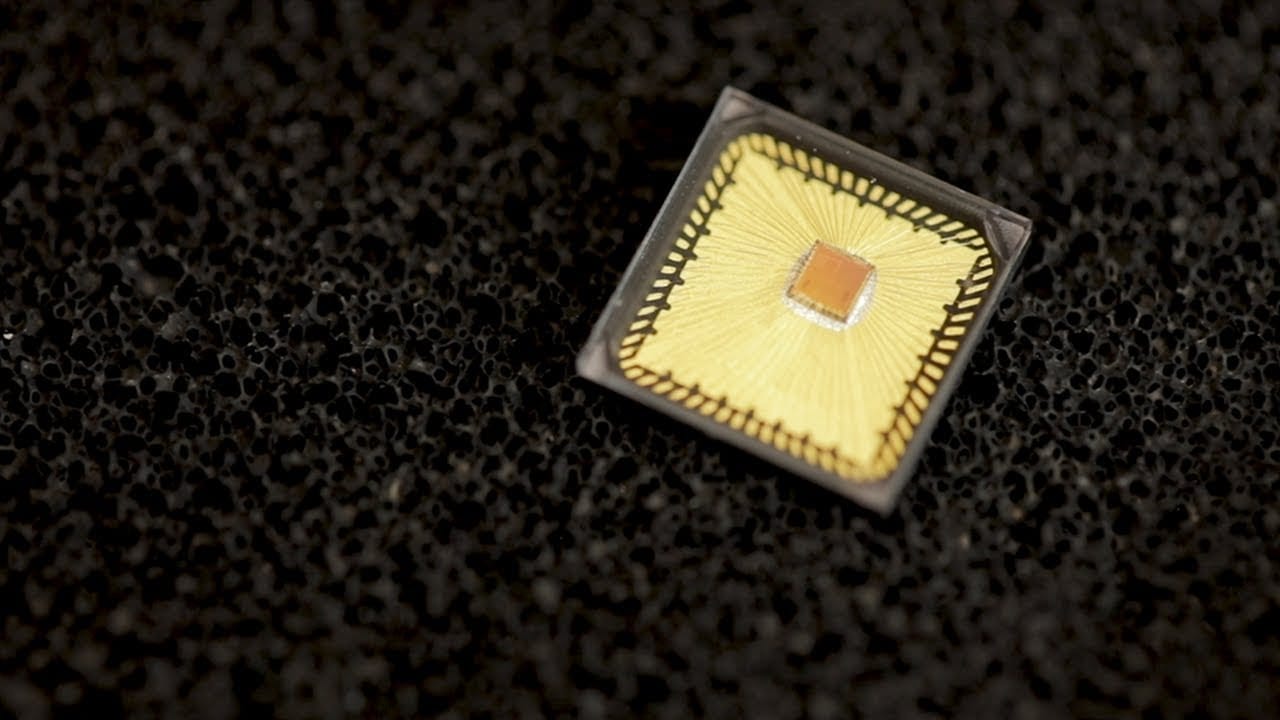
Wi-Fi HaLow - a new Wi-Fi HaLow chip from Australian semiconductor firm Morse Micro
245

In truth, Wi-Fi HaLow is not new. The solution, geared towards low-power mid-range IoT solutions, was announced back in 2016. But there is gathering momentum around it, with chips and devices in the latter stages of development and a queue of customers apparently lined up.

Wi-Fi HaLow (802.11ah) uses sub-GHz spectrum frequencies below 900 MHz to nearly double the range of traditional Wi-Fi, which relies on the 2.4 GHz and 5 GHz spectrum bands, according to the Wi-Fi Alliance. It offers better penetration and lower power for long life fit-and-forget IoT solutions. 

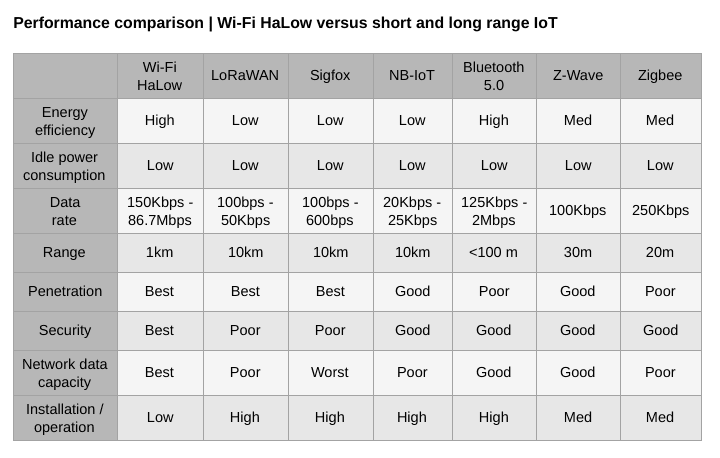
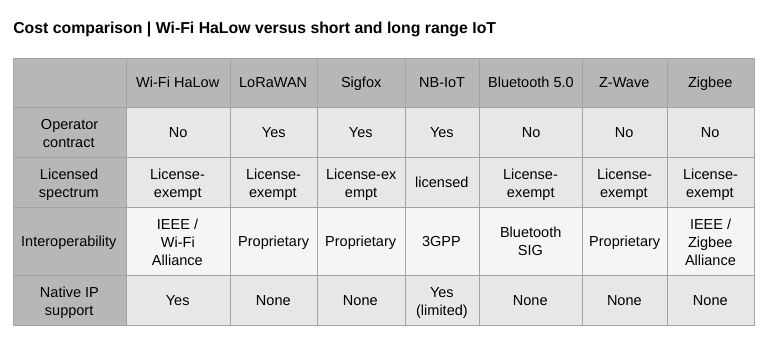
It will offer multi-vendor interoperability by using existing Wi-Fi protocols, making it compatible with Wi-Fi Alliance certified products, and offering the same government-grade security and easy setup as current Wi-Fi solutions. It straddles the line between low-power short-range technologies like Bluetooth Low Energy (BLE) and Zigbee, and the traditional LPWA set, including LoRaWAN, NB-IoT, and Sigfox.

Australia-based fabless semiconductor company Morse Micro, which has raised AUD$30 million from investors since it was founded in 2016, is one of those developing chips for the new WI-FI technology. It claim a 10-times advance on its Wi-Fi HaLow chips in terms of range, compared with conventional Wi-Fi; IoT modules based on its hardware will last “many years” on a single coin-cell battery, it says. 

The Morse Micro team includes “original inventors” of Wi-Fi, and designers of Wi-Fi chips, the company says. It is a prominent contributor to the Wi-Fi Alliance to bring interoperability for Wi-Fi HaLow; the current vice-chair of the Wi-Fi HaLow task group is a member of the firm’s executive staff, it adds.

Who better, then, to give the skinny on HaLow, and what it means for the IoT space. Here, we speak with Vahid Manian, chief operating officer Morse Micro, about the development, target markets, and potential impact of Wi-Fi HaLow.

What is Wi-Fi HaLow?

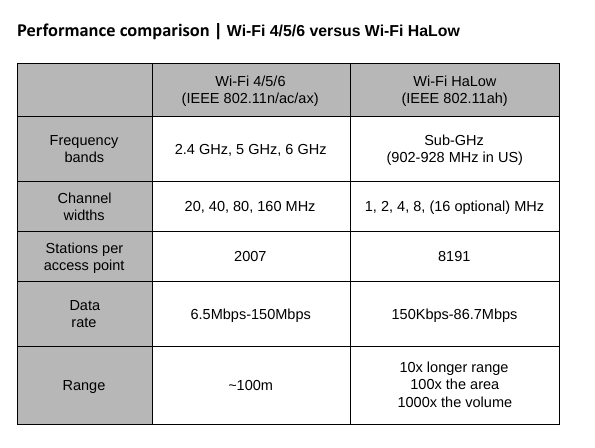
“Wi-Fi HaLow is the name given by the Wi-Fi AlIiance to the low-power, long-range Wi-Fi standard specified by the IEEE 802.11ah task group – similar to the conventional Wi-Fi 4/5/6 names provided for 802.11n/ac/ax. 

Vahid Morse Micro e1593727239801

Manian – 10 times the distance, 100 times the area

“Conventional Wi-Fi enables users to stream movies and download files quickly using wide channels of radio frequencies in the 2.4GHz, 5GHz, and 6GHz bands. The network congestion, range limitations, and higher power usage of conventional Wi-Fi, along with the limited number of devices that can be connected to a single wireless access point (AP), are no longer viable in a connected world of smart devices. 

“Such limitations impede new IoT-centric business models that are emerging across industries, which require greater capacity, range and battery operation while minimizing deployment costs and timelines. 

“Wi-Fi HaLow uses narrower channels of radio frequencies in the license exempt, sub-GHz band which penetrate better through materials, allowing connections reaching up to 10 times farther, 100 times the area and 1,000 times the volume than traditional WiFi. 

“Wi-Fi HaLow is ideally suited for IoT devices as it allows over 8,000 robust connections to a single access point over 1 km range and can take advantage of new sleep modes that save power. Wi-Fi HaLow adopted the highest enterprise-grade security protocol WPA3 and, with a throughput range of hundreds of Kbps to tens of Mbps, can easily support over-the-air firmware upgrades as well as video streaming.”
HaLow2

Who is using Wi-Fi HaLow? 

“While we cannot publicly name customers that we are currently engaged with, we can say that In the initial stage of deployment, Wi-Fi HaLow is expected to be used in both indoor and outdoor applications where standard Wi-Fi cannot reach as in the case of battery-operated surveillance systems, wireless cameras, and doorbells. 

“Another typical use case would be large venues, where a single HaLow access point can substitute for a large number of APs, obviating inefficient, complex mesh architectures, simplifying installation and reducing total cost of ownership.”

Who is promoting Wi-Fi HaLow?

“The Wi-Fi Alliance has staff members and a dedicated Wi-Fi HaLow task group that are actively contributing to the development of interoperability and certification programs with tier-one system integrators and service providers who are closely following the progress of the group.”

What are the use cases for Wi-Fi HaLow?

“The potential use cases for this technology are broad, but include: smart home automation, surveillance cameras and sensors, building access control and security, biometric IDs and keypads, industrial process control, logistics management and asset, warehouse connectivity, intelligent lighting control, retail solutions, drone video and navigation, vehicle-to-vehicle communication, and rural internet and cloud connectivity.”

How does Wi-Fi HaLow compare with other IoT technologies? 
HaLow1

HaLow3

What is the availability of Wi-Fi HaLow devices? 

“Wi-Fi HaLow devices are at different stages of prototype development. We anticipate solutions coming soon.”

Who is producing Wi-Fi HaLow chips / modules?

“Multiple member companies of the Wi-Fi Alliance are developing Wi-Fi HaLow solutions. For the detailed list of members Please visit Wi-Fi Alliance website.”

What is the wider Wi-Fi HaLow ecosystem like?

“Wi-Fi is the most ubiquitous wireless communications protocol in use today with an installed base of over 5B devices today which is expected to triple in the coming decade. The rapid growth of the IoT has forced a rethinking of Wi-Fi, revealed technological gaps and what role it needs to play in an all-encompassing connected world. The higher demands for long-range connectivity and low power requirements for many IoT and machine-to-machine (M2M) applications are ushering in Wi-Fi HaLow at an increasingly faster rate this year and for the years ahead.”

What is the market expectation for Wi-Fi HaLow?

“In 2020, experts estimate the installation of 31 billion IoT devices and by 2025 more than 75 billion IoT devices will be connected. Wi-Fi HaLow offers an optimized solution for the growing amount of challenging use cases for data rates between hundred bits-per-second up to tens of Megabits-per-second to cover larger areas with single Access point at low power, highest enterprise-grade security, and with no subscription fees.”

You Might Also Like
  • How the FCC can protect IoT innovation and GPS resilience in the 900 MHz band (Reader Forum)
  • ‘You can’t tame it’ – private networks, open standards and the AI proof for IoT
  • LoRaWAN eyes ‘fourth pillar’ status as IoT apps start to stack
  • Report: Scaling Optical Networks For The Hyperscale And AI Era
  • AI demands to drive multiple optical network architectures, Ciena says
  • AI is making DCI a critical infrastructure priority, says AFL

Table of Contents

  • What is Wi-Fi HaLow?
  • Who is using Wi-Fi HaLow? 
  • Who is promoting Wi-Fi HaLow?
  • What are the use cases for Wi-Fi HaLow?
  • How does Wi-Fi HaLow compare with other IoT technologies? 
  • What is the availability of Wi-Fi HaLow devices? 
  • Who is producing Wi-Fi HaLow chips / modules?
  • What is the wider Wi-Fi HaLow ecosystem like?
  • What is the market expectation for Wi-Fi HaLow?
Share 0 LinkedinEmail
James Blackman
James Blackman

James Blackman has been writing about the technology and telecoms sectors for over a decade. He has edited and contributed to a number of European news outlets and trade titles. He has also worked at telecoms company Huawei, leading media activity for its devices business in Western Europe. He is based in London.

previous post
PALs auction: First-day bidding hints at a shake-up
next post
China’s Guangdong Province ends June with over 78,000 5G base stations

White Papers

  • Enea White Paper: Why Intelligent AAA is the Swiss Army Knife of Telecom

  • CSG White Paper: Telco AI Enabler: Mediation’s Defining Role

  • Enea White Paper: Scalable Database Design for 5G and Beyond

  • Supermicro and NVIDIA Whitepaper: Powering sovereign AI at scale

  • VIAVI Whitepaper: RAN scenario generators and their critical role for future-proofing AI-native RAN in Advanced 5G and 6G networks

Editorial Reports

  • Report: Scaling Optical Networks For The Hyperscale And AI Era

  • Test And Measurement Market Pulse Report

  • Editorial Report: Securing telecom infrastructure for the quantum era

Webinars

  • Webinar: Rethinking the RAN as AI, cloud and openness converge

  • Webinar: Scale-Up, Scale-Out, Scale-Across – Building AI-Era Network Fabrics

  • Webinar: NTN in motion – evolving standards, expanding services

  • Webinar: Noise-Figure Measurements with RFmx and PXI VSTs

  • Qualcomm Webinar – Building the 6G Standard: Key developments to know

Since 1982, RCR Wireless News has been providing wireless and mobile industry news, insights, and analysis to mobile and wireless industry professionals, decision makers, policy makers, analysts and investors.

Facebook Twitter Youtube Linkedin Envelope Rss

Useful Links

  • Subscribe
  • About RCR Wireless News
  • Contact Us
  • Advertise
  • Editorial Calendar
  • Archive
  • RSS
  • Wireless News Archive
  • Subscribe
  • About RCR Wireless News
  • Contact Us
  • Advertise
  • Editorial Calendar
  • Archive
  • RSS
  • Wireless News Archive

Edtior's Picks

How the FCC can protect IoT innovation and GPS resilience in the 900...
What defines network performance in 5G and beyond? A CTO Perspective
Elisa says AI automation has cut network incidents by over 80%

Latest Articles

How the FCC can protect IoT innovation and GPS resilience in the 900 MHz band (Reader Forum)
What defines network performance in 5G and beyond? A CTO Perspective
Elisa says AI automation has cut network incidents by over 80%
“We’re going after the operator channel” – Druid bets on simplicity to scale private 5G

© 2026 RCR Wireless News All Right Reserved. Developed by Eight Hats.

Cookie Policy | Privacy Policy

RCR Wireless
  • News
  • Channels
    • 5G
    • 6G
    • BSS OSS
    • Carriers
    • IoT
    • Network Infrastructure
    • Open RAN
    • Private 5G
    • Telco AI
    • Telco Cloud
    • Test & Measurement
  • Resources
    • Reports
    • Webinars
    • White papers
    • AI Fundamentals
    • Analyst Angle
    • Editorial Calendar
    • Fundamentals
      • 5G NR Release 17
      • AI
        • Telco AI in 2025
    • Podcasts
      • Let’s Get Digital with Carrie Charles
      • Wireless Connectivity to Enable Industry 4.0 for the Middleprise
      • Well Technically…
      • Will 5G Change the World
      • Accelerating Industry 4.0 Digitalization
  • AI Infrastructure
  • Programs
  • Events
  • RCRtv
  • Advertise
  • Subscribe
RCR Wireless
  • News
  • Channels
    • 5G
    • 6G
    • BSS OSS
    • Carriers
    • IoT
    • Network Infrastructure
    • Open RAN
    • Private 5G
    • Telco AI
    • Telco Cloud
    • Test & Measurement
  • Resources
    • Reports
    • Webinars
    • White papers
    • AI Fundamentals
    • Analyst Angle
    • Editorial Calendar
    • Fundamentals
      • 5G NR Release 17
      • AI
        • Telco AI in 2025
    • Podcasts
      • Let’s Get Digital with Carrie Charles
      • Wireless Connectivity to Enable Industry 4.0 for the Middleprise
      • Well Technically…
      • Will 5G Change the World
      • Accelerating Industry 4.0 Digitalization
  • AI Infrastructure
  • Programs
  • Events
  • RCRtv
  • Advertise
  • Subscribe
@2020 - All Right Reserved. Designed and Developed by PenciDesign