


RCR Wireless
  • News
  • Channels
    • 5G
    • 6G
    • BSS OSS
    • Carriers
    • IoT
    • Network Infrastructure
    • Open RAN
    • Private 5G
    • Telco AI
    • Telco Cloud
    • Test & Measurement
  • Resources
    • Reports
    • Webinars
    • White papers
    • AI Fundamentals
    • Analyst Angle
    • Editorial Calendar
    • Fundamentals
      • 5G NR Release 17
      • AI
        • Telco AI in 2025
    • Podcasts
      • Let’s Get Digital with Carrie Charles
      • Wireless Connectivity to Enable Industry 4.0 for the Middleprise
      • Well Technically…
      • Will 5G Change the World
      • Accelerating Industry 4.0 Digitalization
  • AI Infrastructure
  • Programs
  • Events
  • RCRtv
  • Advertise
  • Subscribe
Tuesday, July 28, 2026
RCR Wireless
  • News
  • Channels
    • 5G
    • 6G
    • BSS OSS
    • Carriers
    • IoT
    • Network Infrastructure
    • Open RAN
    • Private 5G
    • Telco AI
    • Telco Cloud
    • Test & Measurement
  • Resources
    • Reports
    • Webinars
    • White papers
    • AI Fundamentals
    • Analyst Angle
    • Editorial Calendar
    • Fundamentals
      • 5G NR Release 17
      • AI
        • Telco AI in 2025
    • Podcasts
      • Let’s Get Digital with Carrie Charles
      • Wireless Connectivity to Enable Industry 4.0 for the Middleprise
      • Well Technically…
      • Will 5G Change the World
      • Accelerating Industry 4.0 Digitalization
  • AI Infrastructure
  • Programs
  • Events
  • RCRtv
  • Advertise
  • Subscribe
Add RCR Wireless as a preferred source on Google
  • Qualcomm 6G Insights
  • Huawei Content Hub
  • Qualcomm – 6G Vision
  • OSS/BSS Channel
  • RCRTech Roundtable: AI Infrastructure
RCR Wireless
RCR Wireless
  • Advanced Mimo
  • Mobile mmWave
  • 5G Positioning
  • Green Networks
  • Metaverse
  • Automotive
  • Industrial and Wide-area IoT
Copyright 2021 - All Right Reserved
Home - Who disaggregated my RAN? Part 7: Virtualized RAN: Closer than you think
Network Function Virtualization (NFV)Open RANReader Forum

Who disaggregated my RAN? Part 7: Virtualized RAN: Closer than you think

by rcrwireless July 13, 2020
written by rcrwireless July 13, 2020 Share
LinkedinEmail
Share 0LinkedinEmail
ATIS O-RAN
169

In previous blogs in this “Who Disaggregated My RAN? series, we have looked at the benefits of a disaggregated Open RAN, including the growth of an ecosystem to support the deployment of an Open RAN. We have also looked at how these disaggregated solutions compare in terms of performance.  Naturally, as we consider the benefits of using commercial off-the-shelf (COTS) hardware for Open RAN solutions, the next logical cost savings option comes in the area of virtualization. Here the term virtualization is used to mean a VNF (Virtualized Network Function) or a CNF (Cloud-native Network Function). What are these VNFs and CNFs anyways? Let’s dig into this topic further.

The many benefits of a virtualized RAN solution

A virtualized implementation means dynamic scaling in and scaling out of functions as per the demand (capacity, throughput and load balancing). This is in contrast to the traditional approach of spending more CapEx on proprietary hardware in order to add capacity. Also, as the software architecture becomes more flexible to support multiple deployment scenarios, operators can avoid buying different hardware and software configurations to support different deployment scenarios. Thus, the overall savings in TCO that can be achieved with virtualized RAN solutions are very attractive for operators.  

ETSI NFV architecture 

The concept of a virtual machine isn’t new and has been used in both Enterprise and Telecom. However, the telecom industry has many stringent requirements with less tolerance for down-time, so there had been considerable skepticism about telecom solutions working well in virtualized environments. In 2012, an initiative was launched by operators to create virtualized solutions for telecom industry. A whitepaper was released that addressed meeting performance and resiliency requirements, and the European Telecommunications Standards Institute (ETSI) began to develop standards that laid the foundation for networks nodes to be implemented in virtualized environments. ETSI continues to work on this topic, with many releases of specifications to ensure standardization and interoperability in virtualization. 

Most of the initial implementations of virtualized machines for telco products adopted the strategy of creating multiple virtual machines within the same host hardware. The telco world capitalized on this strategy and much of the cloud implementation, mostly on the core network, was moved to virtualized implementations called Virtualized Network Functions (VNF). Some of the LTE network core network implementations started adopting control and user plane separation and virtualization, and many of these implementations were compliant to ETSI NFV architecture.

RAN-specific challenges in virtualization

While the virtualization principles can be applied to RAN nodes as well, there are some specific challenges especially in processing related to Layer 1 and Layer 2 functionalities. Meeting the tight timing and latency constraints in the RAN data path can be a challenge. It is also harder to separate out tightly intertwined functions and call processing across Layer 1 and Layer 2 modules.

With the advent of many fast data path options and hardware accelerators, some of these challenges were solved. Intel’s FlexRAN solution was one of the earliest reference designs made available for RAN vendors to start the journey to virtualized RAN implementations. Radisys and Intel have been partnering since the initial release of FlexRAN reference design to provide 4G and 5G virtualized RAN solutions.

Going cloud-native 

Another important trend in cloud computing has been the widespread use of containers to implement cloud-based solutions. This allows a lightweight and efficient way of spinning many instances of network functions rather than creating many virtual machine instances. This approach, called Cloud-native Network Function (CNF) is now being adopted by many vendors to virtualize the RAN. There are many design paradigms like microservices-based architecture and stateless processing in network functions that can be applied to create high performance and highly scalable RAN solutions. The goal is to design highly granular software modules and make them scale dynamically as per demand.

O-RAN cloud architecture for RAN

As operators are moving forward with their O-RAN deployments, the question remains of which virtualization approach to take: VNF or CNF? 

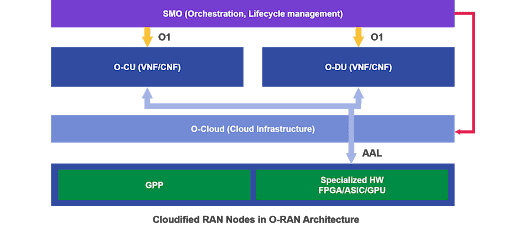
The answer to that question is in many ways subjective. Open RAN allows for either option in some of the nodes. The O-RAN Alliance uses a neutral term – “cloudified” – to represent both VNF and CNF. 

The O-RAN Alliance has a working group that is focused on cloudification and orchestration for RAN nodes. The O-RAN Cloud (called O-Cloud) platform is illustrated in the diagram below. 
unnamed 4

The unique aspect about this cloud platform definition is the inclusion of hardware acceleration abstraction APIs. These APIs (called AAL APIs) cover commonly required functions like encryption, integrity, channel encoding/decoding, and fronthaul acceleration.

An edge cloud

As 4G and 5G technologies are enabling higher bandwidths and multiple use cases, there has also been a strong trend of co-locating edge computing infrastructure and RAN functions in a cloud environment at the edge. This trend is creating a demand in the market for appropriate hardware and cloud platforms to cater to both RAN and edge requirements. Projects in the LFEdge open source community, especially Akraino, are providing deployment options for these requirements.

Virtualized RAN is here to stay

With COTS hardware and cloud platforms becoming a reality for RAN deployments, operators are now prepared to deal with the nuances of fully cloudified radio access networks. This requires more “IT like” skills in the operations teams and this journey has already begun. Recently there has been a slew of announcements from many RAN vendors about their virtualized RAN products. vRAN deployments are here to stay. The industry forums, open source community and cloud infrastructure vendors are all working to solve the vRAN deployment challenges. 

One such challenge is the need for deploying and managing vRAN solutions in an automated fashion. Service Management and Orchestration (SMO) platforms solve these problems. How do these SMOs deploy and manage cloudified RAN solutions? We’ll take a look at that in detail in our next blog. 


You Might Also Like
  • Why throwing money at broadband speeds isn’t fixing America’s internet (Reader Forum)
  • Only 50 of 170 digital infrastructure firms will exist in in five years (Reader Forum)
  • The most expensive wireless system is the one you install twice (Reader Forum)
  • Agentic AI – the $60bn opportunity for telecom operators (Reader Forum)
  • The (agentic) future of AI-to-AI connectivity (Reader Forum)
  • Friday (telco diary) | Telco reset, RAN reboot, P5G reality check

Table of Contents

  • The many benefits of a virtualized RAN solution
  • ETSI NFV architecture 
  • RAN-specific challenges in virtualization
  • Going cloud-native 
  • O-RAN cloud architecture for RAN
  • An edge cloud
  • Virtualized RAN is here to stay
Share 0 LinkedinEmail
Avatar of rcrwireless
rcrwireless

previous post
The Sunday Brief: Fiber always wins (until it doesn’t)–2020 edition
next post
Qualcomm makes investment in India’s Jio Platform for future 5G rollout

White Papers

  • Norton eBook: The 2026 Telco Playbook

  • Enea White Paper: Why Intelligent AAA is the Swiss Army Knife of Telecom

  • CSG White Paper: Telco AI Enabler: Mediation’s Defining Role

  • Enea White Paper: Scalable Database Design for 5G and Beyond

  • Supermicro and NVIDIA Whitepaper: Powering sovereign AI at scale

Editorial Reports

  • Market Pulse Report: Telco AI in 2026 – Trends, Challenges and Opportunities

  • Nvidia Report: The State of AI in Telecommunications: 2026 Trends

  • Report: Scaling Optical Networks For The Hyperscale And AI Era

Webinars

  • Webinar: Building 6G — aligning technology, policy and purpose

  • SIMCom Webinar: Scaling your next deployment – from plastic to provisioning

  • Webinar: Rethinking the RAN as AI, cloud and openness converge

  • Webinar: Scale-Up, Scale-Out, Scale-Across – Building AI-Era Network Fabrics

  • Webinar: NTN in motion – evolving standards, expanding services

Since 1982, RCR Wireless News has been providing wireless and mobile industry news, insights, and analysis to mobile and wireless industry professionals, decision makers, policy makers, analysts and investors.

Facebook Twitter Youtube Linkedin Envelope Rss

Useful Links

  • Subscribe
  • About RCR Wireless News
  • Contact Us
  • Advertise
  • Editorial Calendar
  • Archive
  • RSS
  • Wireless News Archive
  • Subscribe
  • About RCR Wireless News
  • Contact Us
  • Advertise
  • Editorial Calendar
  • Archive
  • RSS
  • Wireless News Archive

Edtior's Picks

Network agents are “ready” for commercial use, but are telcos? (Analyst Angle)
Monday (telco diary) | ‘A new telco growth profile’?
Verizon strikes $1bn DCI deal with Google; AI cloud and edge sales to...

Latest Articles

Network agents are “ready” for commercial use, but are telcos? (Analyst Angle)
Monday (telco diary) | ‘A new telco growth profile’?
Verizon strikes $1bn DCI deal with Google; AI cloud and edge sales to ramp in 2027
SK Telecom launches dedicated AI infra company

© 2026 RCR Wireless News All Right Reserved. Developed by Eight Hats.

Cookie Policy | Privacy Policy

RCR Wireless
  • News
  • Channels
    • 5G
    • 6G
    • BSS OSS
    • Carriers
    • IoT
    • Network Infrastructure
    • Open RAN
    • Private 5G
    • Telco AI
    • Telco Cloud
    • Test & Measurement
  • Resources
    • Reports
    • Webinars
    • White papers
    • AI Fundamentals
    • Analyst Angle
    • Editorial Calendar
    • Fundamentals
      • 5G NR Release 17
      • AI
        • Telco AI in 2025
    • Podcasts
      • Let’s Get Digital with Carrie Charles
      • Wireless Connectivity to Enable Industry 4.0 for the Middleprise
      • Well Technically…
      • Will 5G Change the World
      • Accelerating Industry 4.0 Digitalization
  • AI Infrastructure
  • Programs
  • Events
  • RCRtv
  • Advertise
  • Subscribe
RCR Wireless
  • News
  • Channels
    • 5G
    • 6G
    • BSS OSS
    • Carriers
    • IoT
    • Network Infrastructure
    • Open RAN
    • Private 5G
    • Telco AI
    • Telco Cloud
    • Test & Measurement
  • Resources
    • Reports
    • Webinars
    • White papers
    • AI Fundamentals
    • Analyst Angle
    • Editorial Calendar
    • Fundamentals
      • 5G NR Release 17
      • AI
        • Telco AI in 2025
    • Podcasts
      • Let’s Get Digital with Carrie Charles
      • Wireless Connectivity to Enable Industry 4.0 for the Middleprise
      • Well Technically…
      • Will 5G Change the World
      • Accelerating Industry 4.0 Digitalization
  • AI Infrastructure
  • Programs
  • Events
  • RCRtv
  • Advertise
  • Subscribe
@2020 - All Right Reserved. Designed and Developed by PenciDesign
