


RCR Wireless
  • News
  • Channels
    • 5G
    • 6G
    • BSS OSS
    • Carriers
    • IoT
    • Network Infrastructure
    • Open RAN
    • Private 5G
    • Telco AI
    • Telco Cloud
    • Test & Measurement
  • Resources
    • Reports
    • Webinars
    • White papers
    • AI Fundamentals
    • Analyst Angle
    • Editorial Calendar
    • Fundamentals
      • 5G NR Release 17
      • AI
        • Telco AI in 2025
    • Podcasts
      • Let’s Get Digital with Carrie Charles
      • Wireless Connectivity to Enable Industry 4.0 for the Middleprise
      • Well Technically…
      • Will 5G Change the World
      • Accelerating Industry 4.0 Digitalization
  • AI Infrastructure
  • Programs
  • Events
  • RCRtv
  • Advertise
  • Subscribe
Tuesday, July 7, 2026
RCR Wireless
  • News
  • Channels
    • 5G
    • 6G
    • BSS OSS
    • Carriers
    • IoT
    • Network Infrastructure
    • Open RAN
    • Private 5G
    • Telco AI
    • Telco Cloud
    • Test & Measurement
  • Resources
    • Reports
    • Webinars
    • White papers
    • AI Fundamentals
    • Analyst Angle
    • Editorial Calendar
    • Fundamentals
      • 5G NR Release 17
      • AI
        • Telco AI in 2025
    • Podcasts
      • Let’s Get Digital with Carrie Charles
      • Wireless Connectivity to Enable Industry 4.0 for the Middleprise
      • Well Technically…
      • Will 5G Change the World
      • Accelerating Industry 4.0 Digitalization
  • AI Infrastructure
  • Programs
  • Events
  • RCRtv
  • Advertise
  • Subscribe
Add RCR Wireless as a preferred source on Google
  • Qualcomm 6G Insights
  • Huawei Content Hub
  • Qualcomm – 6G Vision
  • OSS/BSS Channel
RCR Wireless
RCR Wireless
  • Advanced Mimo
  • Mobile mmWave
  • 5G Positioning
  • Green Networks
  • Metaverse
  • Automotive
  • Industrial and Wide-area IoT
Copyright 2021 - All Right Reserved
Home - UK to release 6 GHz and 100 GHz spectrum for Wi-Fi in smart homes, offices, factories
BuildingsCarriersInternet of Things (IoT)News & Event CoveragePolicySmart CitiesSmart FactorySmart HomeWi-FiWired Networks, Fiber

UK to release 6 GHz and 100 GHz spectrum for Wi-Fi in smart homes, offices, factories

by James Blackman January 27, 2020
written by James Blackman January 27, 2020 Share
LinkedinEmail
Share 0LinkedinEmail
Vodafone
260

UK regulator Ofcom is proposing to make 500MHz of contiguous spectrum in the lower 6 GHz band available for unlicensed indoor Wi-Fi and low-power outdoor Wi-Fi usage. It has also revealed plans to release an additional 18GHz of Extremely High Frequency (EHF) spectrum, above 100 GHz, for private and shared access.

Ofcom has started consulting to make the lower 6 GHz band, at 5925-6425 MHz, available for Wi-Fi on a licence-exempt basis. It said new capacity will support higher volumes of data, along with new technologies and applications. Usage will be for enhancing Wi-Fi connectivity indoors, mainly, in homes, offices, and industrial sites. But it will also go to support limited outdoor coverage and traffic hand-off.

It said Wi-Fi users could share the band with incumbent fixed links and satellite users for up to 250mW indoor and 25mW outdoor unlicensed uses. “These maximum limits would be sufficient to enable the envisaged use cases,” it said.

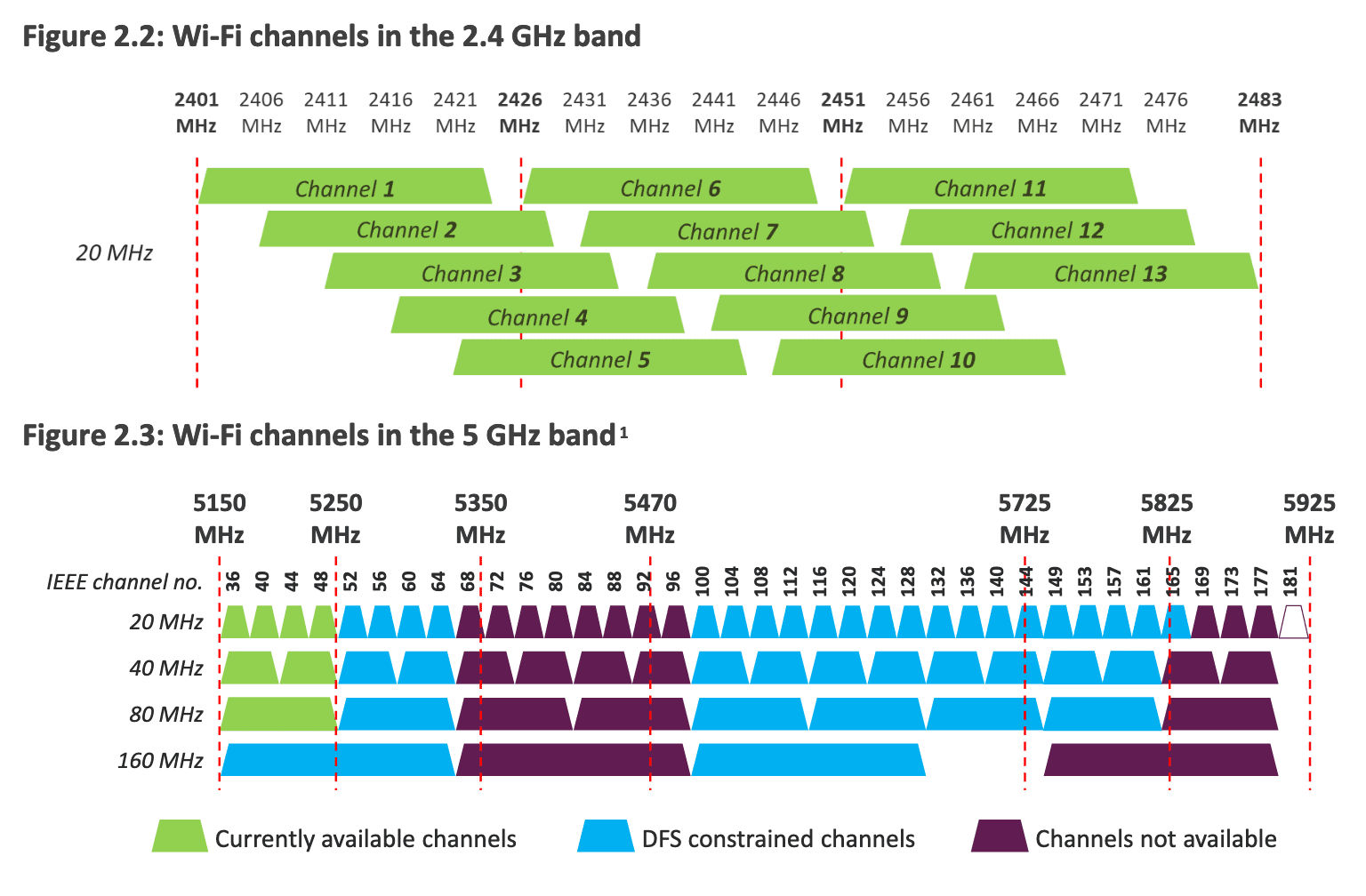
At the same time, Ofcom has said it will remove the Dynamic Frequency Selection (DFS) requirements, which force routers to scan for radars, for indoor Wi-Fi (up to 200mW) in the 5.8 GHz band (5725-5850 MHz). The band is “lightly used”, it said, and DFS adds cost to and impedes performance of Wi-Fi equipment.
Ofcom Wi Fi at 2.4 and 5 GHz

Takeup of Wi-Fi in the band has been slow since its release in 2017. “The interference risk to radars from indoor Wi-Fi use is very low,” it said, noting also the UK is the only country to impose such requirements on the 5.8 GHz band.

Frequency bands above 100 GHz offer large bandwidths and different propagation properties to lower frequency bands. They are suited to health screening applications, non-invasive quality assurance in the pharmaceutical and manufacturing industries, and high-speed data links, said Ofcom.

It noted as well such technologies remain at an early stage. As it stands, these EHF frequencies are reserved for space-related applications such as Earth Exploration-Satellite Services (EESS). Ofcom said chances of interference with new digital apps are “extremely low”. Most would be indoor applications.

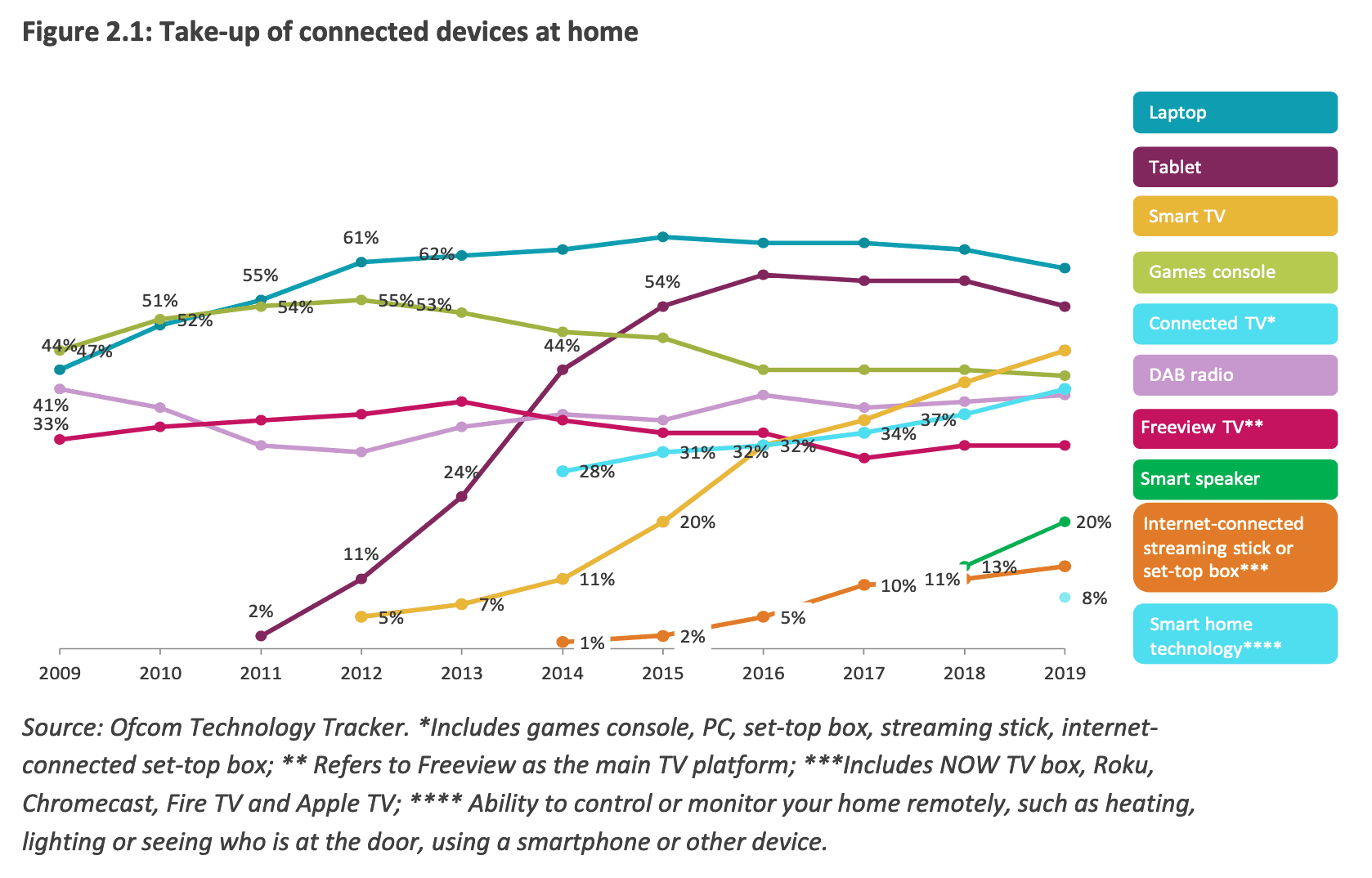
In general, Ofcom said Wi-Fi use is growing, driven by the rising number of connected devices and the arrival of innovative applications such as augmented reality (AR), virtual reality (VR) and ultra high-definition (UHD; 4k and 8k resolution) video. It pointed to cloud-gaming, 360 video, ‘holographic’ video, also.

It highlighted the role of Wi-Fi for enterprises in mesh networks in office settings, and the call for bandwidth for both parties in terms of broadcast / streaming content provision and consumption.
Ofcom home Wi Fi

At the same time, it moved to highlight the value of Wi-Fi in industrial settings, notably for “manufacturing, enterprise, logistics and transport”. These will benefit from the proposed 500MHz of spectrum in the lower 6 GHz band, it said.

“The increasing number of connected devices and sensors is extending the uses for IoT. The vast amount of data generated by these devices is also driving demand for communications,” it said, quoting old Cisco figures that the number of IoT devices will reach 3.9 billion by 2022, from under a billion back in 2017.

It said: “Smart factories are increasingly using wireless technologies including Wi-Fi, to ‘cut cables’ in production facilities to increase flexibility and drive up productivity.”

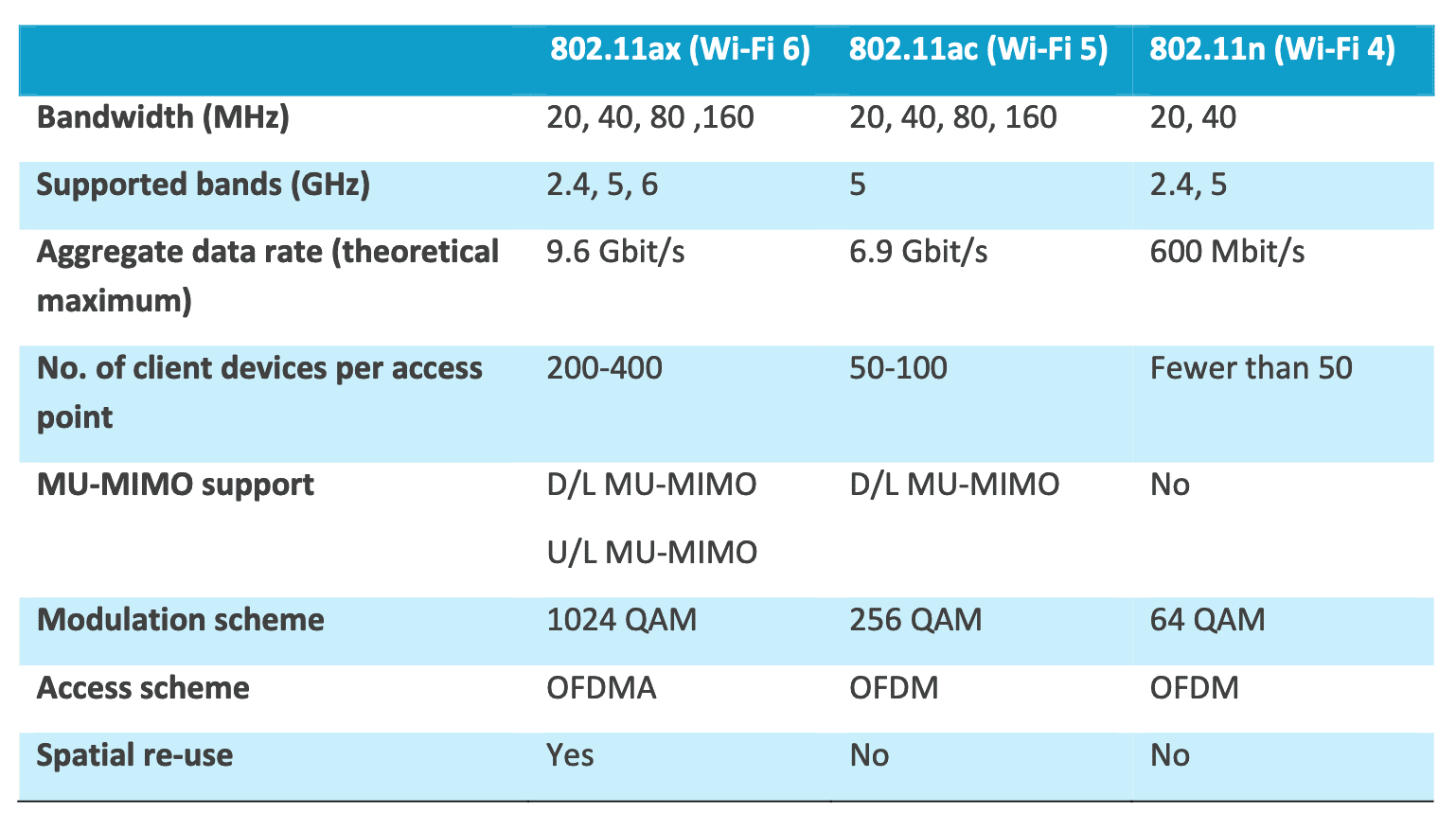
It said 5G is raising expectations for consumer, enterprise and industrial Wi-Fi services, and that newer-generation variants like Wi-Fi 6 (IEEE 802.11ax), and even Wi-Fi 7 (802.11be), are improving spectral efficiency and network performance. Wi-Fi 7 will seek to increase maximum throughput to 30Gbps, and reduce latency and improve reliability. It will not be available for several years.

Wi-Fi 6 was designed to support large numbers of users in congested environments such as conference venues and sports arenas, using new techniques such as multi-user MIMO, OFDMA and BSS colouring.
Ofcom Wi fi 6 7

Wi-Fi use in the UK is currently authorised in the 2.4 GHz and 5 GHz bands. The lower 6 GHz band appeals as it is adjacent to the 5 GHz band, has similar mid-range propagation characteristics, and offers wide, non-overlapping channels.

Ofcom wants to harmonize UK spectrum usage with other markets. The European Commission issued a mandate to the European Conference of Postal and Telecoms Administrations (“CEPT”) in late 2017 to study sharing and technical conditions for harmonized wireless access systems, including local radio networks, in the 5925-6425 MHz band.

CEPT expects that compatibility and coexistence are feasible under certain conditions (including low power, indoor-only uses) local radio networks and incumbent fixed links and satellite users.

In the US, the 6 GHz band is also being discussed for Wi-Fi to ease congestion and promote innovation. In October 2017, the Federal Communications Commission (FCC) published a notice seeking input on ‘flexible access’, particularly unlicensed access for Wi-Fi, in spectrum bands between 3.7 and 24 GHz. This sought detailed comment on the 3.7-4.2 GHz, 5925-6425 MHz, and 6425-7125 MHz bands.

In October 2018, it proposed riles to make the full 6 GHz band (5925-7125 MHz) available for unlicensed Wi-Fi use. The reply phase closed in February 2019; 6 GHz products may be available in the US from late 2020.

Ofcom stated: “We consider that people in the UK may be able to benefit from device availability and economies of scale for new, innovative technologies if this band is opened up both internationally and in the UK for similar purposes.”

At the same time, it noted growing international interest in the 100-200GHz frequency range. The FCC adopted new rules in March 2019 to expedite the deployment of new services in the spectrum above 95 GHz, making 21.2GHz of spectrum available for use by unlicensed devices across four spectrum bands (116-123GHz; 174.8-182 GHz; 185-190 GHz and 244-246 GHz).

Ofcom’s consultation on 5925-6425 MHz spectrum runs until March 20; a final decision will be taken later in 2020; it will publish its decision on the 18GHz above 100 GHz in the summer 2020 and set the framework by the end of 2020.

Last summer, Ofcom confirmed plans to open up a large tranche of the UK airwaves for enterprises to deploy private and shared networks, dedicating the 3.8-4.2 GHz band for local deployments, requiring national operators to relinquish unused licensed spectrum to enterprises, and making available the lower 26 GHz band for private and shared access as well.

Ofcom will release spectrum in both shared spectrum bands and in licensed spectrum, already paid for by mobile operators for national coverage. The move represents a significant shift in UK spectrum policy, and follows spectrum liberalisation in other markets, notably the US and Germany, geared towards industrial transformation.


You Might Also Like
  • Elisa says AI automation has cut network incidents by over 80%
  • Why consolidation will reshape MDU connectivity (part 3/3) – Analyst Angle
  • Tuesday | Vertical build-outs, horizontal break-ups (Editorial Diary)
  • ‘You can’t tame it’ – private networks, open standards and the AI proof for IoT
  • Monday | Global enterprise reset (Editorial Diary)
  • China Mobile outlines ‘mobile intelligence’ vision at MWC Shanghai
Share 0 LinkedinEmail
James Blackman
James Blackman

James Blackman has been writing about the technology and telecoms sectors for over a decade. He has edited and contributed to a number of European news outlets and trade titles. He has also worked at telecoms company Huawei, leading media activity for its devices business in Western Europe. He is based in London.

previous post
Pentagon blocks plan to increase restrictions on Huawei sales: Report
next post
Cisco to provide Wi-Fi 6 to MWC Barcelona venue

White Papers

  • Enea White Paper: Why Intelligent AAA is the Swiss Army Knife of Telecom

  • CSG White Paper: Telco AI Enabler: Mediation’s Defining Role

  • Enea White Paper: Scalable Database Design for 5G and Beyond

  • Supermicro and NVIDIA Whitepaper: Powering sovereign AI at scale

  • VIAVI Whitepaper: RAN scenario generators and their critical role for future-proofing AI-native RAN in Advanced 5G and 6G networks

Editorial Reports

  • Report: Scaling Optical Networks For The Hyperscale And AI Era

  • Test And Measurement Market Pulse Report

  • Editorial Report: Securing telecom infrastructure for the quantum era

Webinars

  • Webinar: Rethinking the RAN as AI, cloud and openness converge

  • Webinar: Scale-Up, Scale-Out, Scale-Across – Building AI-Era Network Fabrics

  • Webinar: NTN in motion – evolving standards, expanding services

  • Webinar: Noise-Figure Measurements with RFmx and PXI VSTs

  • Qualcomm Webinar – Building the 6G Standard: Key developments to know

Since 1982, RCR Wireless News has been providing wireless and mobile industry news, insights, and analysis to mobile and wireless industry professionals, decision makers, policy makers, analysts and investors.

Facebook Twitter Youtube Linkedin Envelope Rss

Useful Links

  • Subscribe
  • About RCR Wireless News
  • Contact Us
  • Advertise
  • Editorial Calendar
  • Archive
  • RSS
  • Wireless News Archive
  • Subscribe
  • About RCR Wireless News
  • Contact Us
  • Advertise
  • Editorial Calendar
  • Archive
  • RSS
  • Wireless News Archive

Edtior's Picks

What defines network performance in 5G and beyond? A CTO Perspective
Elisa says AI automation has cut network incidents by over 80%
“We’re going after the operator channel” – Druid bets on simplicity to scale...

Latest Articles

What defines network performance in 5G and beyond? A CTO Perspective
Elisa says AI automation has cut network incidents by over 80%
“We’re going after the operator channel” – Druid bets on simplicity to scale private 5G
Enea White Paper: Why Intelligent AAA is the Swiss Army Knife of Telecom

© 2026 RCR Wireless News All Right Reserved. Developed by Eight Hats.

Cookie Policy | Privacy Policy

RCR Wireless
  • News
  • Channels
    • 5G
    • 6G
    • BSS OSS
    • Carriers
    • IoT
    • Network Infrastructure
    • Open RAN
    • Private 5G
    • Telco AI
    • Telco Cloud
    • Test & Measurement
  • Resources
    • Reports
    • Webinars
    • White papers
    • AI Fundamentals
    • Analyst Angle
    • Editorial Calendar
    • Fundamentals
      • 5G NR Release 17
      • AI
        • Telco AI in 2025
    • Podcasts
      • Let’s Get Digital with Carrie Charles
      • Wireless Connectivity to Enable Industry 4.0 for the Middleprise
      • Well Technically…
      • Will 5G Change the World
      • Accelerating Industry 4.0 Digitalization
  • AI Infrastructure
  • Programs
  • Events
  • RCRtv
  • Advertise
  • Subscribe
RCR Wireless
  • News
  • Channels
    • 5G
    • 6G
    • BSS OSS
    • Carriers
    • IoT
    • Network Infrastructure
    • Open RAN
    • Private 5G
    • Telco AI
    • Telco Cloud
    • Test & Measurement
  • Resources
    • Reports
    • Webinars
    • White papers
    • AI Fundamentals
    • Analyst Angle
    • Editorial Calendar
    • Fundamentals
      • 5G NR Release 17
      • AI
        • Telco AI in 2025
    • Podcasts
      • Let’s Get Digital with Carrie Charles
      • Wireless Connectivity to Enable Industry 4.0 for the Middleprise
      • Well Technically…
      • Will 5G Change the World
      • Accelerating Industry 4.0 Digitalization
  • AI Infrastructure
  • Programs
  • Events
  • RCRtv
  • Advertise
  • Subscribe
@2020 - All Right Reserved. Designed and Developed by PenciDesign