
The rise of new technologies such as 5G is profoundly influencing the communications market and driving operators and equipment vendors to rapidly evolve with respect to technology architecture and organizational structure. In the 5G environment, the demands from user are diversified, and the global network is being changed and reconstructed as technology evolves.
In the 5G era, the new services are becoming more demanding for the network that carries them. Features, such as flexibility, easy to expand and easy to use, have become basic capabilities that the carrier network should have. 5G follows the basic principle of separating forward from control. With respect to the 5G network architecture, the principle is displayed in the following: data plane deployment to the edge, control plane concentration, and a large number of distributed gateways. This requires that hardware or software switch of a 5G distributed gateway cam play an important role in services such as flow diversion, priority processing, high reliability, and low latency communication.
Therefore, SDN technology has quickly become the focus of operators. The technology can virtualize multiple isolated virtual networks on the physical network based on the tunneling technology, so that different users can use independent network resource slicing to improve network resource utilization and realize flexible networks. At the same time, it can also integrate the cloud with the network, and the configuration of the network is fully integrated into the dynamic configuration of the service to achieve the movement of the network with the cloud, and the migration of the network with the cloud, eventually bringing benefits to the enterprise.
Because SDN has so many advantages, major manufacturers have launched their own SDN solutions. Among which, the open source community’s OpenFlow solutions, and EVPN solutions represented by Cisco, Juniper and other hardware manufacturers, have gradually become the mainstream of the market.
OpenFlow Solution
The centralized control solutions represented by OpenFlow are completely controlled by the SDN controller, and the way is also called strong control. The OpenFlow solution is mainly composed of OpenFlow switches and SDN Controllers. OpenFlow switches forward the traffic from the data layer; controllers perform centralized control on the network to implement the functions of the control layer.
The core of the forwarding layer in the OpenFlow network consists of switches that support OpenFlow software and hardware, and the layer is responsible for forwarding data packets. Each software or hardware switch that supports OpenFlow has a FlowTable. The switch itself forwards data packets only according to the contents of the flow table. The SDN Controller is responsible for generating, maintaining, and delivering the FlowTable. The OpenFlow specification defines more than ten keywords from L2 to L4, and each keyword in the FlowTable can be wildcarded. Which matching rule is used in a specific network is determined by different usage scenarios. For example, in a pure layer-2 networking environment, only fields in the layer-2 need to be matched, and other fields can be wildcarded.
Compared with the packet processing flow in the traditional network, the flow direction in the traditional switch is manually designated by the configuration. There is no concept of data flow, and only packet-level switching and routing processing are implemented; and in the OpenFlow network, the delivery of all network-related configurations is replaced by the SDN Controller through the delivery flow table. This determines the transmission path of all packet flows in the network. The entire system is shown below:
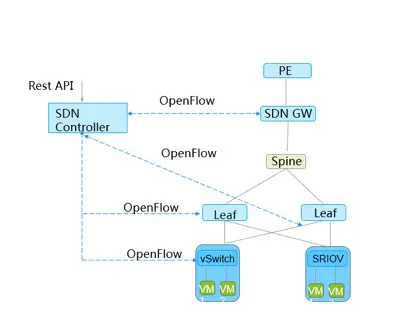
Figure 1 Network Topology Under OpenFlow
EVPN Solution
The loose control solutions represented by BGP EVPN are self-learning through the network device control plane protocol. The way is also called weak control.
EVPN (Ethernet Virtual Private Network) is a multi-protocol address mapping standard. By using BGP as a routing protocol, and in combination with EVPN, it can bring a complete control plane to VXLAN. The idea is different from the centralized flow table delivered in the OpenFlow mode. The original VXLAN based implementation solution has no control plane. Through the flooding of the data plane, VTEP is discovered, and MAC address learning results in the flooding. VXLAN introduces EVPN as the control plane to solve the original flooding problem. The BGP EVPN routing information is exchanged between VTEPs to implement automatic discovery of VTEP and mutual notification of host information to solve the previous flooding problem.
EVPN inherits the advantages of both MP-BGP and VXLAN, and it usually adopts the layered architecture of GW-Spine-Leaf. The device at the leaf layer performs the EVPN-related processing on the packets as the VTEP. The core device in the Spine layer forwards the packets according to the destination address of the packets. The GW, which acts as the gateway device, is responsible for forwarding the DC traffic and encapsulating/decapsulating the VXLAN tunnel.
With the EVPN technology as the control layer of the VXLAN network, the data plane becomes much simpler. The data plane EVPN, through BGP, notifies the locally learned information, and the peer end, according to the route received by the BGP, forwards the information to the remote VXLAN tunnel, so that a unicast entry is formed. The packet is forwarded to the destination VTEP by searching the local VTEP entry, and then sent to the destination VTEP through the VXLAN tunnel. The destination VTEP decapsulates the VXLAN tunnel and forwards it to the destination server. It can be seen that, from the perspective of data, EVPN is only responsible for the control plane of VXLAN, that is, the transmission of the forwarding information, resulting in no impact on the VXLAN data plane. The entire system is shown below:
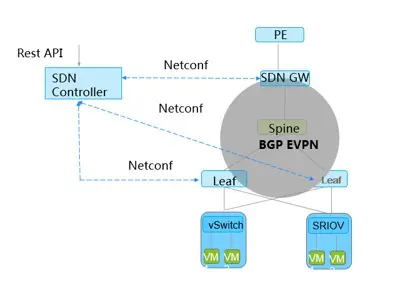
Figure 2. Network Topology Under EVPN
| Feature | OpenFlow | EVPN |
| VTEP node | Software equipment/hardware equipment | Hardware equipment |
| Control service | L2/L3 Forwarding, security/QoS/TAP policy | EVPN is used for L2/L3 Forwarding, and a perfect solution also needs Netconf or other configuration protocols. |
| Function flexibility | Very high, and its function is limited to the controller mode. | Low, and the hardware must be upgraded. |
| Network Scale | Under the virtualization application scenario, the network scale that can be managed is small. | Under the virtualization application scenario, the network scale that can be managed is big. |
| Reliability | Higher | High |
| Service release performance | High | Low (NetConf) |
| Forward performance | Limited to the software vSwitch performance | High |
| Multi-equipment vendor scenario support | By using OpenFlow, you can only control the VTEPand GW equipment. The Underlay network can be constructed by different vendors. | EVPN is not wrong, but Netconf cannot realize interoperation among different vendors. |
| Applicable scenario | Applicable to the scenario of soft and hard decoupling. The SDN solution is completely unrelated to hardware. It is only necessary to deploy software devices to implement network virtualization and reduce the threshold for introducing SDN. | Applicable to the SDN transformation needs initiated from the network department by customers whose cloud and network are managed and invested respectively. It is applicable to the large-scale deployment network to control all the hardware networks so that fault location can be made in end-to-end mode. |
Table 1: Contrast of Features of OpenFlow and EVPN
ZTE ZENIC vDC controller provides the end-to-end DC SDN solution
ZENIC vDC controller is a carrier-grade cluster controller product launched by ZTE. It focuses on SDN requirements of cloud data center and is targeted at hybrid Overlay (OpenFlow + EVPN), hardware overlay (EVPN) and software Overlay (OpenFlow) application scenarios. The scenarios can realize the integration of the cloud management platform and the network management platform, provide unified resources planning and deployment, quickly build a new type of virtualized data center, and provide an end-to-end data center SDN solution.
Based on ZTE’s technology accumulation in data center construction and data communication, ZTE ZENIC vDC controller provides open and flexible capabilities, which can help operators and G&E customers build a new virtualized data center network.