RCR Wireless
  • News
  • Channels
    • 5G
    • 6G
    • BSS OSS
    • Carriers
    • IoT
    • Network Infrastructure
    • Open RAN
    • Private 5G
    • Telco AI
    • Telco Cloud
    • Test & Measurement
  • Resources
    • Reports
    • Webinars
    • White papers
    • AI Fundamentals
    • Analyst Angle
    • Editorial Calendar
    • Fundamentals
      • 5G NR Release 17
      • AI
        • Telco AI in 2025
    • Podcasts
      • Let’s Get Digital with Carrie Charles
      • Wireless Connectivity to Enable Industry 4.0 for the Middleprise
      • Well Technically…
      • Will 5G Change the World
      • Accelerating Industry 4.0 Digitalization
  • AI Infrastructure
  • Programs
  • Events
  • RCRtv
  • Advertise
  • Subscribe
Saturday, July 25, 2026
RCR Wireless
  • News
  • Channels
    • 5G
    • 6G
    • BSS OSS
    • Carriers
    • IoT
    • Network Infrastructure
    • Open RAN
    • Private 5G
    • Telco AI
    • Telco Cloud
    • Test & Measurement
  • Resources
    • Reports
    • Webinars
    • White papers
    • AI Fundamentals
    • Analyst Angle
    • Editorial Calendar
    • Fundamentals
      • 5G NR Release 17
      • AI
        • Telco AI in 2025
    • Podcasts
      • Let’s Get Digital with Carrie Charles
      • Wireless Connectivity to Enable Industry 4.0 for the Middleprise
      • Well Technically…
      • Will 5G Change the World
      • Accelerating Industry 4.0 Digitalization
  • AI Infrastructure
  • Programs
  • Events
  • RCRtv
  • Advertise
  • Subscribe
Add RCR Wireless as a preferred source on Google
  • Qualcomm 6G Insights
  • Huawei Content Hub
  • Qualcomm – 6G Vision
  • OSS/BSS Channel
  • RCRTech Roundtable: AI Infrastructure
RCR Wireless
RCR Wireless
  • Advanced Mimo
  • Mobile mmWave
  • 5G Positioning
  • Green Networks
  • Metaverse
  • Automotive
  • Industrial and Wide-area IoT
Copyright 2021 - All Right Reserved
Home - Analyst Angle: Linking 3GPP activities to influence and patents
Analyst AngleLTE

Analyst Angle: Linking 3GPP activities to influence and patents

by RCR Wireless News November 14, 2018
written by RCR Wireless News November 14, 2018 Share
LinkedinEmail
Share 0LinkedinEmail
3GPP carrier aggregation
100

Facts about 3GPP contributions

In a previous article, ABI Research presented the complex nature of the 3rd Generation Partnership Project (3GPP), a collaborative effort that brings together key stakeholders from all around the globe and several Standard Setting Organizations (SSOs), to set mobile standards in stone. The article also discussed and identified the process that 3GPP work groups follow to standardize cellular technologies and concluded that the 3GPP’s process is quite complex, influenced by several internal (3GPP processes) and external parameters (company priorities). A Technical Specification (TS) document, which is the main body of the formal 3GPP standard, is typically a patchwork of hundreds of smaller contributions that culminates with years of R&D and distills discussions taking place in person during 3GPP meetings and via email between these meetings. Even after a 3GPP TS is frozen, there are Change Requests (CRs) that aim to change a part of the TS, ranging from a critical input to a spelling mistake. To complicate matters even further, there is significant responsibility placed on the chairperson of each individual group to select which contributions to prioritize. For example, some 3GPP work group chairs have mandated that multi-company contributions take priority, forcing participants to work together.

ABI Research has been closely following 3GPP developments and the essential patent market landscape. At the same time, both domains are subject to in-depth academic and market study, while there is no consensus in terms of methodology to identify influence in either of these domains. However, this article tries to adopt a qualitative approach to identifying the key stakeholders in a key 3GPP feature.

Qualitative analysis: Carrier aggregation

Carrier (or spectrum) aggregation (CA) has become a key feature of 3GPP technologies and one of the most widely deployed technologies that has enabled mobile devices to operate at Gigabit speeds. This is arguably the most important feature of LTE-Advanced and now all networks and mid-to-high tier smartphones support it, so much so that chipset manufacturers are benchmarked according to the number of bands from which they can aggregate spectrum. For example, the latest chipsets couple CA features with 4×4 Multiple Input, Multiple Output (MIMO) to reach 2Gbps (3GPP UE Cat.20), by aggregating more than 100MHz of spectrum across six or seven channels. In order to truly understand key influencers for CA in particular, it is important to understand how CA came to be and how it was introduced in mobile networks.

Figure 1: Introduction of Carrier Aggregation across 3GPP2 and 3GPP Groups
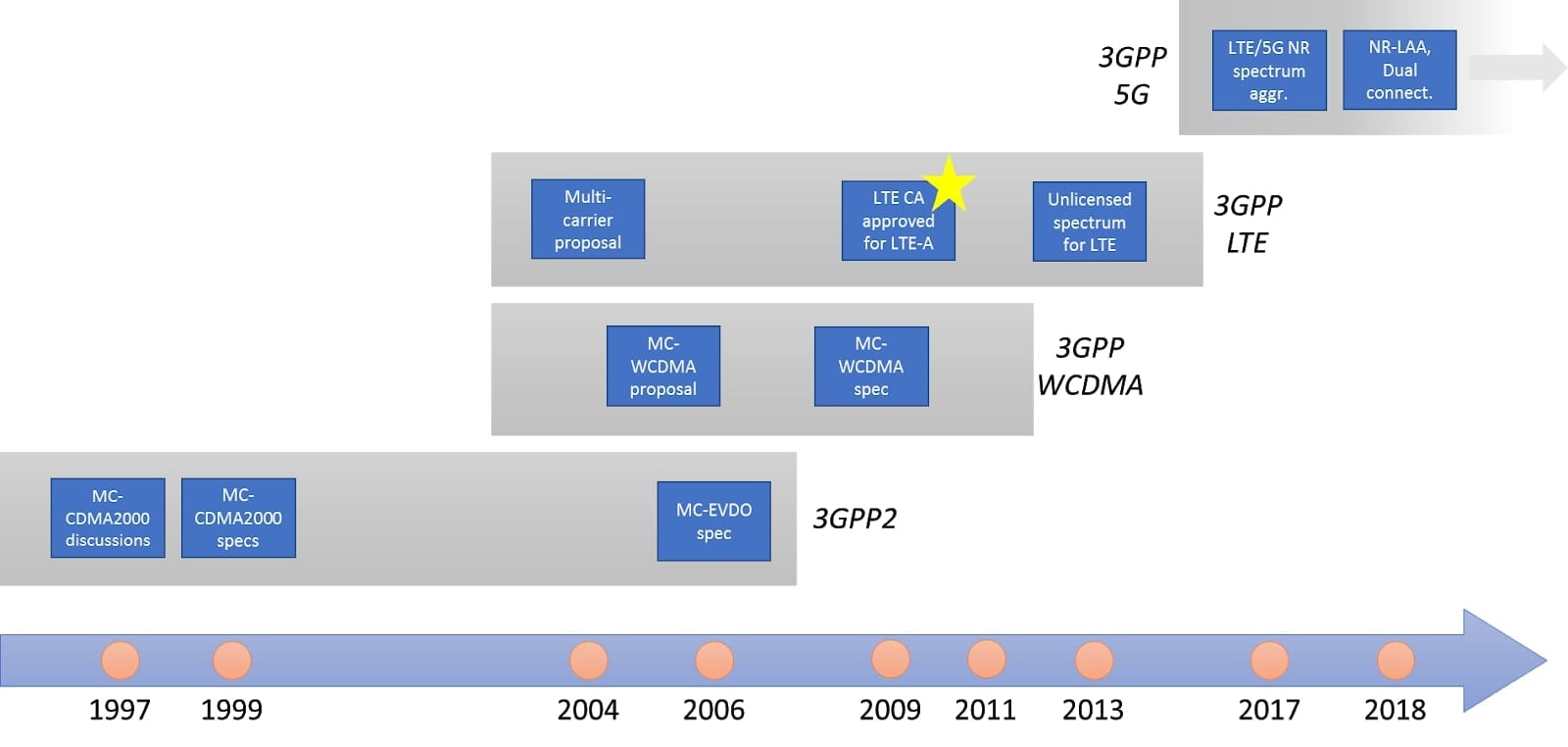
image1

In its essence, CA combines spectrum from different bands in a single air interface. The concept is not new; it has been in discussion for more than 20 years, when Multicarrier CDMA2000 was assessed in a small group even before standardization activities commenced. This initial group was Lucent, Motorola, Nortel, and Qualcomm. The expertise and patents of Lucent, Motorola, and Nortel have been dispersed in the industry, with some now owned by Tier One vendors (e.g., Nokia now owns Lucent and some Motorola assets), while other patents are owned by consortia (e.g., Nortel’s patents were bought by a consortium that includes Apple, Ericsson, Microsoft, Sony, and others). Qualcomm is the only company that has remained a key contributor to both the 3GPP2 and 3GPP and was part of these initial discussions.

CA in LTE-Advanced was the culmination of several years of previous work that also took place outside the auspices of the 3GPP. The technical features of MC-CDMA2000, MC- EVDO, and MC-HSPA) are foundational elements of CA in LTE-Advanced, much like CA is now the foundation of spectrum aggregation and dual connectivity for 5G New Radio (NR). Intellectual property and expertise related to all of these previous technologies and standards are relevant to CA in LTE-Advanced and should be considered when assessing standards influence. However, counting contributions to the 3GPP does not account for these, and certainly does not provide a clear and consistent picture of essential patent ownership.

Conclusion

ABI Research’s analysis indicates that identifying CA influence requires much more than just counting contributions, rapporteurs of CRs. LTE-Advanced—and any other 3GPP Release—includes a plethora of technical features that complicate the assessment even further. To truly understand influence, technical expertise, and essential patent ownership, one must understand the evolution of a technical feature that may have started decades ago. Only by doing so is it then possible to understand which companies hold the most essential patents related to a feature and will likely remain key influencers in the future.

Standards influencers and top contributors are, of course, important to advance the industry, but the market itself is the greatest measure of success. Companies that are active in the 3GPP and successfully reach the mass market with their products should be considered key influencers. Furthermore, it is important to follow companies that are the first ones to release products, such as Qualcomm being the first to launch CA-capable chipsets in the industry. These bold first steps create industry momentum and the economies of scale in devices and infrastructure that are needed for end-user adoption.


You Might Also Like
  • Netgear’s quiet reinvention as a B2B and SaaS company (Analyst Angle)
  • Fifteen years on, how did that 1,000x mobile broadband forecast fare? (Analyst Angle)
  • Why consolidation will reshape MDU connectivity (part 3/3) – Analyst Angle
  • Why consolidation will reshape MDU connectivity (part 2/3) – Analyst Angle
  • Consolidation is reshaping MDU connectivity (part 1/3) – Analyst Angle
  • HPE Discover 2026 – the full-stack agentic enterprise (Analyst Angle)

Table of Contents

  • Facts about 3GPP contributions
  • Qualitative analysis: Carrier aggregation
  • Conclusion
Share 0 LinkedinEmail
RCR Wireless News

previous post
Huawei intros smart city platform, calls it only “full-stack” system for cities
next post
ZTE Convergent Common Core pushes the 5G network evolution

White Papers

  • Norton eBook: The 2026 Telco Playbook

  • Enea White Paper: Why Intelligent AAA is the Swiss Army Knife of Telecom

  • CSG White Paper: Telco AI Enabler: Mediation’s Defining Role

  • Enea White Paper: Scalable Database Design for 5G and Beyond

  • Supermicro and NVIDIA Whitepaper: Powering sovereign AI at scale

Editorial Reports

  • Market Pulse Report: Telco AI in 2026 – Trends, Challenges and Opportunities

  • Nvidia Report: The State of AI in Telecommunications: 2026 Trends

  • Report: Scaling Optical Networks For The Hyperscale And AI Era

Webinars

  • Webinar: Building 6G — aligning technology, policy and purpose

  • SIMCom Webinar: Scaling your next deployment – from plastic to provisioning

  • Webinar: Rethinking the RAN as AI, cloud and openness converge

  • Webinar: Scale-Up, Scale-Out, Scale-Across – Building AI-Era Network Fabrics

  • Webinar: NTN in motion – evolving standards, expanding services

Since 1982, RCR Wireless News has been providing wireless and mobile industry news, insights, and analysis to mobile and wireless industry professionals, decision makers, policy makers, analysts and investors.

Facebook Twitter Youtube Linkedin Envelope Rss

Useful Links

  • Subscribe
  • About RCR Wireless News
  • Contact Us
  • Advertise
  • Editorial Calendar
  • Archive
  • RSS
  • Wireless News Archive
  • Subscribe
  • About RCR Wireless News
  • Contact Us
  • Advertise
  • Editorial Calendar
  • Archive
  • RSS
  • Wireless News Archive

Edtior's Picks

AT&T and Ericsson use network sensing to spot drones with ordinary 5G towers
Huawei sees Mobile AI driving new wave of uplink network investment
Spectrum supercycle – US opens floodgates; UK shares it out

Latest Articles

AT&T and Ericsson use network sensing to spot drones with ordinary 5G towers
Huawei sees Mobile AI driving new wave of uplink network investment
Spectrum supercycle – US opens floodgates; UK shares it out
Why throwing money at broadband speeds isn’t fixing America’s internet (Reader Forum)

© 2026 RCR Wireless News All Right Reserved. Developed by Eight Hats.

Cookie Policy | Privacy Policy

RCR Wireless
  • News
  • Channels
    • 5G
    • 6G
    • BSS OSS
    • Carriers
    • IoT
    • Network Infrastructure
    • Open RAN
    • Private 5G
    • Telco AI
    • Telco Cloud
    • Test & Measurement
  • Resources
    • Reports
    • Webinars
    • White papers
    • AI Fundamentals
    • Analyst Angle
    • Editorial Calendar
    • Fundamentals
      • 5G NR Release 17
      • AI
        • Telco AI in 2025
    • Podcasts
      • Let’s Get Digital with Carrie Charles
      • Wireless Connectivity to Enable Industry 4.0 for the Middleprise
      • Well Technically…
      • Will 5G Change the World
      • Accelerating Industry 4.0 Digitalization
  • AI Infrastructure
  • Programs
  • Events
  • RCRtv
  • Advertise
  • Subscribe
RCR Wireless
  • News
  • Channels
    • 5G
    • 6G
    • BSS OSS
    • Carriers
    • IoT
    • Network Infrastructure
    • Open RAN
    • Private 5G
    • Telco AI
    • Telco Cloud
    • Test & Measurement
  • Resources
    • Reports
    • Webinars
    • White papers
    • AI Fundamentals
    • Analyst Angle
    • Editorial Calendar
    • Fundamentals
      • 5G NR Release 17
      • AI
        • Telco AI in 2025
    • Podcasts
      • Let’s Get Digital with Carrie Charles
      • Wireless Connectivity to Enable Industry 4.0 for the Middleprise
      • Well Technically…
      • Will 5G Change the World
      • Accelerating Industry 4.0 Digitalization
  • AI Infrastructure
  • Programs
  • Events
  • RCRtv
  • Advertise
  • Subscribe
@2020 - All Right Reserved. Designed and Developed by PenciDesign