

A Q&A with Manfred Hahn, VP and Technical Plant Manager, Bosch Rexroth
Many companies in several industries are adopting smart manufacturing strategies in a move to improve operation efficiency and gain more value from business. One of the companies that has embraced digital transformation is Bosch Rexroth. Enterprise IoT Insights discussed the firm’s digital transformation strategy with Manfred Hahn, Vice President and Technical Plant Manager, Bosch Rexroth.
Q: Digital transformation is a bit of a buzzword; how has your company approached that process?
A: Bosch has a clear vision and strategy towards the digital transformation. On the top level, there are Bosch Mobility solutions, smart driver and traffic systems for the automotive industry. Bosch’s consumer industry covers security systems, smart appliances, homes, energy and commercial buildings. Finally, our industrial sector covers smart machinery and factory technology.
As part of the industrial sector, Bosch Rexroth is a key producer of hydraulics and factory automation products systems and solutions. At Bosch Rexroth, we are seeing the digital transformation as a great opportunity to grow and venture into new business models and markets.
Bosch and Bosch Rexroth have more than 270 manufacturing plants worldwide and over 100 years of manufacturing experience. We are the leading supplier of sensors, factory automation equipment, smart tools and in-house machine building and software development capabilities. By using the latest technologies within our own manufacturing facilities as the lead user, we are able to sell this expertise to our existing and new customers as a lead provider.
Q: Specific to manufacturing operations, how has connectivity and IoT changed the way you run your business?
A: In manufacturing or logistics, the accessibility of data and its analysis is much faster and available in real time. Business decisions can be made immediately instead of hours or even days later with connectivity and IoT implementation. This increases productivity, improved quality and customer satisfaction. In all, it will improve profitability and sustain our business in the future.
Q: What were some of the problems you needed to solve?
A: As part of our systematic continuous improvement process, we constantly focus on improvements in our operational processes. Using this process, we determined to increase the utilization of our production lines, and reduce costs through increased efficiency and production quality. This was the premise for building a multi-product line to assemble 34,500 different part numbers of our industrial controls product.
Q: Can you detail the technologies used to solve those problems?
A: The new multi-product line utilizes many smart factory technologies to deliver an extraordinary combination of productivity and versatility.
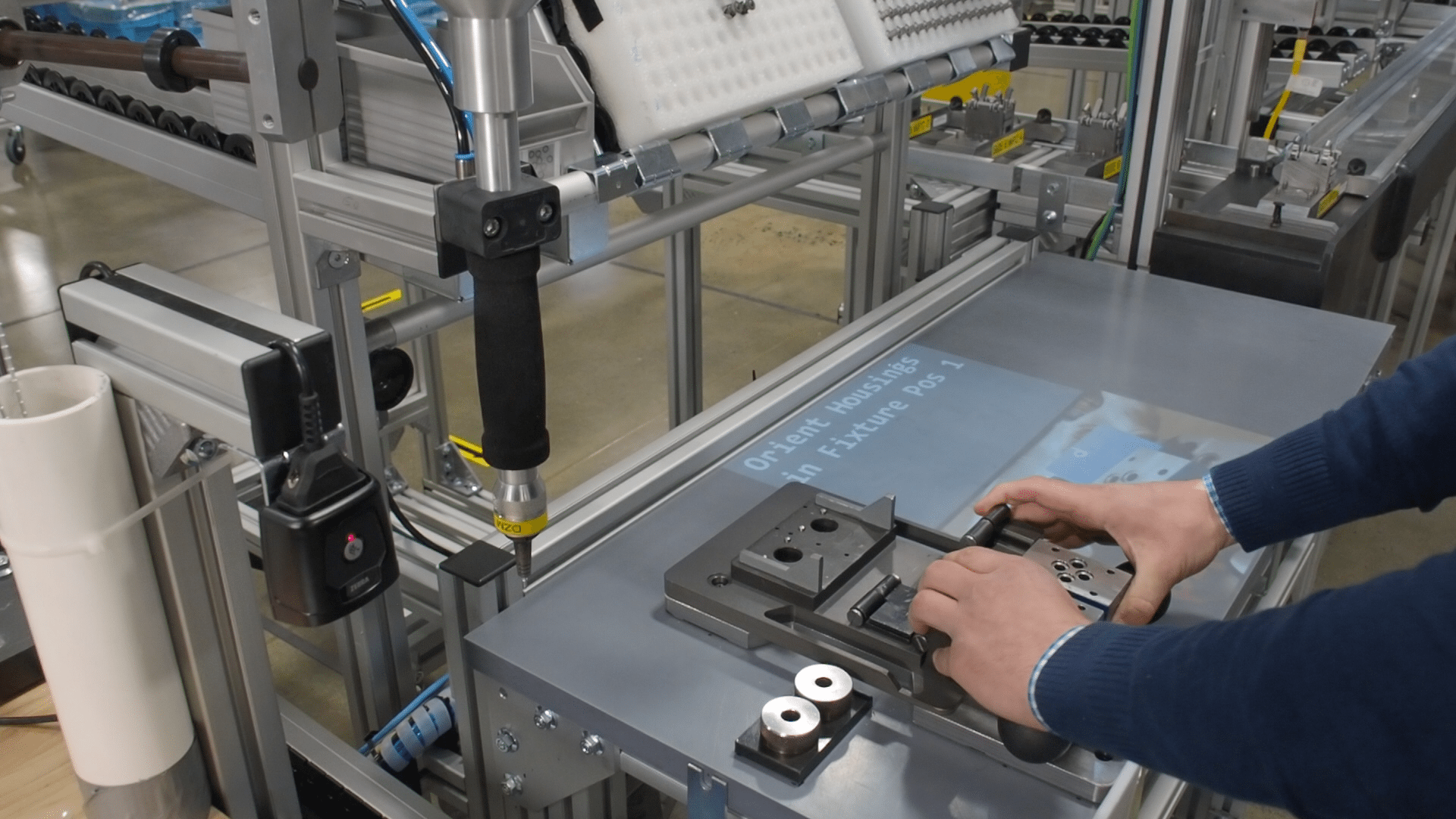
A production information system continually collects, filters and displays production data, immediately informing operators and managers about the status of the line. The individual workstations on the line read Bluetooth tags to identify the user and adapt the workplace to their skills and preferences. Assembly instructions for the product being worked on are beamed with a light guided system (LGS) or displayed on the screen with a level of detail that depends on the worker’s level of experience.
The line determines the identity of products coming down the line based on radio frequency identification (RFID) tags. Then torque drivers automatically load the right tool and move into position to tighten fasteners, enabling operators to focus on other tasks.
The RFID tag communicates with each individual station, including material requests and assembly operations required for the product in the fixture. Some of these operations, such as torque driving operation are performed automatically. The central workstation where the valves are tightened have three different screwdrivers and is supplied with valves from two sides. The torque drivers move into a position on a gantry and can be equipped with a different screwdriver in seconds.
The RFID tags of the products moving down the line are monitored by the production control system to trigger replenishment of components when needed. Automatic guided vehicles (AGV) are loaded with parts at a central loading station. Here, the parts required to fulfill each order are loaded onto carts and delivered by the AGV to the multi-product line shortly before they are scheduled to be built.
As mentioned earlier, all production sequence is managed by an intercommunication and information system around the assembly operator. The operator receives the information and material in time to make the correct assembly and quality step as specified. The waste of non-value added tasks, such as machine downtime or rework, has been greatly reduced as a result of the new technology driven by the digital transformation.
Q: Separate from the technology, were there any implications to your workforce related to digital transformation?
The increased utilization of new technology raises apprehension as well as curiosity. Building smartness and intelligence into the production processes and machinery has been misconstrued to replacing the human workforce. Although certain non-value added work (rework, material expediting, tracking machine downtime, data analysis, and more) will be reduced by the technology, the productivity increases and reduces the human intervention with the production deviations.
It is really important to communicate and include all stakeholders early in the change process. For example, the assembly operators have been really engaged as the front line users of this technology and therefore they helped us shape the solutions. Associates also benefit from the digital transformation. With machines now capable of providing quick information of the production processes, frees up an associate’s time to do higher value work and increase productivity of the entire system.
Q: What are some of the key lessons you learned from the process?
A: First and foremost, we learned to start small but still get started. Make sure transparency is established early in the process and lean manufacturing is a foundational element. Be proactive to understand the best entry point into digital transformation or the biggest opportunity for improvement and develop a clear roadmap. Finally, communicate often and make sure to include the people impacted by the conversation.
Human resources with the background of IT and IoT along with machine building experience are needed in order to establish the technology and the drive for digital transformation. Intelligent machinery and production assistance systems ultimately help the operators in their day-to-day activities in the plant. Ensuring their experience is positive is paramount to getting acceptance from the operators and supervisors. Because of this, having skilled software developers with user experience on the team will become crucial.
Q: What, if any, problems did you encounter through the implementation?
A: Changing management’s and, more broadly, the human understanding of technical competencies outside of what factories usually have established is crucial. For example, IT in manufacturing may require a longer learning curve due to new technology and lower experience level of your staff. However, as the technology becomes more familiar, the learning curve will become shorter.
Q: What guidance would you offer your colleagues looking to transform their manufacturing operations?
A: Assess your current production level in terms of robust work standards and lean manufacturing.
- Establish transparency for each production line and logistics processes to understand the deviations from the standards.
- Determine the biggest opportunity for improvement within your company and develop a roadmap. However, consider working with expert consultants externally if the task becomes too daunting. Stay focused on your vision and road map with small gains and wins.
- Communicate and train your associates respectively in those fields of actions.
- Connect with HR and key management to create a target structure with the needed resources and skill set to run a smart factory.
Digital transformation is an exciting development that will support the human even more and not replace it. However, IT/IoT skills in manufacturing will become more necessary as this shift towards digital transformation continues.
The technological challenge will be the cyber/data security since most of the communication and transactions of data will be wireless in stored in clouds. Bosch has been addressing this by implementing IT for manufacturing plants to keep data secure and within our plants.

