


RCR Wireless
  • News
  • Channels
    • 5G
    • 6G
    • BSS OSS
    • Carriers
    • IoT
    • Network Infrastructure
    • Open RAN
    • Private 5G
    • Telco AI
    • Telco Cloud
    • Test & Measurement
  • Resources
    • Reports
    • Webinars
    • White papers
    • AI Fundamentals
    • Analyst Angle
    • Editorial Calendar
    • Fundamentals
      • 5G NR Release 17
      • AI
        • Telco AI in 2025
    • Podcasts
      • Let’s Get Digital with Carrie Charles
      • Wireless Connectivity to Enable Industry 4.0 for the Middleprise
      • Well Technically…
      • Will 5G Change the World
      • Accelerating Industry 4.0 Digitalization
  • AI Infrastructure
  • Programs
  • Events
  • RCRtv
  • Advertise
  • Subscribe
Monday, July 20, 2026
RCR Wireless
  • News
  • Channels
    • 5G
    • 6G
    • BSS OSS
    • Carriers
    • IoT
    • Network Infrastructure
    • Open RAN
    • Private 5G
    • Telco AI
    • Telco Cloud
    • Test & Measurement
  • Resources
    • Reports
    • Webinars
    • White papers
    • AI Fundamentals
    • Analyst Angle
    • Editorial Calendar
    • Fundamentals
      • 5G NR Release 17
      • AI
        • Telco AI in 2025
    • Podcasts
      • Let’s Get Digital with Carrie Charles
      • Wireless Connectivity to Enable Industry 4.0 for the Middleprise
      • Well Technically…
      • Will 5G Change the World
      • Accelerating Industry 4.0 Digitalization
  • AI Infrastructure
  • Programs
  • Events
  • RCRtv
  • Advertise
  • Subscribe
Add RCR Wireless as a preferred source on Google
  • Qualcomm 6G Insights
  • Huawei Content Hub
  • Qualcomm – 6G Vision
  • OSS/BSS Channel
  • RCRTech Roundtable: AI Infrastructure
RCR Wireless
RCR Wireless
  • Advanced Mimo
  • Mobile mmWave
  • 5G Positioning
  • Green Networks
  • Metaverse
  • Automotive
  • Industrial and Wide-area IoT
Copyright 2021 - All Right Reserved
Home - In a smart city, the billboard will bounce back
Internet of Things (IoT)News & Event CoverageSmart Cities

In a smart city, the billboard will bounce back

by David Pringle July 6, 2016
written by David Pringle July 6, 2016 Share
LinkedinEmail
Share 0LinkedinEmail
128

For the advertising industry, the smart city may be a better medium than the smartphone

As more urban infrastructure gets connected, city mayors may find advertising executives beating a path to their doors. That’s because the advertising industry has a serious problem – it needs more digital real estate.

Among attendees at the Cannes Lions International Festival of Creativity earlier this month, a frequent refrain was the increasing difficulty of breaking through all the digital noise to capture consumers’ attention. Younger people in particular spend a growing amount of time glued to their smartphones, where they increasingly employ advertising blockers to prevent their limited screen space and limited mobile data allowances being eaten up by commercials. One in five smartphone users, or almost 420 million people worldwide, block advertising when browsing the web on cellphones, according to PageFair, a startup trying to tackle the problem. Although PageFair may be talking up the problem, it is clear many people regard their phone as a highly personal device on which advertising isn’t welcome.

In any case, the sheer volume of digital content and advertising aimed at smartphones is growing exponentially as major brands jostle for consumers’ attention. Some of the world’s biggest advertisers have been pumping out commercials at a rapid rate in the hope of breaking through the noise.  
“In our quest for dynamic, real-time marketing in the digital age, we were producing thousands of new ads a year,” Marc Pritchard, chief brand officer of P&G, told the Cannes Lions festival. “The world is getting louder and more complex, and were simply adding to the noise.” Pritchard said P&G is now changing tack, raising the creative bar and prioritizing quality over quantity.

The best medium for brand building?

At the same time, advertisers are increasingly aware that smartphones aren’t well suited to brand building – the traditional domain of television advertising. Although so-called millennials (people who became adults around 2000) watch less TV than previous generations and rarely read newspapers and magazines, they do wait at bus stops, get stuck in traffic jams and pass through railway stations, making billboards a key channel for brands looking to reach this generation.

Today, “out-of-home” advertising (essentially billboards) attracts 6.5% of all advertising globally (in dollar terms), generating about $33 billion per year, according to research by Magna Global. This segment of the ad market is growing about 3% to 4% per year, which is much slower than the double-digit growth in digital advertising, but faster than TV and radio (see graphic).
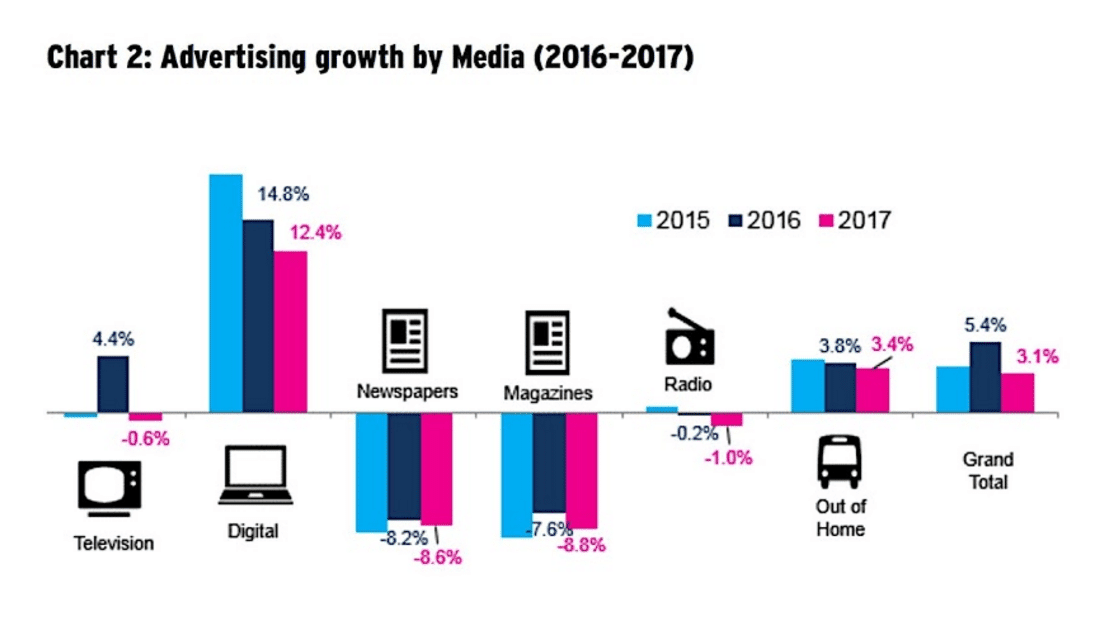
Screen Shot 2016-07-05 at 2.00.17 PM

That growth could soon accelerate. In many respects, the billboard represents a good compromise between the interests of consumers and brands – it is highly visible, but it doesn’t intrude on your personal space. You don’t have to look at it.

Moreover, the growing number of connected digital screens and smart city sensors mean billboards no longer have to be blunt instruments. Indeed, they can be precision tools. Screen space can be bought and sold at auctions based on real-time data showing how many people are in the vicinity, how many of these people are standing still and their demographic profiles. City administrations and transport operators could capture this data either by working with cellular service providers or by mining usage of transport apps and “footfall” data captured by roadside sensors and cameras.

Ideally, consumers should be able to opt to share personal information in return for rewards. At the Cannes festival, ad tech firm xAd touted an app that tracked attendees’ locations in return for a chance to win a free dessert or $5,000. Festival goers could also use the app to see the locations with the highest footfall in real time, flagging the most popular events and exhibits. Municipalities could use similar solutions to incentivize citizens to selectively share their location.

In essence, advertisers need to be aware that the smartphone is not the only screen and it is not the only sensor. As they install connected devices to support smart city solutions, such as traffic management, public information systems and crowd management, municipalities should consider how they can use the same infrastructure to serve the advertising industry. Smart billboards delivering targeted and timely advertising could generate significant revenues for city administrations and transport operators, while also helping the advertising industry rediscover its mojo. If the mood in Cannes is anything to go by, the humble billboard has a bright future ahead of it.


You Might Also Like
  • When the push becomes the pull – private 5G and physical AI
  • Fast-growing private 5G offers blueprint for AI-era telecoms
  • Monday (telco diary) | Consolidation, orchestration, automation
  • Wireless Logic’s 21st acquisition exposes IoT consolidation paradox
  • Thursday (telco diary) | The plumbing is the product
  • How the FCC can protect IoT innovation and GPS resilience in the 900 MHz band (Reader Forum)
Share 0 LinkedinEmail
David Pringle

A highly experienced and accomplished business and technology journalist, David Pringle runs Pringle Media, which provides analytical, writing and editing services to organizations in the telecoms, media and technology sectors. A regular moderator of panel discussions at major industry conferences, David has worked on Mobile World Live television at the past six editions of the Mobile World Congress. Based in London, David also serves as an associate director at research and advisory firm STL Partners. Prior to founding Pringle Media in 2009, David worked at the GSMA, providing media relations support to the CEO, chairman and other senior executives in the mobile industry. Between 2000 and 2005, David was the European technology and telecommunications correspondent for The Wall Street Journal covering Vodafone, Nokia, Ericsson, British Telecom and other major multinationals. He has also served as deputy editor of Information Strategy, a pan-European title owned by The Economist Group.

previous post
In a smart city, the billboard will bounce back
next post
Analyst Angle: Apple opens Siri to developers

White Papers

  • Norton eBook: The 2026 Telco Playbook

  • Enea White Paper: Why Intelligent AAA is the Swiss Army Knife of Telecom

  • CSG White Paper: Telco AI Enabler: Mediation’s Defining Role

  • Enea White Paper: Scalable Database Design for 5G and Beyond

  • Supermicro and NVIDIA Whitepaper: Powering sovereign AI at scale

Editorial Reports

  • Nvidia Report: The State of AI in Telecommunications: 2026 Trends

  • Report: Scaling Optical Networks For The Hyperscale And AI Era

  • Test And Measurement Market Pulse Report

Webinars

  • Webinar: Building 6G — aligning technology, policy and purpose

  • SIMCom Webinar: Scaling your next deployment – from plastic to provisioning

  • Webinar: Rethinking the RAN as AI, cloud and openness converge

  • Webinar: Scale-Up, Scale-Out, Scale-Across – Building AI-Era Network Fabrics

  • Webinar: NTN in motion – evolving standards, expanding services

Since 1982, RCR Wireless News has been providing wireless and mobile industry news, insights, and analysis to mobile and wireless industry professionals, decision makers, policy makers, analysts and investors.

Facebook Twitter Youtube Linkedin Envelope Rss

Useful Links

  • Subscribe
  • About RCR Wireless News
  • Contact Us
  • Advertise
  • Editorial Calendar
  • Archive
  • RSS
  • Wireless News Archive
  • Subscribe
  • About RCR Wireless News
  • Contact Us
  • Advertise
  • Editorial Calendar
  • Archive
  • RSS
  • Wireless News Archive

Edtior's Picks

From experiment to expectation: BAI on delivering private 5G across Australian industry
When the push becomes the pull – private 5G and physical AI
Elisa targets data center growth through fiber connectivity

Latest Articles

From experiment to expectation: BAI on delivering private 5G across Australian industry
When the push becomes the pull – private 5G and physical AI
Elisa targets data center growth through fiber connectivity
Subsea shift – ITU and FCC redraw rules for global cable resilience

© 2026 RCR Wireless News All Right Reserved. Developed by Eight Hats.

Cookie Policy | Privacy Policy

RCR Wireless
  • News
  • Channels
    • 5G
    • 6G
    • BSS OSS
    • Carriers
    • IoT
    • Network Infrastructure
    • Open RAN
    • Private 5G
    • Telco AI
    • Telco Cloud
    • Test & Measurement
  • Resources
    • Reports
    • Webinars
    • White papers
    • AI Fundamentals
    • Analyst Angle
    • Editorial Calendar
    • Fundamentals
      • 5G NR Release 17
      • AI
        • Telco AI in 2025
    • Podcasts
      • Let’s Get Digital with Carrie Charles
      • Wireless Connectivity to Enable Industry 4.0 for the Middleprise
      • Well Technically…
      • Will 5G Change the World
      • Accelerating Industry 4.0 Digitalization
  • AI Infrastructure
  • Programs
  • Events
  • RCRtv
  • Advertise
  • Subscribe
RCR Wireless
  • News
  • Channels
    • 5G
    • 6G
    • BSS OSS
    • Carriers
    • IoT
    • Network Infrastructure
    • Open RAN
    • Private 5G
    • Telco AI
    • Telco Cloud
    • Test & Measurement
  • Resources
    • Reports
    • Webinars
    • White papers
    • AI Fundamentals
    • Analyst Angle
    • Editorial Calendar
    • Fundamentals
      • 5G NR Release 17
      • AI
        • Telco AI in 2025
    • Podcasts
      • Let’s Get Digital with Carrie Charles
      • Wireless Connectivity to Enable Industry 4.0 for the Middleprise
      • Well Technically…
      • Will 5G Change the World
      • Accelerating Industry 4.0 Digitalization
  • AI Infrastructure
  • Programs
  • Events
  • RCRtv
  • Advertise
  • Subscribe
@2020 - All Right Reserved. Designed and Developed by PenciDesign