

RCR Wireless
  • News
  • Channels
    • 5G
    • 6G
    • BSS OSS
    • Carriers
    • IoT
    • Network Infrastructure
    • Open RAN
    • Private 5G
    • Telco AI
    • Telco Cloud
    • Test & Measurement
  • Resources
    • Reports
    • Webinars
    • White papers
    • AI Fundamentals
    • Analyst Angle
    • Editorial Calendar
    • Fundamentals
      • 5G NR Release 17
      • AI
        • Telco AI in 2025
    • Podcasts
      • Let’s Get Digital with Carrie Charles
      • Wireless Connectivity to Enable Industry 4.0 for the Middleprise
      • Well Technically…
      • Will 5G Change the World
      • Accelerating Industry 4.0 Digitalization
  • AI Infrastructure
  • Programs
  • Events
  • RCRtv
  • Advertise
  • Subscribe
Wednesday, July 22, 2026
RCR Wireless
  • News
  • Channels
    • 5G
    • 6G
    • BSS OSS
    • Carriers
    • IoT
    • Network Infrastructure
    • Open RAN
    • Private 5G
    • Telco AI
    • Telco Cloud
    • Test & Measurement
  • Resources
    • Reports
    • Webinars
    • White papers
    • AI Fundamentals
    • Analyst Angle
    • Editorial Calendar
    • Fundamentals
      • 5G NR Release 17
      • AI
        • Telco AI in 2025
    • Podcasts
      • Let’s Get Digital with Carrie Charles
      • Wireless Connectivity to Enable Industry 4.0 for the Middleprise
      • Well Technically…
      • Will 5G Change the World
      • Accelerating Industry 4.0 Digitalization
  • AI Infrastructure
  • Programs
  • Events
  • RCRtv
  • Advertise
  • Subscribe
Add RCR Wireless as a preferred source on Google
  • Qualcomm 6G Insights
  • Huawei Content Hub
  • Qualcomm – 6G Vision
  • OSS/BSS Channel
  • RCRTech Roundtable: AI Infrastructure
RCR Wireless
RCR Wireless
  • Advanced Mimo
  • Mobile mmWave
  • 5G Positioning
  • Green Networks
  • Metaverse
  • Automotive
  • Industrial and Wide-area IoT
Copyright 2021 - All Right Reserved
Home - Time for smart cities to prioritize air pollution
Internet of Things (IoT)News & Event CoverageSmart Cities

Time for smart cities to prioritize air pollution

by David Pringle May 27, 2016
written by David Pringle May 27, 2016 Share
LinkedinEmail
Share 0LinkedinEmail
92

There is a compelling case for deploying LPWA networks to monitor local air quality in smart cities

More than three million people die prematurely each year because of ambient air pollution caused by high concentrations of small and fine particulate matter, according to the World Health Organization (WHO). That makes air pollution the greatest environmental risk to health.

Ahead of the World Health Assembly in Geneva this week, the WHO estimated that more than 80% of people living in urban areas are exposed to air quality levels that exceed WHO limits. And that figure relates only to those cities that actually monitor air quality.

In other words, air pollution is now a very serious health challenge, as well as an environmental issue, in a fast urbanising world. Although there should be a compelling socio-economic case for using Internet of Things technologies to get a grip on this problem, the issue may be falling into the cracks between central and local governments. The “to do lists” of smart cities units tend to focus on connecting infrastructure and services, such as street lighting, waste collection and traffic management systems, rather than trying to tackle health issues, which are usually the concern of central government (for more on smart cities’ priorities, join our webinar on June 1st). But monitoring air quality could ultimately yield much greater societal benefits than smart city solutions focused on efficiency savings, both in terms of quality of life and reducing healthcare costs and working days lost to illness.

Conduct a broad cost-benefit analysis

With the advent of low power, wide area (LPWA) networks, which should lower the cost of connecting sensors substantially, health authorities and municipalities could team up to do a cost-benefit analysis on the deployment of connected air quality monitors throughout urban areas. Such an analysis is likely to show the socio-economic benefits will be substantial. The localized data collected by connected monitors could be used to predict when air quality will deteriorate in specific neighborhoods, enabling health authorities to warn vulnerable citizens, such as the elderly or asthmatic, to stay indoors, use inhalers and avoid strenuous exercise.

Integrating localized air quality data with traffic data and weather data could also help long-term and short-term transport, waste management and energy planning – three major factors influencing air quality.  A city administration may decide to close particular roads or suspend waste incineration when the air quality in a neighborhood drops below certain thresholds.

As they can support tens of thousands of connections in a single cell, LPWA networks could be used to capture information from air quality monitors on every street corner and set of traffic lights. Some of these connections could also be used to transmit information from sensors tracking noise levels and the movement of vehicles, thereby helping municipalities pursue other objectives.

Air quality analytics firm BreezoMeter and Current, a new energy-focused unit within GE, have forged a partnership aimed at providing cities with real-time air quality and traffic analytics through the deployment of connected street lights equipped with appropriate sensors. The partners say that city leaders will be able to use the data they capture to help reroute and organize traffic to reduce air pollution and congestion.

Raising awareness and engaging citizens

Some startups are also experimenting with mobile air quality sensors. Plume Labs has attached such sensors to some of London’s ubiquitous pigeons, while also asking for human volunteers to carry them around the city. It then uses Twitter and its apps to relay the results to interested Londoners.

In a blog post, Plume Labs CEO Romain Lacombe stressed that attaching sensors to pigeons isn’t just a publicity stunt: “Air pollution is a huge environmental health issue, killing 10,000 people every year in London alone. Putting air sensors on the back of pigeons goes beyond raising awareness of this problem and helps Londoners understand the impact of pollution in an accessible, tangible and immediate way.”

In any case, the importance of raising awareness shouldn’t be underestimated. Monitoring air quality in a way that is very visible to a city’s residents would help to engage the population in caring for their immediate environment and would also stimulate more interest in smart city solutions.

Although the WHO says many of the cities with the worst air quality are in low income countries with little public money to spend [see graphic], some are in countries with large and/or fast growing economies.
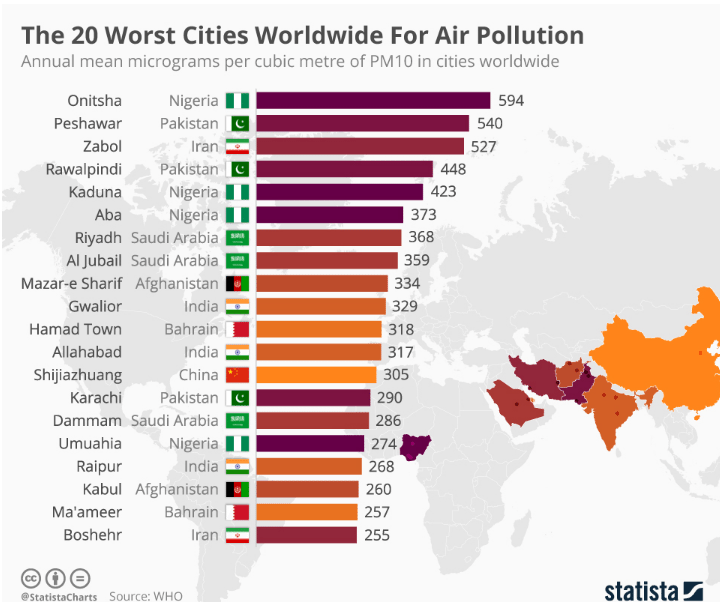
Screen Shot 2016-05-27 at 7.00.37 AM

Saudi Arabia, China, Bahrain and India all have cities that fall in the top 20 for worst air pollution. If these countries were to deploy LPWA-based air monitoring solutions in their major cities, other poorer countries could benefit from the ensuing economies of scale and the lessons they learn.

During the first industrial revolution, London had really filthy air. Over the past century, the UK capital has gradually cleaned up its act. Equipped with the latest digital technologies, today’s fast developing cities will have the tools to move much more quickly. Now is the time to act on air quality.

You Might Also Like
  • Monday (telco diary) | Sovereign AI for Industry 4.0
  • When the push becomes the pull – private 5G and physical AI
  • Fast-growing private 5G offers blueprint for AI-era telecoms
  • Monday (telco diary) | Consolidation, orchestration, automation
  • Wireless Logic’s 21st acquisition exposes IoT consolidation paradox
  • Thursday (telco diary) | The plumbing is the product

Table of Contents

  • There is a compelling case for deploying LPWA networks to monitor local air quality in smart cities
  • Conduct a broad cost-benefit analysis
  • Raising awareness and engaging citizens
Share 0 LinkedinEmail
David Pringle

A highly experienced and accomplished business and technology journalist, David Pringle runs Pringle Media, which provides analytical, writing and editing services to organizations in the telecoms, media and technology sectors. A regular moderator of panel discussions at major industry conferences, David has worked on Mobile World Live television at the past six editions of the Mobile World Congress. Based in London, David also serves as an associate director at research and advisory firm STL Partners. Prior to founding Pringle Media in 2009, David worked at the GSMA, providing media relations support to the CEO, chairman and other senior executives in the mobile industry. Between 2000 and 2005, David was the European technology and telecommunications correspondent for The Wall Street Journal covering Vodafone, Nokia, Ericsson, British Telecom and other major multinationals. He has also served as deputy editor of Information Strategy, a pan-European title owned by The Economist Group.

previous post
ITU and UNECE launch platform to promote smart cities
next post
Time for smart cities to prioritize air pollution

White Papers

  • Norton eBook: The 2026 Telco Playbook

  • Enea White Paper: Why Intelligent AAA is the Swiss Army Knife of Telecom

  • CSG White Paper: Telco AI Enabler: Mediation’s Defining Role

  • Enea White Paper: Scalable Database Design for 5G and Beyond

  • Supermicro and NVIDIA Whitepaper: Powering sovereign AI at scale

Editorial Reports

  • Nvidia Report: The State of AI in Telecommunications: 2026 Trends

  • Report: Scaling Optical Networks For The Hyperscale And AI Era

  • Test And Measurement Market Pulse Report

Webinars

  • Webinar: Building 6G — aligning technology, policy and purpose

  • SIMCom Webinar: Scaling your next deployment – from plastic to provisioning

  • Webinar: Rethinking the RAN as AI, cloud and openness converge

  • Webinar: Scale-Up, Scale-Out, Scale-Across – Building AI-Era Network Fabrics

  • Webinar: NTN in motion – evolving standards, expanding services

Since 1982, RCR Wireless News has been providing wireless and mobile industry news, insights, and analysis to mobile and wireless industry professionals, decision makers, policy makers, analysts and investors.

Facebook Twitter Youtube Linkedin Envelope Rss

Useful Links

  • Subscribe
  • About RCR Wireless News
  • Contact Us
  • Advertise
  • Editorial Calendar
  • Archive
  • RSS
  • Wireless News Archive
  • Subscribe
  • About RCR Wireless News
  • Contact Us
  • Advertise
  • Editorial Calendar
  • Archive
  • RSS
  • Wireless News Archive

Edtior's Picks

South Korea launches AI-RAN project to advance industrial AI
Tuesday (telco diary) | Telco agents and outcomes
AT&T’s bets on “best tech” (fiber) pay off with record adds, improving margins 

Latest Articles

South Korea launches AI-RAN project to advance industrial AI
Tuesday (telco diary) | Telco agents and outcomes
AT&T’s bets on “best tech” (fiber) pay off with record adds, improving margins 
The most expensive wireless system is the one you install twice (Reader Forum)

© 2026 RCR Wireless News All Right Reserved. Developed by Eight Hats.

Cookie Policy | Privacy Policy

RCR Wireless
  • News
  • Channels
    • 5G
    • 6G
    • BSS OSS
    • Carriers
    • IoT
    • Network Infrastructure
    • Open RAN
    • Private 5G
    • Telco AI
    • Telco Cloud
    • Test & Measurement
  • Resources
    • Reports
    • Webinars
    • White papers
    • AI Fundamentals
    • Analyst Angle
    • Editorial Calendar
    • Fundamentals
      • 5G NR Release 17
      • AI
        • Telco AI in 2025
    • Podcasts
      • Let’s Get Digital with Carrie Charles
      • Wireless Connectivity to Enable Industry 4.0 for the Middleprise
      • Well Technically…
      • Will 5G Change the World
      • Accelerating Industry 4.0 Digitalization
  • AI Infrastructure
  • Programs
  • Events
  • RCRtv
  • Advertise
  • Subscribe
RCR Wireless
  • News
  • Channels
    • 5G
    • 6G
    • BSS OSS
    • Carriers
    • IoT
    • Network Infrastructure
    • Open RAN
    • Private 5G
    • Telco AI
    • Telco Cloud
    • Test & Measurement
  • Resources
    • Reports
    • Webinars
    • White papers
    • AI Fundamentals
    • Analyst Angle
    • Editorial Calendar
    • Fundamentals
      • 5G NR Release 17
      • AI
        • Telco AI in 2025
    • Podcasts
      • Let’s Get Digital with Carrie Charles
      • Wireless Connectivity to Enable Industry 4.0 for the Middleprise
      • Well Technically…
      • Will 5G Change the World
      • Accelerating Industry 4.0 Digitalization
  • AI Infrastructure
  • Programs
  • Events
  • RCRtv
  • Advertise
  • Subscribe
@2020 - All Right Reserved. Designed and Developed by PenciDesign
