


RCR Wireless
  • News
  • Channels
    • 5G
    • 6G
    • BSS OSS
    • Carriers
    • IoT
    • Network Infrastructure
    • Open RAN
    • Private 5G
    • Telco AI
    • Telco Cloud
    • Test & Measurement
  • Resources
    • Reports
    • Webinars
    • White papers
    • AI Fundamentals
    • Analyst Angle
    • Editorial Calendar
    • Fundamentals
      • 5G NR Release 17
      • AI
        • Telco AI in 2025
    • Podcasts
      • Let’s Get Digital with Carrie Charles
      • Wireless Connectivity to Enable Industry 4.0 for the Middleprise
      • Well Technically…
      • Will 5G Change the World
      • Accelerating Industry 4.0 Digitalization
  • AI Infrastructure
  • Programs
  • Events
  • RCRtv
  • Advertise
  • Subscribe
Sunday, August 2, 2026
RCR Wireless
  • News
  • Channels
    • 5G
    • 6G
    • BSS OSS
    • Carriers
    • IoT
    • Network Infrastructure
    • Open RAN
    • Private 5G
    • Telco AI
    • Telco Cloud
    • Test & Measurement
  • Resources
    • Reports
    • Webinars
    • White papers
    • AI Fundamentals
    • Analyst Angle
    • Editorial Calendar
    • Fundamentals
      • 5G NR Release 17
      • AI
        • Telco AI in 2025
    • Podcasts
      • Let’s Get Digital with Carrie Charles
      • Wireless Connectivity to Enable Industry 4.0 for the Middleprise
      • Well Technically…
      • Will 5G Change the World
      • Accelerating Industry 4.0 Digitalization
  • AI Infrastructure
  • Programs
  • Events
  • RCRtv
  • Advertise
  • Subscribe
Add RCR Wireless as a preferred source on Google
  • Qualcomm 6G Insights
  • Huawei Content Hub
  • Qualcomm – 6G Vision
  • OSS/BSS Channel
  • RCRTech Roundtable: AI Infrastructure
RCR Wireless
RCR Wireless
  • Advanced Mimo
  • Mobile mmWave
  • 5G Positioning
  • Green Networks
  • Metaverse
  • Automotive
  • Industrial and Wide-area IoT
Copyright 2021 - All Right Reserved
Home - Virtualizing the connected car: Why not?
Connected CarsFundamentalsInternet of Things (IoT)

Virtualizing the connected car: Why not?

by Claudia Bacco July 28, 2015
written by Claudia Bacco July 28, 2015 Share
LinkedinEmail
Share 0LinkedinEmail
6G smart road
80

Not really virtualizing the whole car, but starting with the head unit. Redbend by Harman looks at the head unit as a central source of computing power resident in the vehicle. As more and more power-hungry functionality gets packed into the connected car it becomes unrealistic to have a dedicated hardware resource for each function.

While it all sounds pretty interesting, how will it actually evolve? Likely in stages. The first step is about virtualizing the computing resources in the head unit to support different functions in the car. For example, the head unit itself, a heads-up display, Wi-Fi router and external devices the driver might bring into the vehicle such as a smartphone or camera. Today the virtualization parameters will be set and remain constant. Over time this could evolve to be more like virtualization in the IT or telecom world, an NFV-type model, where the virtualized sectors could be changed dynamically. If we look even further into the future, there could be a centralized pool of computing resources in the car that is allocated across different requirements as needed. More functionality going into connected cars that requires computing resources ultimately increases power requirements and cost. Both of which are a negative outcome.

Hardware is another area that continues to increase in the connected car. More and more ECUs are being added to allow for additional functionality with the same result of increased cost, computing resources and power requirements. Redbend is also working on ECU consolidation, basically allowing an ECU to support more than one function. But hold on, what about the security risks associated with this idea?

When thinking about security and the opportunity to hack a connected car remotely, one of the safeguards usually mentioned is that a hacker would have to access the network that controls the ECUs, which today is separate from that of the infotainment infrastructure. And then in order to cause any real damage, the hacker would likely need to take control of more than one ECU. If ECUs are able to support more than one function, wouldn’t it be an additional security risk?

This leads us to the next area Redbend is spending time – cybersecurity. Using a virtual network model, the key is to stop an attack from moving laterally on the network and contain the problem. Whether that involves stopping an attacker from moving from the infotainment network to the network controlling the ECUs or halting an attack at a single ECU, stopping this lateral movement is important. As Ethernet becomes more prevalent in cars, this problem gains even more importance.

Redbend’s core competency, however, is remote software management. This is where the company’s roots are and today it offers SaaS OTA updates in the connected car, M2M, “Internet of Things” and mobile telephony markets. Their model is to only deliver the incremental bits of data needed in order to reduce the bandwidth required for the transfer. Via a master orchestrator in the car, the updates can be prioritized and scheduled based on the criticality of the update. Whether the vehicle is in motion or parked also will influence which updates can be done when and where, and over what network. Redbend’s solution is access agnostic, but there could be a desire on the part of the OEM or the driver to use Wi-Fi vs. the mobile network for example. This model can also be used to update wearables and smart home technology. OTA
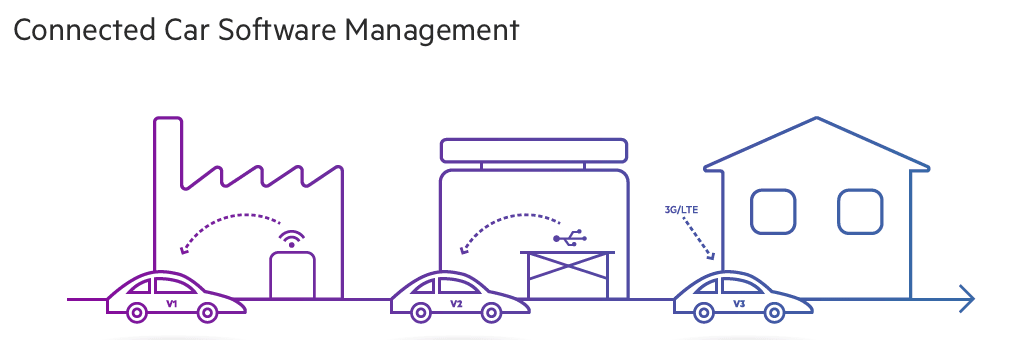
These scenarios are not something for the future, they are available now and in live deployments. Two of the real-world examples announced in the last six months include the following:

  • KDDI for OTA administration of wireless devices including mobile devices and IoT. As more “things” are deployed, the topic of security becomes more relevant along with the importance of updates. Many things are intended to have a very long life without human intervention – always a key topic in IoT when battery life is discussed – but how do software updates occur in a cost-effective and timely manner? With an OTA solution.
  • Garmin is also using Redbend for OTA updates to keep its maps and software current. By reducing the update size to only the new data, these updates can occur in the background while the system is running.

The combination of Redbend and Harman makes for some intriguing options to migrate the connected car toward virtual computing. A secure solution provides some pretty wide-reaching options to the cost containment in the connected car market.

Like what you read? Follow me on twitter!

Claudia Bacco, Managing Director – EMEA for RCR Wireless News, has spent her entire career in telecom, IT and security. Having experience as an operator, software and hardware vendor and as a well-known industry analyst, she has many opinions on the market. She’ll be sharing those opinions along with ongoing trend analysis for RCR Wireless News.


You Might Also Like
  • Japan’s private 5G market is finally moving beyond demo experiments (Analyst Angle)
  • Monday (telco diary) | Sovereign AI for Industry 4.0
  • When the push becomes the pull – private 5G and physical AI
  • Fast-growing private 5G offers blueprint for AI-era telecoms
  • Monday (telco diary) | Consolidation, orchestration, automation
  • Wireless Logic’s 21st acquisition exposes IoT consolidation paradox
Share 0 LinkedinEmail
Claudia Bacco

Contributing [email protected] Originally from Boston, now living in Munich, Germany, Claudia Bacco has a wealth of corporate marketing, branding and positioning experience within technology companies such as Nokia Networks, Juniper Networks, Verizon and AGT International. Claudia has also worked as a consultant advising organizations on their strategic messaging and positioning needs. As a former industry analyst, she worked with startups being a member of their advisory boards during their funding and market launch activities.

previous post
Making Virtual Reality – Coders Episode 19
next post
Sprint prepaid brands Boost, Virgin Mobile add high-speed data bucket option

White Papers

  • Norton eBook: The 2026 Telco Playbook

  • Enea White Paper: Why Intelligent AAA is the Swiss Army Knife of Telecom

  • CSG White Paper: Telco AI Enabler: Mediation’s Defining Role

  • Enea White Paper: Scalable Database Design for 5G and Beyond

  • Supermicro and NVIDIA Whitepaper: Powering sovereign AI at scale

Editorial Reports

  • Market Pulse Report: Telco AI in 2026 – Trends, Challenges and Opportunities

  • Nvidia Report: The State of AI in Telecommunications: 2026 Trends

  • Report: Scaling Optical Networks For The Hyperscale And AI Era

Webinars

  • Webinar: Building 6G — aligning technology, policy and purpose

  • SIMCom Webinar: Scaling your next deployment – from plastic to provisioning

  • Webinar: Rethinking the RAN as AI, cloud and openness converge

  • Webinar: Scale-Up, Scale-Out, Scale-Across – Building AI-Era Network Fabrics

  • Webinar: NTN in motion – evolving standards, expanding services

Since 1982, RCR Wireless News has been providing wireless and mobile industry news, insights, and analysis to mobile and wireless industry professionals, decision makers, policy makers, analysts and investors.

Facebook Twitter Youtube Linkedin Envelope Rss

Useful Links

  • Subscribe
  • About RCR Wireless News
  • Contact Us
  • Advertise
  • Editorial Calendar
  • Archive
  • RSS
  • Wireless News Archive
  • Subscribe
  • About RCR Wireless News
  • Contact Us
  • Advertise
  • Editorial Calendar
  • Archive
  • RSS
  • Wireless News Archive

Edtior's Picks

Building the AI backbone, waiting on the AI billions
Ensuring colocation success by eliminating network observability blind spots (Reader Forum)
Thursday (telco diary) | Vodafone resets, AT&T reloads

Latest Articles

Building the AI backbone, waiting on the AI billions
Ensuring colocation success by eliminating network observability blind spots (Reader Forum)
Thursday (telco diary) | Vodafone resets, AT&T reloads
SK Telecom’s A.X K2 is South Korea’s biggest bet yet on sovereign AI

© 2026 RCR Wireless News All Right Reserved. Developed by Eight Hats.

Cookie Policy | Privacy Policy

RCR Wireless
  • News
  • Channels
    • 5G
    • 6G
    • BSS OSS
    • Carriers
    • IoT
    • Network Infrastructure
    • Open RAN
    • Private 5G
    • Telco AI
    • Telco Cloud
    • Test & Measurement
  • Resources
    • Reports
    • Webinars
    • White papers
    • AI Fundamentals
    • Analyst Angle
    • Editorial Calendar
    • Fundamentals
      • 5G NR Release 17
      • AI
        • Telco AI in 2025
    • Podcasts
      • Let’s Get Digital with Carrie Charles
      • Wireless Connectivity to Enable Industry 4.0 for the Middleprise
      • Well Technically…
      • Will 5G Change the World
      • Accelerating Industry 4.0 Digitalization
  • AI Infrastructure
  • Programs
  • Events
  • RCRtv
  • Advertise
  • Subscribe
RCR Wireless
  • News
  • Channels
    • 5G
    • 6G
    • BSS OSS
    • Carriers
    • IoT
    • Network Infrastructure
    • Open RAN
    • Private 5G
    • Telco AI
    • Telco Cloud
    • Test & Measurement
  • Resources
    • Reports
    • Webinars
    • White papers
    • AI Fundamentals
    • Analyst Angle
    • Editorial Calendar
    • Fundamentals
      • 5G NR Release 17
      • AI
        • Telco AI in 2025
    • Podcasts
      • Let’s Get Digital with Carrie Charles
      • Wireless Connectivity to Enable Industry 4.0 for the Middleprise
      • Well Technically…
      • Will 5G Change the World
      • Accelerating Industry 4.0 Digitalization
  • AI Infrastructure
  • Programs
  • Events
  • RCRtv
  • Advertise
  • Subscribe
@2020 - All Right Reserved. Designed and Developed by PenciDesign