


RCR Wireless
  • News
  • Channels
    • 5G
    • 6G
    • BSS OSS
    • Carriers
    • IoT
    • Network Infrastructure
    • Open RAN
    • Private 5G
    • Telco AI
    • Telco Cloud
    • Test & Measurement
  • Resources
    • Reports
    • Webinars
    • White papers
    • AI Fundamentals
    • Analyst Angle
    • Editorial Calendar
    • Fundamentals
      • 5G NR Release 17
      • AI
        • Telco AI in 2025
    • Podcasts
      • Let’s Get Digital with Carrie Charles
      • Wireless Connectivity to Enable Industry 4.0 for the Middleprise
      • Well Technically…
      • Will 5G Change the World
      • Accelerating Industry 4.0 Digitalization
  • AI Infrastructure
  • Programs
  • Events
  • RCRtv
  • Advertise
  • Subscribe
Tuesday, July 14, 2026
RCR Wireless
  • News
  • Channels
    • 5G
    • 6G
    • BSS OSS
    • Carriers
    • IoT
    • Network Infrastructure
    • Open RAN
    • Private 5G
    • Telco AI
    • Telco Cloud
    • Test & Measurement
  • Resources
    • Reports
    • Webinars
    • White papers
    • AI Fundamentals
    • Analyst Angle
    • Editorial Calendar
    • Fundamentals
      • 5G NR Release 17
      • AI
        • Telco AI in 2025
    • Podcasts
      • Let’s Get Digital with Carrie Charles
      • Wireless Connectivity to Enable Industry 4.0 for the Middleprise
      • Well Technically…
      • Will 5G Change the World
      • Accelerating Industry 4.0 Digitalization
  • AI Infrastructure
  • Programs
  • Events
  • RCRtv
  • Advertise
  • Subscribe
Add RCR Wireless as a preferred source on Google
  • Qualcomm 6G Insights
  • Huawei Content Hub
  • Qualcomm – 6G Vision
  • OSS/BSS Channel
  • RCRTech Roundtable: AI Infrastructure
RCR Wireless
RCR Wireless
  • Advanced Mimo
  • Mobile mmWave
  • 5G Positioning
  • Green Networks
  • Metaverse
  • Automotive
  • Industrial and Wide-area IoT
Copyright 2021 - All Right Reserved
Home - Unifying network performance and application monitoring puts an end to ‘mean time to innocence’ (Reality Check)
5GReality CheckTelco Cloud

Unifying network performance and application monitoring puts an end to ‘mean time to innocence’ (Reality Check)

by Reality Check August 15, 2019
written by Reality Check August 15, 2019 Share
LinkedinEmail
Share 0LinkedinEmail
network intelligence
153

Network architectures are becoming more complex and decentralized. Applications are becoming more advanced, data-heavy, and compute-intensive. Both trends will continue as communications service providers (CSPs) upgrade their 4G networks first, and then begin the migration to 5G.

While doing so, service providers are transforming their business processes, simplifying backend systems as they move to pure cloud and hybrid cloud IT network infrastructures. This transformation in turn creates new challenges around performance management, customer experience, and quality of service (QoS).

In this new network environment, legacy performance and service assurance solutions are simply no longer fit for purpose because they leave operations teams in the dark about what is impacting customer quality of experience (QoE).

The end of “mean time to innocence” as a network performance benchmark

The same goes for service providers’ attitudes about network and application performance. There has long been a heavy focus on reducing “mean time to innocence”—the moment when a provider can confidently state that its network is not to blame for a business customer or subscriber’s QoE problem. 

CSPs now have an opportunity to put an end to the blame game by focusing their efforts instead on network infrastructure performance and its impact on end user experience, closing the loop on maximizing client satisfaction. 

Imagine if, rather than saying, “It’s not our fault!” the provider could instead identify the root cause of an issue–even one outside their direct control—and collaborate or suggest concrete ways to resolve the problem. This is possible by adopting a holistic approach to performance management that covers all aspects of application, service, and network lifecycle management.  

Like it or not, the CSP’s area of responsibility today extends beyond their network border and includes the application experience of their clients, whether in network or out of network. Service providers must realize that common QoE problems, even if the issues are with the app or OS provider, are often attributed to the CSPs themselves. Rather than playing defense, CSPs can instead proactively take responsibility for QoE from the network core all the way to the application edge.

The aim is to proactively monitor and improve QoE for customers on a continual basis rather than racing against the clock to identify and fix network outages and service degradation. This approach reflects a broader move from network operations centric to service experience centric focus.

New architectures bring new network performance challenges

Proactive QoE management requires network performance management (NPM) and application performance management (APM) systems. Collectively, these make up NAPM, which complements existing network monitoring to deliver two essential functions:

  1. Measure the performance of network and applications based on traffic capture and analysis of real customer data
  2. Provide a way to troubleshoot performance degradations

As service providers transform their networks and their business processes, new challenges emerge around performance management. Addressing these challenges requires an end-to-end, multi-layer approach—covering the entire service value chain from core to edge and to applications themselves. 

In order to address all aspects of application, service, and network lifecycle management, this approach must address:

  • Monitoring everything from the service provider’s own core assets right out to the end user and their device. 
  • Monitoring the entire service chain, from the underlay network (such as SDN and virtual data centers) to applications (including cloud-hosted services) and the wider service lifecycle environment.

A comprehensive network-wide service performance management system encompasses several components:

  • Service analytics using automation, machine learning, and artificial intelligence (AI)
  • Passive and active performance monitoring and measurement
  • Continuous, service-based testing
  • Bandwidth utilization metering
  • Distributed packet capture

Only with all of these elements in place can CSPs manage all the visibility challenges presented by their increasingly complex, decentralized and distributed networks—and the services running over them.

Make sense of network performance using service analytics

Many service providers already use a range of performance measurement tools and methodologies for NAPM. However, not all critical performance metrics are clearly visible with these tools and methods—nor is the holistic network. Complete visibility is dependent on a wide-angle view of the entire service infrastructure, with capabilities to drill down deeply into specific problem areas. This includes the interplay and interdependence between seemingly isolated problems that, when correlated, produce unexpected and valuable performance insights.

An analytics engine can only provide meaningful output if the data it first receives as input is granular and high-quality (the old addage of garbage-in, garbage-out). When the data is meaningful, it results in business, operations, and commercial insights useful for proactively improving user experience. 

To realize the full business benefit potential of service analytics, performance management suited to intricate and interconnected networks must include a set of core capabilities:
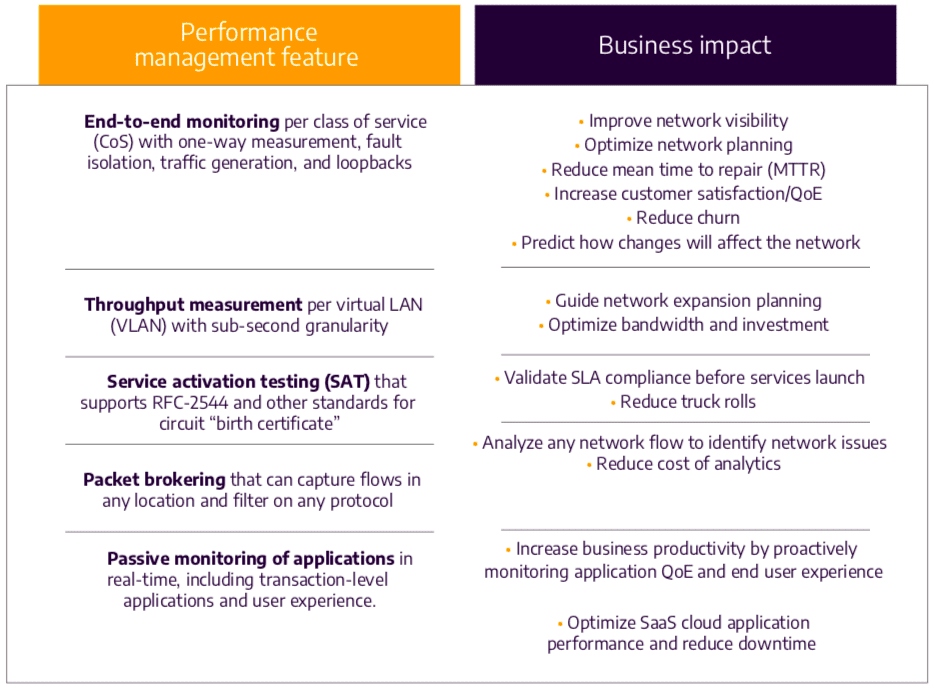
image1


Evolving to a new generation of network performance and service assurance

To sum up:

  • Today’s telecom networks and the services running on them—like internet of things (IoT) and machine-to-machine (M2M) interactions—are more complicated to design, deploy, and manage than their predecessors.
  • This complexity is set to increase as mobile and fixed architectures converge and 5G is rolled out.
  • Traditional network performance and service assurance tools and methods are no longer up to the task of ensuring network performance and a reliable and consistent QoE for customers.
  • Simply minimizing the “mean time to repair” or shifting the blame elsewhere in the event of a network problem or service outage is no longer a practical or sustainable mindset for service providers.
  • The industry must shift to a holistic, service-centric model that combines NPM and APM with emphasis on customer QoE.
  • This shift is a business opportunity! In a Q3 2018 study by analyst firm Heavy Reading, over 70% of CSPs said that their ownership of mobile and edge cloud assets in their networks give them a performance advantage over public cloud providers, especially in the enterprise and business services market.
  • Next-generation performance management can handle virtualization, automation, network slicing, and other complex aspects of service-oriented architectures.
You Might Also Like
  • Mimosa Networks and Viaero Wireless demonstrate scalable 5 GHz and 6 GHz fixed wireless broadband with AFC
  • What defines network performance in 5G and beyond? A CTO Perspective
  • Elisa says AI automation has cut network incidents by over 80%
  • Huawei outlines AI-centric network roadmap for telecom monetization
  • Indosat outlines AI Grid vision as 5G modernization targets nationwide AI-ready network
  • Huawei shows how 5G and AI are reshaping tourism in China

Table of Contents

  • The end of “mean time to innocence” as a network performance benchmark
  • New architectures bring new network performance challenges
  • Make sense of network performance using service analytics
  • Evolving to a new generation of network performance and service assurance
Share 0 LinkedinEmail
Avatar of Reality Check
Reality Check

Subject to editorial review and copy edit, RCR Wireless News accepts bylined thought leadership articles, up to 1000 words, from industry executives. Submitted articles become property of RCR Wireless News. Submit articles to [email protected] with "Reality Check" in subject line.

previous post
#TBT: 600 MHz auction begins; LTE launches number 500+; LTE-U coexistence quarrels … this week in 2016
next post
Ericsson, Vodafone launch commercial 5G services in Ireland

White Papers

  • Enea White Paper: Why Intelligent AAA is the Swiss Army Knife of Telecom

  • CSG White Paper: Telco AI Enabler: Mediation’s Defining Role

  • Enea White Paper: Scalable Database Design for 5G and Beyond

  • Supermicro and NVIDIA Whitepaper: Powering sovereign AI at scale

  • VIAVI Whitepaper: RAN scenario generators and their critical role for future-proofing AI-native RAN in Advanced 5G and 6G networks

Editorial Reports

  • Report: Scaling Optical Networks For The Hyperscale And AI Era

  • Test And Measurement Market Pulse Report

  • Editorial Report: Securing telecom infrastructure for the quantum era

Webinars

  • Webinar: Building 6G — aligning technology, policy and purpose

  • SIMCom Webinar: Scaling your next deployment – from plastic to provisioning

  • Webinar: Rethinking the RAN as AI, cloud and openness converge

  • Webinar: Scale-Up, Scale-Out, Scale-Across – Building AI-Era Network Fabrics

  • Webinar: NTN in motion – evolving standards, expanding services

Since 1982, RCR Wireless News has been providing wireless and mobile industry news, insights, and analysis to mobile and wireless industry professionals, decision makers, policy makers, analysts and investors.

Facebook Twitter Youtube Linkedin Envelope Rss

Useful Links

  • Subscribe
  • About RCR Wireless News
  • Contact Us
  • Advertise
  • Editorial Calendar
  • Archive
  • RSS
  • Wireless News Archive
  • Subscribe
  • About RCR Wireless News
  • Contact Us
  • Advertise
  • Editorial Calendar
  • Archive
  • RSS
  • Wireless News Archive

Edtior's Picks

Deutsche Telekom’s OpenAI partnership has scaled from pilot to full production
Prioritise AI outcomes over agent numbers, says Orange
The (agentic) future of AI-to-AI connectivity (Reader Forum)

Latest Articles

Deutsche Telekom’s OpenAI partnership has scaled from pilot to full production
Prioritise AI outcomes over agent numbers, says Orange
The (agentic) future of AI-to-AI connectivity (Reader Forum)
Monday (telco diary) | Consolidation, orchestration, automation

© 2026 RCR Wireless News All Right Reserved. Developed by Eight Hats.

Cookie Policy | Privacy Policy

RCR Wireless
  • News
  • Channels
    • 5G
    • 6G
    • BSS OSS
    • Carriers
    • IoT
    • Network Infrastructure
    • Open RAN
    • Private 5G
    • Telco AI
    • Telco Cloud
    • Test & Measurement
  • Resources
    • Reports
    • Webinars
    • White papers
    • AI Fundamentals
    • Analyst Angle
    • Editorial Calendar
    • Fundamentals
      • 5G NR Release 17
      • AI
        • Telco AI in 2025
    • Podcasts
      • Let’s Get Digital with Carrie Charles
      • Wireless Connectivity to Enable Industry 4.0 for the Middleprise
      • Well Technically…
      • Will 5G Change the World
      • Accelerating Industry 4.0 Digitalization
  • AI Infrastructure
  • Programs
  • Events
  • RCRtv
  • Advertise
  • Subscribe
RCR Wireless
  • News
  • Channels
    • 5G
    • 6G
    • BSS OSS
    • Carriers
    • IoT
    • Network Infrastructure
    • Open RAN
    • Private 5G
    • Telco AI
    • Telco Cloud
    • Test & Measurement
  • Resources
    • Reports
    • Webinars
    • White papers
    • AI Fundamentals
    • Analyst Angle
    • Editorial Calendar
    • Fundamentals
      • 5G NR Release 17
      • AI
        • Telco AI in 2025
    • Podcasts
      • Let’s Get Digital with Carrie Charles
      • Wireless Connectivity to Enable Industry 4.0 for the Middleprise
      • Well Technically…
      • Will 5G Change the World
      • Accelerating Industry 4.0 Digitalization
  • AI Infrastructure
  • Programs
  • Events
  • RCRtv
  • Advertise
  • Subscribe
@2020 - All Right Reserved. Designed and Developed by PenciDesign
