

RCR Wireless
  • News
  • Channels
    • 5G
    • 6G
    • BSS OSS
    • Carriers
    • IoT
    • Network Infrastructure
    • Open RAN
    • Private 5G
    • Telco AI
    • Telco Cloud
    • Test & Measurement
  • Resources
    • Reports
    • Webinars
    • White papers
    • AI Fundamentals
    • Analyst Angle
    • Editorial Calendar
    • Fundamentals
      • 5G NR Release 17
      • AI
        • Telco AI in 2025
    • Podcasts
      • Let’s Get Digital with Carrie Charles
      • Wireless Connectivity to Enable Industry 4.0 for the Middleprise
      • Well Technically…
      • Will 5G Change the World
      • Accelerating Industry 4.0 Digitalization
  • AI Infrastructure
  • Programs
  • Events
  • RCRtv
  • Advertise
  • Subscribe
Wednesday, July 22, 2026
RCR Wireless
  • News
  • Channels
    • 5G
    • 6G
    • BSS OSS
    • Carriers
    • IoT
    • Network Infrastructure
    • Open RAN
    • Private 5G
    • Telco AI
    • Telco Cloud
    • Test & Measurement
  • Resources
    • Reports
    • Webinars
    • White papers
    • AI Fundamentals
    • Analyst Angle
    • Editorial Calendar
    • Fundamentals
      • 5G NR Release 17
      • AI
        • Telco AI in 2025
    • Podcasts
      • Let’s Get Digital with Carrie Charles
      • Wireless Connectivity to Enable Industry 4.0 for the Middleprise
      • Well Technically…
      • Will 5G Change the World
      • Accelerating Industry 4.0 Digitalization
  • AI Infrastructure
  • Programs
  • Events
  • RCRtv
  • Advertise
  • Subscribe
Add RCR Wireless as a preferred source on Google
  • Qualcomm 6G Insights
  • Huawei Content Hub
  • Qualcomm – 6G Vision
  • OSS/BSS Channel
  • RCRTech Roundtable: AI Infrastructure
RCR Wireless
RCR Wireless
  • Advanced Mimo
  • Mobile mmWave
  • 5G Positioning
  • Green Networks
  • Metaverse
  • Automotive
  • Industrial and Wide-area IoT
Copyright 2021 - All Right Reserved
Home - Report: FCC 600 MHz auction rules to limit AT&T, Verizon participation
PolicyUncategorized

Report: FCC 600 MHz auction rules to limit AT&T, Verizon participation

by Dan Meyer April 16, 2014
written by Dan Meyer April 16, 2014 Share
LinkedinEmail
Share 0LinkedinEmail
142

Published reports indicate that the Federal Communications Commission is planning on setting aside some 600 MHz spectrum for smaller operators, preventing the nation’s two largest operators from bidding on those assets.

Citing people “familiar with the matter,” The Wall Street Journal reported that FCC will set aside up to 30 megahertz of spectrum in the 600 MHz band incentive auction process for bidders controlling less than one-third of spectrum below 1 GHz in those markets. That consideration would be triggered once bidding in each market had hit a to-be-determined financial threshold.

The report notes that such a plan would most likely impact AT&T Mobility and Verizon Wireless, which control a majority of sub-1 GHz spectrum, though it would also impact regional carriers like U.S. Cellular and C Spire Wireless in some markets.

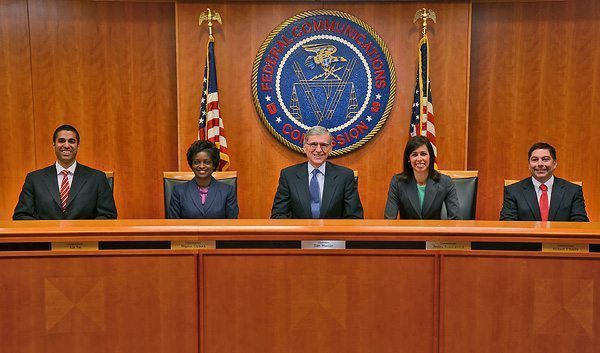
FCC Chairman Tom Wheeler has said he would like to attract as many bidders as possible to the 600 MHz incentive auction, which is scheduled to begin mid-2015. The FCC is in the process of drumming up support from television broadcasters through a reverse auction process in order to gather spectrum that would then be re-auctioned to telecommunications providers.

Roger Sherman, acting chief of the Wireless Telecommunications Bureau at the FCC, spoke at the recent Competitive Carriers Association event about the challenges involved in the 600 MHz incentive auction process.

T-Mobile US and AT&T have battled over competing auction rule proposals centered on limiting the bidding opportunities for AT&T and Verizon Communications.

T-Mobile US, which has been very active in its opposition to open bidding for the spectrum, has put forth its “dynamic market rules” proposal that would place a spectrum aggregation limit on the amount of spectrum that can be won by a single operator. As the carrier explained:

“Under the dynamic market rule, the auction would first proceed with a spectrum-aggregation limit. If the commission’s revenue target is met while the limit is in place, then the auction would be able to close once there is no longer any active bidding. If the revenue target is not met, however, the limit would be gradually relaxed. Should the bidding fail to clear the revenue target once the limit is completely removed, the commission would resume the process by starting at the next lower spectrum target with the aggregation limit in place.”

AT&T has countered that for the FCC to meet revenue goals that AT&T claims could top $30 billion, the government agency should not limit bidding. AT&T VP of federal regulatory Joan Marsh recently noted that for the auction to be successful, the FCC will need to convince television broadcasters to cough up at least 84 megahertz of spectrum, which would provide for 70 megahertz that can then be auctioned to wireless operators. Using the 700 MHz spectrum auction for reference, which garnered nearly $20 billion in bids for 70 megahertz of spectrum, Marsh claims that factoring in relocation costs and any additional funding needed for FirstNet and next-generation 911 services could push the total cost required to run the auction to that $30 billion mark.

Using that revenue mark, Marsh argues that it will take considerable participation of larger operators to meet that funding requirement and that setting aside spectrum or limiting bidding on any license will impact the fund-raising capabilities of the auction.

“The Commission should instead be focused on ensuring that the wireless industry as a whole can raise the $30 billion in auction capital that may be needed to close an 84 [megahertz] auction, especially given capital commitments that will be made for the AWS-3 auction,” Marsh said. “And notably, as we learned with the H-Block auction, there is no guarantee that all major operators will even show up.”

The FCC late last month released partial rules for its upcoming AWS-3 auction that looked to cater to carriers both large and small. Those rules included spectrum licenses to be auctioned off encompassing three 5×5 megahertz options, leaving just a single 10×10 megahertz license covering the country. While the FCC release did not specify the size of geographic size of those licenses, comments indicated that the 5×5 megahertz licenses would include two sized to economic area dimensions and one sized to commercial market area dimensions.

Smaller operators have been pushing for the FCC to carve out sufficient spectrum in smaller geographic areas in an attempt to cater to their more specific coverage needs that generally do not include major markets. CCA has said it would prefer the FCC move forward with CMA-sized licenses, which would include 734 total licenses covering the country. Larger carriers tend to prefer larger license blocks in the EA (176 total licenses) or larger blocks that they claim are easier to manage in an auction format.

The recently completed H-Block auction raised just over $1.5 billion, with Dish Network running away with all 176 EA-sized spectrum licenses that include 10 megahertz in the upper 1.9 GHz hand.

Changing the spectrum scale

The FCC is also reportedly looking at changes in how it weighs spectrum concentration, moving towards a heavier weighing on spectrum holdings below 1 GHz as opposed to spectrum holdings higher up the spectrum scale. The FCC currently places greater scrutiny on spectrum transactions that would place more than one-third of available spectrum in the hands of a single entity. Carriers that hold larger amounts of spectrum in higher bands have asked that the FCC weigh those holdings different than spectrum below 1 GHz.

The move would most likely impact Sprint, which holds nearly 150 megahertz of spectrum in the 2.5 GHz band, and in some cases close to 200 megahertz when including its 1.9 GHz spectrum holdings, across the country.

Bored? Why not follow me on Twitter?

You Might Also Like
  • Monday (telco diary) | Sovereign AI for Industry 4.0
  • Subsea shift – ITU and FCC redraw rules for global cable resilience
  • How the FCC can protect IoT innovation and GPS resilience in the 900 MHz band (Reader Forum)
  • India tightens scrutiny of foreign satellite operators as Jio expands space ambitions
  • ASML’s warning for Europe – sovereignty has to move up the AI stack
  • Hong Kong broadband growth to offset voice decline, GlobalData says
Share 0 LinkedinEmail
Dan Meyer

Contributor

previous post
VoLTE: Progress and problems
next post
Chipmakers focus on MU-MIMO for Wi-Fi

White Papers

  • Norton eBook: The 2026 Telco Playbook

  • Enea White Paper: Why Intelligent AAA is the Swiss Army Knife of Telecom

  • CSG White Paper: Telco AI Enabler: Mediation’s Defining Role

  • Enea White Paper: Scalable Database Design for 5G and Beyond

  • Supermicro and NVIDIA Whitepaper: Powering sovereign AI at scale

Editorial Reports

  • Nvidia Report: The State of AI in Telecommunications: 2026 Trends

  • Report: Scaling Optical Networks For The Hyperscale And AI Era

  • Test And Measurement Market Pulse Report

Webinars

  • Webinar: Building 6G — aligning technology, policy and purpose

  • SIMCom Webinar: Scaling your next deployment – from plastic to provisioning

  • Webinar: Rethinking the RAN as AI, cloud and openness converge

  • Webinar: Scale-Up, Scale-Out, Scale-Across – Building AI-Era Network Fabrics

  • Webinar: NTN in motion – evolving standards, expanding services

Since 1982, RCR Wireless News has been providing wireless and mobile industry news, insights, and analysis to mobile and wireless industry professionals, decision makers, policy makers, analysts and investors.

Facebook Twitter Youtube Linkedin Envelope Rss

Useful Links

  • Subscribe
  • About RCR Wireless News
  • Contact Us
  • Advertise
  • Editorial Calendar
  • Archive
  • RSS
  • Wireless News Archive
  • Subscribe
  • About RCR Wireless News
  • Contact Us
  • Advertise
  • Editorial Calendar
  • Archive
  • RSS
  • Wireless News Archive

Edtior's Picks

South Korea launches AI-RAN project to advance industrial AI
Tuesday (telco diary) | Telco agents and outcomes
AT&T’s bets on “best tech” (fiber) pay off with record adds, improving margins 

Latest Articles

South Korea launches AI-RAN project to advance industrial AI
Tuesday (telco diary) | Telco agents and outcomes
AT&T’s bets on “best tech” (fiber) pay off with record adds, improving margins 
The most expensive wireless system is the one you install twice (Reader Forum)

© 2026 RCR Wireless News All Right Reserved. Developed by Eight Hats.

Cookie Policy | Privacy Policy

RCR Wireless
  • News
  • Channels
    • 5G
    • 6G
    • BSS OSS
    • Carriers
    • IoT
    • Network Infrastructure
    • Open RAN
    • Private 5G
    • Telco AI
    • Telco Cloud
    • Test & Measurement
  • Resources
    • Reports
    • Webinars
    • White papers
    • AI Fundamentals
    • Analyst Angle
    • Editorial Calendar
    • Fundamentals
      • 5G NR Release 17
      • AI
        • Telco AI in 2025
    • Podcasts
      • Let’s Get Digital with Carrie Charles
      • Wireless Connectivity to Enable Industry 4.0 for the Middleprise
      • Well Technically…
      • Will 5G Change the World
      • Accelerating Industry 4.0 Digitalization
  • AI Infrastructure
  • Programs
  • Events
  • RCRtv
  • Advertise
  • Subscribe
RCR Wireless
  • News
  • Channels
    • 5G
    • 6G
    • BSS OSS
    • Carriers
    • IoT
    • Network Infrastructure
    • Open RAN
    • Private 5G
    • Telco AI
    • Telco Cloud
    • Test & Measurement
  • Resources
    • Reports
    • Webinars
    • White papers
    • AI Fundamentals
    • Analyst Angle
    • Editorial Calendar
    • Fundamentals
      • 5G NR Release 17
      • AI
        • Telco AI in 2025
    • Podcasts
      • Let’s Get Digital with Carrie Charles
      • Wireless Connectivity to Enable Industry 4.0 for the Middleprise
      • Well Technically…
      • Will 5G Change the World
      • Accelerating Industry 4.0 Digitalization
  • AI Infrastructure
  • Programs
  • Events
  • RCRtv
  • Advertise
  • Subscribe
@2020 - All Right Reserved. Designed and Developed by PenciDesign
